
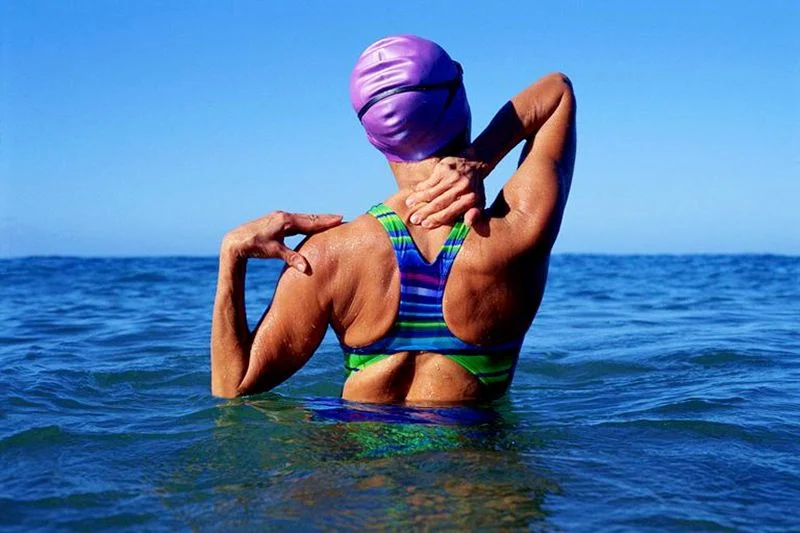

Swimming is often recommended as one of the safest and most therapeutic exercises for the body. It improves cardiovascular fitness, strengthens muscles, and places minimal load on joints. However, despite being a low-impact sport, report shows a frequent neck pain in swimmers during or after training.
Many swimmers assume neck discomfort is normal because the sport involves repetitive head movements, breathing rotations, and prolonged spinal alignment.
But persistent neck pain is not something swimmers should ignore.
In fact, research shows that neck pain is among the most commonly reported musculoskeletal complaints in swimmers, often occurring alongside shoulder pain due to repetitive overhead movements and stroke mechanics. (OUCI)
As a physiotherapist, I often see swimmers, from recreational beginners to competitive athletes, presenting with neck stiffness, muscle tightness, headaches, and reduced cervical mobility.
The good news is that most cases are preventable and treatable with proper technique, training adjustments, and targeted physiotherapy exercises.
This article explains why neck pain occurs in swimmers, highlights lesser-known contributing factors, and provides evidence-based physiotherapy strategies to prevent and manage the condition.
Read about our Complete Neck Pain Guide : Causes, Symptoms, Exercises and Treatment
Quick Answer
Neck pain in swimmers is commonly caused by poor breathing technique, excessive neck rotation, lifting the head during freestyle, or muscle fatigue from repetitive strokes. These errors place repeated stress on the cervical spine and surrounding muscles. Preventing swimmer neck pain involves maintaining a neutral head position, rotating the body during breathing, strengthening neck and shoulder stabilizing muscles, and performing proper warm-up exercises before swimming.
Also read : 10 Swimming Technique Mistakes That Destroy Your Neck
Key Takeaways
- Neck pain is a common issue in swimmers due to repetitive head rotation and poor technique.
- Freestyle breathing errors and excessive neck extension are major contributors.
- Proper warm-up routines improve shoulder and cervical spine stability.
- Strengthening the rotator cuff and upper back muscles helps prevent injuries.
- Improving thoracic mobility reduces strain on the neck during swimming.
- Early physiotherapy intervention can prevent chronic cervical problems.
Why Swimmers Commonly Develop Neck Pain
Swimming requires coordinated movement of the entire body.
The neck, however, plays a particularly delicate role in maintaining head alignment while allowing breathing and rotation.
During freestyle swimming, for example, the neck repeatedly performs rotation and slight extension every few strokes to allow breathing.
These repeated movements, sometimes thousands per training session, can overload the cervical spine.
Researchers studying master swimmers found that neck pain is closely associated with swimming volume and stroke technique, particularly in freestyle swimmers. (OUCI)
Over time, repetitive stress combined with muscle fatigue can lead to:
- Cervical muscle strain
- Joint irritation
- Postural imbalances
- Reduced mobility
- Headaches originating from the neck
Read about : 15 Common Causes of Neck Pain You Should Know
Common Causes of Neck Pain in Swimmers
Poor Breathing Technique
One of the biggest mistakes swimmers make is turning only the head to breathe instead of rotating the body.
This causes excessive strain on the cervical spine because the neck must rotate repeatedly while the body remains relatively stable.
Proper technique involves:
- Rotating the entire body
- Allowing the head to move naturally with the torso
- Maintaining a neutral neck position
Incorrect breathing technique can cause asymmetric loading of neck muscles, eventually leading to pain and stiffness.
Excessive Cervical Extension
Many swimmers unknowingly swim with their head lifted too high in the water.
This leads to:
- Cervical extension
- Compression of posterior neck joints
- Increased muscle tension
In the long term, this posture can cause chronic neck tightness and headaches.
High Training Volume
Competitive swimmers may perform thousands of strokes per session.
Research shows that increasing weekly swimming distance is associated with a higher incidence of neck and shoulder pain in swimmers. (OUCI)
The repetitive nature of swimming makes it similar to other overhead sports such as tennis or baseball, where overuse injuries are common.
Forward Head Posture in Swimmers
Swimmers, especially those who also spend long hours using phones or laptops, often develop forward head posture.
Studies show that elite swimmers frequently demonstrate forward neck and rounded shoulder posture, which alters cervical biomechanics and increases stress on neck structures. (Medico Publication)
Forward head posture leads to:
- Tight upper trapezius and levator scapulae
- Weak deep neck flexors
- Increased load on cervical joints
Learn how posture affects neck pain and correction exercises in our article on Simple Posture Correction Exercises for Forward Head Posture
Muscle Imbalances
Swimming strengthens some muscles while under-activating others.
Common imbalances include:
Tight muscles:
- Upper trapezius
- Levator scapulae
- Sternocleidomastoid
Weak muscles:
- Deep neck flexors
- Lower trapezius
- Serratus anterior
These imbalances alter neck mechanics and contribute to pain.
Breathing on One Side Only
Many swimmers breathe exclusively to one side during freestyle.
Over time this creates asymmetrical cervical rotation patterns and muscular imbalance.
Studies comparing breathing patterns in swimmers found measurable differences in cervical rotation between breathing styles. (commons.und.edu)
Bilateral breathing helps maintain balanced muscle activity.
Poor Thoracic Mobility
This is a lesser-known factor.
When the upper back (thoracic spine) is stiff, swimmers compensate by rotating their neck excessively.
The result:
- Neck overuse
- Reduced efficiency
- Increased injury risk
Kickboard Training
Many swimmers develop neck pain during kickboard drills.
Why?
When using a kickboard, swimmers often:
- Lift their head
- Extend their neck
- Compress cervical joints
This posture places significant stress on the neck.
Read About: How to Choose the Right and Best Pillow for Neck Pain
Symptoms of Swimmer’s Neck Pain
Common symptoms include:
- Neck stiffness after swimming
- Pain when turning the head
- Tight trapezius muscles
- Headaches originating at the base of the skull
- Pain on one side of the neck
- Reduced neck range of motion
- Pain radiating into the shoulders
If symptoms include numbness, tingling, or arm weakness, medical evaluation is necessary.
Read about: Effective Neck Pain Exercises At Home: A Complete Guide to Relief and Improved Mobility
How Physiotherapy Helps Swimmers With Neck Pain
Physiotherapy focuses on:
- Correcting technique
- Restoring cervical mobility
- Strengthening stabilizing muscles
- Improving posture
- Reducing muscle tension
A well-designed rehabilitation program often combines:
- Manual therapy
- Postural retraining
- Strengthening exercises
- Stroke correction
Learn About: The Ultimate Neck Stretch Routine for Desk Workers in 2026
Advanced Physiotherapy Strategies for Swimmer’s Neck Pain
What Modern Research Says About Swimmer Neck Injuries
Recent sports medicine research shows that neck pain in swimmers is strongly linked to stroke mechanics, training load, and cervical posture.
A study analyzing masters swimmers found that 55 out of 61 swimmers reported cervical pain, and those with excessive neck extension or excessive body roll during breathing had significantly higher neck symptoms. (PubMed)
Another large observational study showed that training volume and biomechanical imbalances significantly increase overuse injuries in swimmers, highlighting the importance of corrective training programs and early physiotherapy intervention. (PubMed)
Recent corrective-exercise trials in swimmers also show that 8-week postural correction programs significantly improve head-neck alignment, shoulder function, and range of motion. (PMC)
In elite swimming programs, physiotherapy now focuses on:
- cervical spine stabilization
- thoracic mobility restoration
- scapular control
- neuromuscular retraining
- stroke-specific rehabilitation
This approach is called sport-specific kinetic chain rehabilitation.
Read About: Best Sleeping Position for Neck Pain: A Physiotherapist’s Complete Guide
Swimmer-Specific Physiotherapy Exercises
Below are exercises commonly used in high-performance sports physiotherapy clinics.
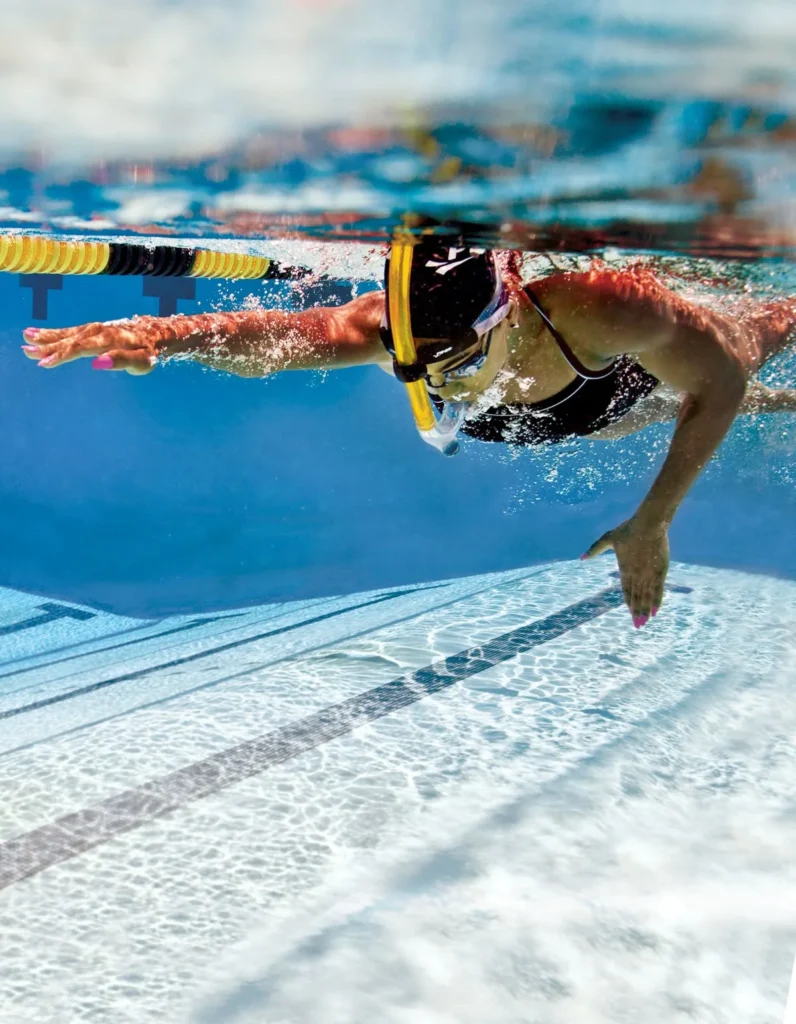
1. Deep Water Cervical Stabilization Drill
Why this works
Most land exercises fail to replicate swimming posture.
This exercise trains neck stability in horizontal floating position, exactly like swimming.
How to perform
- Use a snorkel and pull buoy
- Float face down
- Maintain neutral head position
- Engage deep neck muscles
- Hold body alignment for 30 seconds
Progression
Add slow arm strokes while maintaining head stability.
What it trains
- cervical stabilization
- swimming posture control
- neuromuscular coordination
2. Rotational Breathing Control Drill
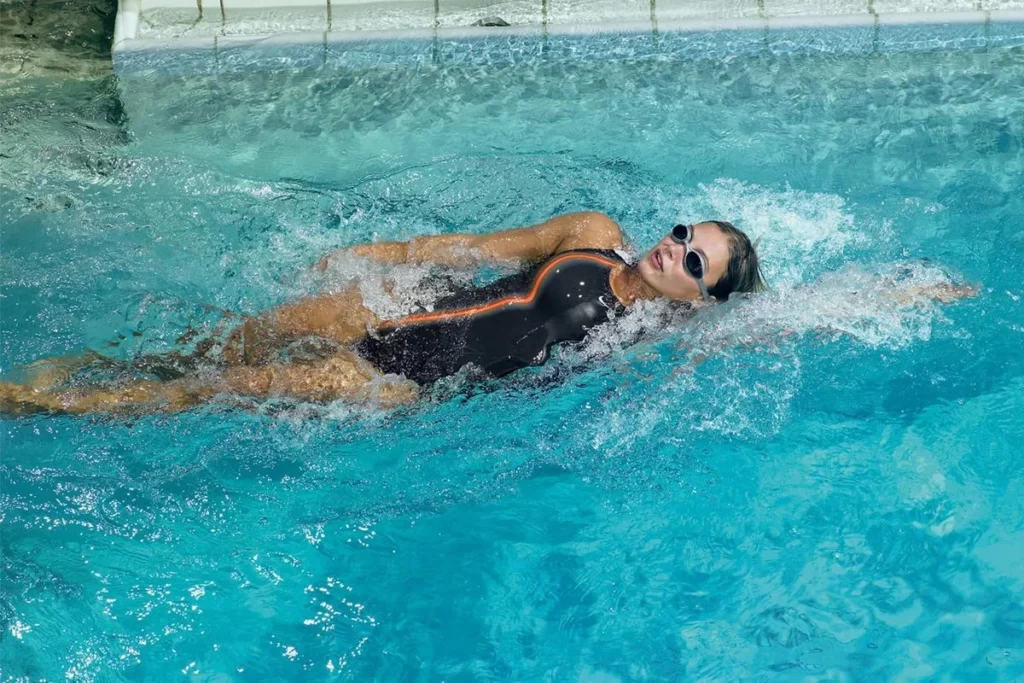
This exercise fixes asymmetrical neck rotation, a major cause of swimmer neck pain.
Steps
- Swim freestyle slowly
- Use a 3-3-3 breathing pattern
- Rotate entire body during breathing
- Keep neck relaxed
Advanced version
Use a center snorkel for training, then gradually reintroduce breathing.
This teaches swimmers to rotate the torso instead of twisting the neck.
3. Cervical-Scapular Integration Exercise
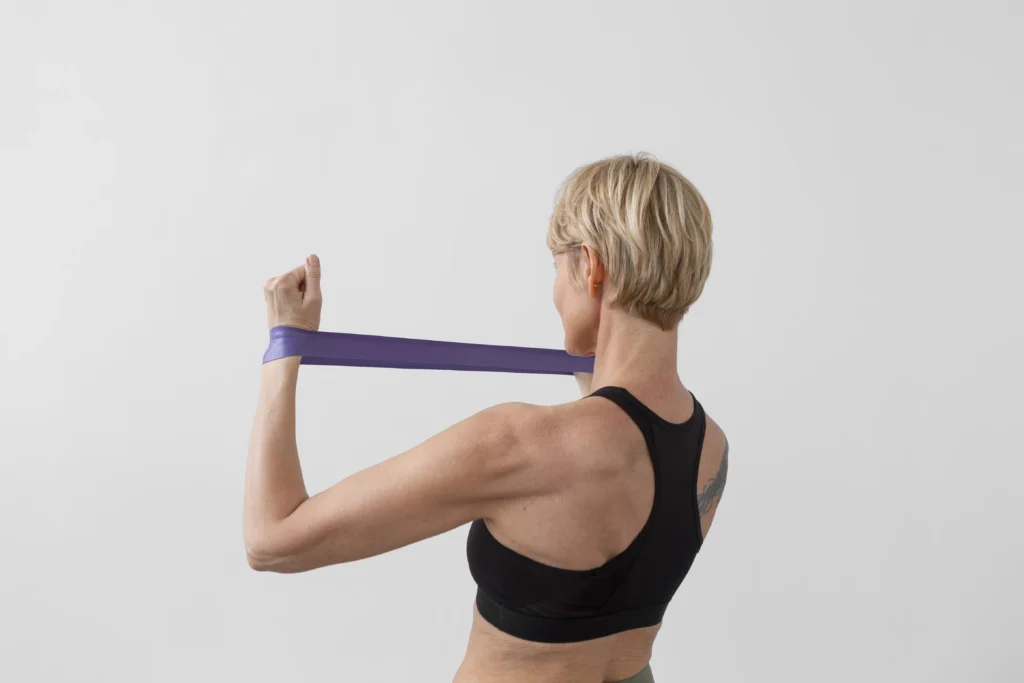
This exercise connects neck stability with shoulder movement, which is essential for swimmers.
Setup
Use resistance band.
Movement
- Chin tuck
- Pull band backward into row
- Maintain cervical neutral
Repetitions
3 sets of 12.
Why it matters
Swimming injuries rarely come from one muscle.
They occur because neck and shoulder stabilizers fail to coordinate.
4. Thoracic Rotation Control Drill
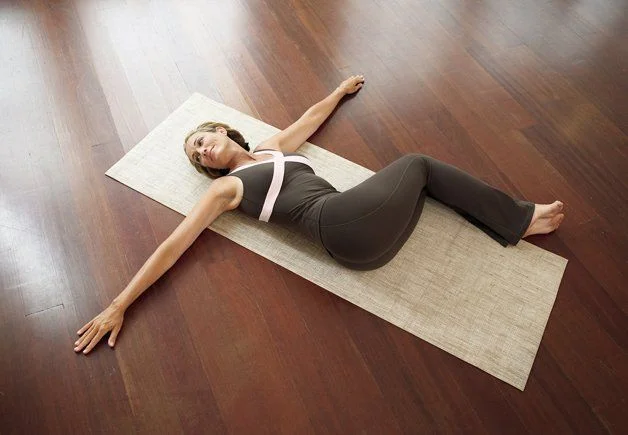
Poor thoracic mobility forces the neck to rotate excessively.
Exercise
Side-lying thoracic rotation.
- Lie on side
- Knees bent
- Rotate upper body backward
- Follow with eyes and head
Reps
10 slow rotations each side.
Benefit
Improves breathing mechanics in freestyle.
5. Anti-Extension Neck Endurance Exercise
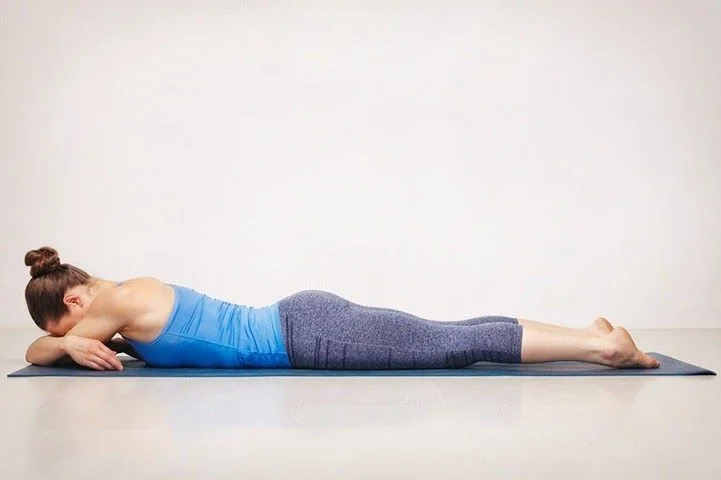
Many swimmers develop neck extension overload.
This exercise strengthens neck endurance against extension stress.
Steps
- Lie prone
- Forehead resting on towel
- Lift head slightly (1–2 cm)
- Hold 10 seconds
Progression
Add small arm strokes.
6. Closed-Chain Cervical Stability Exercise
This is used in elite athletes.
Steps
- Stand facing wall
- Place forehead on soft ball against wall
- Maintain neutral head
- Perform shoulder raises
Why it works
Trains dynamic cervical stability during arm movement.
7. Swimming-Specific Core + Neck Drill
Weak core forces neck compensation.
Exercise
Flutter kick with head support.
- Lie on back
- Lift head slightly
- Perform flutter kicks
Duration
30 seconds × 3.
Also read: How to Relieve Neck Tightness Without Equipment
Rehabilitation Techniques Used in Sports Medicine
Modern physiotherapy is evolving rapidly. Several new rehabilitation technologies are now used for neck pain in athletes.
1. Aquatic PNF Therapy (Bad Ragaz Ring Method)
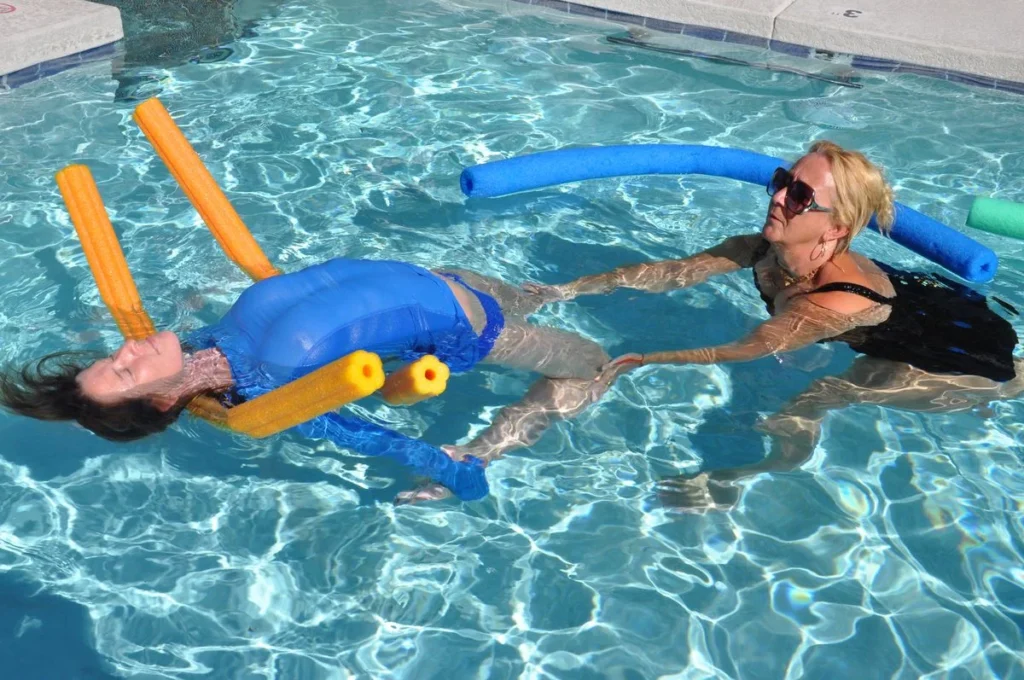
The Bad Ragaz Ring Method is a water-based physiotherapy technique using floating rings to perform resisted neuromuscular exercises. (Wikipedia)
Benefits:
- reduces spinal load
- improves neuromuscular control
- strengthens deep stabilizers
This technique is particularly effective for swimmers because it mimics aquatic conditions.
2. Motion Sensor Stroke Analysis
Elite teams now use wearable motion sensors to track joint movement during swimming.
Recent research using inertial sensors showed that physiotherapy interventions improved joint control and reduced abnormal shoulder rotations during fatigue. (PubMed)
These technologies help physiotherapists:
- identify stroke faults
- correct cervical mechanics
- prevent overuse injuries
3. Virtual Reality Cervical Rehabilitation
One of the newest innovations in physiotherapy is VR-based rehabilitation for neck disorders.
Studies show that VR exercise systems improve patient engagement and adherence to cervical rehabilitation programs, while targeting posture correction and range-of-motion exercises. (arXiv)
Future sports rehabilitation may include:
- VR stroke simulation training
- gamified neck strengthening
- posture feedback systems
4. Neuromuscular Electrical Stimulation (NMES)
Some sports clinics now use targeted neuromuscular electrical stimulation to activate weak cervical stabilizers.
Emerging neuromodulation techniques may help restore motor control in cervical muscles by stimulating neural pathways. (arXiv)
Read more: Cervical Vertigo Explained: Why Neck Pain Make You Feel Dizzy
Severe Complications if Swimmer Neck Pain Is Ignored
Many swimmers dismiss neck pain as simple soreness.
However, untreated neck pain can progress into serious problems.
1. Cervical Disc Degeneration
Repeated neck extension and rotation can accelerate:
- cervical disc dehydration
- disc bulging
- disc herniation
This can eventually cause nerve compression.
Read in detail about: Cervical Disc Degeneration: The Hidden Cause of your Neck Pain
2. Cervicogenic Headaches
Chronic swimmer neck pain can irritate the upper cervical joints and nerves, causing headaches originating from the neck.
Symptoms include:
- pain behind the eyes
- base of skull headaches
- headache triggered by swimming
Read in detail about: What is Cervical Spondylosis? The Truth Behind Chronic Neck Pain
3. Cervical Radiculopathy
If nerve roots become compressed, swimmers may develop:
- arm pain
- tingling in fingers
- numbness
- muscle weakness
This condition can severely affect swimming performance.
Read in detail about: Cervical Radiculopathy: Why Neck Nerve Pain Travels to the Arm
4. Facet Joint Arthropathy
Repetitive cervical extension can cause degeneration of facet joints.
This leads to:
- chronic stiffness
- pain during neck rotation
- reduced swimming ability
Read about : What is Cervical Facet Joint Pain, how it causes cervicogenic headaches and how to correct it naturally
5. Thoracic Outlet Syndrome
Forward head posture combined with shoulder overuse can compress nerves and blood vessels between the neck and shoulder.
Symptoms include:
- arm heaviness
- numbness
- reduced grip strength
Read about: Cervical Ligament Injury or Neck Ligament Tear
6. Performance Decline
Neck pain can alter swimming biomechanics.
This leads to:
- inefficient strokes
- reduced speed
- higher fatigue levels
Read about: What Is Cervical Myofascial Pain Syndrome And How To Relieve Trigger Points
My Personal Physiotherapy Strategy for Swimmers
If I were designing a world-class rehabilitation program for swimmers, I would combine:
Phase 1: Pain Relief
- cervical manual therapy
- soft tissue release
- posture correction
Phase 2: Stability Training
- deep neck flexor strengthening
- thoracic mobility work
- scapular stabilization
Phase 3: Sport-Specific Retraining
- snorkel stroke correction
- body roll drills
- cervical endurance training
Phase 4: Performance Optimization
- breathing symmetry training
- stroke efficiency analysis
- fatigue resistance training
This integrated approach fixes the root cause, not just symptoms.
Read in detail about: How to Fix Upper Crossed Syndrome Naturally
Home exercises Exercises for Swimmer’s Neck
Chin Tucks (Deep Neck Flexor Activation)
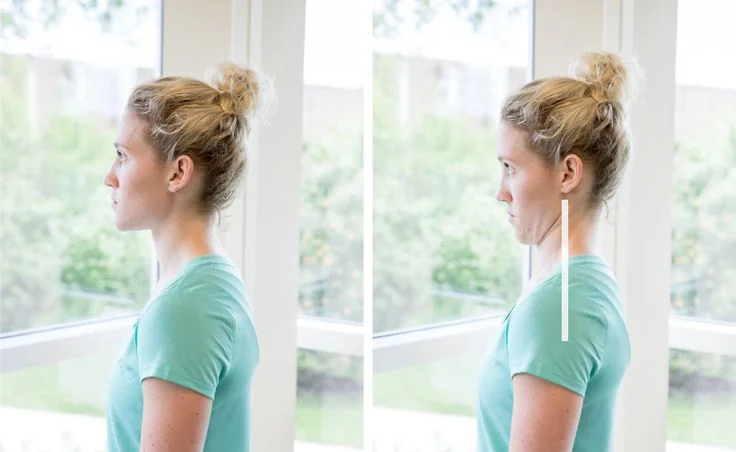
This is one of the most important exercises for cervical stability.
How to perform:
- Lie on your back
- Gently tuck your chin toward your throat
- Keep the head on the floor
- Hold for 5 seconds
- Repeat 10–15 times
Benefits:
- Strengthens deep cervical flexors
- Corrects forward head posture
Cervical Rotation Mobility Exercise

This improves neck flexibility needed for breathing.
Steps:
- Sit upright
- Slowly turn your head to the right
- Hold for 5 seconds
- Return to center
- Repeat on the left side
Repetitions: 10 each side.
Upper Trapezius Stretch
Steps:
- Sit tall
- Gently tilt head to one side
- Use hand for gentle stretch
- Hold for 20 seconds
Repeat 3 times per side.
Levator Scapulae Stretch
Steps:
- Sit upright
- Turn head 45° to the side
- Look down toward your armpit
- Use hand to gently stretch
Hold for 20 seconds.
Thoracic Extension Exercise

Steps:
- Sit on a chair
- Place hands behind your head
- Gently extend your upper back over the chair
- Hold for 5 seconds
Repeat 10 times.
Improving thoracic mobility reduces neck compensation.
Scapular Retraction Exercise
Steps:
- Sit or stand tall
- Pull shoulder blades together
- Hold 5 seconds
- Relax
Repeat 15 times.
This improves shoulder-neck coordination.
Resistance Band Rows
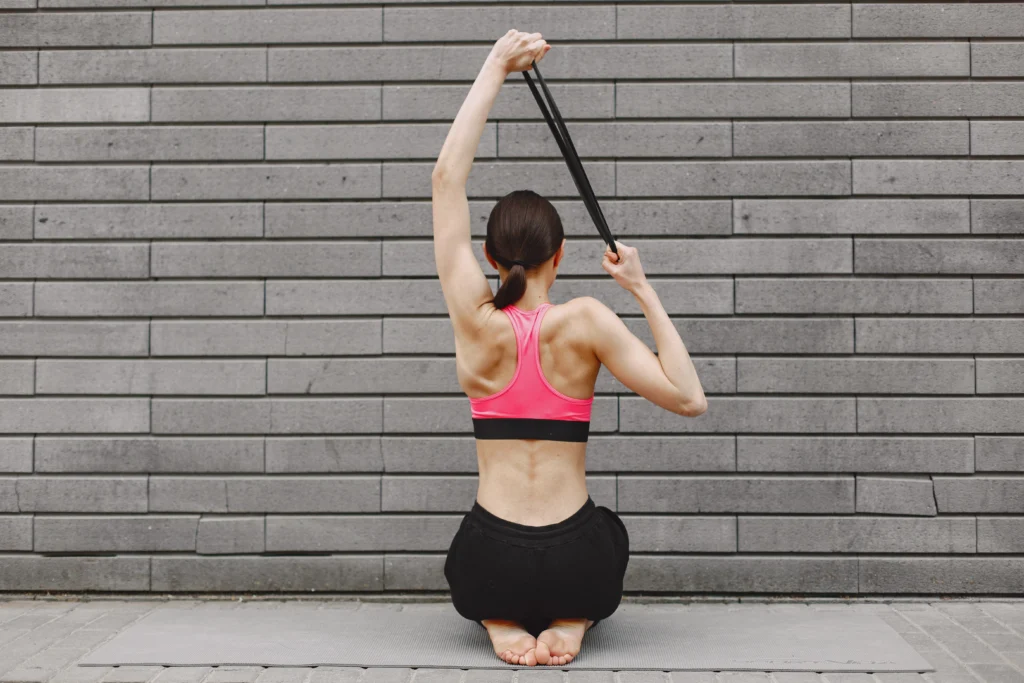
Strengthens upper back muscles.
Steps:
- Hold resistance band
- Pull elbows backward
- Squeeze shoulder blades
Perform 3 sets of 12 repetitions.
Read in detail: Neck Pain from Phone Use? Here’s How to Treat Text Neck Syndrome
Swimming Technique Tips to Protect Your Neck
Maintain Neutral Head Position
Your gaze should be toward the pool floor, not forward.
Rotate the Body, Not Just the Neck
Breathing should come from torso rotation, not neck twisting.
Practice Bilateral Breathing
Alternate sides to maintain muscular balance.
Improve Core Stability
A strong core reduces unnecessary neck movements.
Limit Kickboard Drills
Try:
- Backstroke kick
- Snorkel training
These reduce cervical extension.
Prevention Strategies for Swimmers
To prevent neck pain:
- Warm up properly before swimming
- Stretch after training
- Maintain good posture outside the pool
- Strengthen neck and upper back muscles
- Gradually increase training volume
- Avoid sudden increases in swimming distance
When to See a Physiotherapist
Consult a physiotherapist if you experience:
- Persistent neck pain lasting more than one week
- Pain radiating to the arms
- Frequent headaches
- Reduced neck movement
- Weakness or numbness
Early treatment prevents chronic problems.
A Physio Secret Most Swimmers Don’t Know
One of the biggest hidden causes of swimmer neck pain is thoracic stiffness.
When the upper back cannot rotate properly, the neck must compensate.
Fixing thoracic mobility often eliminates neck pain even without treating the neck directly.
This is why elite physiotherapists treat the entire kinetic chain, not just the painful area.
Physio Prescription
If you are a swimmer experiencing neck pain, start with this simple routine:
Daily exercises (10-15 minutes):
- Chin tucks- 3 sets of 10
- Upper trapezius stretch- 3 × 20 seconds
- Levator scapulae stretch- 3 × 20 seconds
- Thoracic extension- 10 repetitions
- Resistance band rows- 3 × 12
Consistency is more important than intensity.
Red Flags
Seek medical evaluation if neck pain includes:
- numbness in the arm
- tingling in the fingers
- severe headaches
- loss of strength
- dizziness
These may indicate nerve involvement.
Myth About Swimming and Neck Pain
Myth: Swimming is completely safe for the neck.
Reality: Swimming is low impact but still involves repetitive cervical movement, which can cause overuse injuries when technique or posture is poor.
Frequently Asked Questions
1. Why does my neck hurt after swimming?
Neck pain after swimming usually occurs due to improper breathing technique, excessive neck extension, muscle fatigue, or poor posture during strokes like freestyle or breaststroke.
2. Which swimming stroke causes the most neck pain?
Freestyle and breaststroke are the most common strokes associated with neck pain because they involve repetitive head lifting or rotation for breathing.
3. Can swimming cause cervical spine problems?
Swimming itself is generally safe, but poor technique and excessive training can strain cervical muscles and joints, leading to neck pain.
4. How can swimmers prevent neck pain?
Swimmers can prevent neck pain by maintaining a neutral head position, rotating the body instead of twisting the neck, strengthening neck muscles, and practicing bilateral breathing.
5. What exercises help swimmer’s neck pain?
Chin tucks, upper trapezius stretches, levator scapulae stretches, thoracic mobility exercises, and scapular strengthening exercises are commonly recommended.
Final Word
Swimming should strengthen your body, not cause pain.
If you experience neck discomfort while swimming, the solution is rarely to stop swimming entirely. Instead, focus on improving technique, correcting posture, and strengthening stabilizing muscles.
With proper physiotherapy guidance, most swimmers can return to the pool pain-free and even improve their performance.
Stay tuned with us for more health related topics.
Follow us on LinkedIn and Instagram for more.
More Read


Medical Disclaimer!
This article has been reviewed and written under the guidance of our Head Physiotherapist, Dr. Kruti Raj (PT, MUHS,CPT,CMPT). The information shared is intended for educational purposes only and should not be considered a substitute for personalized medical advice, diagnosis, or treatment.
Please consult us or any other qualified healthcare professional before beginning any exercise program, especially if you are experiencing pain, recovering from injury, or managing a medical condition.


