


Rib pain during pregnancy can make sitting, sleeping, and deep breathing uncomfortable as the body adapts to a growing baby.
Pregnancy teaches women very quickly that the body can create strange symptoms nobody warned them about.
Rib pain is one of them.
Many pregnant women expect lower back pain, swollen feet, or nausea.
But aching ribs, burning pain under the bra line, or sharp discomfort while turning in bed often catches them completely off guard.
Some women even worry something is wrong with their lungs, heart, or liver.
Quick Answer
Pregnancy causes rib pain mainly because the growing uterus pushes upward into the rib cage, changing posture, breathing patterns, and muscle tension. Hormonal changes also loosen joints and ligaments around the ribs, making the area more sensitive. Many women feel rib pain more during the third trimester when the baby’s movements, rib cage expansion, and pressure under the breasts increase. Gentle physiotherapy, posture correction, breathing exercises, supportive sleep positions, and reducing upper body strain can help relieve discomfort naturally.
In most cases, pregnancy rib pain is completely normal.
But that does not mean it should be ignored.
As a physiotherapist,
I often notice that women are told rib pain is “just part of pregnancy” without anyone properly explaining why it happens or what actually helps.
The truth is, rib pain during pregnancy is usually caused by a combination of :
posture changes, muscle strain, breathing pattern changes, expanding ribs, hormonal effects, and simple lack of space inside the body.
What makes it more frustrating is that rib pain usually appears at the exact stage when sleep becomes difficult, sitting feels uncomfortable, and fatigue is already high.
The good news is that understanding the cause often makes the pain much easier to manage.
Key Takeaways
- Rib pain during pregnancy is very common, especially in the second and third trimesters.
- The growing baby and expanding uterus place upward pressure on the rib cage and diaphragm.
- Hormonal changes loosen rib joints and increase muscle sensitivity.
- Poor posture, shallow breathing, and tight bras can quietly worsen rib discomfort.
- Right-sided rib pain is common because of baby positioning and pressure near the liver area.
- Breathing exercises and gentle thoracic mobility work often provide noticeable relief.
- Most pregnancy rib pain is harmless, but severe pain with swelling, headache, or breathing difficulty needs urgent medical attention.
- Prenatal physiotherapy can help improve posture, breathing mechanics, sleep comfort, and muscle tension naturally.
Rib Pain During Pregnancy Feels Different for Every Woman
Some women describe it as:
- A sharp stabbing pain below the breasts
- A bruised feeling around the ribs
- Burning pain near the upper abdomen
- Tightness while breathing deeply
- Pain while laughing or coughing
- Tenderness under the bra strap
- A baby’s foot “stuck” in the ribs
For many women, the pain is worse:
- At night
- After sitting too long
- During the third trimester
- After eating large meals
- While twisting in bed
- During long car rides
One thing I commonly hear in clinic is:
“It feels like my baby is living inside my ribs.”
Honestly, that description is not far from reality.
Why Pregnancy Causes Rib Pain
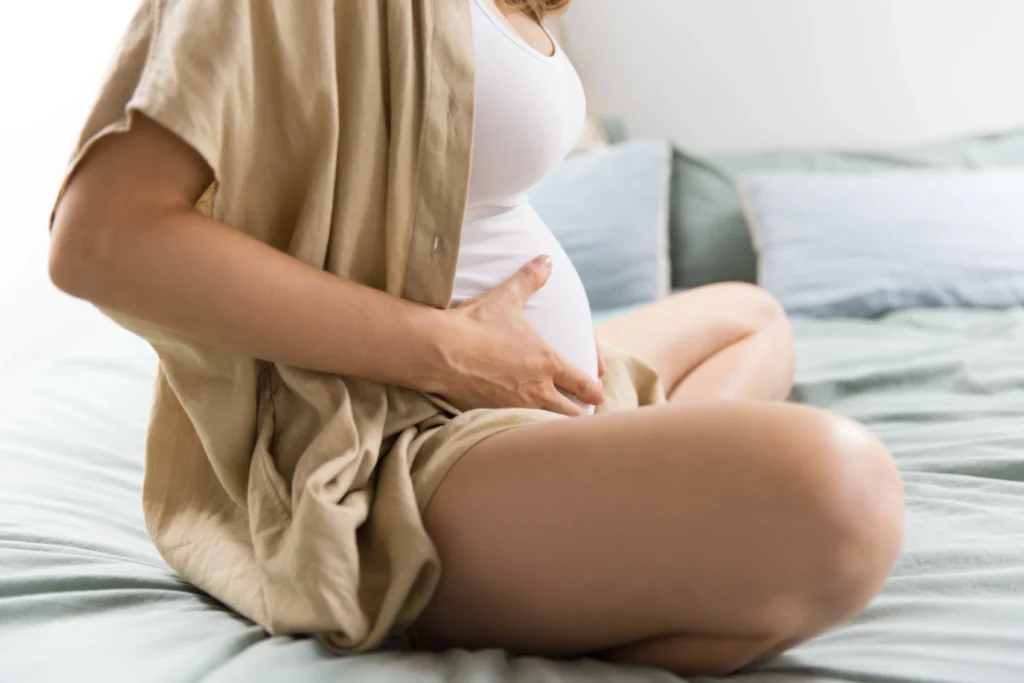
Your Rib Cage Really Expands During Pregnancy
This surprises many women.
The rib cage does not stay fixed during pregnancy.
It actually widens to help accommodate the growing uterus and changing breathing mechanics.
Research has shown that the angle of the lower ribs increases during pregnancy as the body adapts to reduced abdominal space. (PMC)
That widening changes how muscles around the chest and upper abdomen function.
Some muscles become overstretched while others tighten excessively trying to compensate.
This is one reason women suddenly feel sore around the bra line even without injury.
Many also notice their bra band size increasing during pregnancy even if breast size changes only slightly.
The rib cage itself is physically expanding.
The Baby Starts Taking Up More Space Than Most Women Realize
By the third trimester, the uterus pushes upward toward the diaphragm and lower ribs.
For women with shorter torsos, there is often very little space left between the pelvis and rib cage. The baby essentially occupies nearly the entire abdominal cavity.
That pressure changes:
- Posture
- Breathing mechanics
- Rib movement
- Muscle activation
- Sitting comfort
Women carrying larger babies or twins often feel rib pain earlier.
One lesser-known thing I notice clinically is that some babies repeatedly settle under the same rib area for weeks.
The mother ends up feeling soreness in one exact spot every day.
Usually the right side.
Why Rib Pain Is Commonly Worse on the Right Side
Many pregnant women panic about right-sided rib pain because it can feel intense.
Most of the time, it happens because:
- The liver sits on the right side
- The uterus often rotates slightly rightward
- Babies commonly position their feet upward into the right ribs
A baby stretching against the ribs repeatedly can irritate the intercostal muscles and nearby nerves.
However, severe right upper rib pain should never be ignored.
Rarely, it may signal conditions like:
- Preeclampsia
- HELLP syndrome
- Gallbladder irritation
Women should seek urgent medical care if rib pain comes with:
- Headache
- Visual disturbances
- Sudden swelling
- Nausea
- High blood pressure
- Breathing difficulty
Pregnancy Changes the Way You Breathe
This is one of the most overlooked causes of rib discomfort.
As the uterus expands upward, the diaphragm has less room to move normally.
Many women unknowingly switch from relaxed diaphragmatic breathing to shallow chest breathing.
That creates extra tension in:
- Neck muscles
- Upper chest muscles
- Intercostal muscles
- Upper back muscles
Some women describe it as:
“I feel like I cannot take a satisfying deep breath.”
This feeling is extremely common in late pregnancy.
Research has shown pregnancy significantly alters respiratory mechanics and chest wall motion. (NLM)
From a physiotherapy perspective, breathing pattern retraining often helps rib pain more than women expect.
The Intercostal Muscles Often Become Irritated
The intercostal muscles sit between the ribs and help with breathing and trunk movement.
During pregnancy these muscles are under constant stretch because:
- The rib cage widens
- Posture changes
- Breathing mechanics shift
- Abdominal pressure increases
Simple activities can suddenly trigger pain:
- Reaching overhead
- Turning quickly
- Getting out of bed
- Sneezing
- Carrying groceries
- Coughing
Women sometimes think they “pulled a muscle,” and honestly, that is not completely wrong.
These muscles can become irritated and overworked during pregnancy.
Posture Is a Bigger Problem Than Most Pregnant Women Realize
As the belly grows forward, many women lean backward without noticing.
That posture creates:
- Rib flare
- Tight upper back muscles
- Increased lumbar arch
- Shoulder tension
- Reduced rib mobility
A study in the Journal of Physical Therapy Science found pregnancy significantly changes spinal alignment and trunk mechanics, contributing to musculoskeletal pain. (PMC)
What makes this worse is modern lifestyle habits.
Most pregnant women today spend hours:
- Sitting at desks
- Looking down at phones
- Driving
- Resting in soft couches
The upper back gradually stiffens while the front ribs become overloaded.
I often notice women trying to “sit straight” by pushing the chest upward aggressively.
That actually increases rib compression.
A better approach is gentle spinal lengthening instead of exaggerated chest lifting.
Tight Bras Quietly Make Rib Pain Worse
This is one of the most common things nobody talks about.
During pregnancy:
- The rib cage expands
- Breathing needs increase
- Breast tissue changes
- Posture shifts
Yet many women continue wearing the same bra size for months.
A tight bra compresses already sensitive ribs and intercostal nerves.
Some women experience major relief simply from switching to a softer maternity bra with a wider band.
Clinically, I have seen women believe they had severe musculoskeletal rib pain when the primary issue was constant compression from restrictive bras.
Stress Can Increase Rib Pain Too
Pregnancy is emotional as well as physical.
Stress changes breathing patterns dramatically.
Women under stress often:
- Hold their breath unconsciously
- Breathe shallowly
- Tighten chest muscles
- Raise their shoulders
Over time, this creates muscular tension around the ribs and upper back.
This is why rib pain often feels worse:
- At night
- During anxiety
- After emotionally stressful days
The body and nervous system are deeply connected.
Why Rib Pain Gets Worse at Night
Most women notice rib discomfort becomes more obvious in the evening.
There are several reasons:
- Muscles fatigue throughout the day
- The baby settles differently when lying down
- Slouched sitting accumulates strain
- Fluid retention increases pressure
- Sleep positions compress irritated tissues
Many women also twist awkwardly while trying to reposition themselves in bed.
This repeatedly strains already sensitive rib muscles.
Sleeping Tips That Actually Help
The most comfortable sleeping position for many women is:
- Left side lying
- Pillow between knees
- Pillow supporting the abdomen
- Upper arm supported on a pillow
Supporting the upper arm is surprisingly helpful because it reduces pull on the rib cage and upper chest muscles.
Avoid sleeping:
- Flat on the back late in pregnancy
- With the arm overhead
- Twisted forward sharply
A small towel roll behind the upper back sometimes helps reduce rib pressure as well.
Gentle Movement Usually Helps More Than Complete Rest
Many women become afraid to move because rib pain feels sharp.
But complete rest often increases stiffness.
Safe movement helps:
- Rib mobility
- Circulation
- Breathing mechanics
- Muscle relaxation
- Posture awareness
Usually helpful activities include:
- Walking
- Prenatal yoga
- Pelvic tilts
- Thoracic mobility exercises
- Breathing exercises
- Swimming
Movements should feel relieving, not aggressive.
One Simple Breathing Exercise I Frequently Teach
Side Rib Breathing
Sit comfortably with hands around the lower ribs.
Breathe in slowly through the nose and try to expand the ribs sideways into the hands.
Do not force the chest upward.
Exhale slowly through pursed lips.
Repeat for 1 to 2 minutes.
This simple exercise often helps because many pregnant women stop using the lower rib cage efficiently.
Digestive Changes Can Mimic Rib Pain
Sometimes the discomfort is not entirely musculoskeletal.
Pregnancy hormones relax the digestive tract, increasing reflux and bloating.
That pressure can create:
- Burning under the ribs
- Upper abdominal tightness
- Pain after meals
- Chest discomfort while lying down
Women often think this is rib injury when it is partly digestive pressure combined with muscular tension.
Some Rib Pain After Pregnancy Is Also Normal
Many women expect immediate relief after delivery.
But the body still needs time to recover.
The rib cage gradually returns toward its pre-pregnancy position over weeks and months.
Muscles that adapted during pregnancy remain tight or weak for some time.
Breastfeeding posture can also continue stressing the upper ribs and thoracic spine.
Postnatal physiotherapy can help restore:
- Rib mobility
- Core coordination
- Breathing mechanics
- Thoracic posture
When Rib Pain Should NOT Be Ignored
Most pregnancy rib pain is harmless. Still, some symptoms require urgent medical assessment.
Seek medical care immediately if rib pain is associated with:
- Chest pain
- Severe shortness of breath
- Fever
- Sudden swelling
- Severe headache
- Visual disturbances
- High blood pressure
- Persistent vomiting
- Reduced fetal movement
Pain should never simply be dismissed because someone is pregnant.
A Physiotherapist’s Honest Advice
One thing I genuinely wish more pregnant women heard is this:
You do not need to wait until pain becomes unbearable before seeking help.
Many women spend months assuming discomfort is “normal” when simple adjustments could improve things significantly.
Small changes often matter more than complicated treatments:
- Better posture while sitting
- Supporting the ribs during sleep
- Breathing differently
- Wearing less restrictive bras
- Moving more frequently
- Reducing upper body tension
Pregnancy places enormous physical demands on the body.
Rib pain is often the body’s way of saying:
“I need more support and less strain.”
And honestly, that message deserves attention.
Frequently Asked Questions About Rib Pain During Pregnancy
Is rib pain normal during pregnancy?
Yes, rib pain is very common during pregnancy, especially in the later months when the baby grows larger and pushes upward against the rib cage and surrounding muscles.
Why does pregnancy rib pain feel worse at night?
Rib pain often becomes worse at night because muscles become fatigued throughout the day, sleep positions increase pressure on the ribs, and the baby may shift upward while lying down.
Why is rib pain usually on the right side during pregnancy?
The uterus often rotates slightly toward the right side, and babies commonly position their feet upward into the right rib cage, causing pressure and muscle irritation.
Can a baby kicking cause rib pain?
Yes, repeated kicks and stretching movements against the ribs can irritate the intercostal muscles and cause soreness or sharp discomfort under the breasts.
Can physiotherapy help pregnancy rib pain?
Yes, prenatal physiotherapy can help improve posture, breathing mechanics, muscle flexibility, and rib mobility while reducing strain on the upper body.
Which sleeping position helps rib pain during pregnancy?
Sleeping on the left side with pillows supporting the abdomen, knees, and upper arm is usually the most comfortable position for reducing rib pressure.
When should rib pain during pregnancy be checked by a doctor?
Seek medical care immediately if rib pain is severe or associated with headache, swelling, fever, chest pain, breathing difficulty, or high blood pressure symptoms.
Does rib pain go away after delivery?
For most women, rib pain improves gradually after childbirth as the rib cage, breathing mechanics, and posture slowly return toward normal.
Stay tuned with us for more health related topics.
Follow us on LinkedIn and Instagram for more.
More Read


Medical Disclaimer!
This article has been reviewed and written under the guidance of our Head Physiotherapist, Dr. Kruti Raj (PT, MUHS,CPT,CMPT). The information shared is intended for educational purposes only and should not be considered a substitute for personalized medical advice, diagnosis, or treatment.
Please consult us or any other qualified healthcare professional before beginning any exercise program, especially if you are experiencing pain, recovering from injury, or managing a medical condition.


