


An ankle stress fracture is a bone injury that develops when repeated loading exceeds the bone’s ability to repair itself.
Unlike a fracture caused by a sudden fall or impact, it often begins gradually, with pain that appears during exercise and becomes more persistent over time.
Quick Answer: Ankle Stress Fracture
An ankle stress fracture is a bone injury caused by repeated loading that exceeds the bone’s ability to repair itself. It often develops gradually and may worsen if impact activity continues.
- Common symptoms: Localised bone pain, tenderness, swelling and pain during walking or running.
- Common causes: Sudden training increases, repetitive impact and inadequate recovery.
- Diagnosis: Clinical examination and imaging. Early stress fractures may not appear on X-rays.
- Treatment: Activity modification, protected weight-bearing when needed and specialist management.
- Physiotherapy: Gradual restoration of strength, mobility and function when loading is safe.
Important: Stop impact exercise if you suspect a stress fracture and seek medical assessment. Do not repeatedly hop or run to test the pain.
Runners, athletes and people who suddenly increase their walking or training demands may be at risk.
Recognizing the warning signs early can help prevent the injury from progressing and reduce the risk of prolonged recovery.
Key Takeaways
Localised bone pain that repeatedly returns during walking or running should not be dismissed as ordinary soreness.
Some stress fractures are not visible initially. Further assessment or MRI may be needed when suspicion remains.
Stop painful impact activities and follow medical advice about walking, immobilisation and weight-bearing.
Progress strength, balance and impact activity according to the injury’s location, healing and clinical guidance.
Training load, recovery, nutrition and bone health may all need attention to reduce recurrence risk.
What Is an Ankle Stress Fracture?
A stress fracture develops when repeated forces create microscopic bone damage faster than the body can repair it.
The injury may begin as a stress reaction and progress to a visible fracture if excessive loading continues.
Although people commonly use the term ankle stress fracture, the injury may involve the tibia or fibula near the ankle, the talus or nearby foot bones.
The exact location matters because some bone stress injuries have a higher risk of delayed healing or nonunion. (Patel et al., 2011)
What Causes a Stress Fracture of the Ankle?
Sudden increases in training
Rapidly increasing running distance, speed, hill work or jumping frequency can expose bones to loads they have not adapted to tolerate.
Repetitive impact activities
Running, football, basketball, gymnastics and dance involve repeated loading of the lower limbs.
Stress fractures may develop when training demands consistently exceed recovery capacity.
Changes in everyday activity
Starting a physically demanding job, increasing daily walking or suddenly spending long periods standing can increase bone loading, particularly when these changes occur without gradual adaptation.
Reduced bone strength and inadequate nutrition
Low bone mineral density, inadequate energy intake, vitamin D deficiency, hormonal disturbances and certain medical conditions can increase susceptibility to bone stress injuries.
Insufficient recovery
Repeated hard training sessions, inadequate rest and returning to impact activity before a previous injury has recovered can contribute to recurrent bone stress.
Stress Fracture of the Ankle: Symptoms You Should Not Ignore
1. Localised pain over the bone
Pain is often concentrated in a specific area rather than spread across the entire ankle.
Tenderness directly over the affected bone may be noticeable, although this symptom alone cannot confirm a fracture.
2. Pain during walking or running
Early symptoms may appear only during exercise and settle with rest.
As the injury progresses, pain may begin earlier during activity or occur during ordinary walking.
3. Swelling around the ankle
Mild, localised swelling may develop near the affected bone.
Significant bruising is not always present, so the absence of bruising does not rule out a stress fracture.
4. Pain that repeatedly returns
Pain that disappears during rest but returns whenever running or jumping resumes may indicate that the bone is not tolerating the current load.
5. Pain during daily activities
Discomfort during routine walking, climbing stairs or standing suggests that the injury may be more significant than ordinary post-exercise soreness.
6. Pain at rest or at night
Pain that persists at rest or wakes you at night deserves prompt medical assessment.
It is not specific to a stress fracture, but it should not be ignored.
Important: Do not repeatedly hop, run or jump to test a painful ankle. Stop impact activity and seek assessment if a stress fracture is suspected.
Stress Fracture vs Ankle Sprain
An ankle sprain affects ligaments, while a stress fracture affects bone.
The symptoms can overlap, so clinical assessment is important.
| Feature | Stress fracture | Ankle sprain |
|---|---|---|
| Typical onset | Often gradual after repetitive loading | Often sudden after twisting the ankle |
| Main structure affected | Bone | Ligaments |
| Pain location | Often localised over bone | Often around the injured ligament |
| Swelling | May be mild or localised | May be more noticeable |
| Activity pattern | Often worsens with repeated loading | Often worsens with movements stressing the injured ligament |
A stress fracture can develop without a memorable accident.
Persistent pain after a presumed sprain, especially following an increase in activity, may warrant further investigation.
Ankle Stress Fracture: Myth vs Fact
MYTH: A stress fracture always causes severe pain immediately.
FACT: Symptoms often begin gradually. Pain may initially occur only during exercise and become more persistent as the injury progresses.
MYTH: A normal X-ray rules out a stress fracture.
FACT: Early stress fractures may not be visible on X-rays. Further investigation, including MRI, may be needed.
MYTH: If the pain settles with rest, running is safe again.
FACT: Pain reduction does not confirm bone healing. Return to running should follow a suitable recovery plan and medical guidance.
MYTH: Physiotherapy means starting ankle exercises immediately.
FACT: Rehabilitation must match the fracture location and healing stage. Protecting the bone and following weight-bearing restrictions come first.
How Is an Ankle Stress Fracture Diagnosed?
Clinical examination
A clinician reviews the activity history, pain location, tenderness, swelling and walking ability.
They may also assess previous injuries and factors affecting bone health.
X-rays
X-rays are commonly used initially, but early stress fractures may not be visible.
Bone changes can take time to appear, so a normal initial X-ray does not always exclude an injury.
MRI scans
MRI can detect bone marrow changes and stress injuries that are not yet visible on X-rays.
It may be recommended when clinical suspicion remains despite normal initial imaging.
CT scans
CT can provide detailed information about a known fracture and may help assess its location or structure in selected cases.
The American College of Radiology identifies MRI as an important investigation for suspected stress fractures that remain unclear after initial radiographs. (Expert Panel on Musculoskeletal Imaging, 2024)
Which Stress Fractures Need Particular Attention?
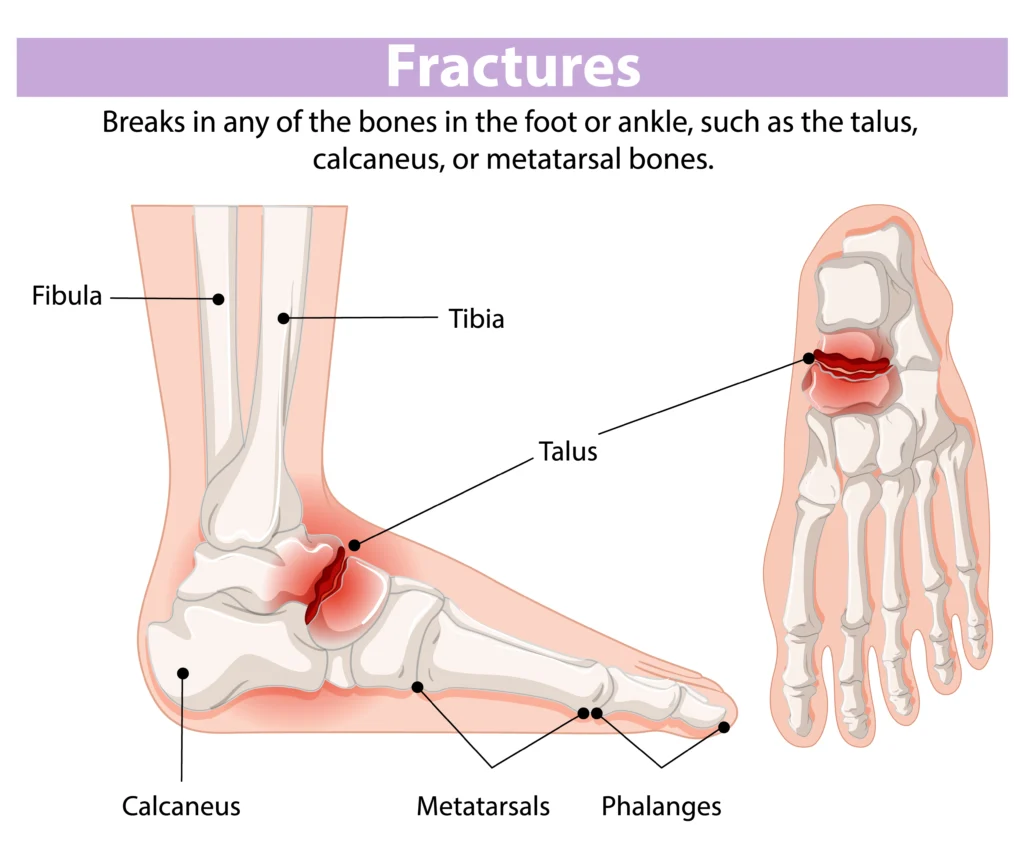
The location of a bone stress injury affects treatment and the risk of complications.
Tibial stress fracture
The tibia is the larger lower-leg bone.
Some tibial stress fractures have a favourable prognosis, while others require closer monitoring because of a greater risk of delayed healing.
Fibular stress fracture
The fibula runs along the outer side of the lower leg.
Many fibular stress fractures respond well to appropriate load modification, but diagnosis and management still depend on the exact injury.
Talar stress fracture
The talus transfers body weight through the ankle and hindfoot.
Stress fractures involving this bone require particular attention because some may heal slowly or develop complications.
Some other foot bone stress injuries are also considered high-risk.
A clinician should identify the affected bone before deciding whether ordinary walking, exercise or weight-bearing is safe.
Treatment for an Ankle Stress Fracture
Treatment aims to protect the bone while it heals and address the factors that contributed to the injury.
Activity modification
Running, jumping and other activities that load the injured bone may need to stop temporarily.
Alternative exercise should only be considered when appropriate for the fracture and cleared by the treating clinician.
Protected weight-bearing
Some injuries can be managed by reducing impact.
Others require a walking boot, crutches or restricted weight-bearing.
These decisions depend on the fracture’s location and severity.
Surgery in selected cases
Most low-risk stress fractures do not require surgery.
Certain high-risk fractures, displaced injuries or fractures that fail to heal may require an operation.
Physiotherapy for an Ankle Stress Fracture
Physiotherapy helps restore function, rebuild activity tolerance and address contributing factors.
Rehabilitation must be tailored to the affected bone and the stage of healing.
1. Manage load and protect the bone
The first priority is to prevent repeated stress on the injured area.
A physiotherapist can help with safe mobility, prescribed walking restrictions and crutch use when needed.
Pain relief does not necessarily mean that the bone has healed.
2. Maintain general mobility and strength
Where appropriate, exercises for unaffected joints and muscle groups can help maintain conditioning during recovery.
Exercises that load the injured ankle or foot must follow the clinician’s guidance.
3. Restore strength progressively
After sufficient healing, rehabilitation may include calf strengthening, ankle control exercises and progressive resistance work.
The intensity should increase gradually without provoking renewed pain at the injury site.
4. Rebuild balance and movement control
Balance exercises and lower-limb control training can prepare the person for more demanding daily activities.
Their timing depends on weight-bearing restrictions, fracture location and clinical progress.
5. Return to running and sport
Return to impact activity should be based on recovery criteria rather than a fixed number of weeks.
A 2024 review of return-to-running guidance after tibial bone stress injuries identified several considerations: pain-free walking, assessment of local bone tenderness, strength and functional capacity, attention to high-risk injuries, and correction of contributing factors.
The authors also noted that evidence for specific return-to-running protocols remains limited. (George et al., 2024)
How Long Does an Ankle Stress Fracture Take to Heal?
Recovery depends on the affected bone, injury severity, bone health and treatment.
Some lower-risk injuries recover over several weeks, while others require several months or longer.
High-risk fractures may need prolonged protection and evidence of healing before impact activity resumes.
Returning to running too early can cause symptoms to recur or allow the injury to progress.
Your physiotherapist and treating clinician should guide the progression according to the injury’s risk profile and recovery.
Risk Factors for Repeated Stress Fractures
A recurring stress fracture may indicate that more than training load needs attention.
- Previous stress fracture: A previous bone stress injury increases concern about recurrence.
- Low energy availability: Consuming insufficient energy to support exercise and normal body functions can affect bone health.
- Hormonal disturbances: Menstrual irregularities and other hormonal factors may contribute to reduced bone strength.
- Nutritional deficiencies: Inadequate nutrition or certain deficiencies may impair bone health.
- Training errors: Sudden increases in volume or intensity without enough recovery can overload bone.
- Underlying health conditions: Some conditions and medications can affect bone strength and healing.
Recurrent injuries may warrant a broader medical assessment of nutrition, training, hormonal health and bone health rather than simply repeating the same rehabilitation programme.
How Can You Reduce the Risk?
- Increase exercise demands gradually instead of making sudden changes.
- Include adequate recovery between demanding sessions.
- Avoid training through persistent, localised bone pain.
- Maintain a balanced diet with adequate energy and nutrients.
- Seek professional advice about nutritional or bone-health concerns when relevant.
- Address strength, movement and training factors identified during rehabilitation.
- Return to impact activity gradually after medical clearance when required.
There is no single training rule that prevents every stress fracture.
Prevention should reflect individual risk factors, training demands and recovery capacity.
When Should You Seek Medical Attention?
Arrange prompt medical assessment if you develop persistent, localised ankle or lower-leg pain that worsens with walking or running.
Seek urgent assessment if you cannot bear weight, experience severe or rapidly worsening pain, or develop substantial swelling.
Pain at rest or at night also warrants prompt evaluation.
If a stress fracture is suspected, stop impact exercise until you receive appropriate advice.
Early assessment can help prevent progression and identify injuries that need more protective treatment.
Lesser-Known Facts About Ankle Stress Fractures
Early X-rays can appear normal
Some bone stress injuries are not visible on initial radiographs.
Persistent symptoms may require further assessment or MRI.
Stress fractures affect more than athletes
Sudden changes in work, walking routines or exercise can increase repetitive bone loading, even in people who do not participate in competitive sport.
Pain reduction does not confirm healing
Symptoms can settle before a bone is ready for its previous activity demands.
Return to running should be based on recovery, injury location and clinical guidance.
Rehabilitation includes prevention
Physiotherapy is not limited to restoring movement and strength.
It can also help identify training, loading and functional factors that may have contributed to the injury.
Final Thoughts: Protect Your Ankle
An ankle stress fracture may start with mild pain that appears only during activity. Ignoring repeated symptoms can allow the injury to progress, so persistent localised bone pain deserves proper assessment.
Physiotherapy can help rebuild strength, balance and activity tolerance once the bone can safely tolerate rehabilitation. The right plan also addresses training load, recovery and other factors that may have contributed to the injury.
Remember: Stop impact exercise if a stress fracture is suspected, follow medical advice and return to running gradually when it is safe.
Conclusion
A stress fracture around the ankle may begin with mild, localized pain that gradually becomes more persistent.
Recognizing the symptoms, obtaining an accurate diagnosis and protecting the injured bone can reduce the risk of complications.
Physiotherapy supports a gradual return to walking, strengthening and sport once loading is safe.
The most effective rehabilitation plan addresses both the bone injury and the factors that contributed to it.
Frequently Asked Questions
1. What are the first signs of an ankle stress fracture?
Early symptoms often include localised pain over a bone during running or walking. Pain may initially settle with rest but can become more persistent if repetitive loading continues.
2. Can an ankle stress fracture be missed on an X-ray?
Yes. Early stress fractures may not be visible on X-rays. If clinical suspicion remains, a clinician may recommend MRI or other imaging.
3. How long does an ankle stress fracture take to heal?
Recovery depends on the affected bone, severity and individual health. Some lower-risk injuries heal over several weeks, while others take several months or longer.
4. Can I walk with an ankle stress fracture?
It depends on the bone involved and the severity of the injury. Some fractures require protected or restricted weight-bearing. Follow the treating clinician’s instructions.
5. Can physiotherapy help an ankle stress fracture?
Yes. Once the injury can safely tolerate rehabilitation, physiotherapy can help restore strength, movement, balance and activity tolerance. The programme must respect bone-healing and loading restrictions.
6. When can I start running again?
Running should resume gradually when recovery criteria are met. Depending on the fracture location and severity, clinical assessment or imaging evidence of healing may be needed before returning to impact activity.
Stay tuned with us for more health related topics.
Follow us on LinkedIn and Instagram for more.
Medical Disclaimer
This article is intended for general educational purposes only and does not replace professional medical advice, diagnosis or treatment. Persistent or localised bone pain may require medical assessment. If a stress fracture is suspected, stop impact exercise and seek appropriate clinical guidance. Follow your treating clinician’s instructions regarding weight-bearing, rehabilitation and return to sport.


