


In clinical practice, one of the first things patients are asked is to rate their pain.
It sounds simple. But it rarely gives the full picture.
Two people may report the same pain intensity, yet their daily lives can look completely different. One continues working and functioning normally.
The other struggles with sleep, avoids movement, and feels restricted throughout the day.
This difference is exactly why the Neck Disability Index is used.
It shifts the focus from pain to function.
Instead of asking how much it hurts, it asks how much it is affecting your life.
Read about our Complete Neck Pain Guide : Causes, Symptoms, Exercises and Treatment
The Neck Disability Index (NDI) is a clinically validated questionnaire used to understand how neck pain affects your daily life. It evaluates activities such as work, sleep, concentration, and movement, helping physiotherapists measure functional limitation rather than just pain intensity.
Read about: Early Signs of Cervical Spine Damage You Should Never Ignore
• NDI measures how neck pain affects real-life function, not just pain levels
• A change of 5 to 7 points usually reflects meaningful improvement
• Movement behaviour and daily habits strongly influence disability scores
• Muscle coordination matters more than just strength in neck recovery
• Stress, sleep, and psychological factors can significantly affect outcomes
• Physiotherapy focuses on restoring confidence, movement, and function
Read: What Is Spurling’s Test And How To Perform
What is the Neck Disability Index
The Neck Disability Index, commonly called NDI, is a questionnaire designed to measure how neck pain impacts daily activities.
It was introduced by Vernon and Mior and has remained one of the most widely used outcome tools in musculoskeletal physiotherapy. (Vernon and Mior 1991)
It includes ten sections:
- Pain intensity
- Personal care
- Lifting
- Reading
- Headaches
- Concentration
- Work
- Driving
- Sleeping
- Recreation
Each section is scored from 0 to 5. The total score is calculated out of 50 and then converted into a percentage.
Read: Lhermitte’s sign- An Electic Shock Sensation Down The Neck
How clinicians interpret NDI scores
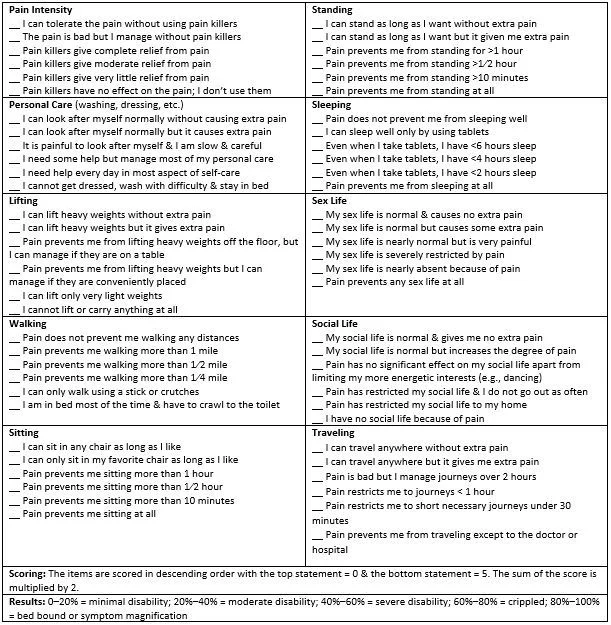
Traditionally, the score is divided into categories:
- 0 to 4 indicates no disability
- 5 to 14 indicates mild disability
- 15 to 24 indicates moderate disability
- 25 to 34 indicates severe disability
- Above 35 indicates complete disability
But in real clinical settings, we do not rely only on these labels.
What matters more is how the score changes over time.
A reduction of about 5 to 7 points is considered meaningful improvement in most patients. (Cleland et al. 2008)
Recent evidence suggests that this threshold may vary depending on the patient population and condition. (Saltychev et al. 2024)
Read more: Cervical Myelopathy: The Hidden Neck Condition Affecting Your Walking
What the NDI actually measures
Many people assume that NDI is just another pain scale.
It is not.
It reflects how neck pain interferes with:
- Daily activities
- Thinking and concentration
- Sleep quality
- Work performance
- Social and recreational life
This makes it a functional measure rather than a symptom score.
Read: What is Torticollis? How to treat neck tilt condition
Why two people with the same score can feel very different
This is something patients often find confusing.
Two individuals may both have an NDI score of 20, but their problems are not the same.
One may avoid movement due to fear.
Another may continue activity but struggle with fatigue and sleep.
The NDI score does not diagnose the problem. It highlights where limitations exist.
Read more: Cervical Vertigo Explained: Why Neck Pain Make You Feel Dizzy
Physiotherapy perspective: what drives a high NDI score
From a clinical standpoint, a high NDI score rarely points to a single issue.
It is usually the result of multiple small factors stacking together over time. Some are physical, some behavioural, and some are not obvious until you ask the right questions.
When I assess a patient with a higher score, I am not just looking at the neck. I am trying to understand patterns.
Read about : What is Cervical Facet Joint Pain, how it causes cervicogenic headaches and how to correct it naturally
Movement behaviour
One of the first things you notice is how a person moves.
Some patients turn their whole body instead of the neck. Others move slowly, almost as if they are protecting the area even when there is no sharp pain.
This is not always conscious.
It often develops gradually. A slight discomfort leads to reduced movement. Reduced movement leads to stiffness. Stiffness then reinforces the idea that movement is unsafe.
Over time, the body adapts to this pattern.
What started as pain becomes a habit.
And that habit is what keeps the disability score high, even when tissue healing has already happened.
Read more: Rheumatoid Arthritis Neck: Causes, Symptoms and Treatments
Muscle coordination
This is something patients rarely expect.
Most people think their neck is weak. In reality, it is often not weak, but poorly coordinated.
There is a difference.
The deep cervical muscles are meant to provide subtle stability. They do not produce large movements, but they control how the neck behaves during activity.
In many patients with neck pain, these muscles are not doing their job efficiently.
Instead, larger superficial muscles take over. These muscles are not designed for fine control, so they tend to overwork.
This leads to:
- Early fatigue
- Tightness
- A feeling of heaviness or pulling (Falla et al. 2004)
So what the patient feels as stiffness is often a coordination issue, not just tight muscles.
Read: Simple Posture Correction Exercises for Forward Head Posture
Postural load and daily habits
Posture is often blamed too quickly.
Sitting with a forward head posture for a few minutes is not the problem. The body can tolerate that.
The real issue is how long you stay there without change.
In many working professionals, especially those using laptops or phones for extended periods, the neck is under continuous low-level load for hours.
There is very little variation.
No breaks. No resets.
This leads to gradual fatigue rather than sudden injury.
Patients often say, “I did nothing, but my neck started hurting.”
In reality, they did the same thing for too long.
Read: 10 Proven Home Remedies for Neck Pain from Anxiety
Psychological factors
This is where things become less visible but more influential.
Stress and anxiety do not just affect the mind. They change how the body responds to discomfort.
Muscles tend to stay more tense.
Pain feels more intense.
Movement feels less safe.
Some patients begin to associate certain movements with harm, even when those movements are not dangerous.
This is known as fear avoidance behaviour.
Over time, they start doing less, not because they cannot, but because they feel they should not.
That reduction in activity directly reflects in the NDI score. (Lee et al. 2015)
Read About: Best Sleeping Position for Neck Pain: A Physiotherapist’s Complete Guide
Sleep quality
Sleep is one of the most underestimated factors in recovery.
When sleep is disturbed, the body does not get enough time to regulate inflammation and restore normal function.
Pain thresholds can drop.
Small discomforts feel more intense.
Energy levels remain low, which reduces willingness to move.
Patients often report that their pain feels worse in the morning or after a poor night of sleep.
This is not a coincidence.
It is a physiological response. (Finan et al. 2013)
Read About: How to Choose the Right and Best Pillow for Neck Pain
What ties all of this together
When you step back and look at these factors together, a pattern becomes clear.
A high NDI score is rarely about damage.
It is more often about how the body is functioning day to day.
- How you move
- How long you stay in one position
- How your muscles coordinate
- How you respond to stress
- How well you recover at night
Each of these may seem small on its own.
But together, they shape how much your neck problem affects your life.
And that is exactly what the NDI is trying to capture.
Read about: Cervical Ligament Injury or Neck Ligament Tear
What recent research tells us about NDI
Modern studies have reinforced the reliability and usefulness of NDI.
A large review confirmed that NDI has strong reliability and consistency across different patient groups. Saltychev et al. (2024)
It also shows strong correlation with pain and functional outcomes, but it is not identical to them.
This means pain and disability are related but not the same.
Also Read : Neck Cracking: Benefits, Risks, and the Truth About Stroke
Why NDI sometimes stays high even when pain improves
This is a common clinical observation.
Patients often report reduced pain but still have a high disability score.
This happens because NDI reflects behaviour and function, not just symptoms.
If a person continues to avoid movement or lacks confidence in activity, the score may not improve significantly.
Also Read: Ultimate 6 Weeks Neck Rehabilitation Exercises For Pain Relief
How physiotherapy helps improve NDI scores
The goal of physiotherapy is not just pain relief. It is restoration of function.
Phase 1: reducing sensitivity
- Gentle movement
- Breathing exercises
- Education about pain
The aim is to reduce fear and calm the system.
Phase 2: restoring control
- Deep neck flexor activation
- Scapular stability exercises
Focus is on improving coordination rather than strength alone.
Phase 3: functional reintegration
- Practice of daily activities
- Work-related movements
- Gradual exposure to previously avoided tasks
Phase 4: building tolerance
- Strength training
- Endurance exercises
- Dynamic movement training
Read about: Effective Neck Pain Exercises At Home: A Complete Guide to Relief and Improved Mobility
Important limitations of NDI
While NDI is useful, it is not a standalone diagnostic tool.
It does not identify:
- Nerve compression
- Structural instability
- Serious underlying conditions
Clinical examination is always necessary.
Read about: Yoga for Neck Pain: Poses That Actually Work
A practical takeaway from clinical experience
If I had to explain NDI simply to a patient, I would say:
It tells us how your neck is affecting your life, not just how it feels.
That distinction helps guide meaningful recovery.
Read : Chiropractic for Neck Pain: Does It Really Work?
Frequently Asked Question
Q1. What does the Neck Disability Index actually measure?
It measures how neck pain affects your ability to perform everyday activities like working, sleeping, reading, and moving comfortably.
Q2. What is considered a good NDI score?
A score below 10 percent is generally considered minimal or no disability.
Q3. How much improvement in NDI is meaningful?
A reduction of around 5 to 7 points is usually considered clinically important improvement.
Q4. Can I have a high NDI score even with mild pain?
Yes, because NDI reflects functional limitation and behaviour, not just pain intensity.
Q5. Does posture alone increase NDI score?
Not exactly. It is prolonged static posture and lack of movement variation that contributes more.
Q6. Can physiotherapy reduce NDI score?
Yes, physiotherapy helps improve movement patterns, reduce pain, and restore daily function.
Q7. How often should NDI be reassessed?
It is typically reassessed every 2 to 4 weeks during treatment.
Q8. Does poor sleep affect NDI score?
Yes, poor sleep can increase pain sensitivity and slow recovery, which may raise disability scores.
Stay tuned with us for more health related topics.
Follow us on LinkedIn and Instagram for more.
More Read


Medical Disclaimer!
This article has been reviewed and written under the guidance of our Head Physiotherapist, Dr. Kruti Raj (PT, MUHS,CPT,CMPT). The information shared is intended for educational purposes only and should not be considered a substitute for personalized medical advice, diagnosis, or treatment.
Please consult us or any other qualified healthcare professional before beginning any exercise program, especially if you are experiencing pain, recovering from injury, or managing a medical condition.


