


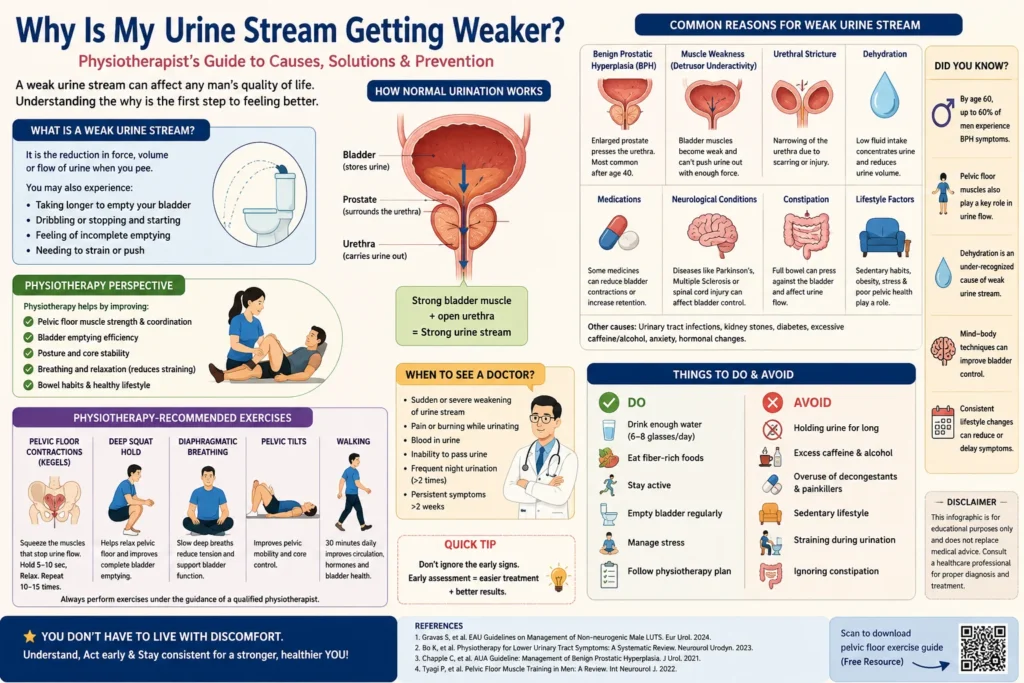
Weak urine stream in men can be an early sign of a urinary or prostate problem, but it may also be linked to bladder function, medications, neurological conditions or pelvic-floor dysfunction.
You may notice it almost casually at first.
You stand at the toilet, start urinating, and realize the stream does not have the force it used to.
It takes longer to finish.
Perhaps you have to wait a few seconds before anything starts.
Maybe the stream stops and starts, you dribble afterward, or you feel that your bladder has not completely emptied.
Quick Answer
A weakening urine stream can happen because of an enlarged prostate, urethral narrowing, bladder weakness, certain medicines, infection, diabetes, neurological problems or pelvic floor dysfunction.
In men over 50, prostate-related lower urinary tract symptoms are common, but a weak stream should not automatically be blamed on the prostate.
Important: If you suddenly cannot urinate, have blood in your urine, fever/chills, severe lower abdominal pain, or significant difficulty emptying your bladder, seek medical attention promptly.
A weaker urine stream is easy to dismiss as “just getting older.”
Sometimes age is part of the explanation, but it is not the whole story.
A weak stream can occur when urine encounters resistance on its way out, when the bladder muscle is not generating enough pressure, or when the muscles that should relax during urination are actually staying tense.
Prostate enlargement, urethral narrowing, urinary infections, certain medicines, neurological conditions, diabetes and pelvic floor dysfunction can all contribute.
This is why I would not recommend treating every weak stream as a prostate problem.
Current urological guidance emphasizes that male lower urinary tract symptoms can originate from the bladder, prostate, urethra or other parts of the urinary system.
From a physiotherapy perspective, there is another important point: urination is a coordination task, not simply a matter of having a “strong” pelvic floor.
That distinction becomes particularly important later in this article.
Key Takeaways
- A weak urine stream is a symptom, not a diagnosis.
- An enlarged prostate is common, but urethral narrowing, bladder dysfunction and pelvic floor problems can also cause weak flow.
- Pelvic floor muscles must relax during urination. More Kegels are not automatically better.
- Constipation, certain cold/allergy medicines and some other medications can worsen urinary difficulty.
- Regular physical activity and sensible fluid, caffeine and bowel habits may support urinary health.
- Persistent or worsening symptoms deserve proper medical evaluation.
- Sudden inability to urinate is an urgent medical problem.
What exactly counts as a weak urine stream?
A weak stream is more than simply producing less urine.
If you drink less water, sweat heavily, or become mildly dehydrated, your urine volume may decrease.
That does not necessarily mean the urinary stream itself has become weaker.
A genuine change in urinary flow may look like:
- Taking longer to begin urinating
- A thin or weak stream
- A stream that starts and stops
- Needing to strain or push
- Taking unusually long to empty the bladder
- Dribbling after finishing
- Feeling that urine remains inside
- Needing to urinate again soon after
- Reduced force compared with your previous normal
These symptoms are commonly grouped under lower urinary tract symptoms, or LUTS.
A recent JAMA review notes that weak stream, urgency and nocturia are common LUTS in men, particularly with increasing age, and that persistent symptoms can sometimes be associated with urinary retention and other complications. (JAMA review)
One lesser-known point is that the strength of your stream cannot tell you exactly how large your prostate is.
A man with a considerably enlarged prostate may have relatively mild urinary symptoms, while another man with less enlargement may experience significant obstruction.
NIDDK specifically notes that prostate size does not necessarily correspond directly with the severity of urinary symptoms.
So, please do not try to estimate your prostate size by watching the toilet stream.
The most common reason: an enlarged prostate
For many middle-aged and older men, benign prostatic hyperplasia, commonly called BPH, is an important possibility.
The prostate sits below the bladder and surrounds part of the urethra.
As prostate tissue enlarges, it can increase resistance around the urinary passage.
That can produce:
- Weak stream
- Difficulty starting
- Hesitancy
- Interrupted flow
- Dribbling
- Incomplete emptying
- Increased frequency
- Urgency
- Night-time urination
BPH is not prostate cancer. It is a benign enlargement of prostate tissue.
However, the symptoms overlap with several other conditions, which is why assuming “it must be BPH” can delay the correct diagnosis.
NIDDK lists BPH, prostatitis, bladder problems, urinary infections and prostate cancer among possible explanations for urinary symptoms. (NIDDK)
A useful fact many men don’t know
The prostate does not have to be enormous to cause trouble.
The location and configuration of the enlarged tissue matter.
A smaller amount of tissue positioned around the bladder outlet can interfere with urination more than its overall size might suggest.
That is one reason a physical examination and appropriate testing are more useful than trying to diagnose yourself based on symptoms alone.
Could the bladder itself be the problem?
Yes.
Urination requires the bladder muscle, urinary sphincters, pelvic floor and nervous system to coordinate properly.
Think of it as a controlled sequence:
The bladder contracts → the outlet relaxes → urine flows.
If the bladder cannot contract effectively, the stream may become weak even when the urethra is not significantly blocked.
Urinary retention can result either from an obstruction or from inadequate bladder force.
NIDDK identifies weak bladder muscles, overdistension, aging, neurological problems and other conditions among potential contributors. (NIH)
This becomes especially relevant in people with diabetes or certain neurological disorders.
Diabetes can affect urination in a surprisingly indirect way
Most people associate diabetes with frequent urination.
But long-standing high blood glucose can also damage the nerves that control bladder sensation and function.
Some people eventually have difficulty recognizing when their bladder is full or emptying it effectively.
NIDDK explains that diabetic nerve damage can interfere with bladder emptying and, over time, contribute to urinary retention. (NIDDK: Diabetes)
Therefore, a man with diabetes who develops a progressively weaker stream should not automatically assume that the prostate is responsible.
Your urethra can also become narrower
Another possibility that deserves more attention is a urethral stricture.
A urethral stricture is a narrowing caused by scar tissue in the urethra.
Previous trauma, instrumentation, surgery, infection or inflammation can contribute.
It can produce a particularly characteristic pattern:
- Thin stream
- Prolonged urination
- Spraying or altered stream
- Difficulty starting
- Straining
- Incomplete emptying
- Recurrent urinary infections
The European Association of Urology notes that uroflowmetry may show a prolonged plateau in urethral stricture, although uroflowmetry alone is not sufficiently reliable to diagnose a stricture. (EAU Guidelines)
This is an important reason not to keep trying stronger and stronger exercises at home when the stream is progressively narrowing.
If the urethra is physically narrowed, exercises cannot “open” the scar tissue.
Here is the angle many men miss: your pelvic floor may be too tight
This is one of the most overlooked possibilities.
When people hear “pelvic floor,” they often think only about weakness.
But muscles can also be overactive, poorly coordinated or unable to relax at the right time.
During urination, the pelvic floor and urinary sphincter need to release appropriately.
If a person habitually holds tension in the pelvic region, repeatedly strains to urinate, has chronic pelvic pain, or has developed dysfunctional voiding habits, the outlet may not relax efficiently.
A 2025 review on non-relaxing pelvic floor dysfunction describes it as an underrecognized cause of functional bladder outlet obstruction and lower urinary tract symptoms.
The review highlights pelvic floor physiotherapy as an important treatment approach after appropriate assessment. SpringerLink
This is where I want to challenge one common piece of advice.
Don’t automatically start doing hundreds of Kegels
If your pelvic floor is genuinely weak, strengthening may be useful.
But if your pelvic floor is already overactive, constantly squeezing it harder may make relaxation more difficult.
The goal during urination is not maximum pelvic floor strength.
It is appropriate contraction when needed and complete relaxation when needed.
Research into male pelvic floor rehabilitation has also shown considerable variation in exercise programs, with differences in muscles targeted, intensity, assessment and instructions. (Wiley)
That is why individualized assessment matters.
What does a physiotherapist actually look for?
When I assess a man with urinary complaints, I am not simply asking, “Are your pelvic floor muscles weak?”
I want to understand the entire movement and pressure system around the pelvis.
Depending on the presentation, assessment may include:
- Breathing pattern
- Abdominal bracing habits
- Pelvic floor resting tension
- Ability to contract and relax the pelvic floor
- Hip mobility
- Pelvic and lower abdominal muscle tension
- Posture and movement habits
- Bowel habits
- Straining during bowel movements
- Pain around the pelvis
- Previous pelvic surgery
- Urinary habits
- Exercise patterns
- Sexual symptoms
A non-relaxing pelvic floor can coexist with urinary, bowel and sexual symptoms, which is why looking at the symptoms as a whole is more useful than treating one muscle in isolation. (Elsevier)
Why straining to urinate is a bad habit
If your stream is weak, your natural reaction may be to push harder.
Try not to make that your routine.
Repeated straining can increase abdominal pressure and alter pelvic floor coordination.
It can also turn urination into a “pushing” activity rather than allowing the bladder and outlet to perform their normal sequence.
Instead, sit or stand comfortably, relax your abdomen, breathe normally and give your bladder time to work.
If you consistently need to strain to initiate or maintain urine flow, that is information worth telling your doctor.
Constipation can quietly worsen urinary symptoms
This is another connection that often gets missed.
The bladder and bowel occupy the same confined pelvic region and share neural and muscular relationships.
A chronically full rectum can influence pelvic floor activity and bladder symptoms.
NIDDK includes constipation among factors that can contribute to urinary problems and recommends adequate fiber, fluids and regular physical activity as part of preventing urinary retention related to constipation. (NIDDK)
So if a man tells me:
“I have a weak urine stream, pelvic tightness and I am constipated most days,”
I would not look at his urinary symptoms in isolation.
Improving bowel habits may be one piece of the bigger picture.
Could your medicines be weakening your urine flow?
Absolutely.
This is one of the most practical things to check.
Some medications can interfere with bladder emptying or increase outlet resistance.
NIDDK lists several categories associated with urinary retention, including antihistamines, decongestants, anticholinergic medications, some antidepressants, opioids and others. (NIDDK: Causes)
Cold and allergy medicines deserve special attention.
For example, decongestants containing agents such as pseudoephedrine or phenylephrine can aggravate urinary retention in susceptible men, particularly those with prostate enlargement.
This does not mean you should stop prescribed medication yourself.
Instead, check the ingredients and ask your doctor or pharmacist whether a recently started medicine could be contributing.
Caffeine may not weaken the stream, but it can make the whole problem feel worse
Caffeine is a slightly different story.
It does not necessarily cause mechanical obstruction, but it can influence bladder sensation, urgency and frequency.
A controlled study found that caffeine can promote earlier bladder sensation and urinary frequency in people with lower urinary tract symptoms. (PMC)
A small double-blind crossover study also found reductions in urgency and frequency with decaffeinated compared with caffeinated drinks, although its sample was small. (Wolters Kluwer)
So if you have a weak stream plus frequent urgency and multiple bathroom trips, try reducing caffeine rather than simply cutting your overall fluid intake.
Should you drink less water?
This is a common mistake.
Some men with urinary symptoms deliberately become dehydrated because they are tired of frequent bathroom trips.
That can backfire.
Your body still needs adequate fluid. Concentrated urine may irritate the urinary tract in some people, and dehydration can also contribute to constipation.
The better strategy is usually to distribute fluids sensibly throughout the day and avoid large amounts immediately before bedtime if nocturia is a problem.
Do not severely restrict fluids unless your healthcare professional has specifically advised you to do so.
What tests are useful for a weak urine stream?
Your evaluation should be guided by your symptoms rather than by ordering every possible test.
A clinician may consider:
Urine testing
A urine test can look for evidence of infection, blood and other abnormalities.
Prostate assessment
Depending on age, symptoms and risk factors, your clinician may assess the prostate and discuss PSA testing where appropriate.
Post-void residual measurement
This is one of the most useful and relatively simple tests.
You urinate, and then an ultrasound or bladder scanner estimates how much urine remains.
A high residual does not automatically prove prostate obstruction because poor bladder muscle function can also cause incomplete emptying.
The EAU specifically cautions that post-void residual can result from obstruction and/or impaired detrusor function. (EAU)
Uroflowmetry
This measures urine flow over time.
Instead of simply asking, “Is your stream weak?”, the clinician can obtain an objective flow curve and maximum flow rate.
It is particularly useful when interpreted together with your symptoms and residual urine measurement.
Further urological investigations
If a urethral narrowing, neurological problem, complicated obstruction or another condition is suspected, additional testing may be appropriate.
The EAU guidelines recommend urodynamics selectively rather than routinely for every man with urinary symptoms.
What can actually help improve urinary symptoms?
Treatment depends entirely on the cause.
For BPH, medical treatment may include medications such as alpha-blockers or 5-alpha-reductase inhibitors, depending on the individual’s prostate, symptoms and risk profile.
The updated 2026 American Urological Association guideline emphasizes individualized, shared decision-making for LUTS/BPH treatment, including consideration of benefits, adverse effects and durability. (PubMed)
For significant obstruction that does not respond adequately to conservative or medical treatment, procedural or surgical options may be considered.
For urethral stricture, treatment is directed at the scar-related narrowing.
For infection or prostatitis, treatment is based on the clinical diagnosis.
For neurological bladder dysfunction, the underlying neurological and bladder mechanisms need to be evaluated.
And for pelvic floor dysfunction, physiotherapy can become particularly valuable.
Where physiotherapy can genuinely help
Physiotherapy is not a replacement for urological assessment when a weak stream could represent obstruction.
But once serious structural causes have been considered, a pelvic health physiotherapist can address problems such as:
- Pelvic floor overactivity
- Poor pelvic floor relaxation
- Dysfunctional voiding patterns
- Abdominal bracing
- Breathing-related pelvic tension
- Constipation-related pelvic floor dysfunction
- Pelvic pain
- Post-prostate-treatment continence problems
- General pelvic and hip movement restrictions
A small study of men with chronic pelvic pain syndrome found that pelvic floor biofeedback and re-education were associated with improvements in symptoms and pelvic floor muscle tone. (NCBI)
Another prospective study used a comprehensive pelvic floor programme involving manual therapy, therapeutic exercise, biofeedback and relaxation strategies in men with chronic pelvic pain syndrome. (TAU)
The important point is that this is not simply a Kegel exercise programme.
The treatment may involve learning how to relax as much as learning how to contract.
Exercise may help your overall urinary health
Regular physical activity is worth including in the bigger picture.
An observational meta-analysis involving more than 43,000 men found that moderate and vigorous physical activity were associated with lower odds of BPH/LUTS compared with sedentary behavior. (NCBI)
However, I would not promise a man that walking or exercising will “cure” an obstructed prostate.
The evidence for physical activity as a direct treatment for established LUTS has been less certain.
A Cochrane review found low- or very-low-quality evidence for several exercise-based interventions, meaning exercise should be viewed as part of healthy self-management rather than a substitute for medical treatment. (Cochrane Review)
That distinction keeps the advice realistic.
A surprisingly useful strategy: self-management
Lifestyle changes are sometimes dismissed as too simple to matter.
But research suggests they can have meaningful effects for some men.
A systematic review and meta-analysis of self-management interventions found clinically important improvements in LUTS severity compared with usual care, although the included interventions varied and some studies had methodological limitations. (Ann Fam Med)
Practical strategies may include:
- Managing caffeine intake
- Avoiding excessive evening fluids
- Maintaining regular physical activity
- Treating constipation
- Avoiding unnecessary bladder irritants
- Reviewing medications with a professional
- Maintaining a healthy body weight
- Not repeatedly postponing urination for very long periods
- Avoiding habitual straining to urinate
The newest evidence also continues to support self-management as a useful component of LUTS care rather than an afterthought. (PMC)
What you should avoid doing
If your urine stream is progressively weakening, avoid these common mistakes:
Don’t assume it is “normal aging”
Age increases the likelihood of urinary problems, but a new or worsening symptom still deserves attention.
Don’t diagnose yourself with BPH
Several different conditions produce similar urinary symptoms.
Don’t perform hundreds of Kegels without assessment
A tight pelvic floor needs relaxation and coordination, not necessarily more strengthening.
Don’t repeatedly strain to urinate
Give the bladder and outlet an opportunity to coordinate naturally.
Don’t drastically restrict water
Manage fluid timing rather than deliberately dehydrating yourself.
Don’t ignore constipation
Bowel and bladder function are more connected than many people realize.
Don’t overlook medicines
Especially if symptoms appeared after starting a cold medicine, allergy medication, antidepressant or another new drug.
Don’t wait if symptoms are progressing
A slowly worsening stream is worth discussing before it becomes acute retention.
When is a weak urine stream an emergency?
There is an important difference between a weak stream and being unable to urinate.
Seek urgent medical attention if you suddenly cannot pass urine despite a strong urge to urinate.
Acute urinary retention can require immediate bladder drainage.
NIDDK also recommends prompt medical evaluation for symptoms such as blood in the urine, fever or chills with urinary symptoms, significant lower abdominal discomfort, severe urinary difficulty or incomplete emptying. (NIDDK: Prostate Problems)
Do not try to force urine out by repeatedly straining.
A simple way to think about your symptoms
If your stream is weaker, ask yourself four questions:
1. Is the change new?
A new change deserves more attention than a lifelong pattern.
2. Is the stream weak because there is less urine, or is the flow itself weaker?
These are not the same problem.
3. Do you have other symptoms?
Frequency, urgency, nocturia, pain, blood, pelvic discomfort, dribbling and incomplete emptying provide valuable clues.
4. Can you relax while urinating?
If you are holding your breath, tightening your abdomen, clenching your buttocks and pushing hard, pelvic floor coordination may deserve assessment.
These questions do not diagnose the cause, but they can make your medical consultation much more productive.
What You Can Do Today
Sit or stand comfortably, breathe normally and allow your bladder time to empty.
Ask your doctor or pharmacist whether a new cold, allergy or other medicine could be affecting urination.
A pelvic floor that is too tight may need relaxation and coordination rather than more strengthening.
Regular bowel movements, adequate fiber, appropriate fluids and physical activity can support healthy bladder function.
A clinician may consider urine testing, prostate assessment, uroflowmetry and post-void residual measurement depending on your symptoms.
One final point I want men to remember
A weak urine stream is not embarrassing, and it is not something you have to silently tolerate.
The urinary system is influenced by the prostate, bladder, urethra, nervous system, medications, bowel function and pelvic floor.
Treating only one part without understanding the whole picture can lead to frustration.
As a physiotherapist, I particularly want men to understand that pelvic floor health is about coordination, not simply strength.
If your pelvic floor is weak, strengthening may help.
If it is overactive, relaxation may be more important.
If your urethra is narrowed, you need urological treatment.
If your prostate is obstructing the outlet, medical or procedural treatment may be appropriate.
If your bladder is underactive because of neurological or metabolic problems, the treatment strategy is different again.
The goal is therefore not to “force a stronger stream.”
The goal is to find out why the stream became weaker in the first place.
That is the safest route to effective treatment.
Frequently Asked Questions
Why is my urine stream getting weaker?
A weak urine stream can be caused by an enlarged prostate, urethral narrowing, bladder dysfunction, medications, infection, neurological conditions, diabetes or pelvic floor dysfunction.
Is a weak urine stream always caused by an enlarged prostate?
No. Prostate enlargement is common in older men, but weak flow can also occur because of urethral stricture, bladder muscle weakness, neurological problems, medication effects or pelvic floor dysfunction.
Can pelvic floor dysfunction cause a weak urine stream?
Yes. An overactive or poorly relaxing pelvic floor can interfere with normal bladder outlet relaxation and contribute to dysfunctional urination in some people.
Should I do Kegel exercises for a weak urine stream?
Not automatically. Kegel exercises strengthen the pelvic floor, but some men with urinary difficulty have excessive pelvic floor tension and may benefit more from relaxation and coordination training.
Can constipation affect urination?
Yes. Constipation and pelvic floor dysfunction can interact with bladder function, and improving bowel habits may help some urinary symptoms.
When should I see a doctor for a weak urine stream?
See a healthcare professional if your stream is persistently weak, progressively worsening, associated with incomplete emptying, blood in the urine, pain, fever, recurrent urinary infections or significant urinary difficulty.
Is suddenly being unable to urinate an emergency?
Yes. Sudden inability to urinate despite a strong urge can represent acute urinary retention and requires urgent medical attention.
Can exercise improve urinary symptoms in men?
Regular physical activity may support overall urinary health and has been associated with lower odds of BPH and lower urinary tract symptoms, although exercise should not be considered a replacement for appropriate medical treatment when obstruction is present.
Stay tuned with us for more health related topics.
Follow us on LinkedIn and Instagram for more.
More Read


Medical Disclaimer!
This article has been reviewed and written under the guidance of our Head Physiotherapist, Dr. Kruti Raj (PT, MUHS,CPT,CMPT). The information shared is intended for educational purposes only and should not be considered a substitute for personalized medical advice, diagnosis, or treatment.
Please consult us or any other qualified healthcare professional before beginning any exercise program, especially if you are experiencing pain, recovering from injury, or managing a medical condition.


