


If you’re considering shoulder fracture treatment without surgery, what you do right now can decide how well your shoulder heals.
When someone walks into my clinic with a shoulder fracture, they rarely talk about the bone.
They talk about:
- Not being able to sleep
- Struggling to wear clothes
- Fear of moving the arm
- Sudden loss of independence
This is where a shoulder fracture becomes more than an injury.
It becomes a disruption to daily life.
Quick Answer
A shoulder fracture is a break in one of the shoulder bones, most commonly the upper arm bone near the joint. Most cases heal without surgery, but recovery depends heavily on early, guided movement and physiotherapy. Stiffness can begin within a few weeks, so controlled exercises and gradual use of the arm are essential for full recovery.
Key Takeaways
- Most shoulder fractures heal without surgery if managed properly
- Early controlled movement is critical to prevent stiffness
- Physiotherapy plays a bigger role than the fracture itself
- Recovery takes time, consistency, and patience
- Avoid both over-resting and over-exercising
- Using your arm gradually in daily life speeds up recovery
What exactly is a shoulder fracture
The shoulder is not a single joint.
It is a combination of structures working together.
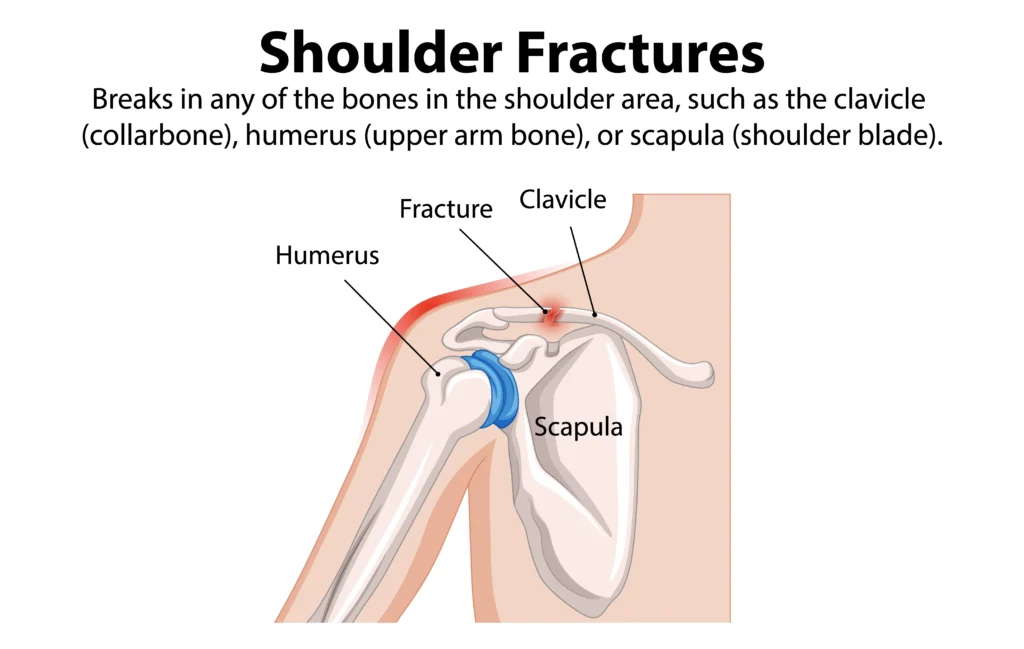
The three main bones involved are:
- Humerus
- Scapula
- Clavicle
Most fractures happen in the upper part of the humerus, called a proximal humerus fracture.
Studies show that around 80 to 90 percent of these fractures can be treated without surgery
(Handoll et al. 2015)
Why this injury behaves differently from other fractures
A broken leg limits walking.
A broken shoulder affects almost everything:
- Eating
- Grooming
- Driving
- Sleeping
What makes it more complex is that the shoulder is highly mobile.
If movement is not restored early, stiffness becomes a bigger problem than the fracture itself.
Research highlights that stiffness can begin within 2 to 4 weeks if movement is delayed (Frontiers in Medicine 2025)
Common causes
This is not always a high-impact injury.
Typical causes include:
- Simple falls at home
- Slipping in the bathroom
- Road accidents
- Weak bones due to osteoporosis
Interestingly, many elderly patients fall not due to weakness but due to poor balance and coordination.
This is something physiotherapy directly improves.
What to Do in the First 48 Hours
The first two days matter more than people think.
Keep it simple:
- Rest the arm in a sling
- Use ice for 10 to 15 minutes
- Avoid unnecessary movement
- Keep the arm slightly elevated
Do not try to test your movement at this stage.
Types of Shoulder Fractures Simplified
Proximal humerus fracture
This is the most common type I see in practice.
It involves the upper part of the arm bone, right near the shoulder joint.
It is especially common in older adults, often after a simple fall at home.
What many people do not realize is that bone quality plays a big role here.
With age-related bone thinning, even a low-impact fall can lead to a fracture.
Clinically, these fractures are often classified based on how many parts of the bone are displaced.
That matters because:
- Simple fractures usually heal without surgery
- More complex ones may need surgical fixation
From a rehab perspective, this type is tricky because stiffness develops quickly.
Early guided movement becomes essential.
Clavicle fracture
This is a break in the collarbone, the long bone that connects your shoulder to your chest.
It is more common in younger individuals and often happens during:
- Sports injuries
- Bike or bike-like falls
- Road accidents
Patients usually notice a visible bump or deformity over the collarbone.
Lifting the arm becomes painful almost immediately.
The good part is that most clavicle fractures heal well with conservative treatment using a sling.
But here is something often missed:
Even after the bone heals, shoulder strength and posture may not return automatically.
Without rehab, people can end up with:
- Shoulder drooping
- Weakness during overhead activities
Scapular fracture
This one is rare and usually seen in high-impact trauma.
Examples include:
- Car accidents
- Major falls
- Direct blows to the back
The scapula is a strong, well-protected bone, so it takes significant force to break it.
Because of that, these fractures are often associated with other injuries like rib fractures or lung issues.
From a physiotherapy point of view, recovery focuses not just on healing but also on restoring coordination between the shoulder blade and arm.
This coordination is what allows smooth, pain-free movement.
If not addressed, patients often complain of persistent discomfort even after the bone heals.
Symptoms that patients actually notice
Instead of textbook definitions, here is what people describe:
- Deep aching or sharp pain
- Inability to lift the arm
- Bruising and swelling
- Pain during sleep
- Feeling that the shoulder is not stable
How to sleep with a shoulder fracture
Sleep is usually the first thing that gets disturbed.
Most patients tell me nights are worse than the day.
Here is what actually helps:
- Sleep on your back if possible
- If side sleeping, lie on the uninjured side
- Hug a pillow to support the injured arm
- Place a small pillow under the elbow for comfort
If pain wakes you up often, it is normal in the early phase. It improves gradually.
Calculate your ideal sleep time here: “Sleep Calculator“
Diagnosis and what it really tells us
Doctors usually confirm the fracture using:
- X-ray
- CT scan if needed
But here is something important:
The X-ray shows the bone.
It does not predict how well you will move later
Recovery depends more on rehabilitation than imaging.
Red flags you should not ignore
Most fractures heal well, but watch for these:
- Severe increase in shoulder pain suddenly
- Numbness or tingling in the arm
- Fingers turning pale or cold
- Swelling that keeps increasing
If you notice these, do not wait. Get it checked.
Healing timeline in real life
Patients often expect a straight-line recovery.
That is not how it works.
First 2 weeks
Pain is dominant. Movement is minimal.
2 to 6 weeks
Critical phase where stiffness can develop.
Early movement during this period improves outcomes significantly (Lefevre-Colau et al. 2007)
6 to 12 weeks
Strength begins returning. Movement improves.
3 to 6 months
Functional recovery. Most daily tasks become easier.
Up to 1 year
Full confidence and strength may take this long.
Long-term recovery: what to expect
Even after healing, some things take time:
- Strength may still feel less
- Overhead movement may feel tight
- Endurance takes longer to build
This is normal. Continue exercises even after pain is gone.
Daily activities: what you can and cannot do
This is what people really want to know.
You can usually do:
- Walking
- Light typing
- Eating with support
Avoid in early weeks:
- Lifting weight
- Reaching overhead
- Sudden movements
Start using the arm slowly in daily life. That itself becomes part of rehab.
The biggest myth that delays recovery
Many patients are told to rest completely.
That advice is outdated.
Recent evidence suggests that early controlled movement leads to better recovery compared to prolonged immobilization (Cureus 2024)
This does not mean aggressive exercise. It means safe, guided motion.
Physiotherapy: Shoulder fracture treatment without surgery
This is the part most people underestimate.
Phase 1: Protection and pain control
- Sling support
- Gentle hand and elbow movement
- Ice therapy
Goal is simple. Prevent stiffness without stressing the fracture.
Phase 2: Early movement
- Pendulum exercises
- Assisted lifting
- Shoulder blade activation
Ignoring the scapula is one of the biggest reasons patients develop long-term issues.
A Simple Daily Routine for Recovery
You do not need a complicated plan.
Try this:
- 5 minutes gentle movement
- 5 minutes posture correction
- 5 minutes light exercises
Do this once or twice daily.
Consistency matters more than intensity.
Simple home exercises you can start
These are usually safe when your physio clears you.
- Pendulum swings
- Finger walking on the wall
- Assisted arm lifting with the other hand
Keep movements slow and controlled. No forcing.
Phase 3: Strength building
- Resistance bands
- Rotator cuff exercises
- Postural correction
At this stage, patients feel better and often overdo things. That can delay recovery.
Phase 4: Functional recovery
- Overhead movements
- Daily activity training
- Return to work or sports
When can you return to work or gym
This depends on your recovery stage.
- Desk work can start early with support
- Light activity around 6 to 8 weeks
- Gym or heavy work after 10 to 12 weeks
Do not rush. Returning too early often sets you back.
A lesser-known but important research insight
A recent study found that structured home exercise programs can be as effective as supervised therapy in certain cases (ScienceDirect 2024)
This tells us something important:
Consistency matters more than location
Common mistakes that slow down healing
These are patterns seen repeatedly:
- Keeping the arm immobilized for too long
- Avoiding movement due to fear
- Starting heavy exercises too early
- Ignoring posture
- Waiting for pain to completely disappear
The last one is especially harmful.
Movement should begin before pain is completely gone.
What most people get wrong about recovery
These are things I hear often:
“I will start moving once pain is completely gone”
“I should not move at all for a few weeks”
“I feel better, so I can lift weight now”
All three can delay recovery.
Healing and movement need to go together.
When is surgery required
Most fractures do not need surgery.
It is usually recommended when:
- Bones are significantly displaced
- Joint alignment is affected
- Fracture is complex
Even after surgery, physiotherapy determines the final outcome.
The stiffness problem most people underestimate
Stiffness is not a side effect. It is a major complication.
Research shows that a significant percentage of patients develop restricted movement if rehab is delayed (MDPI 2024)
That is why early movement is essential.
Nutrition and healing
Bone healing is influenced by what you eat.
Focus on:
- Calcium
- Vitamin D
- Protein
Poor nutrition can delay recovery even if exercises are done correctly.
How to prevent future shoulder fractures
This is especially important for older adults.
- Work on balance
- Strengthen your legs and core
- Improve home safety
- Get bone health checked
Prevention is often simpler than recovery.
The psychological side of recovery
This part is rarely discussed.
Patients often feel:
- Fear of movement
- Frustration
- Loss of independence
Reassurance and gradual exposure to movement are part of physiotherapy.
What I tell my patients in simple words
- Move a little every day
- Do not wait for zero pain
- Do not rush strengthening
- Use your arm in daily activities gradually
Quick Self-Check for Your Recovery
Ask yourself:
- Can I move my arm a little more each week
- Is pain slowly reducing
- Am I able to do small daily tasks better
If yes, you are on the right track.
If not, your rehab may need adjustment.
Conclusion
Thinking shoulder fracture treatment without surgery is enough?
The wrong approach could slow your healing more than you realize.
If there is one thing I want you to take from this, it is this:
A fracture will heal with time.
But your shoulder will only recover if you move it the right way.
Most people focus too much on the X-ray and not enough on how their shoulder is actually functioning.
In real life, what matters is not just whether the bone has healed, but whether you can reach, lift, sleep comfortably, and trust your arm again.
Shoulder fracture treatment without surgery is not about doing more.
It is about doing the right things at the right time.
You will have days where it feels stiff.
Some days it may even feel like progress has stopped.
That is completely normal. Healing is not a straight line.
Stay consistent with your exercises.
Do not wait for pain to disappear completely before moving.
And do not rush back into heavy activity just because you feel slightly better.
Over time, small improvements add up.
And one day, you will realize you are using your arm without thinking about it.
That is when you know your shoulder has truly recovered.
Shoulder fracture treatment without surgery works, but only if done right, or you risk a longer and weaker recovery.
Frequently Asked Questions
Can a shoulder fracture heal without surgery?
Yes, most shoulder fractures heal without surgery if the bones are stable and proper physiotherapy is followed.
When should I start physiotherapy?
Physiotherapy usually begins within 1 to 3 weeks depending on your doctor’s advice and pain level.
How long does recovery take?
Most people recover in 3 to 6 months, but full strength may take up to a year.
Is it normal to have pain during movement?
Mild discomfort is normal during recovery, but sharp pain should be avoided.
Can I use my arm during recovery?
Yes, gradual use in daily activities is encouraged as part of rehabilitation.
What is the biggest mistake people make?
Either resting too much or starting heavy activity too early can delay recovery.
Stay tuned with us for more health related topics.
Follow us on LinkedIn and Instagram for more.
More Read


Medical Disclaimer!
This article has been reviewed and written under the guidance of our Head Physiotherapist, Dr. Kruti Raj (PT, MUHS,CPT,CMPT). The information shared is intended for educational purposes only and should not be considered a substitute for personalized medical advice, diagnosis, or treatment.
Please consult us or any other qualified healthcare professional before beginning any exercise program, especially if you are experiencing pain, recovering from injury, or managing a medical condition.


