Can poor posture make your belly look bigger?
Yes, your posture can change how your body is positioned and make your abdomen appear more prominent.
Have you ever stood in front of a mirror, straightened your back, and suddenly felt that your stomach looked smaller?
Many people notice this and wonder whether poor posture is making their belly look bigger than it actually is.
Quick Answer
Yes, poor posture can make your belly look bigger by changing the alignment of your spine, pelvis, and core muscles. However, poor posture does not create belly fat. Improving posture may help the abdomen appear flatter by allowing the body to assume a more balanced position.
As a physiotherapist, I hear this question regularly.
Some people are worried that they have gained weight, while others feel frustrated because they exercise but still notice that their stomach sticks out.
The good news is that posture and body fat are not the same thing.
Poor posture does not create belly fat, but it can change the way your body is positioned and how your abdomen appears.
Understanding this difference can help you focus on healthy movement patterns rather than becoming discouraged by what you see in the mirror.
Key Takeaways
- Poor posture can change the appearance of your abdomen.
- Posture does not create or remove belly fat.
- The spine, pelvis, rib cage, and core muscles work together.
- Anterior pelvic tilt may influence body appearance but is not the only cause of a protruding stomach.
- Weak core muscles and poor breathing habits can affect posture.
- Pregnancy naturally changes posture and body alignment.
- Regular movement is often more important than finding one perfect posture.
- Small daily habits can improve posture and overall body function.
Can Poor Posture Really Make Your Belly Look Bigger?
The simple answer is yes.
Poor posture can make the abdomen appear more prominent, even though it does not increase the amount of fat around your stomach.
When the body loses its natural alignment, the abdomen may project forward, making the belly look larger than it actually is.
The Better Health Channel identifies a “potbelly” as one of the possible physical manifestations associated with poor posture. (Better Health Channel)
As a physiotherapist,
I often explain that posture affects how the body presents itself, while body fat is influenced by nutrition, physical activity, hormones, genetics, and overall health.
Belly Fat and Belly Appearance Are Different Things
This is one of the biggest misconceptions I see.
A person may have:
- Excess body fat
- Abdominal bloating
- Weak core muscles
- Poor posture
- A combination of these factors
All of these can affect how the abdomen looks.
For example, someone with relatively little body fat may still notice that their stomach protrudes because of the way they stand or sit.
Likewise, someone with excellent posture may still carry abdominal fat.
Recognizing the difference helps set realistic expectations.
Improving posture may change appearance, but it is not a replacement for a healthy lifestyle.
How Does Posture Change the Way Your Belly Looks?
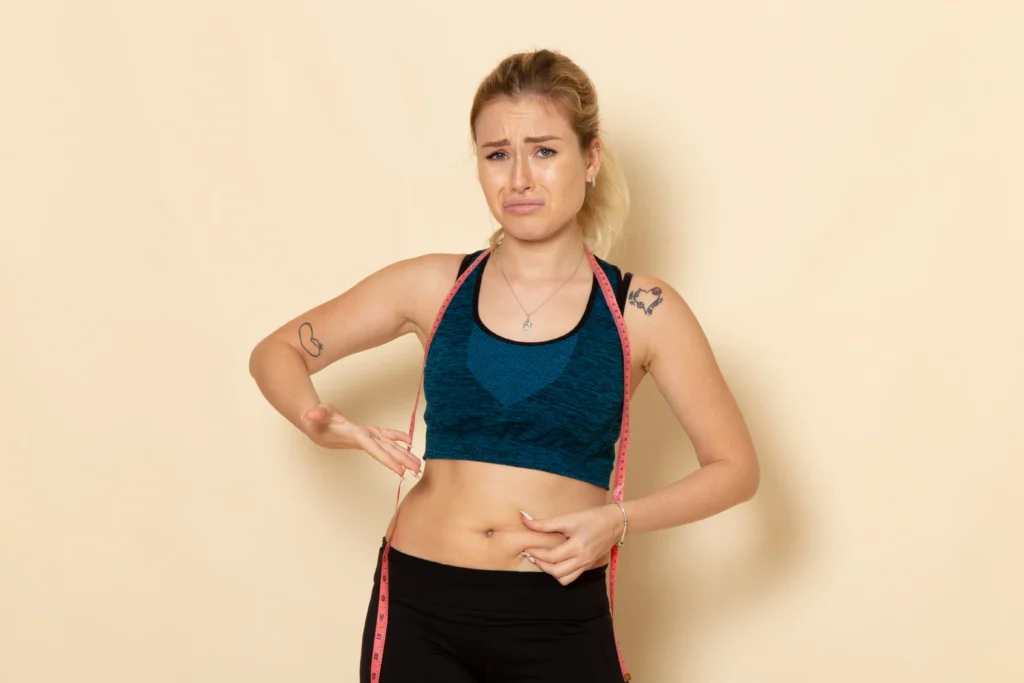
The body functions as one connected system.
The position of the spine, pelvis, rib cage, and muscles all influence each other.
The Spine
The spine naturally has gentle curves that help distribute forces during standing and movement.
When these curves become exaggerated, body alignment changes.
MedlinePlus explains that good posture helps maintain the spine’s natural curves rather than increasing them. (MedlinePlus)
The Pelvis
The pelvis acts as the foundation for the spine.
If its position changes, the alignment of the lower back and abdomen may change as well.
This is one reason why some people notice that standing differently changes the appearance of their stomach almost immediately.
The Rib Cage
Many people who spend long hours sitting develop rounded shoulders and changes in upper body positioning.
This may influence breathing patterns and how the abdominal wall functions during movement.
The Core Muscles
The abdominal muscles do much more than create a six-pack.
They help support the trunk and contribute to postural control.
Healthdirect Australia notes that weak abdominal and back muscles can affect a person’s ability to maintain good posture. (Healthdirect Australia)
What About Anterior Pelvic Tilt?
Social media often blames anterior pelvic tilt for every stomach that sticks out.
The reality is more nuanced.
Anterior pelvic tilt refers to a position where the front of the pelvis rotates downward relative to the back.
Certain pelvic and spinal positions may influence the appearance of the abdomen by changing overall body alignment.
However, not everyone with anterior pelvic tilt has a protruding stomach, and not everyone with a protruding stomach has anterior pelvic tilt.
As a physiotherapist,
I avoid treating one posture pattern as the cause of every problem because the human body is much more complex than that.
Can Sitting Too Much Make Your Belly Look Bigger?
Many adults spend most of their day sitting.
Prolonged sitting may contribute to:
- Rounded shoulders
- Reduced trunk movement
- Tight hip muscles
- Reduced postural variation
Over time, these habits can influence how the body positions itself during standing and walking.
One of the simplest physiotherapy strategies is also one of the most effective:
Move more often.
Standing up, walking for a few minutes, and changing positions regularly can help reduce prolonged static loading.
A Lesser-Known Fact About Breathing and Your Belly
Many people think posture is only about the muscles they can see.
In reality, breathing also plays an important role.
The diaphragm works together with the deep abdominal and spinal muscles to help stabilize the trunk.
Research by (Finta et al. 2018) demonstrated that diaphragm-focused training can influence the function of deep trunk stabilizing muscles, including the transversus abdominis and multifidus.
This is one reason why physiotherapists often include breathing exercises as part of posture rehabilitation programs.
Can Standing Taller Instantly Make Your Belly Look Smaller?
Many people notice this effect the first time they improve their posture.
Standing with better alignment can:
- Improve body positioning
- Reduce excessive slouching
- Help the rib cage and pelvis work together more efficiently
- Improve overall body appearance
It does not remove fat.
Instead, it allows the body to assume a more balanced position.
That is why improving posture can sometimes make the stomach appear flatter, even though body composition has not changed.
Physiotherapist’s Perspective
One of the biggest mistakes I see is people becoming obsessed with finding the perfect posture.
The body was designed to move.
No single posture is ideal if you hold it for hours without changing position.
Instead of trying to stand perfectly all day, focus on simple habits:
- Move regularly.
- Avoid prolonged sitting.
- Strengthen your core muscles.
- Practice healthy breathing patterns.
- Stay physically active.
Small improvements performed consistently often produce better long-term results than chasing perfect posture.
Myths vs Facts About Posture and Belly Appearance
| Myth | Fact |
|---|---|
| Poor posture causes belly fat. | Poor posture can change appearance but does not create fat. |
| Anterior pelvic tilt is the cause of every protruding stomach. | Body shape is influenced by many different factors. |
| Holding your stomach in all day will fix posture. | Healthy breathing and natural core function are more important. |
| There is one perfect posture. | The body benefits from regular movement and changing positions. |
Can Weak Core Muscles Make Your Stomach Stick Out?
Many people assume that having a protruding stomach automatically means they have too much belly fat.
In reality, the muscles that support the trunk also play an important role in the way the abdomen looks and functions.
The deep core is made up of several muscles that work together to support the spine and pelvis during everyday activities.
Research by Hodges and Richardson demonstrated that the transversus abdominis plays an important role in spinal stabilization and trunk control. (Hodges and Richardson 1996)
This does not mean that weak core muscles create fat around the abdomen.
However, poor muscle coordination may influence posture and the way the abdominal wall supports the trunk.
Can Poor Breathing Habits Affect Your Posture?
This is something many people never think about.
Breathing is not just about the lungs.
The diaphragm works together with the abdominal muscles, pelvic floor, and deep back muscles to help stabilize the body.
When people constantly breathe from the upper chest, they may develop increased tension through the neck, shoulders, and upper body while reducing normal trunk movement.
As a physiotherapist,
I often include breathing retraining as part of posture rehabilitation because movement and breathing work together.
A Simple Exercise
Try this:
- Sit comfortably.
- Relax your shoulders.
- Place one hand on your chest and the other on your abdomen.
- Take a slow breath in through your nose.
- Allow the lower ribs and abdomen to move naturally.
- Exhale gently.
This is not about making the belly flat.
It is about encouraging normal breathing mechanics.
Everyday Habits That Can Make Your Belly Appear More Prominent
Many people focus only on exercise but forget about what happens during the other twenty-three hours of the day.
Sitting for Long Periods
Remaining in one position for hours can reduce movement variability and encourage slouched postures.
Looking Down at a Phone
Forward head posture and rounded shoulders may gradually influence overall body alignment.
Standing With Locked Knees
Some people lean backward through the hips and knees while standing, which may alter trunk position.
Holding the Stomach In All Day
Many people constantly tighten their abdominal muscles because they feel self-conscious about their appearance.
Ironically, this can create unnecessary muscle tension and alter natural breathing patterns.
Can Correcting Your Posture Flatten Your Stomach?
This is one of the most common questions I receive.
The honest answer is:
It can improve the appearance of your abdomen, but it will not magically remove body fat.
Correcting posture may help:
- Improve body alignment
- Optimize trunk muscle function
- Reduce excessive slouching
- Improve movement efficiency
- Enhance overall body appearance
Body fat, however, is influenced by many factors including nutrition, physical activity, sleep, hormones, genetics, and general health.
As a physiotherapist, I encourage people to see posture as one piece of the puzzle rather than a miracle solution.
Does Posture Matter During Pregnancy?
Pregnancy naturally changes the way the body moves.
As the abdomen grows, the body adapts to maintain balance.
Many women notice:
- Increased lower back curve
- Different walking patterns
- Changes in pelvic position
- Greater pressure on the trunk muscles
These adaptations are often normal.
The goal is not to force the body into a perfectly upright position but to help it move comfortably and efficiently.
Gentle exercise, walking, prenatal physiotherapy, and breathing exercises may help support the body during these changes.
When Should You Seek Professional Advice?
Sometimes a protruding abdomen is not simply related to posture.
You should consider professional assessment if you experience:
- Persistent or severe back pain
- Progressive abdominal swelling
- Unexplained digestive symptoms
- Difficulty with balance
- Pregnancy-related pelvic pain
- Significant changes after childbirth
A physiotherapist can assess posture, movement patterns, muscle function, and breathing mechanics to identify factors that may be contributing to your symptoms.
Myths vs Facts
Myth
Poor posture causes belly fat.
Fact
Poor posture does not create fat, but it may influence how the abdomen appears.
Myth
Everyone with anterior pelvic tilt has a protruding stomach.
Fact
Body shape is influenced by many factors, and pelvic position is only one part of the picture.
Myth
The solution is to hold your stomach in all day.
Fact
Healthy breathing and natural core function are more important than constant muscle tension.
Myth
There is one perfect posture.
Fact
The body benefits from regular movement and changing positions rather than staying rigidly in one posture all day.
A Lesser-Known Fact About Movement
One of the biggest misconceptions about posture is that it is a single position.
Modern physiotherapy increasingly recognizes that the best posture is often the next posture.
Changing positions regularly, walking, stretching, and staying active may be more beneficial than trying to maintain one “perfect” alignment throughout the day.
Physiotherapist’s Perspective
After years of working with people who struggle with back pain, posture concerns, and body image, I have learned that many people judge themselves too harshly.
A stomach that appears larger on some days does not automatically mean you have gained fat.
The body changes throughout the day because of posture, muscle activity, breathing, digestion, hydration, and normal movement.
Instead of chasing perfection, I encourage people to build healthy habits that support the whole body.
Move often.
Breathe well.
Strengthen gradually.
And remember that posture is about helping your body function better, not about meeting unrealistic appearance standards.
Final Thoughts
Poor posture can make your belly look bigger, but it is only one part of a much larger picture. Body composition, muscle strength, breathing patterns, daily habits, and overall health all influence the way your abdomen looks.
As a physiotherapist, I encourage people to think about posture as a tool for improving movement and comfort rather than chasing unrealistic appearance goals. Better posture supports healthy breathing, efficient movement, and long-term spinal health.
Remember that your body changes throughout the day. Digestion, hydration, muscle activity, and normal movement can all affect the appearance of your stomach. This is completely normal.
A Gentle Reminder:
The goal is not to stand perfectly every minute of the day. The goal is to move often, breathe well, stay active, and build habits that help your body function at its best.
Final Thoughts
Can poor posture make your belly look bigger?
In many cases, yes.
Posture can influence the way the abdomen appears by changing the relationship between the spine, pelvis, rib cage, and trunk muscles.
However, poor posture does not create belly fat, and correcting posture alone is not a weight-loss strategy.
As a physiotherapist, I believe the most helpful approach is to think beyond appearance.
Good posture supports efficient movement, comfortable breathing, better balance, and overall physical well-being.
Rather than trying to stand perfectly every second of the day, aim to move regularly, strengthen your body, and develop healthy habits that you can maintain over time.
Sometimes the biggest improvement does not come from changing the shape of your stomach.
It comes from changing the way you understand and care for your body.
Frequently Asked Questions
Can poor posture really make your belly look bigger?
Yes. Changes in spinal and pelvic alignment can make the abdomen appear more prominent.
Does poor posture cause belly fat?
No. Poor posture changes body appearance but does not create fat around the abdomen.
Can fixing my posture flatten my stomach?
Improving posture may improve abdominal appearance, but it is not a substitute for healthy nutrition and exercise.
Can sitting too much affect posture?
Yes. Long periods of sitting may contribute to muscle stiffness and changes in body alignment.
What is anterior pelvic tilt?
It is a posture pattern where the pelvis rotates forward, which may influence body appearance.
Can weak core muscles affect posture?
Yes. The deep abdominal and back muscles contribute to trunk stability and postural control.
Does pregnancy change posture?
Yes. Pregnancy naturally alters the body’s center of gravity and movement patterns.
What is the best posture?
Modern physiotherapy suggests that regular movement and changing positions are often more beneficial than trying to maintain one perfect posture.
Stay tuned with us for more health related topics.
Follow us on LinkedIn and Instagram for more.
More Read




Medical Disclaimer!
This article has been reviewed and written under the guidance of our Head Physiotherapist, Dr. Kruti Raj (PT, MUHS,CPT,CMPT). The information shared is intended for educational purposes only and should not be considered a substitute for personalized medical advice, diagnosis, or treatment.
Please consult us or any other qualified healthcare professional before beginning any exercise program, especially if you are experiencing pain, recovering from injury, or managing a medical condition.