


Sperm morphology refers to the size, shape and structural appearance of sperm cells.
During a semen analysis, laboratories examine sperm to determine whether their heads, midpieces and tails have a typical appearance.
Quick Answer
Sperm morphology refers to the size, shape and structure of sperm cells. Abnormal sperm morphology, known as teratozoospermia, means that a higher-than-expected proportion of sperm have an atypical shape. Abnormal morphology does not automatically mean infertility because sperm morphology is only one part of a complete semen analysis.
Abnormal sperm shape is known as teratozoospermia.
It can occur together with low sperm count or poor sperm motility, but some men have abnormal morphology even when their sperm concentration and motility are otherwise normal. (Atmoko et al. 2024)
Key Takeaways
- Sperm morphology describes the size, shape and structure of sperm cells.
- The main areas assessed are the sperm head, midpiece and tail.
- Abnormal sperm morphology is known as teratozoospermia.
- Abnormal morphology does not automatically mean that a man is infertile.
- Sperm morphology should be interpreted together with sperm concentration and motility.
- Smoking, obesity, varicocele, oxidative stress and some medical conditions may affect sperm morphology.
- Some sperm abnormalities have specific genetic causes.
- Lifestyle improvements may support overall sperm health but cannot correct every cause of abnormal morphology.
- Abnormal morphology alone does not automatically mean that ICSI is required.
- Men with abnormal morphology may still conceive naturally or may have fertility-treatment options when needed.
What Is Sperm Morphology?
Sperm morphology describes how closely individual sperm cells resemble the structural features considered typical during microscopic examination.
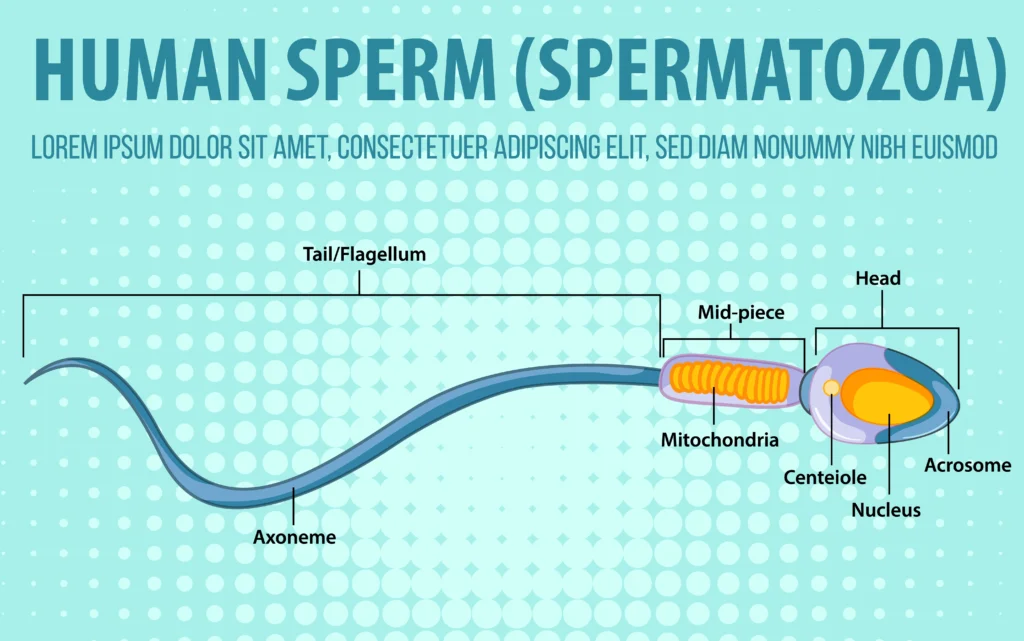
A sperm cell is generally evaluated in three main areas:
- Head
- Midpiece
- Tail
The head contains the genetic material and structures involved in interacting with the egg.
The midpiece contains mitochondria that provide energy for sperm movement.
The tail, also called the flagellum, helps propel the sperm forward.
What Does Normal Sperm Morphology Mean?
“Normal” sperm morphology does not mean that every sperm in a semen sample must have a perfect shape.
Human semen normally contains sperm with a range of structural appearances.
The WHO laboratory manual uses standardized criteria for assessing sperm morphology and emphasizes that the term “normal spermatozoon” has to be interpreted carefully.
Morphology assessment is intended to classify sperm according to defined structural criteria rather than simply label every sperm as healthy or unhealthy. (WHO)
What Are the Main Parts of a Sperm Cell?
Sperm Head
The sperm head contains the nucleus, which carries the paternal genetic material.
It also contains the acrosome, a specialized structure involved in the processes required for fertilization.
Abnormalities in head shape can include unusually large, small, tapered, round or irregular heads.
Sperm Midpiece
The midpiece connects the head to the tail.
It contains mitochondria that provide energy needed for sperm movement.
Structural abnormalities in this region can occur alongside other sperm defects.
Sperm Tail
The tail allows sperm to move.
A sperm may have a short, bent, coiled or otherwise abnormal tail.
Because tail structure is closely related to movement, significant tail abnormalities can sometimes occur together with reduced sperm motility.
What Is Teratozoospermia?
Teratozoospermia means that a higher-than-expected proportion of sperm have abnormal morphology.
It does not mean that every sperm is abnormally shaped.
A semen analysis may report the percentage of sperm considered to have normal morphology according to the laboratory’s assessment criteria.
Teratozoospermia can occur as an isolated finding or alongside abnormalities in sperm concentration and motility.
What Causes Abnormal Sperm Morphology?
Several factors may be associated with abnormal sperm morphology.
These can include:
- Genetic abnormalities
- Varicocele
- Oxidative stress
- Testicular disorders
- Infections
- Certain environmental exposures
- Smoking
- Some medical conditions
- Abnormal sperm development
However, morphology can also be abnormal without an obvious underlying cause.
Research has identified numerous genetic pathways associated with specific sperm structural abnormalities, including defects involving the sperm head, acrosome and flagellum. (Arora et al. 2024)
Can Genetics Affect Sperm Morphology?
Yes.
Some rare genetic abnormalities can produce very distinctive sperm shapes.
For example, certain genetic mutations have been associated with conditions involving abnormal sperm heads, abnormal acrosomes or multiple structural abnormalities affecting the sperm flagella.
These conditions are different from the more common situation in which a semen analysis simply reports a reduced percentage of normally shaped sperm.
Genetic evaluation may therefore be considered in selected men when the clinical history or sperm morphology suggests a specific inherited condition.
What Is Strict Sperm Morphology?
Strict morphology refers to the use of relatively stringent criteria to classify sperm shape.
The assessment considers detailed structural characteristics of the sperm head, midpiece and tail.
Because the criteria are strict, only a relatively small proportion of sperm may be classified as having normal morphology.
This can sometimes be alarming when patients first see their semen-analysis results.
However, a low percentage of normally shaped sperm does not by itself prove that natural conception is impossible.
What Is Considered Normal Sperm Morphology?
Sperm morphology should be interpreted according to the laboratory method and reference framework used.
The WHO 6th edition provides standardized procedures and reference information for semen examination, including morphology assessment.
It also emphasizes laboratory quality control because morphology assessment can be technically challenging. (WHO)
The result should therefore be interpreted in the context of the entire semen analysis, rather than focusing on the morphology percentage alone.
Does Abnormal Morphology Mean Infertility?
No.
This is one of the most important points about sperm morphology.
A man may have a low morphology percentage and still be able to conceive naturally.
Recent reviews have questioned how strongly isolated sperm morphology predicts fertility because studies have produced conflicting results.
Morphology appears to have greater clinical relevance when interpreted alongside other semen parameters and the couple’s overall reproductive history. (Pelzman et al. 2024)
Can Sperm Morphology Be Abnormal Even With Normal Sperm Count?
Yes.
A man can have:
- Normal sperm concentration
- Normal sperm motility
- Reduced normal morphology
This is sometimes called isolated teratozoospermia.
It can be confusing because the other semen parameters may look reassuring.
However, isolated abnormal morphology does not automatically indicate severe infertility.
Can Sperm Morphology Change Between Tests?
Yes.
Semen parameters can vary between samples.
Factors such as illness, fever, abstinence duration, laboratory variation and biological differences can influence semen-analysis results.
Morphology assessment can also have an element of subjectivity because sperm shape is evaluated microscopically.
For this reason, an isolated abnormal morphology result should be interpreted carefully rather than immediately assuming permanent fertility problems.
Does Sperm Morphology Affect Fertilization?
Potentially.
The structure of sperm can influence several processes involved in fertilization.
For example, the sperm head contains structures involved in interacting with the egg, while the tail is important for movement.
However, the relationship between the percentage of normally shaped sperm and actual fertility outcomes is not straightforward.
This is why morphology is only one component of a comprehensive male fertility assessment.
Why Is Sperm Morphology Sometimes Difficult to Interpret?
Human sperm naturally vary considerably in shape.
Even experienced laboratories may encounter challenges when deciding whether a sperm falls within a particular morphology category.
The WHO’s standardized laboratory methods are designed to improve consistency between laboratories and reduce variation in semen-analysis reporting. (WHO)
What Does an Abnormal Morphology Result Mean for You?
An abnormal morphology result should be viewed as one piece of the fertility assessment.
Doctors may also consider:
- Sperm concentration
- Progressive motility
- Total sperm number
- Semen volume
- Medical history
- Physical examination
- Duration of infertility
- Female-partner factors
- Previous fertility treatment
The combination of findings is generally more informative than morphology alone.
Can a Man With Poor Sperm Morphology Have Children?
Yes.
Poor sperm morphology does not automatically prevent natural conception.
Some men with abnormal morphology can conceive without assisted reproductive treatment.
If conception is difficult, fertility specialists can consider the complete clinical picture and determine whether treatments such as IUI, IVF or ICSI may be appropriate.
What Factors Can Affect Sperm Morphology?
Sperm morphology can be influenced by several biological, medical and environmental factors.
These include age, smoking, obesity, varicocele, infections, oxidative stress and certain medical conditions.
However, an abnormal morphology result does not always identify a single underlying cause.
Can Smoking Affect Sperm Morphology?
Yes.
Cigarette smoking exposes the reproductive system to numerous chemicals and can increase oxidative stress.
Studies have associated smoking with poorer semen quality, including abnormalities in sperm morphology.
The effect may be more pronounced when smoking occurs alongside other factors such as varicocele. (Collodel et al. 2009)
This does not mean that every smoker will have abnormal sperm morphology, but smoking is a modifiable factor worth addressing when trying to optimize reproductive health.
Can Obesity Affect Sperm Shape?
Possibly.
Excess body weight can influence hormonal regulation, inflammation and metabolic health, which may affect sperm production.
Research has found associations between obesity and poorer semen parameters, including morphology, although the strength of the association varies between studies.
A 2023 systematic review and meta-analysis found that obese men had lower normal sperm morphology compared with men of normal weight. (Santi et al. 2023)
Can Varicocele Affect Sperm Morphology?
Yes.
A varicocele can alter the testicular environment and has been associated with abnormalities in several semen parameters.
Possible mechanisms include increased testicular temperature, oxidative stress and altered blood flow around the testes.
However, having a varicocele does not automatically mean that sperm morphology will be abnormal.
Can Age Affect Sperm Morphology?
Age can be associated with changes in semen quality.
As men age, changes in testicular function and other biological processes may affect sperm production and quality.
A large study involving more than 11,000 men found that increasing age was associated with changes in several semen parameters, including morphology, motility and vitality. (Verón et al. 2018)
Age alone, however, should not be used to predict an individual’s fertility.
Can Oxidative Stress Damage Sperm Morphology?
Yes.
Sperm cells are particularly vulnerable to oxidative damage because of the composition of their cell membranes and their limited ability to repair cellular damage.
Excessive reactive oxygen species may affect sperm membranes, DNA and cellular structures.
This can potentially contribute to abnormal sperm morphology and other semen abnormalities.
Can Infections Affect Sperm Shape?
Certain infections and inflammatory conditions can affect the male reproductive system.
Inflammation may alter the environment in which sperm develop and can increase oxidative stress.
If a genital infection is suspected, appropriate medical assessment is more useful than trying to correct morphology with supplements alone.
Can Heat Exposure Affect Sperm Morphology?
The testes function at a temperature slightly below core body temperature.
Significant or prolonged increases in testicular temperature have been investigated as potential contributors to impaired spermatogenesis.
Possible sources include certain occupational exposures and conditions that substantially increase scrotal temperature.
However, ordinary activities should not automatically be considered a cause of abnormal sperm morphology.
Can Lifestyle Changes Improve Sperm Morphology?
They may help support overall sperm health, particularly when modifiable risk factors are present.
Useful measures include:
- Stopping smoking
- Maintaining a healthy body weight
- Exercising regularly
- Eating a balanced diet
- Limiting excessive alcohol
- Getting adequate sleep
- Avoiding anabolic steroids
- Managing chronic medical conditions
- Treating identified infections
However, lifestyle changes cannot correct every genetic or structural cause of abnormal sperm morphology.
Can Diet Improve Sperm Shape?
A balanced diet supports overall metabolic and reproductive health.
Foods rich in fruits, vegetables, whole grains, legumes, nuts, fish and other nutrient-dense foods can provide antioxidants and other nutrients required for normal cellular function.
However, there is no single food that can reliably normalize sperm morphology.
Diet should therefore be considered part of a broader healthy lifestyle rather than a specific cure for teratozoospermia.
Do Antioxidant Supplements Improve Sperm Morphology?
This is less straightforward than supplement marketing often suggests.
Some studies have reported improvements in semen parameters after antioxidant supplementation.
However, evidence across different supplements is inconsistent.
An umbrella review of systematic reviews and meta-analyses found that some interventions were associated with improvements in sperm morphology,
but the overall certainty of evidence was limited, and vitamin supplementation did not consistently improve semen parameters. (Ye et al. 2024)
This means supplements should not replace evaluation for an underlying medical cause.
Can Stress Affect Sperm Morphology?
Chronic psychological stress may influence reproductive health through hormonal, behavioral and metabolic pathways.
Stress can also indirectly affect fertility by changing sleep, diet, exercise and alcohol or tobacco use.
However, stress should not automatically be assumed to be the cause of abnormal morphology.
A persistent abnormal semen analysis still deserves appropriate medical evaluation.
Can Testosterone Affect Sperm Morphology?
External testosterone can suppress the hormonal signals required for normal sperm production.
Although testosterone is important for male reproductive physiology, taking testosterone from outside the body can reduce intratesticular testosterone and suppress spermatogenesis.
Men trying to conceive should therefore discuss testosterone therapy with their doctor rather than assuming it will improve fertility.
Can Varicocele Treatment Improve Sperm Morphology?
In selected men, treatment of a clinically significant varicocele may improve semen parameters.
However, varicocele treatment is not automatically recommended for every man who has a varicocele.
Doctors consider the physical examination, semen-analysis abnormalities, fertility history and reproductive goals before recommending treatment.
Can Abnormal Sperm Morphology Be Reversed?
Sometimes semen parameters can improve when a reversible contributing factor is addressed.
For example, treating an underlying medical problem, stopping smoking or addressing significant lifestyle risk factors may support better semen quality.
But improvement is not guaranteed.
Genetic sperm abnormalities and certain structural defects may persist despite lifestyle changes or medical treatment.
Does Improving Morphology Guarantee Pregnancy?
No.
This is an important distinction.
Even if the percentage of normally shaped sperm improves, pregnancy depends on many other factors.
These include:
- Sperm concentration
- Sperm motility
- Total sperm number
- Sperm viability
- Female reproductive health
- Ovulation
- Fallopian-tube function
- Timing of intercourse
- Other genetic and reproductive factors
Sperm morphology should therefore be viewed as one component of fertility assessment, not a standalone predictor of whether pregnancy will occur.
Can IUI Help With Abnormal Sperm Morphology?
In selected couples, intrauterine insemination (IUI) may be considered.
The suitability of IUI depends on the overall semen parameters and the reproductive health of the female partner.
Severely abnormal morphology combined with very low sperm count or motility may make other assisted reproductive approaches more appropriate.
Can IVF Help With Abnormal Sperm Morphology?
Yes.
IVF can provide an option when other fertility factors make natural conception or IUI less suitable.
During IVF, eggs are collected and fertilization occurs in a laboratory environment.
In some situations, ICSI may be used to inject a selected sperm directly into an egg.
However, abnormal morphology alone does not automatically mean that ICSI is required.
What If Sperm Morphology Is Very Low?
A very low morphology percentage can look alarming on a semen report.
However, the result should be interpreted alongside sperm concentration and motility.
A man with low morphology but otherwise favorable semen parameters may have a different fertility outlook from someone with abnormalities across all three major semen parameters.
This is why doctors generally avoid making treatment decisions based solely on morphology.
Can Abnormal Sperm Morphology Be Treated?
Sometimes, but treatment depends on why the morphology is abnormal.
There is no universal medication that can make every abnormally shaped sperm become normal.
The focus is usually on identifying reversible factors, improving overall reproductive health and choosing an appropriate fertility treatment when pregnancy is difficult.
Can Sperm Morphology Improve After Lifestyle Changes?
It may improve when modifiable factors are contributing to poor semen quality.
Stopping smoking, maintaining a healthy weight, exercising regularly, limiting excessive alcohol and avoiding anabolic steroids can support overall sperm health.
However, these changes cannot correct every genetic or structural sperm abnormality.
Can Varicocele Treatment Improve Sperm Morphology?
In selected men, treating a clinically significant varicocele may improve semen parameters.
The decision should be individualized because not every varicocele requires treatment.
Doctors may consider the grade of the varicocele, semen-analysis results, fertility history and whether the couple is actively trying to conceive.
Can Antioxidants Treat Abnormal Sperm Morphology?
Antioxidants have been studied extensively because oxidative stress can affect sperm cells.
Some trials have reported improvements in semen parameters following antioxidant supplementation, but the evidence is inconsistent.
A 2024 umbrella review found that some interventions may improve selected semen parameters, but the certainty of evidence varied considerably between treatments. (Ye et al. 2024)
Therefore, supplements should not be viewed as a guaranteed way to normalize sperm morphology.
Can Medication Improve Sperm Morphology?
Medication may help when an identifiable medical or hormonal problem is contributing to impaired sperm production.
For example, treatment of specific hormonal disorders can improve spermatogenesis in appropriately selected men.
However, there is no general medication that reliably corrects isolated abnormal sperm shape in every patient.
Can Abnormal Morphology Affect Natural Conception?
It can, but the relationship is complicated.
A low percentage of normally shaped sperm does not automatically mean that natural conception is impossible.
In fact, isolated teratozoospermia can sometimes be found in men who are still capable of conceiving naturally.
This is why doctors consider morphology together with sperm concentration, motility, total sperm number and the fertility history of both partners.
Can IUI Help With Abnormal Sperm Morphology?
In selected couples, intrauterine insemination (IUI) may be considered.
The sperm are processed in the laboratory and the prepared sample is placed directly into the uterus around the time of ovulation.
However, IUI may be less suitable when abnormal morphology occurs together with severe reductions in sperm concentration or motility.
The decision should therefore be based on the complete fertility assessment rather than morphology alone.
Can IVF Help With Teratozoospermia?
Yes.
IVF may be considered when pregnancy has not occurred naturally or when other fertility factors make assisted reproduction appropriate.
During IVF, eggs are retrieved and fertilization occurs outside the body.
Depending on the clinical circumstances, conventional IVF or ICSI may be considered.
Does Abnormal Morphology Mean ICSI Is Always Necessary?
No.
This is an important distinction.
Abnormal morphology alone does not automatically mean that ICSI is required.
The decision depends on the severity of the morphology abnormality, sperm concentration and motility, previous fertilization outcomes and other fertility factors.
Some couples may conceive naturally despite abnormal morphology, while others may benefit from assisted reproductive treatment.
Can ICSI Help When Sperm Morphology Is Very Poor?
Yes, in selected cases.
ICSI allows an embryologist to select an individual sperm and inject it directly into the egg.
This reduces the dependence on sperm swimming ability and some of the natural steps involved in fertilization.
A study evaluating men with isolated teratozoospermia found that ICSI can be an effective treatment option in selected patients, although the decision should be individualized rather than based solely on morphology. (Atmoko et al. 2024)
Lesser-Known Fact About Sperm Morphology
A Very Low Morphology Percentage Does Not Mean Every Sperm Is Abnormal
This is one of the most misunderstood aspects of a semen report.
If a laboratory reports a low percentage of normally shaped sperm, it does not mean that the remaining sperm are all incapable of fertilization.
Sperm morphology is based on strict structural classification.
Some sperm that do not meet the laboratory’s criteria for “normal” morphology may still be viable and potentially capable of contributing to fertilization.
This is one reason why morphology should not be interpreted as a simple fertile versus infertile test.
Can Sperm Morphology Improve After a Fever?
It can take time for changes in sperm production to appear in a semen analysis.
A significant fever or systemic illness can temporarily interfere with spermatogenesis.
Because sperm development takes several weeks, an abnormal semen analysis following an illness may not immediately reflect a man’s long-term reproductive potential.
A repeat assessment after an appropriate interval may therefore provide a more useful picture.
How Long Does It Take for Sperm Quality to Change?
Sperm production is a continuous biological process rather than something that changes overnight.
When a potentially reversible factor is addressed, improvement in semen parameters may take several weeks to months to become apparent.
This is why doctors generally do not expect major changes immediately after a lifestyle intervention.
Can Sperm Morphology Be Improved Naturally?
There is no guaranteed natural cure for teratozoospermia.
However, men can support reproductive health by:
- Avoiding smoking
- Maintaining a healthy body weight
- Exercising regularly
- Eating a nutrient-rich diet
- Limiting excessive alcohol
- Avoiding anabolic steroids
- Managing chronic health conditions
- Getting adequate sleep
- Avoiding unnecessary exposure to reproductive toxins
These measures are most useful when combined with appropriate medical evaluation.
Did You Know?
A very low morphology percentage does not mean that every sperm is incapable of fertilization. Sperm morphology is based on strict microscopic classification, and some sperm that do not meet the laboratory criteria for “normal” morphology may still be viable and potentially capable of contributing to fertilization.
When Should You See a Fertility Specialist?
Consider specialist evaluation if:
- Morphology is repeatedly abnormal
- Sperm concentration is also low
- Sperm motility is also reduced
- Pregnancy has not occurred despite regular unprotected intercourse
- There is a history of testicular injury or surgery
- There is a known varicocele
- You have previously used testosterone or anabolic steroids
- There is a history of chemotherapy or radiation
- A genetic cause is suspected
A fertility specialist can determine whether additional testing or treatment is appropriate.
What Tests May Be Recommended?
Depending on the clinical situation, evaluation may include:
- Repeat semen analysis
- Hormone testing
- Physical examination
- Testicular ultrasound in selected cases
- Genetic testing when indicated
- Assessment for infection
- Evaluation of the female partner’s reproductive health
Not every man with abnormal morphology needs every test.
The work-up should be individualized.
Does Abnormal Sperm Morphology Affect the Baby’s Health?
Morphology alone cannot be used to predict the health of a future child.
Sperm morphology is primarily a microscopic assessment of sperm structure.
Some severe sperm abnormalities, particularly those associated with specific genetic disorders, may have implications beyond fertility.
When a distinctive or severe morphological pattern is repeatedly observed, a fertility specialist may consider whether additional genetic evaluation is appropriate.
Sperm Morphology: Myth vs Fact
| Myth | Fact |
|---|---|
| Abnormal sperm morphology means infertility. | Abnormal morphology can affect fertility, but it does not automatically mean that a man cannot father a child. |
| All sperm must have a perfect shape to fertilize an egg. | Human semen naturally contains sperm with different shapes, and morphology is assessed using specific laboratory criteria. |
| A low morphology percentage means all the other sperm are useless. | Sperm that do not meet strict morphology criteria may still be viable and potentially capable of fertilization. |
| Abnormal morphology always has an obvious cause. | Some men have abnormal morphology without a clearly identifiable underlying cause. |
| Supplements can always normalize sperm morphology. | Evidence for supplements is mixed, and treatment depends on the underlying cause. |
| Poor morphology means IVF is always necessary. | Some men with abnormal morphology conceive naturally, while others may benefit from IUI, IVF or ICSI depending on the overall fertility assessment. |
| ICSI is automatically required for abnormal morphology. | Morphology alone does not determine whether ICSI is needed. |
| Sperm morphology is the only important semen parameter. | Morphology should be interpreted alongside sperm concentration, motility, total sperm number and other fertility factors. |
Can Men With Abnormal Sperm Morphology Father Biological Children?
Yes.
Abnormal morphology does not automatically mean infertility.
Many factors contribute to conception, and some men with reduced normal morphology can conceive naturally.
When natural conception is unsuccessful, treatments such as IUI, IVF or ICSI may provide additional options depending on the complete fertility assessment.
Final Thoughts
Abnormal sperm morphology can be concerning when it appears on a semen analysis, but it does not automatically mean that a man is infertile. Morphology is only one part of the overall assessment of male reproductive health.
If sperm morphology is repeatedly abnormal, a qualified urologist, andrologist or fertility specialist can help identify possible contributing factors and determine whether further testing or fertility treatment is appropriate.
Conclusion
Sperm morphology is an important part of semen analysis, but it should never be interpreted in isolation.
An abnormal morphology result does not automatically mean that a man is infertile or that natural conception is impossible.
The most useful approach is to look for potentially reversible causes, assess the other semen parameters and consider the fertility history of both partners.
Lifestyle improvements can support overall reproductive health, while selected medical treatments and assisted reproductive techniques may provide additional options when pregnancy remains difficult.
If sperm morphology is repeatedly abnormal, a qualified urologist, andrologist or fertility specialist can help determine what the result means and whether further evaluation or treatment is appropriate.
Frequently Asked Questions About Sperm Morphology
1. What is sperm morphology?
Sperm morphology refers to the size, shape and structural appearance of sperm cells, including their head, midpiece and tail.
2. What is abnormal sperm morphology called?
Abnormal sperm morphology is commonly referred to as teratozoospermia.
3. What causes abnormal sperm morphology?
Possible factors include genetic conditions, varicocele, oxidative stress, smoking, obesity, infections, testicular disorders and certain environmental or medical factors.
4. Can abnormal sperm morphology be improved?
It may improve when a reversible contributing factor is identified and addressed, although not every cause of abnormal morphology is reversible.
5. What is a normal sperm morphology percentage?
The result depends on the laboratory’s assessment method and reference framework. Morphology should be interpreted together with the other semen parameters rather than in isolation.
6. Can a man with poor sperm morphology have a baby?
Yes. Abnormal morphology does not automatically mean infertility. Some men may conceive naturally, while others may benefit from fertility treatment.
7. Can smoking affect sperm morphology?
Yes. Smoking has been associated with poorer semen quality and may contribute to abnormal sperm morphology.
8. Can obesity affect sperm morphology?
Obesity and associated metabolic changes may affect male reproductive function and have been associated with poorer semen parameters.
9. Does abnormal sperm morphology require ICSI?
Not necessarily. ICSI may be considered in selected situations, but abnormal morphology alone does not automatically mean that ICSI is required.
10. When should I see a fertility specialist?
Consider specialist evaluation when morphology is repeatedly abnormal, other semen parameters are also affected, or pregnancy has not occurred despite regular unprotected intercourse.
Stay tuned with us for more health related topics.
Follow us on LinkedIn and Instagram for more.
More Read


Medical Disclaimer!
This article has been reviewed and written under the guidance of our Head Physiotherapist, Dr. Kruti Raj (PT, MUHS,CPT,CMPT). The information shared is intended for educational purposes only and should not be considered a substitute for personalized medical advice, diagnosis, or treatment.
Please consult us or any other qualified healthcare professional before beginning any exercise program, especially if you are experiencing pain, recovering from injury, or managing a medical condition.


