


An ankle avulsion fracture occurs when a ligament or tendon pulls a small piece of bone away from its attachment.
It often happens when the ankle twists suddenly during walking, running or sport.
Quick Answer: Ankle Avulsion Fracture
An ankle avulsion fracture occurs when a ligament or tendon pulls a small piece of bone away from its attachment. It can happen during a sudden ankle twist, fall or sports injury.
- Healing time: Many uncomplicated fractures heal in approximately 4–6 weeks, although some take longer.
- Common symptoms: Pain, swelling, bruising, tenderness and difficulty walking.
- Treatment: A walking boot or brace, activity modification and weight-bearing as advised by your clinician.
- Physiotherapy: Can help restore ankle movement, strength, balance and walking ability when appropriate.
Important: Recovery depends on the fracture location, ankle stability and any associated ligament injury. Follow your clinician’s advice about weight-bearing and exercises.
Many uncomplicated avulsion fractures heal without surgery.
However, the fragment’s location, ankle stability and associated ligament damage influence treatment and recovery.
Understanding these factors can help you protect the injury and return to normal movement safely.
Key Takeaways
- An avulsion fracture occurs when a ligament or tendon pulls a small bone fragment away from its attachment.
- Symptoms can resemble an ankle sprain, so clinical assessment may be necessary.
- Many uncomplicated fractures heal in around six weeks, but pain and swelling may last longer.
- Treatment depends on the fracture location, displacement and ankle stability.
- Physiotherapy can help restore ankle movement, strength, balance and walking ability when appropriate.
- Return to running and sport should be gradual and guided by recovery and clinical advice.
What Is an Ankle Avulsion Fracture?
An avulsion fracture occurs when a ligament or tendon pulls a small fragment of bone away from the main bone during a forceful movement.
Around the ankle, this can happen when the foot rolls inward or outward or lands awkwardly.
The injury may resemble an ankle sprain because both can cause pain, swelling and bruising.
An avulsion fracture involves bone and may also include damage to the surrounding ligaments or other soft tissues.
The severity depends on the fracture location, fragment displacement and whether the ankle joint remains stable. (Royal Free London NHS Foundation Trust, 2026)
What Causes an Ankle Avulsion Fracture?
Sudden ankle twisting
When the ankle rolls unexpectedly, a ligament may experience enough tension to pull a small piece of bone from its attachment.
Sports injuries
Football, basketball, tennis and other activities involving rapid turns, jumping or awkward landings can create the forces responsible for avulsion fractures.
Falls and uneven surfaces
Landing awkwardly or twisting the foot on uneven ground can injure the ligaments and their bone attachments.
Forceful tendon contraction
A sudden, powerful muscle contraction can also pull a bone fragment away from a tendon attachment.
The exact injury depends on the structure involved.
Ankle Avulsion Fracture Symptoms
Symptoms often resemble those of an ankle sprain, so clinical assessment may be necessary to distinguish them.
Pain around the ankle
Pain is usually felt near the affected bone or ligament attachment.
Walking, turning the foot or moving the ankle may make it worse.
Swelling and bruising
Swelling can develop soon after the injury, while bruising may become more noticeable over the following hours or days.
Tenderness over the bone
The injured area may be painful when touched.
However, tenderness alone cannot confirm a fracture or distinguish it from a ligament injury.
Difficulty walking
Some people struggle to bear weight, while others can still walk despite having a fracture.
Being able to walk does not rule out a broken bone.
Restricted movement or instability
Pain and swelling may limit ankle movement.
If the associated ligaments are injured, the ankle may also feel weak or give way.
Seek urgent medical assessment if the ankle is visibly deformed, there is an open wound, the foot becomes cold or pale, or new numbness develops.
Types of Ankle Avulsion Fractures
The location of the bone fragment helps determine treatment and rehabilitation.
Lateral malleolus avulsion fracture
This involves a fragment near the outer ankle bone, where ligaments attach to the distal fibula.
Some fractures are stable, while others need assessment for associated injuries or ankle instability.
Medial malleolus avulsion fracture
This affects the inner ankle bone.
The clinician must assess the joint and surrounding ligaments because associated injuries can affect stability.
Talar avulsion fracture
A small fragment may break away from the talus, a bone that transfers body weight through the ankle.
Management depends on the exact location and whether the joint surface is affected.
Avulsion fracture near the fifth metatarsal
This injury affects the outer edge of the foot rather than the ankle itself.
It can occur during a twisting injury and cause pain that extends into the surrounding area.
These injuries are not interchangeable.
The exact fracture site matters because different locations can have different healing risks and weight-bearing recommendations.
How Is an Ankle Avulsion Fracture Diagnosed?
Clinical examination
A clinician assesses the injury mechanism, swelling, bone tenderness, walking ability, circulation and sensation.
They may also examine the surrounding ligaments and check for signs of a more extensive fracture.
X-rays
X-rays are commonly used to identify the bone fragment, assess its position and look for associated fractures.
CT or MRI scans
CT may be needed when more detail about the bone fragment or joint surface is required.
MRI may help investigate associated ligament or tendon injuries when the examination and initial imaging do not fully explain the symptoms.
Ankle Avulsion Fracture Treatment
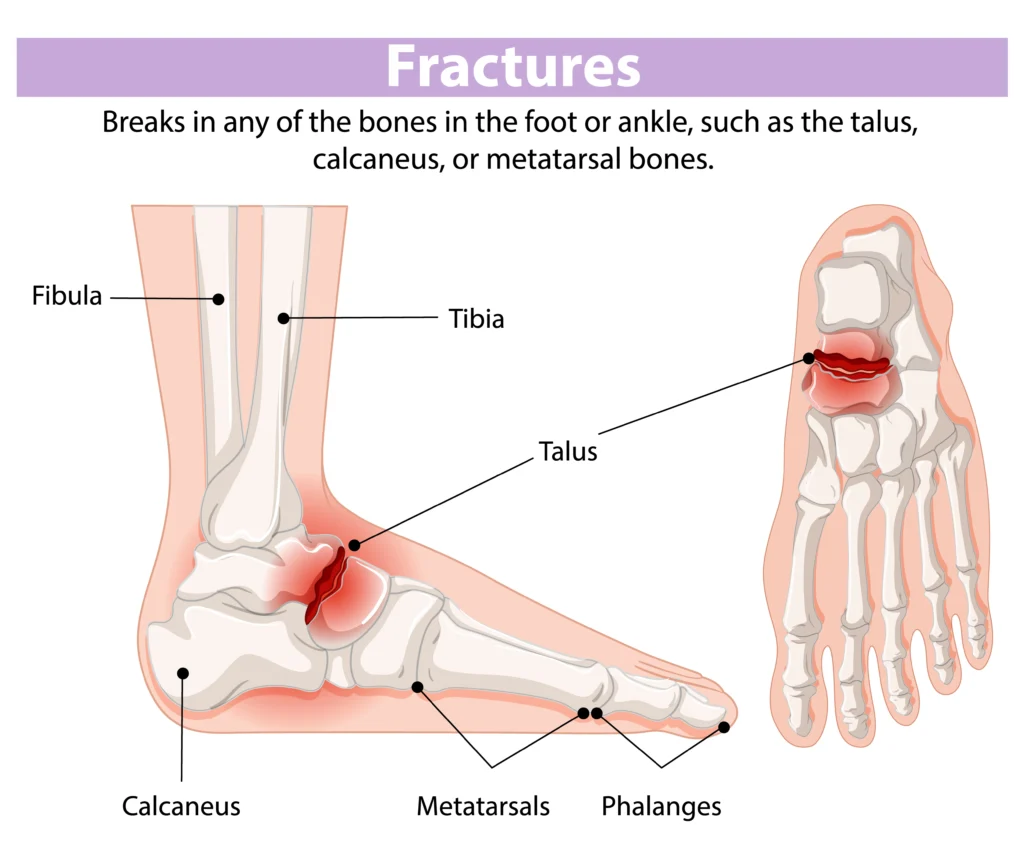
Treatment depends on the fragment’s location and displacement, joint stability and associated soft-tissue injuries.
Conservative treatment
Many uncomplicated, stable avulsion fractures can be treated without surgery.
Management may involve a supportive brace, walking boot, crutches or activity modification.
Some patients can bear weight as comfort allows, while others need specific restrictions.
Follow the instructions provided for your individual fracture rather than assuming that all avulsion injuries can be loaded immediately.
Surgical treatment
Surgery may be considered when the fragment is substantially displaced, joint stability is compromised or other features make conservative treatment unsuitable.
The decision depends on the specific fracture and should be made by an orthopaedic specialist.
How Long Does an Ankle Avulsion Fracture Take to Heal?
Many uncomplicated ankle avulsion fractures heal in approximately six weeks, although some require longer.
The timeline varies with the fracture location, severity, associated ligament damage and individual health.
Bone healing and complete functional recovery are not the same.
Pain, stiffness and swelling may continue for several months, particularly after a period of reduced activity. (NHS inform, 2026)
Early recovery: Protect the injury
During the initial phase, the focus is on managing swelling, maintaining safe mobility and following the prescribed brace, boot or weight-bearing instructions.
Progressive recovery: Restore movement
As the injury stabilises and movement is permitted, gentle ankle exercises can help reduce stiffness.
Walking and daily activity can increase gradually according to symptoms and clinical advice.
Later recovery: Return to normal activity
Longer walks, stairs, running and sport require additional strength, balance and movement control.
Returning to impact activity too early can aggravate symptoms or expose the ankle to another injury.
Physiotherapy After an Ankle Avulsion Fracture
Physiotherapy helps restore movement, strength, balance and confidence after an avulsion fracture.
Rehabilitation should be adapted to the fracture and any associated ligament injury.
1. Manage swelling and maintain safe mobility
Early management may include elevation, appropriate use of walking aids and advice on daily activities.
Gentle movement of unaffected joints can help maintain general mobility.
Follow instructions about when to wear or remove a prescribed boot or brace.
2. Restore ankle range of motion
When movement is permitted, gentle ankle movements can help address stiffness.
The direction and extent of movement should reflect the fracture location and the condition of the injured ligaments.
Do not force painful movements or start exercises that conflict with your clinician’s instructions.
3. Rebuild muscle strength
Once healing permits, physiotherapy may introduce progressive strengthening for the calf and muscles supporting ankle control.
The load should increase gradually, with attention to pain and swelling after activity.
4. Improve balance and stability
Ankle injuries can reduce balance and the ability to control sudden movements.
When appropriate, rehabilitation may progress from supported standing to more challenging balance exercises.
This stage is particularly relevant when an avulsion fracture accompanies ligament damage or recurrent ankle instability.
5. Retrain walking and return to sport
A physiotherapist can help address limping, reduced walking tolerance and difficulty managing stairs.
Later stages may include single-leg control and sport-specific movements when medically appropriate.
Return to sport should be based on pain, movement, strength, balance and the demands of the activity, rather than a fixed number of weeks.
What Should You Avoid During Recovery?
- Returning to running or jumping before the injury is ready.
- Increasing walking distance despite worsening pain or swelling.
- Removing a prescribed support earlier than advised.
- Starting strengthening or balance exercises that exceed your current restrictions.
- Assuming a small fragment means the ankle is stable.
- Ignoring repeated episodes of the ankle giving way.
If an activity causes a sustained increase in pain or swelling, reduce the load and seek advice if symptoms do not settle.
Ankle Avulsion Fracture: Myth vs Fact
MYTH: If I can walk, my ankle is not fractured.
FACT: Some people can walk with a fracture. Walking ability alone cannot rule out a broken bone.
MYTH: A small bone fragment always means a minor injury.
FACT: Associated ligament damage and ankle stability also influence injury severity and treatment.
MYTH: Every avulsion fracture heals in six weeks.
FACT: Many uncomplicated injuries heal in approximately six weeks, but some take longer. Swelling and stiffness may persist after bone healing.
MYTH: Physiotherapy is only about strengthening.
FACT: Rehabilitation may also improve ankle mobility, balance, walking and safe return to activity.
Can an Ankle Avulsion Fracture Cause Long-Term Problems?
Many uncomplicated fractures recover well, but some people experience ongoing symptoms.
Persistent ankle instability
If the associated ligament injury does not recover adequately, the ankle may continue to feel weak or give way.
Ongoing pain and swelling
Symptoms may persist beyond the initial bone-healing period.
Persistent or worsening symptoms warrant reassessment to check for associated injuries or delayed recovery.
Delayed healing
Some fractures need longer to heal because of their location, severity or individual health factors.
Smoking and certain medical conditions can also affect bone healing.
Reduced balance and confidence
After an injury, a person may feel hesitant on uneven surfaces or during quick movements.
Rehabilitation can help rebuild control and confidence as recovery progresses.
How Can You Reduce the Risk of Another Ankle Injury?
- Rebuild ankle strength and balance after injury.
- Return to sport gradually rather than immediately resuming full training.
- Wear suitable footwear for the activity and playing surface.
- Practise controlled landing and direction-change techniques when relevant.
- Address recurrent ankle giving-way with appropriate assessment and rehabilitation.
- Avoid continuing intense activity when pain or swelling is worsening.
These strategies can reduce some avoidable risks, although they cannot prevent every ankle injury.
When Should You Seek Medical Attention?
Arrange medical assessment after a significant ankle twist if you have focal bone tenderness, substantial swelling, persistent pain or difficulty walking.
Seek urgent care if the ankle is visibly deformed, bone is exposed, the foot becomes cold or pale, or new numbness develops.
After diagnosis, seek reassessment if pain or swelling worsens, the ankle repeatedly gives way or recovery stalls despite following the prescribed plan.
Lesser-Known Facts About Ankle Avulsion Fractures
A small fragment can accompany a significant ligament injury
The fragment is only one part of the injury.
Associated ligament damage and joint stability also influence treatment.
Walking does not rule out a fracture
Some people can put weight on an injured ankle despite a fracture.
Walking ability alone cannot establish whether imaging is needed.
Swelling may outlast bone healing
It is possible for the bone to heal while residual swelling and sensitivity continue.
These symptoms should gradually improve, and persistent or worsening problems need reassessment.
Rehabilitation addresses more than the bone
Once loading is safe, physiotherapy can also target stiffness, weakness, balance and movement control to help restore everyday function.
Final Thoughts
An ankle avulsion fracture can be painful, but many uncomplicated injuries recover well with appropriate protection and gradual rehabilitation. Healing often takes around six weeks, although full recovery may take longer.
Physiotherapy can help restore ankle movement, strength, balance and walking confidence at the appropriate stage. Follow your clinician’s advice, progress activity gradually and seek reassessment if symptoms worsen or recovery stalls.
Conclusion
An ankle avulsion fracture occurs when a ligament or tendon pulls a small piece of bone away from its attachment.
Many stable injuries heal without surgery, often in around six weeks, but the fracture location and associated ligament damage influence recovery.
Physiotherapy can help restore movement, strength, balance and walking confidence when the injury is ready for rehabilitation.
Following medical guidance and progressing activity gradually can support recovery while reducing the risk of further injury.
Frequently Asked Questions
1. How long does an ankle avulsion fracture take to heal?
Many uncomplicated fractures heal in approximately six weeks. Recovery can take longer depending on the fracture and associated injuries.
2. Can you walk with an ankle avulsion fracture?
Some people can walk with this injury, while others cannot bear weight comfortably. Follow your clinician’s weight-bearing instructions.
3. Does an ankle avulsion fracture require surgery?
Many stable fractures are treated without surgery. Surgery may be considered if the fragment is significantly displaced or the ankle is unstable.
4. Is physiotherapy necessary after an ankle avulsion fracture?
Not everyone needs the same rehabilitation programme. A physiotherapist can address stiffness, weakness, balance and walking difficulties when appropriate.
5. When can I return to running?
Return to running depends on healing, pain, ankle movement, strength and balance. Progress gradually and obtain clinical clearance when required.
6. Can an ankle avulsion fracture cause long-term problems?
Some people experience persistent pain, stiffness or instability. Ongoing or worsening symptoms should be reassessed.
Stay tuned with us for more health related topics.
Follow us on LinkedIn and Instagram for more.
More Read


Medical Disclaimer
This content is for general educational purposes only and is not a substitute for professional medical advice, diagnosis or treatment. Suspected ankle fractures require appropriate clinical assessment. Do not begin exercises, change weight-bearing restrictions or discontinue a prescribed boot or brace without guidance from your treating clinician. Seek urgent medical care for a visibly deformed ankle, an open wound, a cold or pale foot, or new numbness.


