


If your baby is not sitting independently yet, you may wonder whether their balance, muscle strength and motor development are progressing as expected.
A baby learning to sit independently is an exciting developmental milestone.
It allows babies to explore their surroundings, reach for toys, interact with caregivers and gradually use their hands more freely.
Quick Answer: When Should a Baby Sit Independently?
Most babies gradually develop independent sitting during their first nine months. Some begin with supported sitting, progress to tripod sitting and eventually learn to sit without using their hands for support.
According to the CDC, sitting without support and getting into a sitting position independently are two milestones expected by 9 months.
If your baby cannot sit independently by 9 months, discuss their development with a pediatrician. Pediatric physiotherapy can help assess trunk control, balance, posture and movement difficulties.
However, babies do not develop sitting skills at exactly the same age.
Some begin sitting with support, while others initially lean forward on their hands before developing the balance needed to sit independently.
Understanding these stages can help parents recognize normal developmental progress and identify when professional assessment may be necessary.
From a pediatric physiotherapy perspective, sitting involves much more than holding the body upright.
It requires head control, trunk stability, postural adjustments, balance reactions and coordinated muscle activity.
Difficulties with these abilities can sometimes affect a baby’s progress towards independent sitting.
Key Takeaways
- Most babies gradually develop independent sitting during their first nine months.
- Supported sitting, tripod sitting and independent sitting are different developmental stages.
- Trunk control, muscle strength and balance are essential for independent sitting.
- Premature babies may need developmental monitoring using corrected age.
- Poor head control, unusual muscle tone and asymmetrical movement deserve attention.
- Pediatric physiotherapy can help assess posture, balance and gross motor development.
- Always supervise sitting practice and provide safe floor-play opportunities.
When Do Babies Start Sitting Independently?
Most babies gradually develop the skills needed for independent sitting during the first nine months of life.
According to the CDC, sitting without support and getting into a sitting position independently are two separate developmental milestones expected by 9 months.
These milestones represent skills that at least 75% of children are expected to demonstrate by that age, rather than strict deadlines for every baby. (CDC, 2026)
The World Health Organization’s Multicenter Growth Reference Study examined the development of six gross motor milestones in healthy children.
It reported a window of approximately 3.8 to 9.2 months for sitting without support.
This wide range demonstrates that babies can acquire the same motor skill at different ages.
However, a developmental window should not be used to dismiss concerns when a baby is struggling with several movement skills. (WHO Multicentre Growth Reference Study Group, 2006)
Baby Sitting Milestones: What Is Normal at Each Age?
Sitting develops gradually as babies gain head control, trunk stability and the ability to maintain their balance.
The following guide describes commonly observed stages of sitting development.
These are approximate developmental patterns, not fixed deadlines.
3-4 Months: Developing Head and Upper-Body Control
At this stage, babies are developing the head and upper-body control needed for later sitting.
Parents may notice that their baby:
- Holds their head more steadily when supported.
- Pushes up on their forearms during tummy time.
- Begins bringing their hands towards the middle of the body.
- Shows improved control when held in an upright position.
Most babies still require substantial support when placed in a sitting position.
The abdominal and back muscles are continuing to develop the ability to maintain an upright posture against gravity.
4-5 Months: Beginning Supported Sitting
As head control improves, babies may become more comfortable when held in a supported sitting position.
Some begin maintaining their upper body more steadily when an adult supports their trunk or pelvis.
They may also start reaching towards nearby toys while sitting with assistance.
Occasional leaning forwards or sideways is common because independent balance is still developing.
5-6 Months: Exploring Tripod Sitting
Tripod sitting is an intermediate stage in which babies lean forwards and place their hands on the floor to support their body.
At this stage, some babies may:
- Briefly maintain a sitting position using their hands.
- Keep their head relatively steady.
- Shift their weight slightly while reaching.
- Show improved control of their upper body.
Tripod sitting does not mean that a baby has developed full independent sitting.
The hands are still being used to provide stability.
6-7 Months: Improving Trunk Control
Many babies become more comfortable maintaining a sitting position as their trunk control improves.
Some may briefly sit without using their hands for support, although they may still lose their balance when reaching for toys or turning their head.
Their ability to make small postural adjustments gradually improves.
These adjustments help the baby remain upright when the body moves away from its center of balance.
7-8 Months: Developing Independent Sitting
During this period, many babies develop greater confidence when sitting without support.
They may begin:
- Sitting independently for longer periods.
- Reaching for toys while maintaining their balance.
- Turning their head and upper body.
- Using both hands to explore objects.
- Recovering their posture after small shifts in balance.
Some babies may also begin exploring transitions between sitting and other positions.
8-9 Months: More Controlled Sitting and Transitions
By 9 months, sitting without support and getting into a sitting position independently are CDC developmental milestones.
Babies increasingly use their hands to play while maintaining an upright posture. Some also begin moving from lying down into sitting without assistance.
If your baby is not sitting independently by 9 months, discuss this with a pediatrician and ask whether a developmental assessment is appropriate. (CDC, 2026)
Supported Sitting vs Tripod Sitting vs Independent Sitting
Parents sometimes assume that their baby has achieved independent sitting simply because they can remain upright for a few seconds.
However, these positions involve different levels of postural control.
| Sitting stage | What it means |
|---|---|
| Supported sitting | An adult provides support around the baby’s trunk or pelvis. |
| Tripod sitting | The baby leans forward and uses both hands on the floor for balance. |
| Independent sitting | The baby maintains an upright position without external support or continuous hand support. |
| Dynamic sitting | The baby maintains balance while reaching, turning or playing with toys. |
From a physiotherapy perspective, observing how a baby controls their body during movement is just as important as measuring how long they can sit still.
A baby who can sit briefly but immediately falls when reaching for a toy may still be developing dynamic trunk control and balance reactions.
Why Is My Baby Not Sitting Independently Yet?
Several factors can influence when babies develop independent sitting.
A delay does not automatically indicate a medical condition, but persistent difficulty may require professional assessment.
1. Limited trunk control
Trunk control refers to the ability to stabilize and move the central part of the body, including the abdomen, back and pelvis.
These muscles help babies maintain an upright position while sitting.
If trunk control is limited, a baby may lean excessively forwards or sideways, collapse at the waist or struggle to maintain balance.
2. Reduced opportunities for floor play
Babies develop movement skills through repeated opportunities to explore different positions.
Spending most waking hours in car seats, bouncers, swings and other restrictive equipment may reduce opportunities for active movement.
Supervised floor play allows babies to practice reaching, rolling, weight shifting and changing positions.
3. Differences in muscle tone
Muscle tone refers to the resistance muscles offer during passive movement and their contribution to postural control.
Babies with unusually low muscle tone may find it harder to maintain an upright position. Increased muscle tone can also restrict movement and affect balance.
These differences require professional assessment and should not be diagnosed by parents based on appearance alone.
4. Premature birth
Babies born prematurely may acquire motor milestones later than babies born at full term.
Corrected age is often used when monitoring their development during early childhood. It accounts for how early the baby was born compared with the expected due date.
For example, a baby born eight weeks early may be assessed using an age adjusted by those eight weeks.
The CDC also advises using corrected age for babies born more than three weeks prematurely when completing its developmental milestone checklists.
Parents should discuss the appropriate developmental expectations with their pediatrician. (CDC, 2026)
5. Developmental or neurological conditions
Certain medical conditions can affect muscle strength, coordination, postural control and motor development.
For example, cerebral palsy and some neuromuscular disorders may affect a baby’s ability to maintain an upright position or develop independent sitting.
However, delayed sitting alone cannot establish any diagnosis. A comprehensive medical and developmental assessment is needed to understand the underlying reason.
When Should Parents Worry About Delayed Sitting?
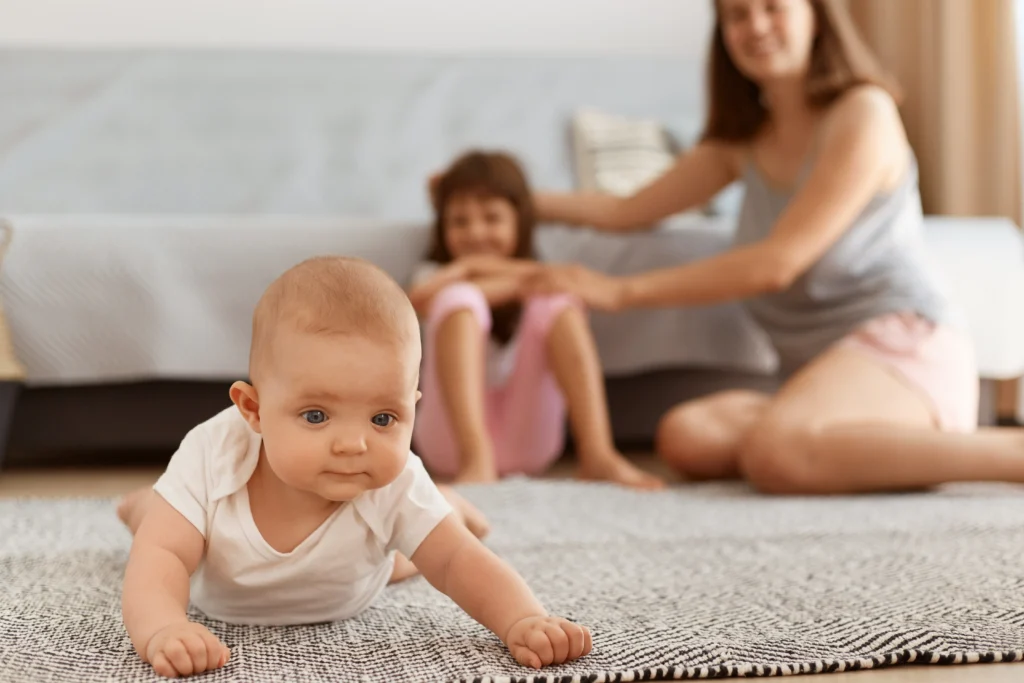
If your baby is approaching 9 months and cannot sit independently, arrange a discussion with a pediatrician rather than waiting indefinitely.
Certain signs may indicate that a more detailed developmental assessment is needed.
Poor head control
A baby who struggles to keep their head steady while being held or supported may have difficulties with postural control.
Persistent poor head control, particularly when accompanied by other movement difficulties, warrants assessment.
Difficulty maintaining an upright position
Some babies repeatedly collapse forwards or sideways when placed in a sitting position.
Occasional loss of balance is expected during learning. However, an inability to maintain any unsupported sitting position by around 9 months should be discussed with a healthcare professional.
Unusually stiff or floppy muscles
Notice whether your baby’s body appears unusually rigid or floppy during everyday activities.
Differences in muscle tone can affect trunk stability, balance and the ability to maintain an upright posture.
Limited movement or reaching
Babies gradually learn to reach for toys, shift their weight and use both hands while sitting.
If your baby has difficulty reaching, rarely moves their arms or legs, or consistently favors one side, discuss these observations with a healthcare professional.
Difficulty with other developmental milestones
Delayed sitting becomes more concerning when accompanied by difficulties with other motor skills, such as rolling, head control or pushing up during tummy time.
The American Academy of Pediatrics recommends evaluating motor development through developmental surveillance and appropriate screening.
Its clinical report highlights the importance of observing motor symmetry, posture, muscle tone and functional movement. (Noritz & Murphy, 2013)
Loss of previously acquired skills
If your baby previously maintained a sitting position or demonstrated another movement skill but has stopped doing so, seek prompt medical assessment.
Loss of previously acquired developmental skills should never be considered normal variation.
How Can Parents Help Their Baby Learn to Sit Independently?
Parents can encourage sitting development through safe, supervised play that helps babies practice balance, trunk control and coordinated movement.
The objective is to provide opportunities for movement rather than force a baby into a position before they are developmentally ready.
1. Encourage supervised tummy time
Tummy time helps babies develop neck, shoulder and upper-body strength.
These muscles contribute to the postural control required for sitting.
Place your baby on their tummy while awake and supervised. Use toys or your voice to encourage head lifting, looking around and reaching.
Begin with manageable sessions and gradually increase the duration according to your baby’s tolerance.
2. Practise supported sitting
When your baby has sufficient head control, practise supported sitting on a firm floor mat.
Support the baby around the hips or lower trunk rather than pulling their arms.
This gives the baby opportunities to experience an upright position while gradually developing postural control.
Remain close enough to prevent falls, as babies can lose their balance unexpectedly.
3. Encourage reaching for toys
Place a lightweight toy within comfortable reach while your baby is sitting with appropriate support.
Encourage them to reach forwards and towards either side.
These activities help babies practice weight shifting, trunk movement and balance.
Avoid placing toys too far away or encouraging movements that cause the baby to lose control.
4. Introduce side-lying play
Side-lying activities allow babies to explore different body positions and practice reaching across their bodies.
Place your baby on their side while awake and supervised, offering a toy within comfortable reach.
This encourages coordinated movement of the arms, trunk and head.
5. Provide regular floor-play opportunities
Allow your baby time to explore movement on a safe, firm play mat.
Reaching, kicking, rolling and changing positions provide movement experiences that contribute to later motor skills.
Avoid keeping babies in restrictive equipment for unnecessarily long periods when they could safely engage in supervised floor play.
Important safety guidance: Never leave your baby unattended while practicing sitting. Avoid propping babies with pillows or using sitting devices as a substitute for supervised practice. Always place babies on their backs for sleep.
How Does Pediatric Physiotherapy Help Babies Who Are Not Sitting?
Pediatric physiotherapy plays an important role in assessing and supporting babies who experience difficulties with gross motor development.
When a baby is not sitting independently, a pediatric physiotherapist evaluates the movement skills contributing to sitting rather than focusing only on the milestone itself.
Assessment of trunk control and postural stability
The physiotherapist observes how well the baby maintains an upright position and controls the head, trunk and pelvis.
They assess whether the baby leans excessively, collapses forwards or struggles to maintain balance.
The quality of movement is important.
Two babies may sit for a similar duration but demonstrate very different levels of postural control.
Evaluation of muscle strength and tone
The physiotherapist examines movement patterns, muscle tone and the baby’s ability to activate muscles required for postural stability.
This helps identify whether weakness, altered muscle tone or coordination difficulties may be contributing to delayed sitting.
Assessment of righting reactions
Righting reactions are automatic movements that help babies bring their head and body back towards an upright position when their balance is disturbed.
For example, when a baby leans slightly to one side, the head and trunk gradually adjust to help maintain alignment.
These reactions contribute to postural stability and become increasingly important as babies develop independent sitting.
Assessment of protective extension
Protective extension refers to the ability to extend an arm towards the floor when losing balance, helping protect the body from a fall.
A physiotherapist may observe these responses as part of a broader assessment of postural control and motor development.
The timing and quality of these responses depend on developmental stage, so they should be interpreted clinically rather than used as a home diagnostic test.
Evaluation of balance and weight shifting
Sitting requires babies to move their bodies without immediately losing stability.
A physiotherapist may observe how the baby responds to reaching, turning and changes in body position.
These activities help identify difficulties with dynamic sitting balance and trunk coordination.
Individualized physiotherapy activities
Depending on the assessment, a physiotherapist may recommend:
- Supported sitting activities to develop trunk control.
- Reaching activities to encourage controlled weight shifting.
- Tummy time to develop upper-body strength.
- Side-lying play to encourage coordinated movement.
- Age-appropriate floor activities to improve postural control.
- Practice of transitions between lying, sitting and other positions when developmentally appropriate.
Activities should be tailored to the baby’s individual needs rather than using the same exercises for every infant.
Parent education and home programs
Parents play an important role in supporting motor development.
A pediatric physiotherapist can demonstrate appropriate positioning, handling techniques and home activities so parents can safely encourage movement during everyday play.
The objective is to improve functional movement and independence, not simply to make the baby sit as early as possible.
Myth vs Fact: Baby Sitting Development
MYTH: Every baby must sit independently at exactly six months.
FACT: Babies develop sitting skills at different ages. Sitting without support is a CDC nine-month milestone.
MYTH: If a baby can sit for a few seconds, independent sitting is complete.
FACT: Dynamic balance, reaching and maintaining posture during movement are also important.
MYTH: A baby who falls forward while sitting has weak muscles.
FACT: Falling forward may reflect developing trunk control and balance. Persistent difficulties need assessment.
MYTH: Premature babies should follow the same milestone timetable as full-term babies.
FACT: Corrected age may be used when monitoring the development of babies born prematurely.
MYTH: Physiotherapy is only necessary for babies with diagnosed conditions.
FACT: Pediatric physiotherapy can also assess movement difficulties and guide developmental support.
Why Is Early Physiotherapy Assessment Important?
Early assessment can help identify babies who may need additional support before movement difficulties become more established.
The American Academy of Pediatrics recommends early identification of motor delays because timely referral can support developmental intervention, diagnostic evaluation and appropriate treatment planning. (Noritz & Murphy, 2013)
For babies with suspected motor delays, physiotherapy may form part of a multidisciplinary care plan involving pediatricians, developmental specialists and other healthcare professionals.
However, not every baby who sits later needs a structured physiotherapy program.
The need for treatment depends on the assessment findings, overall development and underlying cause.
Does Delayed Sitting Mean a Developmental Disorder?
No. A baby who is late to sit independently does not necessarily have a developmental disorder.
Some babies take longer to develop postural control, while others may experience difficulties related to muscle tone, coordination, strength or underlying medical conditions.
The important consideration is the baby’s overall developmental progress.
Healthcare professionals assess several factors, including:
- Head and trunk control.
- Muscle tone and functional strength.
- Movement symmetry.
- Rolling and reaching abilities.
- Balance and postural reactions.
- Progress towards other age-appropriate milestones.
A developmental milestone should never be interpreted in isolation. The quality of movement, the baby’s medical history and the presence of other developmental concerns all contribute to clinical decision-making.
Final Thoughts
Every baby develops at their own pace, and learning to sit independently takes time, practice and coordination. While some babies sit earlier, others need more time to develop the balance and trunk control required for this milestone.
If your baby is approaching 9 months and is still unable to sit without support, consider seeking professional advice. Pediatric physiotherapy can help assess movement difficulties and guide parents towards appropriate developmental activities.
Every little movement is a step towards greater independence!
Conclusion
Independent sitting is an important milestone that develops gradually as babies improve their head control, trunk stability, balance and coordination.
Although many babies develop independent sitting during the first nine months, developmental timing varies.
By 9 months, sitting without support and getting into a sitting position independently are important milestones to monitor.
Parents can encourage sitting development through supervised tummy time, supported sitting, reaching activities and regular floor play.
However, if a baby is approaching 9 months and cannot sit independently, or shows other signs of motor delay, professional assessment is recommended.
Pediatric physiotherapy can help identify movement difficulties, assess postural control and guide parents in supporting their baby’s development safely.
The goal is not to rush developmental milestones but to help every baby build the strength, balance and coordination needed for independent movement.
Frequently Asked Questions
1. At what age should a baby sit independently?
Many babies develop independent sitting during the first nine months. The CDC identifies sitting without support as a nine-month milestone.
2. Is it normal for a 7-month-old baby not to sit independently?
Some seven-month-old babies are still developing independent sitting. However, their overall movement, head control and progress with other milestones should also be considered.
3. Why does my baby fall forward when sitting?
A baby may fall forwards because trunk control and balance are still developing. Persistent difficulty maintaining an upright position should be discussed with a paediatrician.
4. Should I make my baby sit with pillows?
Avoid relying on pillows or positioning devices to prop your baby into sitting. Instead, provide supervised, age-appropriate floor play and supported sitting when appropriate.
5. Can physiotherapy help a baby who is not sitting?
Yes. Pediatric physiotherapy can assess trunk control, muscle tone, balance and movement patterns, and provide individualized activities when additional support is needed.
Stay tuned with us for more health related topics.
Follow us on LinkedIn and Instagram for more.
More Read


Medical Disclaimer
This article is intended for general educational and informational purposes only. It does not replace professional medical advice, diagnosis or treatment. Every baby’s development is different, and developmental milestones may vary. If you have concerns about your baby’s sitting ability, posture, muscle tone or movement, consult a qualified pediatrician or pediatric physiotherapist. Never delay seeking professional medical advice because of information read online.


