
vcure long logo vcure long logo
  • Physiotherapy
  • Health & Fitness
  • News
Reading: All you need to know about breastfeeding- Part 2
V CureV Cure
Font ResizerAa
Search
Follow US
© Vcure Healthcare 2025. All Rights Reserved.
Child & Mother Carewomens health

All you need to know about breastfeeding- Part 2

VCure Healthcare
Last updated: May 11, 2022 8:06 PM
By VCure Healthcare
3 Min Read
Share
SHARE

Attachment during breastfeeding-

A baby needs to be well attached, to the womans body to stimulate and also to remove milk from the breast. A good attachment is also essential to ensure an adequate supply and a good flow of milk.

Important points to note-

  1. Hold your baby close.
  2. Let your baby’s head tip back.
  3. When your baby is attached properly, their chin will be pressed onto your breast.
  4. Your baby’s nose should be clear for easy breathing.
  5. In the correct position, your baby will be able swallow and also breathe comfortably.
  6. If your baby’s nose appears to be blocked, move their bottom closer to you. This will thus create a head tilt.
  7. Their cheeks will appear fuller.

Positioning

Position of the mother

The mother can sit or be lying down, or standing. She needs to be relaxed and also comfortable. It is essential that the back Is not strained. If sitting use a pillow for support, and she should not be leaning forward while holding the baby.

Position of the baby

  • The baby’s body should be straight. Also the baby’s head can be slightly extended at the neck.
  • The baby’s body should be close to the mother.
  • His or her whole body should be supported by pillows or also on mothers lap.

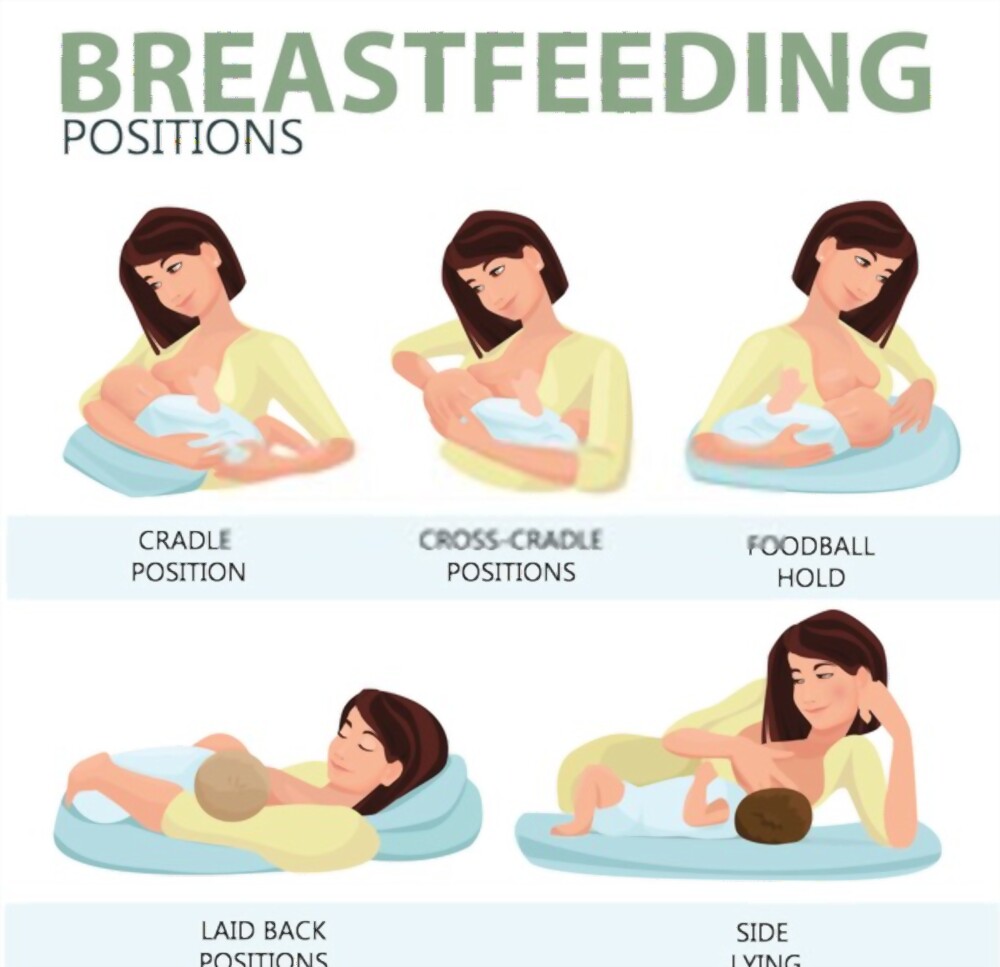
Some of the positions that can be used for breastfeeding:

  1. Laid back position: Shift your hips forward to create a semi-reclined position.You can also use pillows and cushions to provide support wherever you need it.

2. Cradle: Mother hold the head of the baby on the elbow of the same upper extremity from the breast in which she is feeding, while the buttock of the baby supported on the hand of the mother. It is recommended that the mother puts pillows behind her back and also under the elbow

3. Cross- cradle: The mother should sit upright and put pillows behind her back. If the infant is feeding at the left breast, the mother holds the infant with the right hand and vice versa.

4. Side-lying:

Mother and the baby lie down facing each other.(your neck and back should be supported.) Take the arm that you’re lying on to support your baby. You can use a pillow behind your baby’s back for support.

This position is usually not advisable as milk can enter into the ear.
feeding- vcurehealthcare

Also read- https://vcurehealthcare.com/know-how-to-exercise-for-a-healthy-pelvic-floor/

You Might Also Like

Heart Valve Treatments: The Game-Changing Innovations You Need to Know!

Color Doppler Pregnancy Scan: Everything You Need to Know

Canada’s Measles Outbreak Exposes Vaccine Gaps

Unlocking Knee Pain Relief: How Physiotherapy Can Change Your Life!

Vaginal Odor: When It’s Normal and When to Worry

TAGGED:vcurehealthcare
Share This Article
Facebook Email Copy Link Print

Latest

Baby-Led Weaning vs Spoon-Feeding
Baby-Led Weaning vs Spoon-Feeding: Which Is Better for Your Baby?
Child & Mother Care Physiotherapy
Separation Anxiety in Toddlers
Separation Anxiety in Toddlers: How to Make Goodbyes Easier
Child & Mother Care Physiotherapy
Food Allergies in Babies
Food Allergies in Babies: Early Symptoms and Emergency Warning Signs
Child & Mother Care Physiotherapy
Baby sleep regression
Baby Sleep Regression: Why Is Your Baby Suddenly Waking at Night?
Child & Mother Care Physiotherapy

More Articles

Separation Anxiety in Toddlers
Child & Mother CarePhysiotherapy

Separation Anxiety in Toddlers: How to Make Goodbyes Easier

By Dr. Kruti Raj (PT, MUHS, CPT, CMPT)
29 Min Read
Food Allergies in Babies

Food Allergies in Babies: Early Symptoms and Emergency Warning Signs

By Dr. Kruti Raj (PT, MUHS, CPT, CMPT)
Baby-Led Weaning vs Spoon-Feeding
Child & Mother CarePhysiotherapy

Baby-Led Weaning vs Spoon-Feeding: Which Is Better for Your Baby?

By Dr. Kruti Raj (PT, MUHS, CPT, CMPT)
33 Min Read
Child & Mother CarePhysiotherapy

Baby Sleep Regression: Why Is Your Baby Suddenly Waking at Night?

Your baby was finally sleeping for longer stretches. Bedtime had become more predictable, night feeds were…

By Dr. Kruti Raj (PT, MUHS, CPT, CMPT)
Child & Mother CarePhysiotherapy

Baby Reflux vs Normal Spitting Up: Signs Parents Should Know

Baby reflux vs normal spitting up Seeing milk come back up after a feed is common…

By Dr. Kruti Raj (PT, MUHS, CPT, CMPT)
Child & Mother CarePhysiotherapy

Brachycephaly in Infants: Why Is the Back of Baby’s Head Flat?

Brachycephaly in Infants Have you noticed that the back of your baby's head looks flatter than…

By Dr. Kruti Raj (PT, MUHS, CPT, CMPT)
Child & Mother CarePhysiotherapy

Tummy Time: How Much Does Your Baby Need at Each Age?

Tummy time is an important part of a baby's early movement and physical development. It gives…

By Dr. Kruti Raj (PT, MUHS, CPT, CMPT)
Child & Mother CarePhysiotherapy

Positional Plagiocephaly: Why Does One Side of a Baby’s Head Look Flat?

Parents sometimes notice that one side of their baby's head looks flatter than the other. The…

By Dr. Kruti Raj (PT, MUHS, CPT, CMPT)
Child & Mother CarePhysiotherapy

Baby Flat Head Syndrome: When Can Repositioning Help?

Noticing a flat area on your baby's head can be worrying, especially during the first few…

By Dr. Kruti Raj (PT, MUHS, CPT, CMPT)
V Cure

Vcure Healthcare is All-in-One integrated Healthcare platform which helps to better manage chronic illnesses, prescription management & creates a continuum of care.

Categories

  • Physiotherapy
  • Health & Fitness
  • Child & Mother Care
  • Mental Health
  • Lifestyle
  • Diet & Nutrition
  • womens health
  • healthcare news

Quick Links

  • About Us
  • Contact

© Vcure Healthcare 2025. All Rights Reserved.

Welcome Back!

Sign in to your account

Username or Email Address
Password

Lost your password?

Not a member? Sign Up