


How breast weight affects posture is more complex than simply “pulling the shoulders forward.
Breast size and weight can influence how the upper body is loaded during standing, sitting and movement.
For some women, heavier breasts may place additional demands on the neck, shoulders, upper back and chest muscles.
Over time, this may contribute to discomfort, fatigue or changes in how a person naturally positions their body.
Quick Answer
Breast weight can influence the mechanical load placed on the neck, shoulders, upper back and trunk, which may contribute to discomfort or postural changes in some women. However, large breasts do not automatically cause poor posture or pain. Physiotherapy can help by improving strength, mobility, endurance and movement strategies so the body can manage everyday loads more comfortably.
However, breast size does not automatically mean that someone will have poor posture or pain.
Posture is influenced by many factors, including muscle strength, mobility, movement habits, physical activity, body structure and the demands placed on the body.
Key Takeaways
- Breast weight can increase the mechanical demands placed on the upper body.
- Large breasts do not automatically cause poor posture or pain.
- Strength and endurance of the upper back, shoulders and trunk can help the body manage physical loads.
- Posture should not be treated as a single “perfect” position that must be maintained all day.
- Physiotherapy can assess individual movement patterns and develop an appropriate exercise programme.
- A supportive bra may improve comfort, particularly during physical activity, but it is not a standalone posture treatment.
How Can Breast Weight Affect Posture?
The breasts are positioned toward the front of the chest.
As breast volume and weight increase, the body may need to accommodate this additional anterior load.
This does not mean the body simply gets “pulled forward.”
The spine, rib cage, shoulder blades and muscles work together to maintain balance.
The body continually makes small adjustments to keep the head and trunk positioned over the base of support.
When the load is substantial, these adjustments may increase the physical demands placed on certain tissues.
Does Having Large Breasts Cause Forward Head Posture?
Not necessarily.
Forward head posture can have many contributing factors, including prolonged sitting, screen use, occupational demands, reduced upper-body endurance and individual anatomy.
Breast weight may be one factor that influences how a person positions their upper body, particularly when combined with other physical demands.
It is therefore more accurate to think about overall mechanical loading rather than blaming breast size alone.
Can Breast Weight Pull the Shoulders Forward?
Heavier breasts may contribute to increased demand on the muscles that support the shoulder girdle.
Some women may naturally adopt a more rounded or guarded shoulder position because it feels comfortable or reduces the sensation of pulling.
Others may maintain a relatively upright posture without difficulty.
There is no single posture that every woman with larger breasts will develop.
What Happens to the Upper Back?
The thoracic spine and surrounding muscles play an important role in supporting the upper body.
When the shoulders and trunk are repeatedly positioned in a way that increases muscular demand, the upper-back muscles may become fatigued.
This can contribute to aching or discomfort, particularly after prolonged standing, sitting or physical activity.
A systematic review of women with macromastia found associations between breast size and musculoskeletal symptoms, including back, neck and shoulder complaints, although individual experiences vary (Lotan et al., 2025)
Can Large Breasts Affect Neck Posture?
They can contribute to the overall mechanical demands placed on the upper body.
The neck supports the weight of the head and works together with the thoracic spine and shoulder girdle.
If the upper back and shoulders become fatigued, the neck muscles may also have to work harder to maintain comfortable head positioning.
This does not mean that breast weight directly causes neck problems in every woman.
Instead, it can be one component of a larger interaction between body structure, movement and physical load.
Can Breast Weight Cause Shoulder Tension?
Shoulder tension can occur when the muscles around the neck and shoulder girdle are working continuously to support the upper body.
This may become more noticeable during prolonged standing, walking, household activities or exercise.
Bra straps can also create pressure across the shoulders in some women, particularly when breast weight is substantial.
However, shoulder discomfort can have many causes, so breast weight should not automatically be assumed to be responsible.
Is Poor Posture the Real Problem?
Not always.
The idea that there is one “bad posture” responsible for pain is an oversimplification.
A posture can become uncomfortable when it is maintained for too long or when the body does not have sufficient capacity to tolerate the physical demands placed on it.
This is why physiotherapy generally focuses on movement variability, strength, endurance and functional capacity, rather than simply telling someone to “sit up straight.”
Can Breast Weight Increase Muscle Fatigue?
Potentially.
The muscles supporting the spine and shoulder girdle have to respond to the loads placed on the body throughout the day.
If the physical demand exceeds a person’s current endurance, fatigue may develop.
For women with heavier breasts, activities such as prolonged standing, walking or exercise may sometimes increase the perceived load through the upper body.
Building appropriate strength and endurance can help improve the body’s capacity to manage everyday demands.
Does Breast Size Affect Everyone’s Posture in the Same Way?
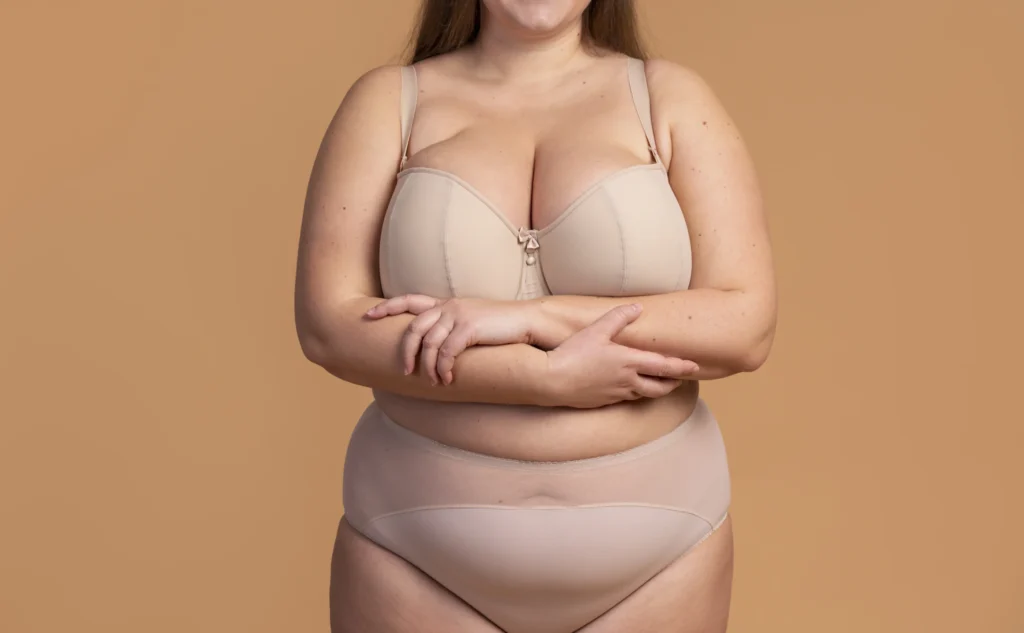
No.
Two women with similar breast sizes can have completely different posture, strength, mobility and pain experiences.
Factors such as body proportions, activity levels, occupation, previous injuries, fitness, breast shape and the way someone moves can all influence how the body responds to load.
This is why an individual assessment is more useful than assuming that breast size automatically determines posture.
What Role Does Physiotherapy Play?
A physiotherapist can assess how the neck, thoracic spine, shoulders, rib cage and surrounding muscles work together.
Rather than focusing only on appearance, the assessment can examine whether particular movements or positions reproduce symptoms and whether strength or mobility limitations are contributing.
Treatment may include strengthening, mobility exercises, movement retraining and strategies for gradually increasing tolerance to activities that cause discomfort.
The objective is not to force the body into a “perfect” posture.
It is to help the person move comfortably and develop enough physical capacity to manage their everyday demands.
How Can Physiotherapy Address Posture-Related Problems?
Physiotherapy does not aim to force the spine into one “correct” posture.
Instead, the focus is usually on improving the body’s ability to tolerate load, move efficiently and perform everyday activities with less discomfort.
For women with heavier breasts, this may involve assessing the thoracic spine, shoulder blades, neck, chest and trunk, followed by an individualised programme of strengthening, mobility and endurance exercises.
Research has found that women with larger breasts can experience differences in upper-torso posture, shoulder movement and scapular muscle endurance, which may help physiotherapists understand some of the mechanical factors contributing to symptoms (McGhee et al., 2018)
Which Muscles Are Important for Supporting Posture?
Postural control involves multiple muscle groups rather than one specific “posture muscle.”
The muscles around the shoulder blades, upper back, neck and trunk work together to control the position of the upper body during standing, reaching, lifting and other activities.
Important contributors include the trapezius, rhomboids, serratus anterior, deep neck muscles and spinal extensor muscles.
The goal is not to keep these muscles contracted throughout the day. Instead, they need sufficient strength and endurance to respond to changing loads and movements.
Can Strengthening the Upper Back Improve Posture?
Strengthening can be useful when reduced muscle strength or endurance is contributing to difficulty tolerating everyday activities.
Exercises such as rows and other resistance-based movements can help develop the capacity of the upper-back and shoulder muscles.
This is particularly relevant because women with larger breasts have been found to demonstrate differences in scapular retraction muscle endurance and shoulder movement compared with women with smaller breasts (McGhee et al., 2018)
However, strengthening should be progressive and individualised.
Doing large numbers of exercises simply to “pull the shoulders back” is not necessarily helpful.
The aim should be to improve the body’s capacity for movement rather than maintain a rigid position.
What About the Chest Muscles?
The chest muscles contribute to shoulder and arm movement, so their mobility and function can be considered during a physiotherapy assessment.
If someone spends long periods in one position, the chest and shoulder region may feel stiff or uncomfortable.
A physiotherapist may therefore include comfortable chest mobility exercises alongside strengthening and movement work.
The goal is not to permanently stretch the chest or force the shoulders backward.
It is to improve comfortable movement between the chest, rib cage, shoulder blades and thoracic spine.
Can Breathing Affect Posture?
Breathing and posture are closely connected because the rib cage, diaphragm and muscles around the trunk and neck work together during breathing.
When someone is uncomfortable or under stress, they may also change their breathing pattern and increase tension around the neck and shoulders.
Relaxed breathing can therefore be included as a supportive component of a broader movement programme when appropriate.
However, breathing exercises should not be presented as a standalone treatment for breast-related musculoskeletal symptoms.
Can a Supportive Bra Improve Posture?
A properly fitting supportive bra may make everyday activities more comfortable for some women with heavier breasts.
Support can be particularly relevant during physical activity, when breast movement and the mechanical load on the upper torso may increase.
However, a supportive bra should not be considered a treatment for posture by itself.
The objective should be to improve overall comfort and support while also addressing strength, movement and physical capacity where required.
Can the Wrong Bra Cause Shoulder and Back Problems?
An uncomfortable or poorly fitting bra may contribute to pressure around the shoulders and upper torso.
However, it would be too simplistic to say that a particular bra is the sole cause of neck, shoulder or back pain.
Breast weight, body composition, physical activity, muscle endurance, work demands and individual movement patterns can all influence symptoms.
This is another reason why a physiotherapy assessment should look at the whole upper-body movement system, rather than focusing only on the bra.
Can Exercise Reduce the Effects of Breast Weight on Posture?
Exercise cannot remove the physical weight of the breasts, but it can help improve the body’s capacity to manage physical loading.
A suitable programme may combine:
- Upper-back strengthening
- Shoulder-blade control
- Thoracic mobility
- Trunk strengthening
- Neck and shoulder exercises
- General cardiovascular activity
- Gradual endurance training
Research involving women across different breast-size groups found that increasing breast size was associated with increasing thoracic flexion torque, while women with hypertrophic breasts reported greater musculoskeletal pain involving the upper back, shoulders, neck and breasts (Coltman et al., 2019)
This provides a useful biomechanical rationale for improving the body’s ability to tolerate load rather than focusing only on posture appearance.
What Exercises Can Help?
There is no single exercise programme that is appropriate for every woman with larger breasts.
The choice should depend on symptoms, strength, mobility, fitness and daily activities.
Resistance-Band Rows
Rows can strengthen the muscles involved in controlling the shoulder blades and upper back.
Start with manageable resistance and focus on smooth, controlled movement rather than aggressively squeezing the shoulder blades together.
Wall Angels
Wall-based arm movements can encourage coordinated movement between the shoulders and thoracic spine.
They should be performed through a comfortable range.
Forcing the arms against the wall is unnecessary.
Thoracic Extension
Gentle thoracic extension exercises can help maintain mobility through the upper back.
This can be particularly useful for people who spend long periods sitting, although the exercise should be adapted if extension increases symptoms.
Chin Tucks
Gentle chin-tuck exercises can help train the deep neck muscles and improve awareness of head and neck positioning.
They should be performed without clenching the jaw or creating neck discomfort.
Scapular Control Exercises
Exercises that improve shoulder-blade control can help with reaching, lifting and other upper-body movements.
The focus should be on controlled movement, rather than holding the shoulder blades permanently “back and down.”
How Often Should You Exercise?
There is no single frequency that applies to everyone.
A consistent, manageable programme is generally more practical than occasional high-intensity exercise.
Exercise should be progressed gradually according to tolerance.
If symptoms consistently become worse during or after exercise, the intensity, range of movement, technique or exercise selection may need to be modified.
Can Losing Weight Reduce the Effects of Breast Weight?
Not necessarily.
Breast composition varies between individuals, and breast size does not always change predictably with overall weight loss.
Therefore, weight loss should not be presented as a universal solution for breast-related musculoskeletal symptoms.
Research examining breast size and spinal posture found that increasing cup size was associated with changes in kyphotic angle and surface rotation, but body mass index also had a significant influence on several posture measurements (Michalik et al., 2024)
This highlights why posture should be assessed as a whole rather than attributing every postural difference to breast weight alone.
When Should You Consider Further Medical Advice?
Persistent neck, shoulder or back pain that interferes with work, exercise, sleep or daily activities deserves appropriate assessment.
You should also seek medical evaluation if you notice a new breast lump, nipple discharge, skin or nipple changes, significant swelling or another unexplained breast change.
Breast size can contribute to mechanical symptoms, but it should not be used to explain away a new or unusual breast symptom.
Can Physiotherapy Prevent Posture Problems Caused by Large Breasts?
Physiotherapy may help improve strength, mobility, endurance and movement strategies, allowing the body to manage physical loading more comfortably.
It cannot guarantee that breast weight will never contribute to symptoms.
The goal is therefore not to achieve a permanently “perfect” posture.
Instead, the focus is on developing enough physical capacity and movement flexibility to handle the demands of everyday life.
Research supports the idea that breast size can influence mechanical loading of the upper torso, while other factors such as body mass also affect posture and musculoskeletal symptoms (Coltman et al., 2019)
This is why an individual physiotherapy assessment is more useful than assuming that breast size alone determines posture or pain.
Can Breast Weight Affect Everyday Activities?
Breast weight can become more noticeable during activities that require prolonged standing, walking, reaching or upper-body movement.
For some women, discomfort may develop gradually rather than immediately.
The symptoms may appear as muscle fatigue, aching around the shoulders, tightness across the upper back or discomfort around the neck.
The important point is that breast weight is only one potential contributor.
A person’s strength, activity level, body structure, work demands and movement habits can all influence how their body responds to the load.
Why Can Standing for Long Periods Be Uncomfortable?
When you stand for an extended period, the muscles of the trunk, upper back and shoulders continuously make small adjustments to keep the body balanced.
If the physical demands exceed your current endurance, muscular fatigue may develop.
For women with heavier breasts, the additional anterior load may increase the demand placed on the upper torso.
This may become more noticeable during prolonged standing, particularly if the person already has neck, shoulder or upper-back discomfort.
Changing position regularly and building general strength and endurance can be more useful than trying to maintain one rigid posture.
Can Walking or Running Be More Difficult With Large Breasts?
It can be for some women.
During higher-impact activities, breast movement can increase discomfort and may make exercise less comfortable.
This can lead some women to avoid running, jumping or other activities altogether.
A supportive sports bra, appropriate exercise progression and gradual conditioning may help improve comfort.
If pain continues despite these adjustments, a physiotherapist can assess whether other factors, such as shoulder mechanics, thoracic mobility or muscular endurance, are contributing.
Can Breast Weight Affect Exercise Technique?
It may influence how comfortable certain movements feel.
For example, exercises involving repeated arm movements, jumping or prolonged upper-body activity may feel more demanding when breast movement or weight creates discomfort.
This does not mean that women with large breasts need a completely different exercise programme.
Instead, exercises can often be modified by changing the resistance, range, speed, position or impact level.
The aim is to find movements that are challenging enough to build capacity without repeatedly aggravating symptoms.
Is Posture Something You Should Constantly Correct?
No.
Trying to hold yourself upright all day by pulling your shoulders back and keeping your chest lifted can actually create unnecessary muscular tension.
The body is designed to move between different positions.
A more useful approach is to develop the strength and endurance to move comfortably between positions.
For example, instead of worrying about whether your shoulders are rounded while working at a desk, consider changing position regularly, taking movement breaks and strengthening the muscles that help you perform your daily activities.
Can Physiotherapy Help With Pain Caused by Breast Weight?
Physiotherapy may be helpful when symptoms have a musculoskeletal component.
A physiotherapist may assess:
- Neck movement
- Thoracic spine mobility
- Shoulder movement
- Scapular control
- Muscle strength and endurance
- Breathing patterns
- Work and exercise habits
- Activities that reproduce symptoms
Treatment can then be tailored to the individual’s findings.
This might include therapeutic exercise, mobility work, movement retraining, manual therapy where appropriate and advice about gradually increasing activity.
What Happens During a Physiotherapy Assessment?
A physiotherapy assessment should go beyond simply looking at whether someone appears to have “good” or “bad” posture.
The physiotherapist may ask when the symptoms began, which activities aggravate them and whether symptoms change throughout the day.
They may then examine the movement of the neck, thoracic spine and shoulders and assess strength and endurance.
The purpose is to determine what is contributing to the symptoms, rather than assuming breast size is automatically responsible.
Can Physiotherapy Reduce the Weight of the Breasts?
No.
Physiotherapy cannot reduce breast tissue or physically remove breast weight.
What it can do is help improve how the body responds to the mechanical demands associated with that weight.
This distinction is important.
The treatment goal is usually to improve function, strength, mobility and comfort, rather than to change breast size.
When Might Breast Reduction Surgery Be Considered?
For some women, symptoms associated with very large breasts can be significant enough to interfere with daily life, exercise, work or quality of life.
In such cases, breast reduction surgery may be discussed with an appropriately qualified healthcare professional.
Physiotherapy can still have a role in conservative management and may also form part of rehabilitation before or after surgery when clinically appropriate.
The decision about surgery is individual and should be made through discussion with the relevant medical team.
Myth vs Fact
Myth: Large breasts automatically cause poor posture.
Fact: Breast weight can influence upper-body loading, but posture is also affected by strength, mobility, activity, body composition, habits and individual anatomy.
Myth: You need to keep your shoulders pulled back all day.
Fact: The body naturally moves between different positions. Building strength, endurance and movement capacity is generally more useful than holding one rigid posture.
What Are Some Lesser-Known Facts About Breast Weight and Posture?
Breast Size Does Not Automatically Mean Poor Posture
A woman can have large breasts and excellent strength, mobility and movement control.
Breast size is one physical factor among many.
Pain Is Not Always Proportional to Breast Size
Two women with similar breast sizes can have completely different symptoms.
Pain is influenced by physical loading as well as individual sensitivity, activity, previous injuries and many other factors.
“Perfect Posture” Is Not the Goal
There is no single posture that the body needs to maintain throughout the day.
Being able to change positions and tolerate different loads is often more meaningful than maintaining one ideal-looking position.
Strong Muscles Do Not Make Breast Weight Disappear
Strengthening can improve the body’s capacity to manage load, but it does not remove the mechanical weight of the breasts.
If symptoms remain significant despite appropriate conservative management, further assessment may be appropriate.
Support and Exercise Can Work Together
A supportive bra may improve comfort during daily activities or exercise, while strengthening and conditioning can improve physical capacity.
These approaches address different aspects of the problem and may complement one another.
Final Thoughts
Breast weight can be one factor affecting how the upper body manages everyday physical loads, but it does not determine posture or pain on its own. If larger breasts are contributing to neck, shoulder or upper-back discomfort, improving strength, mobility, endurance and movement confidence may help.
Physiotherapy can provide an individualised approach based on your symptoms, movement patterns and daily activities. The goal is not perfect posture, it is helping you move comfortably and giving your body the capacity to handle the demands of everyday life.
Conclusion
Breast weight can influence the mechanical demands placed on the upper body, and for some women this may contribute to neck, shoulder or upper-back discomfort.
However, breast size alone does not determine posture or pain.
Strength, endurance, mobility, physical activity, body composition, daily habits and individual anatomy all contribute to how the body manages load.
Physiotherapy can help by assessing these factors and developing an individualized program focused on strength, mobility, endurance and comfortable movement.
Rather than trying to maintain a perfectly upright posture throughout the day, the goal should be to build a body that is capable of moving, adapting and tolerating everyday demands with greater comfort.
Frequently Asked Questions
Can large breasts affect posture?
Large breasts may contribute to changes in upper-body loading and posture in some women. However, posture is influenced by many factors, including strength, mobility, activity and individual anatomy.
Can breast weight cause neck and shoulder pain?
Breast weight can contribute to mechanical loading around the neck and shoulders, although these symptoms can have many other causes.
Can large breasts cause rounded shoulders?
They may influence shoulder positioning in some women, but large breasts do not automatically cause rounded shoulders. Muscle endurance, movement habits and other physical factors also matter.
Can physiotherapy help posture affected by large breasts?
Physiotherapy may help improve strength, mobility, endurance and movement strategies. It cannot change breast size, but it can help the body manage physical loading more effectively.
What exercises are best for large breasts and posture?
There is no single best exercise. Depending on the assessment, a programme may include upper-back strengthening, scapular control, thoracic mobility, neck exercises and general conditioning.
Should I see a physiotherapist for pain related to large breasts?
Consider an assessment if neck, shoulder or upper-back pain is persistent, limits your activities or keeps returning. A physiotherapist can assess whether musculoskeletal factors are contributing.
Stay tuned with us for more health related topics.
Follow us on LinkedIn and Instagram for more.
More Read


Medical Disclaimer!
This article has been reviewed and written under the guidance of our Head Physiotherapist, Dr. Kruti Raj (PT, MUHS,CPT,CMPT). The information shared is intended for educational purposes only and should not be considered a substitute for personalized medical advice, diagnosis, or treatment.
Please consult us or any other qualified healthcare professional before beginning any exercise program, especially if you are experiencing pain, recovering from injury, or managing a medical condition.


