


Persistent pain behind the ankle or along its inner side is often attributed to an ankle sprain, Achilles tendon problem or joint impingement.
However, another possible cause is flexor hallucis longus (FHL) tendinopathy, a condition affecting the tendon that bends the big toe and helps the foot push off during walking, running and jumping.
Quick Answer: What Is FHL Tendinopathy?
Flexor hallucis longus (FHL) tendinopathy is a condition affecting the tendon that bends the big toe and helps the foot push off during walking, running and jumping. It can cause pain behind the inner ankle, beneath the foot or around the big toe.
The condition may develop when repetitive loading exceeds the tendon’s capacity. Physiotherapy can help manage symptoms through activity modification, appropriate mobility work and progressive strengthening. Because FHL problems can resemble other ankle conditions, an accurate clinical assessment is important.
Although associated with ballet dancers, FHL tendon problems can also affect runners and other physically active people.
Because symptoms may extend from the back of the ankle to the arch or big toe, this condition can be mistaken for other foot and ankle disorders.
Key Takeaways
- The FHL tendon helps bend the big toe and supports push-off during walking and running.
- FHL tendinopathy can cause pain behind the inner ankle, beneath the foot or around the big toe.
- Ballet dancers, runners and other active people may be affected by repetitive tendon loading.
- Posterior ankle impingement, Achilles tendinopathy and nerve-related conditions can cause similar symptoms.
- Physiotherapy may include activity modification, mobility exercises, progressive strengthening and functional rehabilitation.
- Exercise selection should be individualised because evidence for a specific FHL rehabilitation protocol remains limited.
- Persistent pain, painful catching or difficulty walking warrants professional assessment.
What Is Flexor Hallucis Longus Tendinopathy?
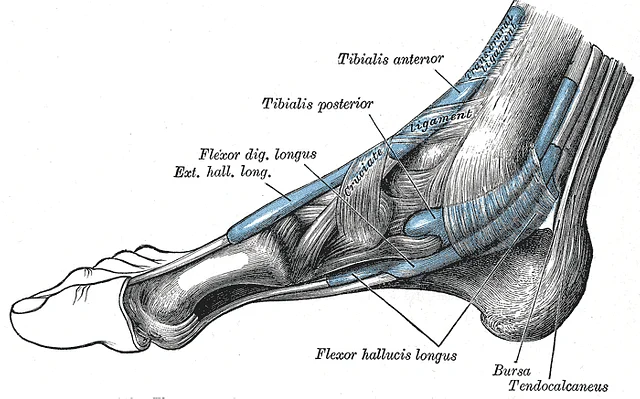
The flexor hallucis longus is a deep muscle in the back of the lower leg.
Its tendon travels behind the inner ankle, passes beneath the foot and attaches to the tip of the big toe.
It helps bend the big toe downward and contributes to push-off during walking, running, jumping and rising onto the toes.
FHL tendinopathy describes a tendon problem associated with pain and reduced tolerance to loading.
FHL tenosynovitis refers to irritation or inflammation of the sheath surrounding the tendon.
These conditions can occur together, but they are not interchangeable.
FHL disorders are recognized as an overlooked source of foot and ankle pain because their symptoms can resemble plantar fasciitis, tarsal tunnel syndrome and other tendon conditions (Schulhofer & Oloff, 2002)
Where Does FHL Tendinopathy Cause Pain?
The location of discomfort depends on which part of the tendon is affected.
- Behind the inner ankle: Pain may occur where the tendon passes behind the medial malleolus, the bony prominence on the inside of the ankle.
- At the back of the ankle: Symptoms may be aggravated by repeated pointing of the foot or activities involving deep ankle plantar flexion.
- Beneath the foot or along the arch: Pain may occur where the tendon travels through the sole.
- Around the big toe: Irritation or restricted tendon movement may cause discomfort when bending or straightening the toe.
A clinical study of 81 patients with FHL disorders found symptoms in several locations, including the posteromedial ankle, plantar heel and midfoot.
This variation helps explain why the condition can be overlooked (Michelson & Dunn, 2005)
What Causes Flexor Hallucis Longus Tendinopathy?
Repetitive loading
Repeated big-toe flexion and push-off movements place demands on the FHL tendon.
Symptoms may develop when training intensity, duration or frequency increases faster than the tendon can tolerate.
Running uphill, sprinting, jumping and repetitive heel raises may aggravate symptoms in susceptible individuals.
Ballet and pointe work
Ballet dancers repeatedly point their feet and rise onto their toes during pointe work and relevé.
These positions place substantial demands on the posterior ankle and FHL tendon.
FHL tendinopathy may occur alongside posterior ankle impingement, although either condition can also occur independently (Rietveld et al., 2018)
Restricted tendon movement
The FHL tendon passes through narrow anatomical spaces behind the ankle and beneath the foot.
Tendon-sheath irritation, thickening or restricted gliding may contribute to pain or catching during movement.
Previous injury and repeated overload may also play a role.
However, not every case has one identifiable cause, and symptoms should not automatically be attributed to poor technique or footwear.
What Are the Symptoms of FHL Tendinopathy?
Common symptoms include:
- Pain or tenderness behind the inner ankle.
- Discomfort during push-off when walking, running or jumping.
- Pain when bending the big toe against resistance.
- Stiffness or discomfort during certain ankle and toe movements.
- Reduced tolerance for running, dancing or prolonged walking.
- Clicking, creaking or a catching sensation in some cases.
Symptoms may initially appear only during activity and later interfere with everyday movement. However, symptom severity varies, and these features alone cannot confirm FHL tendinopathy.
How Is FHL Tendinopathy Different From Other Ankle Conditions?
Several conditions can cause similar pain, making clinical assessment important.
| Condition | Features that may help distinguish it |
|---|---|
| Flexor hallucis longus tendinopathy | Pain behind the inner ankle or along the tendon, sometimes aggravated by big-toe movement |
| Achilles tendinopathy | Pain and tenderness around the Achilles tendon at the back of the heel or lower calf |
| Posterior tibial tendinopathy | Pain along the inner ankle that may extend towards the arch and affect foot support |
| Plantar fasciitis | Pain beneath the heel or along the plantar fascia, often noticeable during the first steps after rest |
| Posterior ankle impingement | Pain at the back of the ankle, particularly during deep pointing of the foot |
| Tarsal tunnel syndrome | Burning, tingling or numbness around the inner ankle or sole |
These conditions can coexist. Persistent posterior ankle pain therefore requires consideration of several possible causes rather than assuming that one tendon is responsible (Luk et al., 2013)
How Is FHL Tendinopathy Diagnosed?
Physiotherapy assessment
A physiotherapist will ask about symptom location, training history, recent changes in activity and movements that aggravate the pain.
The assessment may include:
- Palpation of the FHL tendon and surrounding structures.
- Assessment of ankle and big-toe mobility.
- Resisted big-toe flexion, where appropriate.
- Calf strength and controlled heel-raise assessment.
- Walking, balance and functional movement analysis.
- Assessment of activity-specific demands, such as running or dance movements.
A clinician may examine how ankle position affects big-toe movement. Restricted movement or pain may support suspicion of FHL involvement, but no single test confirms the diagnosis in every case.
When is imaging needed?
Imaging may be considered if symptoms persist, the diagnosis remains uncertain or a more significant injury is suspected.
- Ultrasound: May help assess tendon structure, surrounding fluid and movement during dynamic examination.
- MRI: May help identify tendon or tendon-sheath abnormalities and other causes of posterior ankle pain.
- X-rays: May be useful when a bony abnormality or posterior ankle impingement is suspected.
Imaging findings should be interpreted alongside the clinical assessment.
An abnormal-looking tendon does not automatically mean it is the source of pain.
How Can Physiotherapy Help FHL Tendinopathy?
Physiotherapy aims to manage symptoms, restore comfortable movement and gradually rebuild the foot and ankle’s capacity for activity.
1. Modify aggravating activities
Temporarily reducing painful activities can help manage excessive tendon loading. Depending on the person’s routine, this may involve adjusting running distance, hill training, jumping, pointe work or repeated heel raises.
Complete rest is not always necessary. The goal is to maintain tolerable activity without repeatedly provoking significant symptoms.
2. Restore ankle and big-toe mobility
Gentle, controlled ankle and toe movements may help maintain comfortable mobility when stiffness is present.
Aggressive stretching should be avoided if it reproduces sharp pain, catching or substantial discomfort. The appropriate movement programme depends on the cause and irritability of the symptoms.
3. Build strength progressively
Once symptoms allow, a physiotherapist may introduce graded strengthening for the big-toe flexors, calf muscles and other foot and ankle muscles.
The load should increase according to pain response, strength and functional progress.
There is limited high-quality research establishing one optimal exercise protocol specifically for flexor hallucis longus tendinopathy, so treatment should be individualised.
4. Improve balance and movement control
Balance training, controlled heel raises and functional exercises may help restore confidence and movement control.
For runners and dancers, rehabilitation should eventually reflect the demands of their activity rather than focusing exclusively on isolated muscle strengthening.
5. Plan a gradual return to sport
Return-to-activity planning may include progressively increasing walking duration, running drills, jumping or dance-specific movements.
A physiotherapist can monitor symptoms during exercise and afterward, adjust training loads and help determine when more demanding activities can be reintroduced.
Exercises That May Be Used During Rehabilitation
Exercises should be selected according to the diagnosis, symptom severity and current functional ability.
The following are examples, not a universal programme.
Gentle ankle movements
Move the ankle slowly up and down within a comfortable range.
Avoid forcing the ankle into positions that reproduce sharp posterior ankle pain.
Controlled big-toe movement
Gently bend and straighten the big toe without forcing its end range.
Stop if movement causes painful catching or worsening symptoms.
Supported heel raises
When tolerated, rise onto the balls of the feet while holding a stable surface.
Begin with a manageable range and progress only when symptoms remain controlled.
Progressive functional loading
Walking, balance tasks and activity-specific drills can be introduced as capacity improves.
The difficulty and volume should increase gradually rather than returning immediately to full training.
Important: Stop an exercise that causes sharp pain or significant symptom aggravation. A physiotherapist should assess persistent pain, particularly when the toe catches or the tendon appears to snap.
FHL Tendinopathy: Myth vs Fact
MYTH: Only ballet dancers develop FHL tendinopathy.
FACT: Dancers are a recognised group at risk, but runners and other physically active people may also develop FHL tendon problems.
MYTH: Pain behind the ankle always means Achilles tendinopathy.
FACT: FHL tendinopathy, posterior ankle impingement and other conditions can cause pain in the same general area.
MYTH: Stretching the tendon aggressively speeds up recovery.
FACT: The right approach depends on the diagnosis and symptom severity. Aggressive stretching may aggravate pain or catching in some cases.
MYTH: One exercise programme works for everyone.
FACT: Rehabilitation should be tailored to symptoms, functional ability and activity demands. Strong evidence for one universal FHL exercise protocol is lacking.
How Long Does FHL Tendinopathy Take to Recover?
Recovery depends on the duration of symptoms, the extent of tendon or tendon-sheath involvement, associated conditions and the person’s activity demands.
Recent, mild symptoms may settle sooner than longstanding problems involving restricted tendon movement or posterior ankle impingement.
There is no reliable single recovery timeline for every case.
Research on treatment specifically for flexor hallucis longus tendinopathy remains limited.
A systematic review of dancers found that the available evidence was insufficient to establish strong evidence-based recommendations for conservative treatment (Rietveld et al., 2018)
If symptoms do not improve with appropriate rehabilitation, a specialist may consider further investigations or other treatment options.
Surgery is generally reserved for selected cases that fail to respond adequately to conservative care or involve significant mechanical problems.
When Should You See a Doctor?
Arrange a professional assessment if ankle pain persists, repeatedly returns during activity, limits walking or is accompanied by painful big-toe movement or catching.
Seek urgent medical attention for sudden severe pain, substantial swelling after an injury, inability to bear weight, or a hot, red ankle accompanied by fever.
Do not assume persistent pain is simply a tendon problem.
Stress injuries, joint conditions and nerve-related disorders may require different treatment.
Final Thoughts: Don’t Ignore Persistent Ankle Pain
Flexor hallucis longus tendinopathy can cause pain behind the inner ankle, beneath the foot or around the big toe. Because these symptoms overlap with other conditions, identifying the actual source of pain is an important first step.
Individualised physiotherapy, appropriate activity modification and progressive rehabilitation may help improve function. Persistent pain, painful catching or difficulty walking should not be ignored.
Remember: Not every case of pain behind the ankle is FHL tendinopathy. Seek professional assessment if symptoms persist or interfere with everyday activities.
Conclusion
Flexor hallucis longus tendinopathy is an often-overlooked cause of pain behind the inner ankle, beneath the foot or around the big toe.
It can affect dancers, runners and other active people whose activities place repeated demands on the big-toe flexor tendon.
Because its symptoms overlap with other foot and ankle conditions, accurate assessment is essential.
Individualised physiotherapy, activity modification and progressive rehabilitation may help restore function, while persistent or mechanically complicated symptoms may require further investigation.
Recognising the condition can help people make informed decisions about training, treatment and a safe return to everyday activities.
Frequently Asked Questions
1. What is flexor hallucis longus tendinopathy?
It is a tendon disorder involving the FHL tendon, which helps bend the big toe and supports push-off during walking and running. Symptoms may occur behind the inner ankle, beneath the foot or around the big toe.
2. What causes FHL tendinopathy?
Repeated loading, sudden increases in training demands and activities involving frequent big-toe push-off may contribute. Ballet dancers are a recognised group, but other active people can also be affected.
3. Can FHL tendinopathy cause pain behind the ankle?
Yes. The tendon passes behind the inner ankle, so irritation can cause pain in that region. However, Achilles problems, posterior ankle impingement and other conditions can produce similar symptoms.
4. Can physiotherapy help FHL tendinopathy?
Physiotherapy may help through activity modification, suitable mobility work, progressive strengthening and a gradual return to sport or dance. Treatment should be tailored to the individual’s symptoms and assessment findings.
5. Which exercises are suitable for FHL tendinopathy?
Depending on the diagnosis and symptom severity, rehabilitation may include gentle ankle and big-toe movements, supported heel raises and progressive functional loading. No single exercise programme is suitable for everyone.
6. How long does FHL tendinopathy take to heal?
Recovery varies with symptom duration, tendon involvement, associated conditions and activity demands. Persistent symptoms or painful catching may require further clinical assessment.
Stay tuned with us for more health related topics.
Follow us on LinkedIn and Instagram for more.
More Read


Medical Disclaimer
This article is intended for general educational purposes only and does not replace professional medical advice, diagnosis or treatment. Pain around the ankle, foot or big toe can have several causes, and symptoms alone cannot confirm flexor hallucis longus tendinopathy. Consult a qualified healthcare professional for an appropriate assessment and personalised treatment plan. Do not delay seeking medical care because of information in this article.


