


Hip pain when putting weight on one leg can make walking, climbing stairs, standing to get dressed, or stepping out of a car uncomfortable.
The pain may occur in the groin, on the outer side of the hip, or deep inside the joint.
Quick Answer: Why Does My Hip Hurt When I Stand on One Leg?
Hip pain when putting weight on one leg can result from gluteal tendinopathy, a muscle strain, hip osteoarthritis, joint irritation, or pain referred from the lower back. The location of the pain and the activities that trigger it can help guide assessment.
Physiotherapy may help through appropriate activity modification, progressive strengthening, and movement training when exercise is safe for the underlying condition.
Important: Sudden severe hip pain, pain after a fall, or an inability to bear weight requires urgent medical assessment. Do not attempt exercises if a fracture or serious injury is suspected.
The cause may be a tendon problem, muscle strain, hip osteoarthritis, joint irritation, or pain referred from the lower back.
In some cases, particularly when pain worsens with repeated loading, a bone stress injury needs to be ruled out.
Physiotherapy can help restore strength, movement control, and confidence with everyday activities when exercise is appropriate.
The first step, however, is understanding why the hip hurts and recognizing when medical assessment is needed.
Key Takeaways
- Hip pain during single-leg standing can come from the hip joint, muscles, tendons, or lower back.
- Outer-hip pain may be associated with gluteal tendinopathy, while groin pain can occur with several hip joint conditions.
- Pain location offers clues, but it cannot confirm the diagnosis on its own.
- Physiotherapy may include activity modification, progressive strengthening, balance training, and movement retraining.
- Exercises should match the underlying condition and your ability to tolerate weight-bearing.
- Severe pain, inability to bear weight, or suspected fracture requires prompt medical assessment.
Why Does Putting Weight on One Leg Cause Hip Pain?
When you stand on one leg, your body weight is transferred through that hip.
The gluteal muscles work to keep your pelvis level, while the hip joint and surrounding tissues manage the forces created by standing and movement.
During walking, this process happens repeatedly as you transfer your weight from one leg to the other.
Climbing stairs, stepping onto a raised surface, or balancing on one foot can increase the demands on the hip.
Pain may develop when a tissue is irritated, injured, stiff, or unable to tolerate the current level of loading.
However, pain does not always mean the area is damaged, and the intensity of symptoms alone cannot identify the cause.
Hip pain can arise from structures inside the joint, tissues around the joint, or the lower back.
A clinical review by Chamberlain describes how the location of hip pain can help guide the assessment, although symptoms often overlap. (Chamberlain et al., 2021)
Common Causes of Hip Pain When Bearing Weight
1. Gluteal Tendinopathy
Gluteal tendinopathy affects the tendons of the gluteus medius and gluteus minimus muscles.
These muscles help stabilise the pelvis when you stand on one leg or walk.
The pain is usually felt on the outer side of the hip, close to the bony prominence at the top of the thigh.
It may worsen when walking, climbing stairs, standing on the affected leg, or lying on that side.
Symptoms often develop gradually, especially after an increase in walking, running, hill climbing, or other activities that load the hip.
Physiotherapy commonly involves adjusting aggravating activities and gradually strengthening the hip muscles.
A 2025 systematic review found that exercise and education can improve pain and function in people with gluteal tendinopathy, although the size and duration of the benefits vary. (Bremer et al., 2025)
2. Hip Muscle Strain
The muscles around the hip help control your leg as your weight shifts from one side to the other.
A strain may occur after a sudden twist, sprint, fall, lifting activity, or unfamiliar workout.
Depending on the affected muscle, pain may occur in the groin, front of the hip, outer hip, or buttock.
You might also notice tenderness or discomfort when contracting the muscle or moving your leg against resistance.
Mild strains may improve with temporary activity modification followed by gradual rehabilitation.
Severe pain, significant bruising, or difficulty bearing weight warrants medical assessment.
3. Hip Osteoarthritis
Hip osteoarthritis involves changes to the joint cartilage and surrounding structures.
It can cause pain during weight-bearing activities such as walking, standing, and climbing stairs.
Common symptoms include:
- Pain in the groin or front of the hip.
- Stiffness after sitting or resting.
- Difficulty putting on socks or shoes.
- Reduced hip movement.
- Discomfort during longer walks.
Symptoms often develop gradually, and their intensity can fluctuate.
Age may influence the likelihood of osteoarthritis, but age alone cannot confirm the diagnosis.
Physiotherapy may include strengthening, mobility exercises, activity pacing, and advice on managing everyday tasks.
A systematic review of 18 randomized controlled trials found that exercise therapy can improve pain and function in people with hip osteoarthritis, although the average benefits were generally modest. (Teirlinck et al., 2023)
4. Femoroacetabular Impingement and Other Hip Joint Problems
Femoroacetabular impingement occurs when the shape of the hip bones contributes to abnormal contact during certain movements.
When symptomatic, it may cause deep groin pain or discomfort during deep squats, twisting, or bringing the knee towards the chest.
However, not everyone with this bone shape has a painful condition.
A diagnosis of femoroacetabular impingement syndrome requires a combination of symptoms, clinical signs, and relevant imaging findings, not a scan result alone. (Griffin et al., 2016)
Other joint problems, including labral disorders, can also cause deep groin pain, clicking, or catching.
These symptoms are not specific enough to identify a particular problem without an assessment.
5. Greater Trochanteric Pain Syndrome
Greater trochanteric pain syndrome causes pain around the outer hip.
It can involve the gluteal tendons and nearby tissues, including the bursa.
The pain may be worse when walking, standing on one leg, climbing stairs, or lying on the affected side.
Although people often call this condition hip bursitis, the bursa is not always the main source of symptoms.
Treatment usually focuses on reducing aggravating pressure, adjusting activity, and gradually rebuilding the hip’s capacity to tolerate load.
6. Referred Pain From the Lower Back
Sometimes, pain felt around the hip originates in the lower back or nearby nerves rather than the hip joint itself.
Possible clues include pain in the buttock or thigh, tingling, numbness, burning sensations, or symptoms that change with spinal movement.
Back pain may or may not be present.
A physiotherapist can assess both the hip and the lower back when the symptom pattern suggests that the pain may be referred.
7. Bone Stress Injury or Hip Fracture
A bone stress injury can develop when repeated loading exceeds the bone’s ability to recover.
It can occur in runners and other active people, particularly after a sudden increase in training.
Factors affecting bone strength can also increase risk.
Pain may begin gradually in the groin or hip, become worse with weight-bearing, and eventually affect walking or occur at rest.
Early symptoms can be mistaken for a muscle or tendon problem.
Femoral-neck stress fractures require particular care because delayed diagnosis can allow the injury to progress. (Robertson and Wood, 2017)
Do not try to exercise through unexplained, worsening weight-bearing pain.
If you cannot walk or put weight on the leg, or you develop severe pain after a fall, seek urgent medical assessment.
A suspected fracture needs evaluation before rehabilitation begins.
What Does the Location of the Pain Tell You?
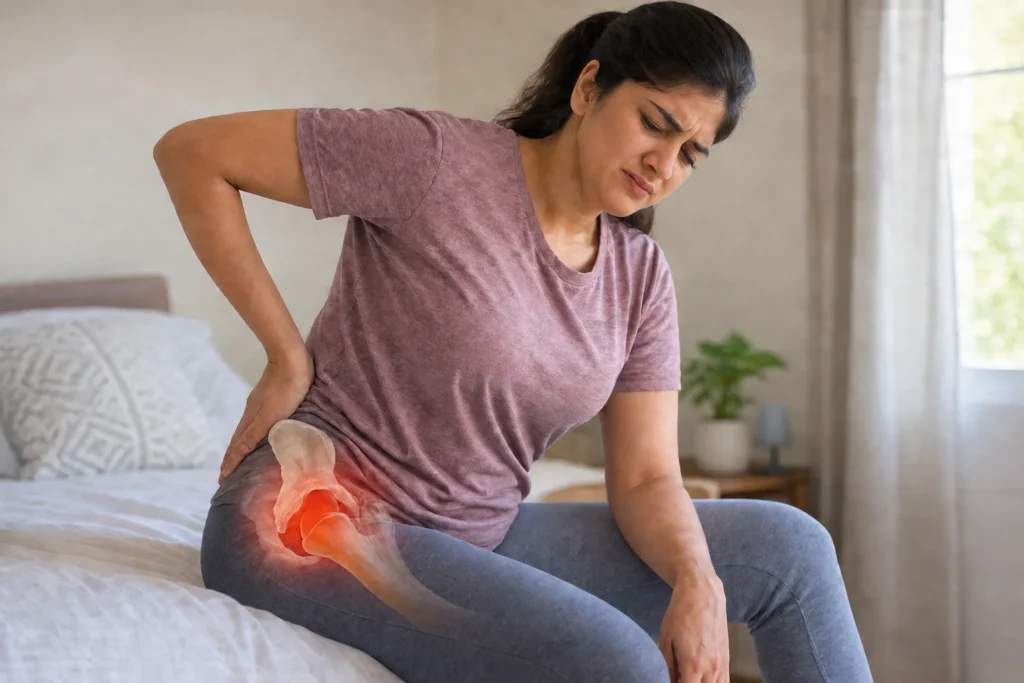
The pain location can provide useful clues, but it cannot confirm a diagnosis.
| Where you feel the pain | Possible causes |
|---|---|
| Outer side of the hip | Gluteal tendinopathy or greater trochanteric pain syndrome |
| Deep in the groin | Hip osteoarthritis, joint irritation, or bone stress injury |
| Front of the hip after a sudden movement | Hip flexor or other muscle strain |
| Buttock with back pain or tingling | Referred pain from the lower back or nerve irritation |
| Deep pain that progressively worsens with activity | A joint problem or bone stress injury that needs assessment |
Pay attention to how the symptoms began, whether they are getting worse, and whether you can walk normally.
Avoid repeatedly testing the painful leg to see how much weight it can tolerate.
Is It More Painful During Walking or When Standing Still?
The difference may help your physiotherapist understand the problem.
- Pain during walking: Repeated loading may aggravate a tendon, joint, muscle, or bone injury.
- Pain when standing on one leg: The hip muscles and tendons must work to control the pelvis, which may provoke symptoms in some conditions.
- Pain during twisting or deep bending: Hip joint irritation or femoroacetabular impingement may be considered, depending on the other findings.
- Pain when moving the leg against resistance: A muscle or tendon problem may be involved, although this finding is not conclusive.
- Pain that continues at rest or at night: This deserves attention when it is new, persistent, or worsening, especially alongside other warning signs.
These patterns guide assessment but do not replace it.
Several hip conditions can produce similar symptoms.
How Does a Physiotherapist Assess Hip Pain?
A physiotherapist will ask when the pain started, where it occurs, what activities aggravate it, and whether you recently changed your exercise routine or experienced an injury.
The assessment may include:
- Gait assessment: Checking for limping, shortened steps, or changes in the way you transfer weight.
- Hip movement testing: Assessing bending, rotation, and other movements when safe.
- Strength testing: Examining the muscles that support and control the hip.
- Functional assessment: Observing relevant activities, such as rising from a chair or climbing a step, if appropriate.
- Back and nerve screening: Checking whether the symptoms may be coming from the lower back or associated with nerve irritation.
Imaging is not necessary for every case of hip pain.
However, a doctor may request an X-ray or other investigation if a fracture, significant joint condition, or another problem requiring medical treatment is suspected.
The purpose of the assessment is to identify the likely cause, decide which activities are safe, and develop a rehabilitation plan that matches your needs.
Physiotherapy Treatment for Hip Pain When Putting Weight on One Leg
Treatment depends on the underlying cause.
Exercises that are appropriate for mild tendon irritation may be unsuitable for someone with a suspected bone injury.
1. Modify Activities That Trigger Pain
Temporarily reduce activities that repeatedly aggravate symptoms, such as long walks, running, deep squats, or frequent stair climbing.
If walking is comfortable and a serious injury has been ruled out, shorter walks and regular changes of position may help you remain active.
If weight-bearing causes marked pain or you cannot walk normally, do not push through it.
2. Build Hip Strength Gradually
When a clinician has determined that exercise is appropriate, strengthening can improve the hip’s ability to control movement and tolerate everyday demands.
Depending on the diagnosis, your physiotherapist may introduce:
- Gluteal isometric exercises: Gently contracting the buttock muscles without substantial joint movement.
- Bridges: Lifting the pelvis while lying on your back to strengthen the gluteal muscles.
- Sit-to-stand practice: Training the muscles used to rise from a chair.
- Supported weight shifts: Practising controlled movement between the legs while holding a stable surface, when safe.
These are examples, not a universal exercise prescription.
Avoid starting them if you have severe or unexplained weight-bearing pain or a possible fracture.
3. Improve Balance and Movement Control
Once weight-bearing is considered safe and symptoms are manageable, rehabilitation may include balance and movement-control exercises.
Progression might move from supported weight shifts to controlled step-ups and, eventually, more demanding single-leg tasks.
The appropriate starting point depends on your symptoms, strength, and functional goals.
A full single-leg stand is not a suitable starting exercise if it causes significant pain.
4. Improve Mobility Where Needed
Some people have restricted hip movement that affects everyday activities.
A physiotherapist may prescribe gentle mobility exercises if stiffness contributes to the problem.
However, more stretching is not always better.
Aggressive hip stretching can aggravate some tendon conditions or provoke pain associated with certain joint problems.
5. Return to Walking and Daily Activities
Rehabilitation should prepare you for the activities that matter in everyday life, not just make exercises easier.
Your physiotherapist may gradually increase walking duration, stair use, standing tolerance, or sport-specific activity.
Progress should reflect how the hip responds during activity and afterwards.
Common Mistakes That Can Delay Recovery
- Pushing through sharp or worsening pain: This may aggravate an injury or delay assessment of a more serious problem.
- Repeatedly testing single-leg standing: Repeatedly provoking symptoms does not establish the diagnosis and may increase irritation.
- Assuming every outer-hip pain is bursitis: Gluteal tendon problems are also common and may need a different rehabilitation approach.
- Starting random online exercises: A program that helps one hip condition may aggravate another.
- Stopping all movement indefinitely: When a serious injury has been ruled out, appropriate activity modification is usually more useful than unnecessary prolonged inactivity.
- Ignoring persistent symptoms: Ongoing pain, a limp, or reduced ability to manage daily activities deserves assessment.
Hip Pain When Bearing Weight: Myth vs Fact
Myth: Pain during single-leg standing always means weak hip muscles.
Fact: Pain can arise from tendons, the hip joint, muscles, or other structures. An assessment is needed to identify the likely cause.
Myth: You should keep exercising through hip pain.
Fact: Exercise should be adjusted to the condition and symptom response. Severe or worsening weight-bearing pain needs assessment before exercise continues.
Myth: All pain on the outer hip is bursitis.
Fact: Outer-hip pain may involve the gluteal tendons and other nearby tissues. The term greater trochanteric pain syndrome covers several possible sources.
Myth: A scan always explains the pain.
Fact: Imaging findings must be interpreted alongside symptoms and examination results. Not every structural change is the source of pain.
What Can You Do at Home?
If symptoms are mild, there has been no significant injury, and you can walk normally, the following measures may help while you monitor your progress:
- Reduce activities that clearly worsen the pain.
- Use comfortable footwear that feels stable when walking.
- Apply a wrapped cold pack for up to 20 minutes if it helps relieve discomfort.
- Avoid repeatedly testing the painful leg.
- Return to activity gradually as symptoms settle.
- Arrange a clinical assessment if pain persists, recurs, or affects normal activities.
Do not rely on home treatment if the pain is severe, worsening, or associated with difficulty bearing weight.
A hot or swollen hip with fever also needs urgent medical assessment.
When Should You Seek Medical Attention?
Seek urgent medical help if:
- You have severe hip pain after a fall or injury.
- You cannot walk or put weight on the affected leg.
- You develop sudden, severe hip pain without a clear injury.
- Your hip is hot or swollen, particularly with fever or feeling generally unwell.
- You develop new significant numbness or weakness after an injury.
Arrange a clinical appointment if:
- The pain keeps returning or gradually worsens.
- You develop a persistent limp.
- Pain affects sleep or everyday activities.
- Symptoms have not improved after around two weeks of appropriate self-care.
- You are physically active and develop progressive weight-bearing pain after increasing your training.
The NHS also advises assessment for hip pain that interferes with normal activities, gets worse, or does not improve with home treatment. (NHS)
A Lesser-Known Fact About Single-Leg Hip Pain
Pain when standing on one leg does not automatically mean your hip muscles are weak.
The task places demands on several structures, including the gluteal tendons, hip joint, and surrounding muscles.
Pain may occur because a tissue is irritated or cannot currently tolerate that load, even when the muscles have reasonable strength.
This is why repeatedly practising single-leg standing is not always the right solution.
Identifying the likely cause and gradually restoring the movements you need is a more useful starting point.
Final Thoughts
Hip pain when putting weight on one leg can have several causes, from tendon irritation and muscle strain to hip joint conditions. Understanding where the pain occurs and what triggers it can help guide the next steps.
Physiotherapy may help restore strength, movement control, and confidence when the condition is suitable for rehabilitation. Exercises should be selected according to your symptoms and clinical assessment rather than performed simply because they are available online.
Remember: Do not push through severe or unexplained weight-bearing pain. Seek medical assessment if you cannot walk normally, the pain follows an injury, or symptoms are worsening.
Conclusion
Hip pain when putting weight on one leg can arise from gluteal tendinopathy, muscle strain, osteoarthritis, other hip joint problems, referred pain, or a bone injury.
The location of the pain, how it began, and whether you can walk normally help guide further assessment.
Physiotherapy can support recovery through appropriate activity modification, progressive strengthening, mobility work, and movement training.
The program should match the underlying condition rather than the symptom alone.
If the pain is severe, worsening, follows an injury, or prevents you from bearing weight, seek medical assessment before attempting rehabilitation.
Identifying the cause early can help you follow a safer and more effective path back to comfortable movement.
Frequently Asked Questions
1. Why does my hip hurt when I stand on one leg?
Possible causes include gluteal tendinopathy, a muscle strain, hip osteoarthritis, joint irritation, or referred pain from the lower back. The location of the pain, how it started, and your ability to walk help guide assessment.
2. Can weak hip muscles cause pain when bearing weight?
Reduced hip strength or movement control may contribute to difficulty with single-leg activities. However, pain can also come from tendons, the hip joint, or other structures, so weakness should not be assumed to be the cause.
3. Should I exercise if my hip hurts when standing on one leg?
That depends on the cause and severity. Gentle, appropriately selected exercises may help some conditions, but severe or unexplained weight-bearing pain should be assessed before starting rehabilitation.
4. Can physiotherapy help hip pain during walking?
Yes, physiotherapy can help many musculoskeletal hip conditions through activity modification, progressive strengthening, mobility work, and movement training. Treatment should be tailored to the underlying problem.
5. When should I seek medical help for hip pain?
Seek urgent medical assessment for sudden severe pain, pain after a fall, inability to bear weight, or a hot or swollen hip with fever. Persistent or worsening pain also warrants a clinical appointment.
6. How long does hip pain from weight-bearing take to improve?
Recovery depends on the cause, severity, and individual circumstances. Mild muscle irritation may settle relatively quickly, while persistent tendon or joint problems may require a longer rehabilitation programme. A suspected bone injury needs medical assessment.
Stay tuned with us for more health related topics.
Follow us on LinkedIn and Instagram for more.
More Read


Medical Disclaimer
This article is for general educational purposes only and does not replace individual medical advice, diagnosis, or treatment. Hip pain during weight-bearing can have several causes, and the information provided cannot determine which condition you have.
Consult a qualified healthcare professional for persistent or worsening symptoms. Seek urgent medical attention for sudden severe pain, inability to bear weight, or other warning signs described in this article. Do not start or continue exercises if a serious injury is suspected without appropriate medical assessment.


