If you’re searching for rotator cuff tear exercises at home, chances are your shoulder has already started limiting your daily life and ignoring it now could make recovery much harder later.
“That sharp shoulder pain you’re ignoring today could quietly turn into a full rotator cuff tear tomorrow.”
As a physiotherapist, I see this every single week, patients who dismissed early shoulder discomfort, only to struggle later with lifting their arm, sleeping, or even dressing.
The good news?
With the right approach, many rotator cuff tears can be managed effectively, often without surgery.
Let’s break this down in a clear, evidence-based, practical way.
Quick Answer
A rotator cuff tear causes shoulder pain, weakness, and limited movement. Most partial tears can be treated with physiotherapy exercises like band rotations, scapular strengthening, and mobility work. Severe tears may require surgery.
Key Takeaways
- Rotator cuff tears may not always cause pain initially
- Physiotherapy is effective for most partial tears
- Scapular strengthening is crucial for recovery
- Avoid early aggressive exercises
- Progressive resistance training gives best outcomes
What Is a Rotator Cuff Tear?
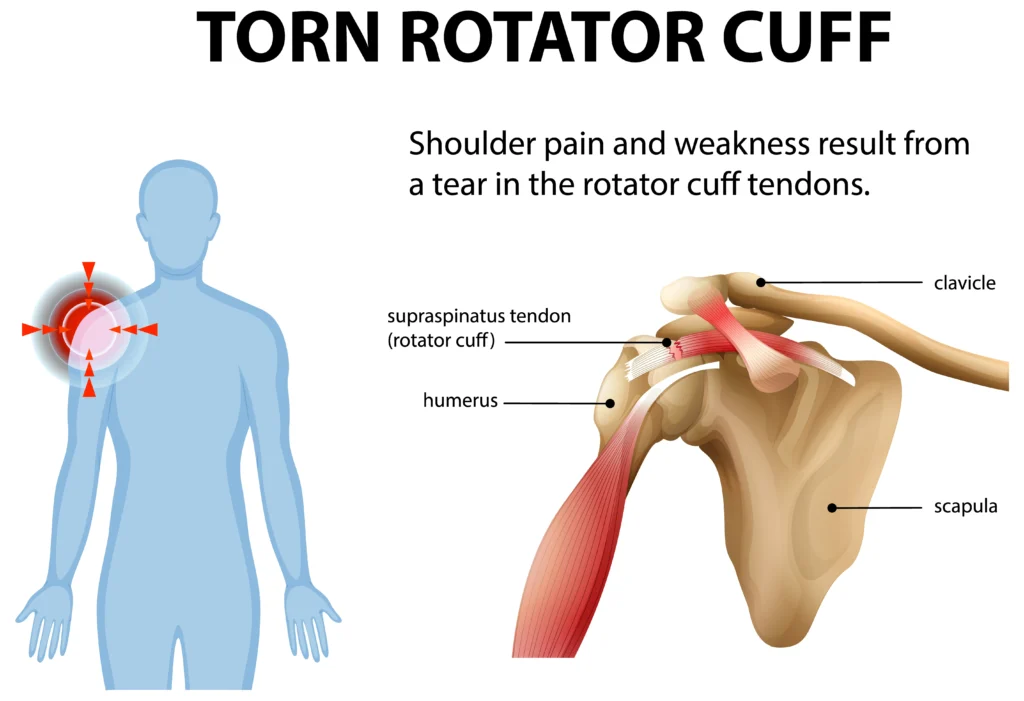
The rotator cuff is a group of four muscles and tendons that stabilize your shoulder and allow smooth arm movement.
A tear occurs when one or more of these tendons are damaged, either partially or completely.
Types of Tears
- Partial tear– tendon fraying but not fully torn
- Full-thickness tear– tendon completely detached
- Degenerative tear– due to aging and wear
- Acute tear– sudden injury (fall, lifting heavy weight)
Lesser-known fact: Many people have tears without symptoms, especially after age 40, but symptoms appear when load exceeds tissue capacity. (Verywell Health)
Rotator Cuff Tear Symptoms You Should Never Ignore
Early Symptoms
- Dull ache in shoulder
- Pain when reaching overhead
- Discomfort while sleeping on that side
Advanced Symptoms
- Weakness lifting arm
- Pain radiating to upper arm
- Clicking or catching sensation
- Reduced range of motion
Research insight: Pain severity doesn’t always match tear size, some large tears are painless, while small tears can be highly symptomatic. (Springer)
Why Do Rotator Cuff Tears Happen?
Common Causes
- Repetitive overhead activity (gym, cricket, badminton)
- Poor posture (forward shoulder position)
- Sudden trauma (fall or jerk)
- Aging-related degeneration
Hidden Risk Factors (Often Missed)
- Weak scapular muscles
- Tight chest muscles
- Sedentary lifestyle
- Poor exercise technique
Interesting research finding: Rotator cuff tears are strongly linked with shoulder joint movement restriction, not just tendon damage. (MDPI)
Diagnosis: How We Confirm a Tear
- Clinical physiotherapy assessment
- Special orthopedic tests
- Imaging:
- MRI (gold standard)
- Ultrasound
- X-ray (to rule out other issues)
At-Home Self-Test
Not a diagnosis, but helpful indicator:
- Can you lift arm above shoulder?
- Do you feel weakness (not just pain)?
- Is night pain disturbing sleep?
If YES to all → consult a professional
Quick Screening Checklist
- Pain while lifting arm
- Weakness
- Night pain
- Limited range
3 or more = get evaluated
Can a Rotator Cuff Tear Heal Without Surgery?
Yes, in many cases.
Evidence-Based Insight
Exercise therapy significantly improves pain and function in rotator cuff tears, especially in partial tears. (PubMed)
Another study shows structured physiotherapy can improve quality of life even in non-repairable tears. (SpringerLink)
Best Physiotherapy Exercises for Rotator Cuff Tear
Here are 10 clinically effective exercises I prescribe:
1. Pendulum Swings
- Lean forward, let arm hang
- Gently swing in circles
Reduces stiffness without strain
2. Passive Shoulder Elevation
- Use other hand to lift arm
Safe early-stage mobility
3. Wall Crawls
- Walk fingers up the wall slowly
Improves range of motion
4. Isometric External Rotation
- Press hand against wall (no movement)
Activates muscles without strain
5. Resistance Band External Rotation
- Keep elbow tucked
- Rotate arm outward
Strengthens infraspinatus
6. Scapular Retraction
- Pull shoulder blades together
Corrects posture
7. Prone Shoulder Extension
- Lift arm slightly off bed
Targets posterior shoulder
8. Side-Lying External Rotation
- Lift light weight outward
Proven high activation exercise
9. Closed Kinetic Chain Exercises
- Wall push-ups
Improves joint stability
Research shows closed chain exercises improve functional outcomes significantly. (Sage Journals)
10. Eccentric Strengthening
- Slow lowering phase
Promotes tendon healing
Evidence: Eccentric loading improves tendon remodeling and reduces pain. (Sage Journals)
Treatment Guide: Step-by-Step Approach
Phase 1: Pain Control
- Rest from aggravating activities
- Ice/heat therapy
- Gentle mobility exercises
Phase 2: Restore Movement
- Stretching
- Passive to active exercises
Phase 3: Strengthening
- Rotator cuff + scapular muscles
- Progressive resistance training
Research: Progressive resistance exercise is more effective than non-progressive rehab. (Sage Journals)
Phase 4: Functional Recovery
- Return to sport/work
- Movement retraining
Daily Activity Modifications
This is where most recoveries succeed or fail.
At Work
- Keep screen at eye level
- Avoid prolonged slouching
- Support arm while typing
While Lifting
- Keep objects close to body
- Avoid overhead lifting early
Driving
- Adjust seat to reduce shoulder strain
Sleeping
- Use pillow under arm
- Avoid sleeping on affected side
Clinical truth: Bad daily habits delay recovery more than lack of exercise.
Home Remedies & Pain Relief Hacks
Ice vs Heat
- Ice: Acute pain/inflammation
- Heat: Stiffness and chronic tightness
Natural Support
- Turmeric (curcumin reduces inflammation)
- Omega-3 fatty acids
Evidence supports anti-inflammatory effects of curcumin in musculoskeletal pain (Journal of Medicinal Food)
Other Helpful Tools
- TENS machine
- Shoulder braces (short-term use only)
- Topical anti-inflammatory gels
Advanced Non-Surgical Treatments
If basic physio isn’t enough:
PRP (Platelet-Rich Plasma)
- Promotes tendon healing
- Mixed but promising results
Corticosteroid Injection
- Reduces pain quickly
- Not a long-term solution
Shockwave Therapy
- Stimulates healing response
- Useful in chronic cases
Dry Needling
- Releases muscle tightness
These should always complement, not replace, rehabilitation.
When Is Surgery Needed?
- Full-thickness tears
- Severe weakness
- No improvement after 3-6 months
- Young active individuals
Post-Surgery Rehab Insight
Early physiotherapy improves long-term function and range of motion. (Springer)
Arthroscopic & Robotic Surgery Explained
Arthroscopic Repair
- Minimally invasive
- Faster recovery than open surgery
Robotic-Assisted Surgery
- Higher precision
- Better tendon alignment
Post-surgery rehab is more important than surgery itself for long-term success.
Recovery Timeline (Week-by-Week)
Understanding recovery reduces anxiety and improves compliance. Here’s what I clinically guide my patients through:
Week 1–2: Pain Control & Protection
- Focus: Reduce inflammation and pain
- Activities: Pendulum exercises, passive movement
- Avoid: Lifting, overhead activity
Research shows early controlled motion prevents stiffness without worsening tears (American Journal of Sports Medicine)
Week 3-6: Mobility + Muscle Activation
- Start active-assisted movements
- Begin isometric strengthening
- Improve scapular control
This phase is crucial, too aggressive = re-injury, too slow = stiffness
Week 6-12: Strength Building Phase
- Resistance band strengthening
- Controlled functional movements
- Gradual load progression
Progressive loading improves tendon healing and strength (British Journal of Sports Medicine)
3-6 Months: Return to Function
- Resume gym/sports gradually
- Focus on endurance + coordination
Nutrition for Tendon Healing
Essential Nutrients
- Protein (tissue repair)
- Vitamin C (collagen synthesis)
- Collagen supplements
- Hydration
Tendons heal slower due to poor blood supply, nutrition matters more than you think.
Lesser-Known Tips That Actually Work
Things To DO
- Sleep with pillow support under arm
- Strengthen shoulder blade muscles first
- Maintain thoracic spine mobility
- Follow gradual loading (not aggressive rehab)
Things To AVOID
- Overhead lifting early
- Sudden jerky movements
- Ignoring night pain
- Overtraining with resistance bands
Clinical reality: Most people worsen their tear by doing exercises too early or incorrectly, not by lack of exercise.
Prevention Strategies
- Warm-up before workouts
- Strengthen rotator cuff regularly
- Fix posture (especially desk workers)
- Avoid repetitive strain without rest
Long-Term Prevention Plan
Weekly Routine
- 2-3 days rotator cuff strengthening
- 2 days posture correction exercises
Monthly Check
- Strength symmetry
- Mobility assessment
Daily Habit
- Maintain posture
- Avoid repetitive strain
Rotator Cuff Tear vs Frozen Shoulder vs Tendinitis
| Feature | Rotator Cuff Tear | Frozen Shoulder | Tendinitis |
|---|---|---|---|
| Pain | Sharp, activity-based | Constant, severe | Dull ache |
| Movement | Limited with weakness | Severely restricted | Painful but possible |
| Strength | Reduced | Normal but stiff | Usually normal |
| Night Pain | Common | Very severe | Mild-moderate |
| Key Sign | Weakness lifting arm | Cannot move arm even passively | Pain on movement |
Many patients are misdiagnosed, this clarity improves treatment outcomes.
Mistakes That Delay Recovery
- Starting strengthening too early
- Ignoring scapular muscles
- Overusing resistance bands
- Sleeping on painful shoulder
- Stopping exercises once pain reduces
Biggest mistake: “Pain gone = treatment done” (Not true)
What Happens If You Ignore It?
- Tear progression
- Muscle wasting
- Frozen shoulder
- Chronic pain
Research shows untreated tears can enlarge over time (Journal of Shoulder and Elbow Surgery)
My Clinical Insight
In my practice, the biggest mistake I see is this:
Patients focus only on the shoulder, ignoring the scapula and posture.
Your shoulder is only as strong as your upper back stability.
Fix that and recovery becomes faster and more sustainable.
Return to Gym & Sports Guide
When to Restart?
- Pain-free movement
- At least 80% strength restored
Safe Exercises
- Rows
- Scapular strengthening
- Light resistance work
Avoid Initially
- Overhead press
- Heavy bench press
- Sudden jerks
Physio Prescription
- Start with pain-free mobility
- Progress to controlled strengthening
- Train scapular stability daily
- Avoid pain >5/10 during exercise
Red Flags
- Sudden inability to lift arm
- Severe trauma history
- Night pain not improving
- Progressive weakness
Myth vs Reality
Myth: Rotator cuff tear always needs surgery
Reality: Most partial tears improve with physiotherapy
Real Case Insight
A 45-year-old desk worker came with 4 months of shoulder pain.
She had:
- Tried random YouTube exercises
- Ignored posture
- Continued gym overhead lifting
After structured rehab:
- Pain reduced in 4 weeks
- Strength improved in 8 weeks
- Full recovery in 4 months
Lesson: Right exercise > more exercise
Final Word
Your shoulder is whispering before it starts screaming. Listen early, act smart, and you can avoid surgery altogether.
The right rotator cuff tear exercises at home can save you months of pain, costly treatments, and even surgery, if you start before your shoulder gets worse.
Frequently Asked Questions
Can a rotator cuff tear heal without surgery?
Yes, most partial rotator cuff tears can heal effectively with structured physiotherapy, strengthening exercises, and activity modification.
How long does it take to recover from a rotator cuff tear?
Recovery typically ranges from 6 weeks to 6 months depending on the severity of the tear and consistency of rehabilitation.
What are the first signs of a rotator cuff tear?
Early signs include shoulder pain while lifting the arm, difficulty sleeping on one side, and a dull ache that worsens with activity.
Which exercises are best for rotator cuff tear recovery?
Exercises like external rotation with resistance bands, scapular strengthening, and controlled mobility exercises are highly effective.
Is it safe to continue gym workouts with a rotator cuff tear?
Yes, but only with modified exercises. Avoid overhead lifting and heavy resistance until guided by a physiotherapist.
When should I consider surgery for a rotator cuff tear?
Surgery is usually considered for full-thickness tears, severe weakness, or when conservative treatment fails after 3–6 months.
Can sleeping position affect shoulder pain?
Yes, sleeping on the affected shoulder can worsen pain. Using a pillow to support the arm helps reduce strain.
Does a rotator cuff tear get worse over time?
Yes, untreated tears can enlarge and lead to weakness, stiffness, and long-term shoulder dysfunction.
Is physiotherapy painful for rotator cuff injuries?
Physiotherapy may cause mild discomfort initially, but sharp pain should be avoided. Exercises are always progressed gradually.
What should I avoid during rotator cuff tear recovery?
Avoid overhead lifting, sudden jerky movements, poor posture, and stopping exercises too early.
Stay tuned with us for more health related topics.
Follow us on LinkedIn and Instagram for more.
More Read






Medical Disclaimer!
This article has been reviewed and written under the guidance of our Head Physiotherapist, Dr. Kruti Raj (PT, MUHS,CPT,CMPT). The information shared is intended for educational purposes only and should not be considered a substitute for personalized medical advice, diagnosis, or treatment.
Please consult us or any other qualified healthcare professional before beginning any exercise program, especially if you are experiencing pain, recovering from injury, or managing a medical condition.