


Hip pain can develop even when you have not fallen, twisted your leg, or experienced an obvious injury.
It may start gradually because of joint changes, irritated tendons, prolonged sitting, or problems affecting the lower back.
Quick Answer: Why Does Your Hip Hurt Without an Injury?
Hip pain without an obvious injury may result from osteoarthritis, gluteal tendinopathy, hip flexor irritation, muscle overuse, prolonged sitting, or referred pain from the lower back.
- Front of the hip or groin: Joint problems or hip flexor irritation.
- Outside of the hip: Greater trochanteric pain syndrome.
- Buttock or back of the hip: Possible referred pain from the lower back or pelvic region.
- Deep pain during weight-bearing: A stress fracture or another bone condition needs consideration.
Physiotherapy perspective: Assessment can identify relevant movement, strength, and functional limitations and guide an individualized rehabilitation plan. Sudden severe pain or inability to bear weight requires urgent medical assessment.
The location of your pain, when it occurs, and whether you experience stiffness, weakness, or difficulty walking can help identify possible causes.
Although many cases involve manageable musculoskeletal problems, some conditions require prompt medical assessment.
Understanding the possible reasons for unexplained hip pain can help you make informed decisions about physiotherapy, daily activities, and when to seek medical care.
Key Takeaways
Osteoarthritis, tendon problems, muscle overuse, and lower back conditions may cause symptoms without an obvious injury.
Groin, outer hip, and buttock pain may have different causes, but location alone cannot confirm a diagnosis.
Individualized strengthening, mobility exercises, movement retraining, and activity modification can improve function.
Severe pain, inability to bear weight, or a hot, swollen hip with fever requires urgent assessment.
12 Possible Causes of Hip Pain Without an Injury
1. Hip Osteoarthritis
Hip osteoarthritis causes changes in the cartilage and other structures within the joint.
Symptoms often develop gradually and become more common with age.
You may experience a deep ache in the groin, stiffness after sitting, or discomfort when walking, climbing stairs, or putting on socks.
Reduced hip rotation can make everyday movements more difficult.
How physiotherapy helps: Individualized strengthening, mobility exercises, and appropriate aerobic activity can improve function and help manage symptoms.
Exercise should be adjusted to your abilities rather than avoided altogether.
Research supports individualized physical therapy interventions for hip osteoarthritis. (Koc et al., 2025)
2. Greater Trochanteric Pain Syndrome
Pain on the outside of the hip may be associated with greater trochanteric pain syndrome (GTPS).
This condition often involves the gluteal tendons and sometimes the nearby bursae.
Common symptoms include tenderness when lying on the affected side, pain while climbing stairs, and discomfort during prolonged walking or standing on one leg.
Although it is often called hip bursitis, the problem is not always caused by inflammation of a bursa.
How physiotherapy helps: Treatment may include education about tendon loading, modification of aggravating activities, and progressive strengthening of the hip muscles.
A randomized trial found that education combined with exercise improved outcomes in people with gluteal tendinopathy. (Mellor et al., 2018)
3. Hip Flexor Tendon Irritation
The hip flexors lift your thigh when you walk, climb stairs, or get into a vehicle.
Repetitive loading or a sudden increase in activity can irritate these muscles and tendons without a single identifiable injury.
You may notice pain at the front of the hip, discomfort when lifting your knee, or symptoms after prolonged sitting.
How physiotherapy helps: A physiotherapist can assess hip-flexor strength, movement, and load tolerance before recommending graded strengthening or mobility exercises.
Avoid forcing stretches that reproduce sharp pain.
Persistent front-of-hip pain should be assessed because joint problems can produce similar symptoms.
4. Muscle Weakness or Overuse
The gluteal, adductor, and other muscles around the hip help control pelvic movement and support everyday activities.
Discomfort may develop after a long walk, increased exercise, prolonged standing, or returning to activity after a break.
Muscle-related pain can feel like an ache or tenderness during particular movements.
However, muscle tightness does not automatically mean a muscle is damaged or is the primary cause of pain.
How physiotherapy helps: Assessment can identify relevant strength or movement limitations.
Gradually rebuilding strength and activity tolerance is often more useful than repeatedly stretching an area that feels tight.
5. Prolonged Sitting and Reduced Movement
Long periods at a desk, during travel, or on a low sofa may aggravate an already sensitive hip.
Sitting can also increase discomfort in people with joint stiffness or conditions that are sensitive to deep hip flexion.
This does not mean sitting alone has damaged the joint.
What may help: Change position regularly, take comfortable movement breaks, and adjust your chair to avoid excessive hip flexion.
If symptoms continue despite these changes, seek an assessment instead of assuming poor posture is the only cause.
6. Referred Pain From the Lower Back
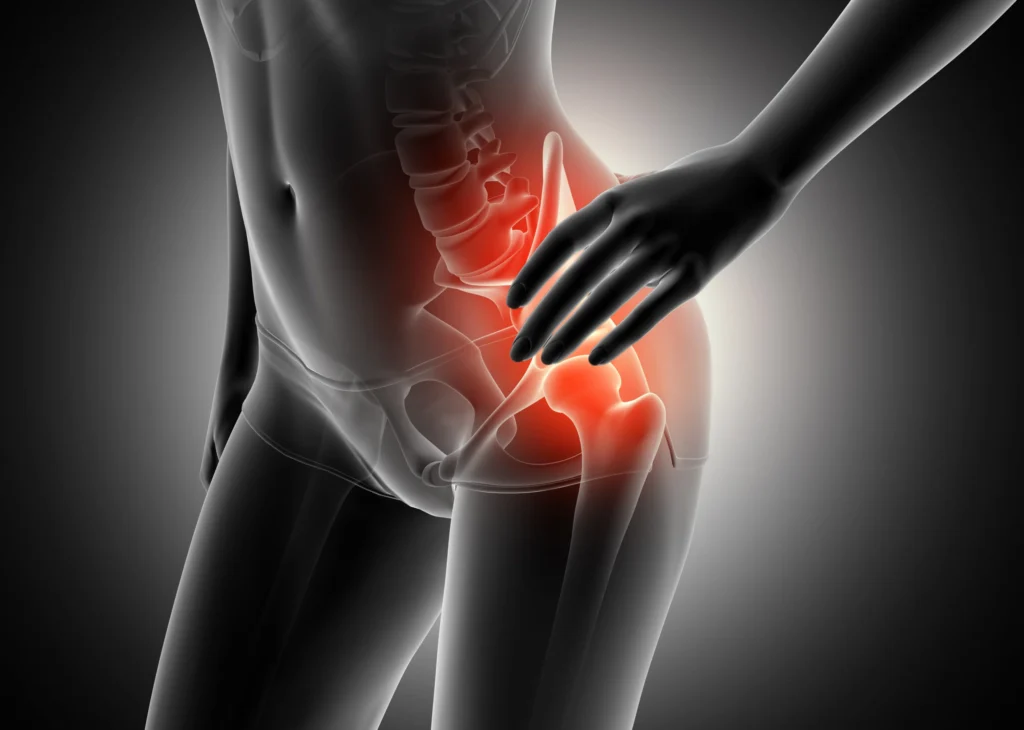
Not all pain felt around the hip originates in the hip joint. Lumbar spine conditions can refer pain into the buttock, outer hip, or thigh.
Clues that the back may be involved include pain that changes with spinal movement, symptoms extending down the leg, tingling, numbness, or weakness.
Back pain may be present, but it is not always noticeable.
How physiotherapy helps: A clinician can assess both the lumbar spine and hip, including neurological function when appropriate.
Treatment depends on the findings and may involve movement modification, appropriate exercises, and gradual restoration of activity.
New or worsening leg weakness needs prompt medical evaluation.
Numbness around the groin or new bladder or bowel dysfunction requires emergency assessment.
7. Sacroiliac or Pelvic Girdle Pain
The sacroiliac joints connect the sacrum at the base of the spine with the pelvis.
Pain in this region may be felt in the buttock or back of the hip and can become noticeable during walking, prolonged standing, or turning in bed.
Pelvic girdle pain can also occur during pregnancy and after childbirth.
However, similar symptoms can arise from the lumbar spine and surrounding muscles.
How physiotherapy helps: Assessment should consider the hip, back, pelvic movement, and functional limitations together.
Treatment may include individualized strengthening and strategies for managing painful daily activities.
A single tender spot cannot confirm the diagnosis.
8. Hip Labral Tear
The labrum is a ring of cartilage around the hip socket that helps support the joint.
Tears may develop following trauma, repetitive twisting movements, or structural differences in the hip, although some tears cause no symptoms.
Possible symptoms include deep groin pain, stiffness, and clicking or catching during movement.
How physiotherapy helps: A clinician can determine whether symptoms suggest a joint problem and whether imaging is appropriate.
Rehabilitation may involve modifying provocative movements and improving strength and movement control. Clicking alone does not confirm a labral tear. (Mayo Clinic)
9. Femoroacetabular Impingement
Femoroacetabular impingement (FAI) occurs when the shape of the hip joint leads to abnormal contact during certain movements.
Some people have these structural features without pain.
When symptomatic, FAI may cause deep groin discomfort during deep squats, repeated hip flexion, or twisting movements.
How physiotherapy helps: Treatment can focus on strengthening, adjusting painful movement patterns, and maintaining comfortable activity.
Structural findings on a scan do not automatically mean a person needs surgery.
10. Inflammatory Arthritis
Conditions such as rheumatoid arthritis and spondyloarthritis can cause hip pain without an injury.
Symptoms may include prolonged morning stiffness, pain after rest, or discomfort in several joints.
Fatigue and other systemic symptoms may also occur, depending on the condition.
How physiotherapy helps: Persistent morning stiffness or multiple painful joints warrants medical assessment.
Once the underlying condition is evaluated, physiotherapy can help maintain strength, mobility, and daily function alongside appropriate medical treatment.
11. Stress Fracture
A stress fracture can develop when repeated loading damages bone, even without a fall or direct impact.
Risk may increase after a rapid rise in running or training volume or when bone strength is reduced.
A femoral neck stress fracture can cause gradually worsening groin pain, particularly during weight-bearing.
Early X-rays may not show the fracture, and MRI may be needed.
Important: Stop impact exercise and seek prompt medical assessment if a stress fracture is suspected.
Do not try to manage persistent weight-bearing pain with strengthening exercises alone.
Delayed diagnosis can allow the fracture to progress. (Bernstein et al., 2022)
12. Avascular Necrosis of the Hip
Avascular necrosis, also called osteonecrosis, occurs when reduced blood supply damages bone tissue.
It can affect the femoral head and may progress over time.
Symptoms can include deep groin, thigh, or buttock pain, initially during weight-bearing and later sometimes at rest.
Risk factors include prolonged high-dose corticosteroid use, heavy long-term alcohol consumption, and certain medical conditions.
Why assessment matters: Medical evaluation and appropriate imaging are important because the condition can cause bone collapse.
Physiotherapy may support function, but it cannot restore the blood supply to damaged bone. (Mayo Clinic)
Where Does Your Hip Hurt?
The location of your pain can help guide an assessment, although symptoms often overlap.
| Pain location | Possible causes |
|---|---|
| Front of the hip or groin | Osteoarthritis, hip flexor irritation, labral problems, FAI |
| Outside of the hip | Greater trochanteric pain syndrome |
| Buttock or back of the hip | Lumbar spine referral, pelvic girdle pain |
| Deep pain during weight-bearing | Osteoarthritis, stress fracture, osteonecrosis |
These patterns are clues rather than diagnostic rules. A clinical examination is needed to determine the likely cause. (Chamberlain, 2021)
How Physiotherapy Can Help
Physiotherapy begins with understanding your symptoms, not simply prescribing hip exercises.
An assessment may include hip and spinal movement, muscle strength, walking, balance, and the activities that aggravate your pain.
Depending on the findings, treatment may involve:
- Progressive strengthening: Improving the capacity of muscles around the hip and pelvis.
- Mobility exercises: Addressing relevant movement restrictions without forcing painful ranges.
- Load management: Adjusting walking, exercise, and daily activities while symptoms settle.
- Movement retraining: Improving tolerance for stairs, standing, squatting, or other functional tasks.
- Education: Understanding what to modify, what to continue, and when further assessment is needed.
The programme should match the diagnosis and your functional goals.
Suspected fractures, infections, and other serious conditions must be medically assessed before routine rehabilitation.
What Can You Do at Home?
If symptoms are mild, you can walk comfortably, and there are no warning signs, consider these measures:
- Temporarily reduce activities that repeatedly worsen the pain.
- Change position regularly if prolonged sitting increases discomfort.
- Continue comfortable everyday movement rather than forcing painful exercises.
- Try a pillow between your knees when sleeping on the unaffected side if that position feels better.
- Monitor whether symptoms improve, persist, or begin affecting sleep and walking.
Do not exercise through sharp or increasing pain. If the cause is unclear and symptoms persist, arrange an assessment.
Myth vs Fact: Hip Pain Without Injury
MYTH: No injury means no serious problem.
FACT: Stress fractures, avascular necrosis, and joint infections can develop without an obvious injury.
MYTH: Every hip problem needs an MRI.
FACT: Imaging depends on the clinical assessment. Some conditions can be managed without scans, while suspected serious conditions may need prompt investigation.
MYTH: All hip pain requires complete rest.
FACT: Many musculoskeletal conditions benefit from appropriately adjusted movement and progressive physiotherapy. Suspected fractures or other serious conditions require medical assessment before exercise.
When Should You Seek Medical Help?
Seek urgent medical assessment
- Sudden, severe hip pain, even without an injury.
- Inability to walk or put weight on the leg.
- A hot or swollen hip, especially with fever or feeling unwell.
- Severe weight-bearing pain when a fracture is possible.
Arrange a medical appointment
- Pain that has not improved after around two weeks.
- Symptoms that keep returning or progressively worsen.
- Pain that disrupts sleep or limits everyday activities.
- Persistent morning stiffness or pain affecting several joints.
A joint infection called septic arthritis can develop without a clear injury and requires urgent treatment.
Sudden severe joint pain, swelling, restricted movement, or fever should not be ignored. (NHS)
Final Thoughts: Take the Right Step Towards Recovery
Hip pain without an injury can result from joint problems, muscle weakness, tendon irritation, or referred pain from the lower back. Identifying the cause is essential for effective treatment.
Physiotherapy can help improve hip strength, mobility, and movement control through individualized exercises, activity modification, and progressive rehabilitation.
If your pain persists or limits daily activities, consult a healthcare professional for assessment. Seek urgent medical care for sudden severe pain or an inability to bear weight. With the right treatment approach, you can work towards reducing pain and restoring comfortable, confident movement.
Conclusion
Hip pain without an injury can result from joint problems, muscle weakness, tendon irritation, or referred pain from the lower back.
Identifying the cause is essential for effective treatment.
Physiotherapy can help improve hip strength, mobility, and movement control through individualized exercises, activity modification, and progressive rehabilitation.
If your pain persists or limits daily activities, consult a physiotherapist for assessment.
Seek urgent medical care for sudden severe pain or an inability to bear weight.
With the right treatment approach, you can work towards reducing pain and restoring comfortable, confident movement.
Frequently Asked Questions
1. Why does my hip hurt when I walk but not when sitting?
Walking repeatedly loads the hip joint, tendons, muscles, and bones. Osteoarthritis and tendon problems are possible causes, but persistent weight-bearing pain should be assessed to exclude a fracture or another significant condition.
2. Why does my hip hurt when I sleep on my side?
Pain on the outer hip may be associated with greater trochanteric pain syndrome. Pressure on sensitive tissues can aggravate symptoms. Persistent night pain warrants assessment.
3. Can sitting all day cause hip pain?
Prolonged sitting can aggravate symptoms in people with sensitive joints, restricted movement, or tendon problems. Movement breaks may help, but ongoing pain deserves assessment.
4. Can hip pain come from the lower back?
Yes. Lumbar spine conditions can refer pain to the buttock, outer hip, or thigh. Tingling, numbness, or weakness may suggest nerve involvement and should be evaluated.
5. Should I see a physiotherapist for unexplained hip pain?
A physiotherapist can assess movement, strength, and functional limitations when a musculoskeletal cause is suspected. Sudden severe pain, fever with a painful hip, inability to bear weight, or suspected fracture requires medical assessment first.
6. How long should I wait before getting hip pain checked?
Seek assessment sooner if pain is severe or worsening. For milder pain, arrange an appointment if it has not improved after around two weeks, keeps returning, or affects sleep or daily activities.
Stay tuned with us for more health related topics.
Follow us on LinkedIn and Instagram for more.
More Read


Medical Disclaimer
This article is intended for general educational purposes only and does not replace professional medical advice, diagnosis, or treatment. The causes discussed are possibilities and cannot establish the reason for an individual’s hip pain. Consult a qualified healthcare professional for persistent, worsening, or unexplained symptoms. Seek urgent medical attention for severe pain, inability to bear weight, or a hot, swollen hip accompanied by fever.


