


Hip pain that comes and goes can be confusing.
You might notice discomfort while walking, climbing stairs, or getting up from a chair, only for it to disappear for a few days and return without an obvious reason.
Quick Answer: Why Does Hip Pain Come and Go?
Hip pain that comes and goes may be related to osteoarthritis, gluteal tendinopathy, muscle strain, hip joint conditions, referred pain from the lower back, or a bone stress injury. Symptoms may fluctuate with activity, movement, and rest.
What should you do? Modify activities that aggravate the pain and seek an assessment if symptoms keep returning or worsen. Sudden severe pain, inability to bear weight, or hip pain accompanied by fever requires urgent medical attention.
This pattern does not always indicate a serious problem, but recurring hip pain should not be ignored.
Muscle and tendon irritation, osteoarthritis, hip joint conditions, and pain referred from the lower back can all cause symptoms that fluctuate with activity.
Understanding where the pain occurs, what triggers it, and how it changes over time can help identify the next steps.
Physiotherapy may help manage many musculoskeletal causes by improving strength, movement, and tolerance for everyday activities.
However, certain symptoms require medical assessment before beginning exercises.
Key Takeaways
- Intermittent hip pain can arise from muscles, tendons, the hip joint, or the lower back.
- Groin pain may involve the hip joint, while outer hip pain commonly involves the gluteal tendons or surrounding tissues.
- Pain that improves with rest may return when the same activity is resumed.
- Physiotherapy can help many musculoskeletal conditions through individualized exercises and activity modification.
- Do not exercise through unexplained, worsening hip or groin pain that could indicate a bone stress injury.
- Severe pain, inability to bear weight, or fever with hip pain warrants urgent medical assessment.
Why Does Hip Pain Come and Go?
Hip pain often fluctuates because the demands placed on the hip change throughout the day.
Walking longer distances, climbing stairs, exercising, or sitting in one position for too long may aggravate sensitive tissues.
Rest may temporarily reduce discomfort, but symptom relief does not always mean the underlying problem has resolved.
Pain can return when the same movement or activity places stress on the affected area again.
The location of the pain can provide useful clues.
Discomfort in the groin may be associated with the hip joint, while pain over the outer hip may involve the gluteal tendons.
Pain around the buttock can sometimes originate from the lower back.
These patterns are not definitive diagnoses.
A clinical assessment considers symptoms, movement, strength, medical history, and other relevant findings. (Chamberlain et al., 2021)
9 Possible Explanations for Hip Pain That Comes and Goes
1. Hip Osteoarthrit
Hip osteoarthritis involves changes in the cartilage and other tissues within the joint.
It can cause pain that fluctuates according to activity levels, particularly during walking, climbing stairs, standing for long periods, or getting up after sitting.
Common symptoms include:
- Pain around the groin or front of the hip.
- Stiffness after resting or first thing in the morning.
- Discomfort during hip rotation or when putting on shoes and socks.
- Reduced walking tolerance or difficulty with everyday activities.
Symptoms may settle after rest and return when activity increases.
Over time, some people notice that the pain occurs more frequently or that their hip movement becomes increasingly restricted.
How physiotherapy may help:
A physiotherapist can develop an individualized program involving strengthening, mobility exercises, and gradual activity progression.
Exercise therapy can improve pain and physical function in people with hip osteoarthritis, although the response varies between individuals. (Teirlinck et al., 2023)
2. Gluteal Tendinopathy
Gluteal tendinopathy affects the tendons of the gluteal muscles, which help stabilize the pelvis during walking and standing on one leg.
The pain is usually felt on the outer side of the hip, sometimes extending down the outer thigh.
It may become noticeable when walking uphill, climbing stairs, standing on one leg, or lying on the affected side.
Symptoms can improve when you reduce the aggravating activity but return when the tendons are exposed to more load than they can currently tolerate.
How physiotherapy may help:
Treatment often involves temporarily modifying painful activities and gradually strengthening the hip muscles.
Avoiding repeated compression of the affected tendons, such as crossing the legs tightly or lying directly on the painful side, may also help.
Progressive strengthening is generally more useful than repeatedly resting the hip without addressing its ability to tolerate everyday loads. (Mellor et al., 2018)
3. Muscle Strain or Tendon Irritation
A hip muscle or tendon can become irritated after an unfamiliar workout, sudden twisting movement, sprinting, lifting, or a rapid increase in physical activity.
The location depends on the tissue involved.
Pain may occur at the front of the hip, around the groin, in the buttock, or along the outer hip.
You might feel relatively comfortable while resting but experience pain when returning to exercise, taking longer walks, or moving the leg against resistance.
Mild strains often improve with temporary activity modification and a gradual return to movement.
However, severe pain, significant bruising, marked weakness, or difficulty bearing weight warrants medical assessment.
How physiotherapy may help:
Rehabilitation may include restoring comfortable movement, rebuilding strength, and progressively reintroducing the activities that triggered the symptoms.
The program should match the severity of the injury rather than follow a fixed exercise routine.
4. Greater Trochanteric Pain Syndrome
Greater trochanteric pain syndrome (GTPS) describes pain around the prominent bone on the outer side of the hip.
It commonly involves the gluteal tendons and can sometimes involve the nearby bursae.
The symptoms overlap with gluteal tendinopathy, which is why these conditions can be difficult to distinguish without an assessment.
Typical features include outer hip pain when climbing stairs, walking for extended periods, standing on one leg, or lying on the affected side.
The pain may ease during quieter periods and return when these activities increase.
Although the condition is often called hip bursitis, inflammation of the bursa is not necessarily the main source of symptoms.
How physiotherapy may help:
A physiotherapist can assess hip strength, pelvic control, walking patterns, and activities that aggravate the pain.
Treatment may include load modification and progressive strengthening, with adjustments based on symptom response.
5. Femoroacetabular Impingement or a Labral Problem
Femoroacetabular impingement syndrome involves a combination of symptoms, clinical findings, and structural features around the hip joint.
A labral problem affects the ring of cartilage that helps deepen the hip socket.
These conditions may cause deep groin pain, stiffness, or discomfort during deep squats, twisting, pivoting, or repeatedly bringing the knee towards the chest.
Some people also experience clicking or catching sensations.
Symptoms may be intermittent because certain positions place more demand on the joint than others.
However, clicking alone does not establish that a labral injury or impingement syndrome is present.
Importantly, not every person with a particular hip bone shape or an imaging abnormality has a symptomatic condition.
How physiotherapy may help:
Treatment may involve modifying painful positions, improving hip and trunk strength, and gradually rebuilding tolerance for daily activities or sport.
Persistent catching, restricted movement, or ongoing groin pain may require further clinical assessment. (Griffin et al., 2016)
6. Referred Pain From the Lower Back
Not all pain felt around the hip originates from the hip joint itself.
Problems involving the lower back can cause discomfort in the buttock, outer hip, or thigh.
You may notice that symptoms change with prolonged sitting, bending forward, standing, walking, or changing spinal positions.
Burning sensations, tingling, numbness, or pain travelling down the leg may suggest nerve involvement.
The hip and lower back can also contribute to symptoms at the same time.
Treating only the area where the pain is felt may therefore overlook an important part of the problem.
How physiotherapy may help:
An assessment of both the hip and lumbar spine can help determine which movements reproduce symptoms and whether nerve-related signs are present.
Treatment may include appropriate movement exercises, strengthening, and advice on managing daily activities.
New or progressive leg weakness, numbness around the groin or saddle region, or changes in bladder or bowel control require urgent medical assessment.
7. Inflammatory Arthritis
Inflammatory arthritis can cause pain and stiffness when the body’s immune system or inflammatory processes affect the joints. Symptoms may fluctuate, with periods of increased discomfort followed by improvement.
Possible clues include prolonged morning stiffness, swelling or pain in several joints, fatigue, and difficulty moving after periods of inactivity.
However, these features are not specific enough to confirm an inflammatory condition.
Hip pain accompanied by persistent stiffness or symptoms affecting multiple joints deserves medical evaluation, particularly when it is new or progressively worsening.
How physiotherapy may help:
Once the condition has been assessed, a physiotherapist may help maintain joint movement, muscle strength, and physical function.
Exercise intensity may need to be adjusted during symptom flares, alongside treatment recommended by the medical team.
8. Bone Stress Injury
A bone stress injury can develop when repeated loading exceeds the bone’s ability to recover. It may occur in runners, athletes, or people who rapidly increase their training volume.
Other factors affecting bone strength can also increase the risk.
A stress injury involving the femoral neck, the region connecting the thigh bone to the hip, is particularly important to recognize.
Symptoms may begin as groin or hip pain during exercise and improve with rest.
As the injury progresses, pain may occur with ordinary walking or even at rest.
This pattern can resemble a muscle or tendon problem, but continuing to exercise through an unrecognized bone stress injury can lead to a more serious fracture.
What should you do?
Stop impact exercise and seek prompt medical assessment if you develop unexplained, worsening hip or groin pain associated with weight-bearing.
Do not attempt to test the hip with repeated hopping or strenuous exercises. (Robertson and Wood, 2017)
9. Hip Fracture or Joint Infection
Although less common explanations for intermittent hip pain, a fracture or joint infection must not be overlooked.
A hip fracture may follow a fall or direct injury.
In people with reduced bone strength, even relatively minor trauma can cause a fracture.
Severe pain, difficulty standing, or an inability to bear weight are important warning signs.
A joint infection may cause severe hip pain, restricted movement, fever, or feeling generally unwell.
The affected area may feel hot or appear swollen, although not every symptom is present in every case.
What should you do?
Seek urgent medical care if you have severe or sudden hip pain, cannot walk or bear weight, or develop severe hip pain with fever or feeling unwell.
Do not attempt to manage these symptoms with home exercises or wait for a routine physiotherapy appointment.
What Does the Location of Intermittent Hip Pain Suggest?
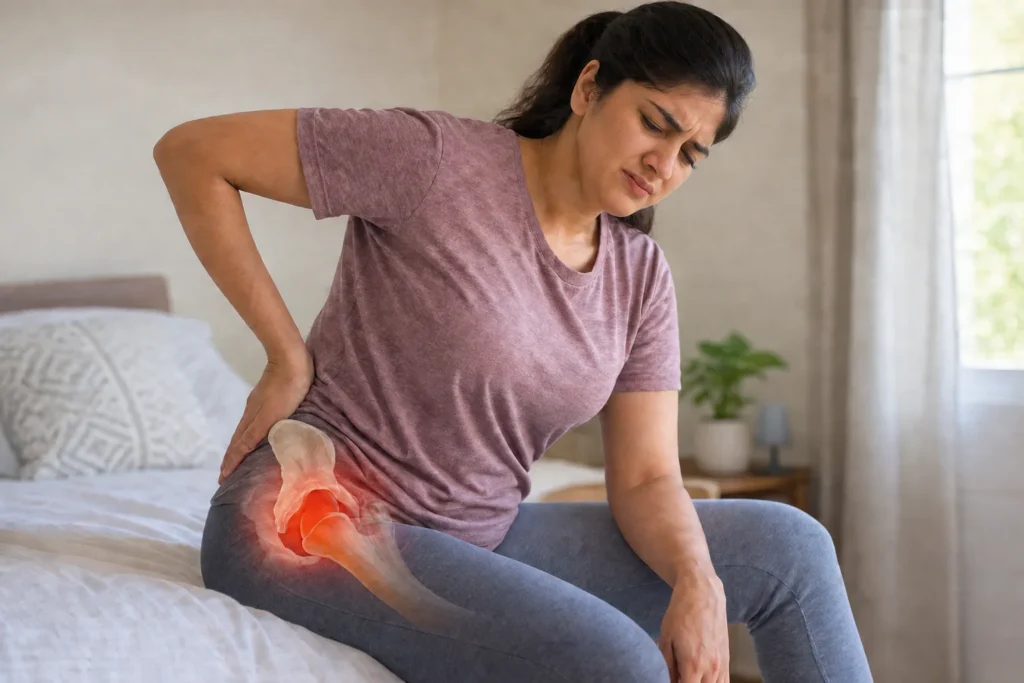
The location of discomfort can help guide an assessment, but it cannot confirm the diagnosis on its own.
| Where you feel the pain | Possible explanations |
|---|---|
| Front of the hip or groin | Hip osteoarthritis, joint irritation, femoroacetabular impingement, or bone stress injury |
| Outer side of the hip | Gluteal tendinopathy or greater trochanteric pain syndrome |
| Buttock or back of the hip | Referred pain from the lower back or other surrounding tissues |
| Pain mainly after exercise | Muscle or tendon irritation, or a bone stress injury |
| Stiffness after rest | Hip osteoarthritis or an inflammatory joint condition |
Notice what brings on the pain, how long it lasts, and whether the pattern is changing.
This information can help a healthcare professional decide whether further investigation is needed.
Why Does Hip Pain Disappear and Return?
Several factors can explain why hip pain seems to improve before coming back.
Changes in activity levels
You may feel comfortable during a quieter week but experience symptoms after a longer walk, a workout, or several days of increased activity.
The hip may tolerate ordinary loads but struggle when demands rise quickly.
Temporary relief from rest
Rest can reduce irritation, but it does not necessarily restore muscle strength, tendon capacity, joint mobility, or bone health.
Symptoms may return when the original activity resumes.
Prolonged sitting or repeated positions
Sitting for extended periods may increase stiffness or discomfort in some hip conditions.
Changing positions and taking movement breaks may help, depending on the underlying cause.
An underlying condition that needs assessment
Recurring pain may reflect osteoarthritis, tendon problems, referred spinal pain, or another condition.
Increasing frequency, worsening intensity, or declining walking ability should not be dismissed as normal fluctuations.
A simple symptom diary can help.
Record the activity that triggered the pain, its location, how long it lasted, and whether it affected your walking or sleep.
Myth vs Fact: Intermittent Hip Pain
MYTH: If the pain disappears, the problem has healed.
FACT: Rest may temporarily reduce symptoms without resolving the underlying cause. Pain that repeatedly returns deserves attention.
MYTH: All outer hip pain is bursitis.
FACT: Outer hip pain may involve the gluteal tendons, bursae, or other nearby structures. An assessment helps distinguish possible causes.
MYTH: Stretching is always the best solution.
FACT: The right approach depends on the cause. Some conditions benefit from strengthening and load management, while certain painful positions may need to be modified.
MYTH: You should keep exercising through hip pain.
FACT: Exercise should be appropriate for the condition. Stop aggravating activity and seek medical assessment for unexplained worsening pain, especially pain during weight-bearing.
How Can Physiotherapy Help With Hip Pain That Comes and Goes?
Physiotherapy aims to identify the factors contributing to symptoms and improve your ability to perform everyday activities safely.
Assessment before exercise
A physiotherapist may examine hip movement, muscle strength, walking patterns, balance, and the response to specific movements.
They may also assess the lower back and screen for signs that require medical referral.
Individualized exercise and strengthening
Depending on the diagnosis, rehabilitation may involve gentle mobility work, isometric exercises, bridges, sit-to-stand practice, or controlled step-ups.
These exercises are examples, not a universal program.
A movement that helps one person may aggravate another condition.
Suspected fractures, infections, and other serious causes must be medically assessed before routine rehabilitation begins.
Gradual return to activity
Returning immediately to your previous exercise level after a period of rest can trigger symptoms again.
A physiotherapist can help you increase walking distance, training volume, or exercise resistance progressively.
Improving confidence and daily function
The goal is not simply to make the pain disappear temporarily.
It is to improve movement, strength, and tolerance for activities such as walking, climbing stairs, working, and participating in recreation.
What Can You Do at Home?
If the pain is mild and there are no warning signs, the following steps may help while you arrange an assessment if symptoms persist.
- Modify painful activities: Temporarily reduce movements that consistently aggravate the hip rather than pushing through increasing pain.
- Avoid sudden increases in exercise: Build up walking distance, running volume, or resistance training gradually.
- Change position regularly: If sitting aggravates your symptoms, try brief movement breaks.
- Use a cold pack if helpful: Apply a wrapped cold pack for up to 20 minutes at a time. Do not place ice directly on the skin.
- Return to movement gradually: Resume comfortable activities progressively rather than immediately returning to your previous workload.
- Arrange an assessment for recurring pain: Repeated episodes deserve attention, especially if your movement or walking ability is changing.
Home care is not a substitute for medical assessment when pain is severe, worsening, associated with an injury, or affecting your ability to bear weight.
When Should You Seek Medical Attention?
Seek urgent medical care if:
- You have sudden, severe hip pain, particularly after a fall or injury.
- You cannot walk or put weight on the affected leg.
- Your hip pain is severe and accompanied by fever, feeling unwell, or a hot or swollen joint.
- You develop new significant weakness, numbness around the groin or saddle region, or changes in bladder or bowel control.
Arrange a medical assessment if:
- The pain keeps returning or gradually becomes more frequent.
- Your hip movement becomes increasingly restricted.
- You develop a persistent limp or difficulty with everyday activities.
- Pain regularly disrupts your sleep or prevents you from exercising.
- Symptoms do not improve after approximately two weeks of appropriate self-care, or they worsen sooner.
Do not wait for a particular time period if the symptoms are severe or concerning. (NHS)
A Lesser-Known Fact About Intermittent Hip Pain
Pain that disappears after rest does not necessarily mean the underlying tissue has healed.
For example, a tendon may feel less painful after its workload is reduced but become irritated again when activity increases.
A bone stress injury can also produce pain that initially appears only during exercise.
The important clue is not just whether the pain disappears.
It is whether the same activity repeatedly brings it back, whether symptoms are becoming more intense, and whether you can do less than you could previously.
This is why recurring hip pain should be assessed in context rather than automatically attributed to muscle tightness or a lack of stretching.
Final Thoughts: Listen to Your Hip
Hip pain that comes and goes is worth paying attention to, even when it settles between episodes. The pattern of pain, the activities that trigger it, and changes in movement can provide important clues about its possible cause.
Physiotherapy can support recovery from many muscle, tendon, and joint conditions through individualized rehabilitation and gradual strengthening. However, recurring pain should be assessed when it persists, worsens, or affects daily activities.
Do not push through unexplained hip pain. Seek appropriate medical advice and choose a rehabilitation approach that addresses the cause, not just the symptoms.
Conclusion
Hip pain that comes and goes can have several explanations, including osteoarthritis, gluteal tendinopathy, muscle strain, hip joint conditions, referred pain from the lower back, and bone stress injuries.
The location of the pain and the activities that trigger it can provide useful clues, but a proper assessment is needed to identify the cause.
Physiotherapy can help manage many musculoskeletal conditions through individualized exercise, activity modification, and gradual strengthening.
However, severe pain, difficulty bearing weight, fever with hip pain, or other warning signs require prompt medical attention.
If your hip pain keeps returning, becomes more intense, or starts limiting your daily activities, seek an appropriate clinical assessment rather than repeatedly resting and hoping it will disappear.
Frequently Asked Questions
1. Why does my hip pain come and go?
Hip pain may fluctuate because of changes in activity, muscle or tendon irritation, osteoarthritis, hip joint conditions, or referred pain from the lower back. Repeated episodes may require clinical assessment.
2. Can hip pain go away and come back without an injury?
Yes. Hip pain can develop without a clear injury when everyday activity repeatedly irritates a tendon, joint, or other tissue. However, unexplained or worsening pain should not automatically be dismissed.
3. Is walking good for intermittent hip pain?
Gentle walking may be appropriate for some causes of hip pain if it does not aggravate symptoms. Reduce the distance or intensity if pain increases, and seek assessment for persistent, unexplained, or worsening pain.
4. Can physiotherapy help hip pain that keeps returning?
Yes. Depending on the cause, physiotherapy may use individualised strengthening, mobility exercises, activity modification, and gradual return to daily activities. Serious causes must be assessed before routine rehabilitation.
5. When should I worry about hip pain?
Seek urgent medical care for sudden severe pain, inability to bear weight, or severe hip pain accompanied by fever or feeling unwell. Recurring or worsening pain also warrants assessment.
6. Does hip pain that improves with rest mean it is healing?
Not necessarily. Rest may reduce symptoms temporarily, but the underlying problem may remain. If pain repeatedly returns or becomes more severe, arrange an appropriate assessment.
Stay tuned with us for more health related topics.
Follow us on LinkedIn and Instagram for more.
More Read


Medical Disclaimer
This article is intended for general educational and informational purposes only. It does not replace professional medical advice, diagnosis, or treatment. Hip pain can have several causes, and the information provided cannot determine the cause of an individual’s symptoms. Consult a qualified healthcare professional for personalized assessment and treatment recommendations. Seek urgent medical care for severe or sudden hip pain, inability to bear weight, or hip pain accompanied by fever or feeling seriously unwell. Do not delay seeking medical advice because of information in this article.


