


Knee pain is one of the most common musculoskeletal complaints, affecting people of all ages, from athletes to older adults dealing with osteoarthritis. One of the effective and foundational exercises prescribed by physiotherapists is the straight leg raise for knee pain.
Weakness in the quadriceps, the large muscle at the front of the thigh, is a key contributor to knee instability, pain, and functional limitations. Strengthening this muscle group is therefore a cornerstone of rehabilitation and long-term knee health.
Also Read: This 7 day knee strengthening exercise plan works like Miracle
Why Strengthening the Quadriceps Matters
The quadriceps muscle group plays an essential role in controlling knee movement and providing stability during standing, walking, stair climbing, and running.
When the quadriceps are weak, other structures such as ligaments, cartilage, and tendons may absorb more load, increasing the risk of pain and injury.
Moreover, research shows that exercises targeting these muscles, including straight leg raises, can significantly reduce pain and improve daily function, especially in conditions like knee osteoarthritis.
Research synthesizing multiple randomized controlled trials found that quadriceps strengthening exercises, such as straight leg raises, reduce knee pain and improve mobility in adults with degenerative knee conditions like osteoarthritis. This makes SLR not just a therapy tool but a long-term strategy for knee health.
What Is a Straight Leg Raise (SLR)?
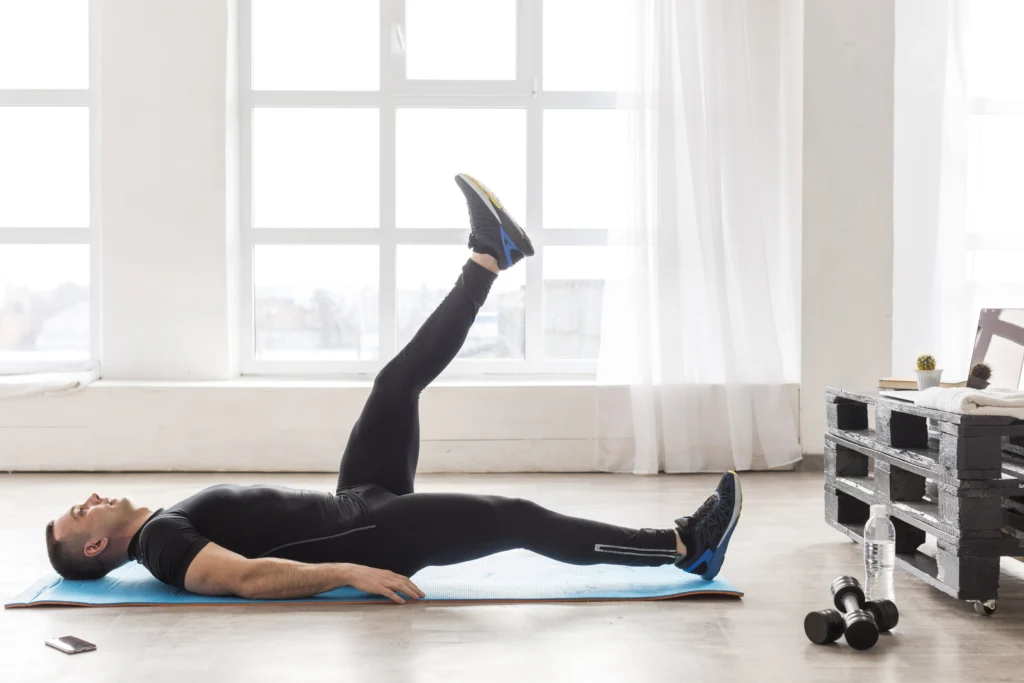
A straight leg raise is a low-impact, open-chain exercise that strengthens the quadriceps without requiring you to bend the knee.
This is especially useful for people with knee pain, limited range of motion, or those recovering from injury or surgery.
When done correctly, a straight leg raise engages the rectus femoris and other quadriceps muscles while minimizing stress directly on the knee joint.
This makes it ideal for early rehabilitation or for individuals who cannot tolerate more demanding knee exercises.
Also Read: Silent Killer? The Shocking Truth About Uric Acid and Your Health!
Step-by-Step Technique: How to Do a Straight Leg Raise
Executing straight leg raises with proper form ensures safety and maximizes benefit. Follow these steps:
1. Start Position
Lie on your back on a firm surface. Bend one knee with the foot flat on the ground, and keep the other leg straight and relaxed on the floor.
2. Engage Your Core and Quadriceps
Before lifting, gently tighten your abdominal muscles and quadriceps of the straight leg. This stabilizes the pelvis and engages the intended muscle group.
3. Lift With Control
Slowly lift your straight leg upward to about hip height or until it aligns with your opposite knee. Maintain a straight knee throughout the movement.
4. Pause and Squeeze
Hold the lifted position for 2–3 seconds, focusing on contracting the quadriceps.
5. Lower Slowly
Lower the leg with control to the starting position. Avoid letting it drop quickly.
6. Repeat the Motion
Perform 10–15 repetitions per set, and complete 2–3 sets per leg based on comfort and strength.
This controlled movement recruits the quadriceps effectively while minimizing stress on the knee itself.
Also Read: Unlocking Knee Pain Relief: How Physiotherapy Can Change Your Life!
How Straight Leg Raises Help Knee Pain
1. Enhances Quadriceps Strength Without Knee Bending
Straight leg raises allow you to strengthen the quadriceps without bending the knee, which can be painful in conditions like arthritis, meniscus irritation, or post-surgery stiffness.
This is why physiotherapists often prescribe SLR early in rehabilitation.
2. Improves Functional Mobility
Strong quadriceps support everyday activities such as standing up, walking, and climbing stairs.
A well-strengthened quadriceps can share joint load more efficiently, decreasing the strain on cartilage and other knee structures.
3. Reduces Pain and Improves Quality of Life
Multiple clinical trials show that quadriceps strengthening programs lead to statistically significant reductions in pain and improvements in knee function in people with knee osteoarthritis.
4. Supports Knee Stability
Weak quadriceps are associated with poor knee control and compensatory movement patterns, which can increase injury risk. Strengthening these muscles enhances knee stability and endurance.
5. Enhances Proprioception and Muscle Coordination
Emerging research suggests that strengthening exercises like SLR not only improve muscle strength but also support proprioceptive awareness, the body’s ability to sense position and movement, which is crucial for joint protection and balance.
Variations and Progressions of Straight Leg Raising

To make straight leg raises more effective and adaptable to individual needs, consider the following variations:
1. Assisted SLR with Strap
Loop a strap or towel around your foot to help lift the leg if initial strength is limited.
2. Hip Rotation Variation
Research indicates that external hip rotation combined with ankle dorsiflexion produces greater quadriceps force during SLR, which can make strength gains more efficient when tailored appropriately.
3. Dynamic Straight Leg Raises
Add a slight hold at the top of the raise (5-8 seconds) to increase muscular endurance.
4. Isometric Holds
Instead of lifting, simply tighten the quadriceps and hold for 10-20 seconds with the knee straight, which can be beneficial when movement is too uncomfortable.
These variations allow progression from gentle activation to stronger strengthening as tolerated.
New and Emerging Approaches
While straight leg raises have long been a core exercise in physiotherapy, a growing body of research explores more integrative approaches:
1. Combined SLR and Proprioceptive Training
A recent study found that pairing straight leg raise techniques with proprioceptive exercises, activities that enhance joint position awareness, led to superior outcomes in knee osteoarthritis management compared with either intervention alone.
This suggests that combining strength with nervous system retraining offers enhanced benefits for pain reduction and mobility.
2. Muscle Targeting Through Position Variation
As noted, activating the quadriceps more fully can be influenced by hip rotation and ankle position during the exercise.
This insight helps customize exercise variations to maximize strength gains in specific quadriceps portions.
Also Read: How to Do a Pelvic Tilt Exercise for Lower Back Pain Relief
Common Mistakes and How to Avoid Them
Even simple exercises like straight leg raises can be done incorrectly. Here are common pitfalls and quick fixes:
Mistake 1: Lifting Too High Too Soon
Trying to lift the leg excessively can lead to hip flexor and lower back compensation. Instead, lift only to the point where you feel a strong quadriceps contraction without discomfort.
Mistake 2: Arching the Lower Back
If your lower back arches when lifting, place a small towel under your pelvis or lower back to maintain neutral alignment.
Mistake 3: Rapid Movement
Fast lifts engage momentum rather than muscle strength. Slow, controlled lifts encourage true muscle recruitment.
Mistake 4: Ignoring Pain Signals
Sharp or increasing knee pain is not a sign of progress. If pain occurs, reduce range and focus on isometric contractions or consult a clinician.
Paying attention to these details ensures safe and effective strengthening.
Also Read: Cat Cow Stretch Benefits for Back Pain- A Complete Guide
Integration into a Daily Knee Strength Program
To optimize results, straight leg raises can be integrated into a weekly knee strengthening routine along with other exercises such as wall slides, quadriceps sets, and hip strengthening movements.
A balanced program might include:
- Straight Leg Raises — foundational strength
- Wall Slides — closed-chain knee control
- Clamshells — hip and glute stability
- Hamstring Curls — posterior support
- Calf Raises — lower leg stability
This comprehensive approach supports knee joint balance from all angles.
Also Read: 10 Best Daily Stretches for Back Pain Relief at Home
Frequently Asked Questions (FAQ)
1. Are straight leg raises safe for knee pain?
Yes. When performed with proper form and within pain limits, straight leg raises are safe and effective for knee strengthening, especially for quadriceps weakness.
2. How often should I do straight leg raises?
Perform 3–5 sessions per week, starting with 10–15 reps per leg and adjusting based on comfort and progress.
3. Can straight leg raises help osteoarthritis?
Yes. Clinical evidence shows that quadriceps strengthening, which includes straight leg raises, reduces pain and improves function in knee osteoarthritis.
4. Should I feel pain when doing this exercise?
A mild muscle fatigue or “muscle burn” is normal. Sharp or increasing joint pain means you should stop and adjust form or seek professional guidance.
5. Do straight leg raises work all parts of the quadriceps?
Straight leg raises primarily target the rectus femoris and overall quadriceps. Variations like hip rotation can enhance activation of specific portions.
6. Are there alternatives if I can’t perform SLR yet?
Yes. Assisted straps, isometric quadriceps contractions, and wall slides are good alternatives or progressions.
7. Can this help after knee surgery?
Straight leg raises are often part of early post-surgical rehabilitation but should be guided by a clinician for safety and timing.
8. Should I combine this with other exercises?
Yes. Strengthening surrounding muscle groups enhances knee joint health and reduces compensatory strain.
9. How long until I see improvement?
Many people notice improved muscle engagement within weeks, with more substantial gains over 6–8 weeks of consistent practice.
10. Can I do this at home without equipment?
Yes. Straight leg raises require no equipment and are ideal for home physiotherapy programs.
Also Read: Ultimate Guide to Home Physiotherapy for Back Pain
From My Physiotherapy Practice to You
In my experience as a physiotherapist, straight leg raises are one of the most starter-friendly yet impactful exercises for knee rehabilitation and quadriceps strengthening.
Most people notice improved confidence in knee control within just a few weeks of consistent practice. Rather than rushing into deep or intense workouts, foundational exercises like SLR build resilience, which makes progression safer and more effective.
Remember that strength is not built overnight. Consistency, proper form, and patience are far more powerful than sporadic high-intensity effort.
Listen to your body, respect its limits, and treat strength building as a steady journey rather than a quick fix.
Keep practicing. Stay attentive to your technique. And trust that every controlled lift brings you closer to stronger, more stable, and less painful knees.
Stay tuned with us for more health related topics.
Follow us on LinkedIn and Instagram for more.
More Read


Medical Disclaimer!
This article has been reviewed and written under the guidance of our Head Physiotherapist, Dr. Kruti Raj (PT, MUHS,CPT,CMPT). The information shared is intended for educational purposes only and should not be considered a substitute for personalized medical advice, diagnosis, or treatment.
Please consult us or any other qualified healthcare professional before beginning any exercise program, especially if you are experiencing pain, recovering from injury, or managing a medical condition.


