If you spend long hours at a desk, use your phone frequently, or have reduced physical activity, there is a high chance your shoulders are already under stress.
Shoulder pain, stiffness, weakness, and rounded posture are no longer limited to athletes or older adults.
They are now extremely common in young professionals and students.
Unlike traditional weights, resistance bands create variable tension.
As the band stretches, resistance increases.
This makes them ideal for the shoulder joint, which is highly mobile and requires stability across multiple ranges of motion.
Instead of placing excessive stress at the weakest joint angle, bands gradually increase load as you press or raise your arms.
This protects the joint while still challenging the muscles.
Another major advantage is accessibility.
You can perform a complete shoulder workout in a small room without machines, racks, or heavy dumbbells.
Bands are portable, affordable, and easy to store.
This removes one of the biggest barriers to consistency, which is lack of equipment or space.
Quick Answer: Resistance Band Shoulder Exercises at Home
Resistance band shoulder exercises at home are an effective way to build strength, improve mobility, and reduce shoulder pain without heavy equipment. By using controlled movements like shoulder presses, lateral raises, face pulls, and external rotations, you can target all major shoulder muscles safely. Perform 2–3 sessions per week with 10–15 repetitions per exercise for best results.
Key Takeaways
- Resistance band shoulder exercises are joint-friendly and ideal for home workouts.
- They provide variable resistance, making movements safer and more effective.
- Target all shoulder muscles including deltoids, rotator cuff, and scapular stabilizers.
- Consistent training improves posture, strength, and mobility.
- Perfect for beginners, rehab, and advanced training when progressed correctly.
- Slow, controlled movements maximize muscle activation and reduce injury risk.
- Progression can be achieved by increasing resistance, reps, or tempo.
- Combining strength, mobility, and stability exercises gives the best results.
Understanding Shoulder Anatomy for Smarter Training
To train effectively, it is important to understand the muscles involved.
The shoulder complex includes three major deltoid heads.
The anterior deltoid is responsible for pressing and front raises.
The lateral deltoid creates width and rounded shape.
The posterior deltoid supports posture and rear shoulder strength.
Beneath the deltoids lie the rotator cuff muscles.
These small stabilizers protect the shoulder joint during movement.
Weak rotator cuff muscles are a leading cause of discomfort and instability.
The scapular stabilizers, including the trapezius, rhomboids, and serratus anterior, control shoulder blade movement.
When these muscles are weak, posture collapses forward and increases risk of injury.
A complete resistance band shoulder workout must target all of these areas.
Why Resistance Band Shoulder Exercises at Home Actually Work
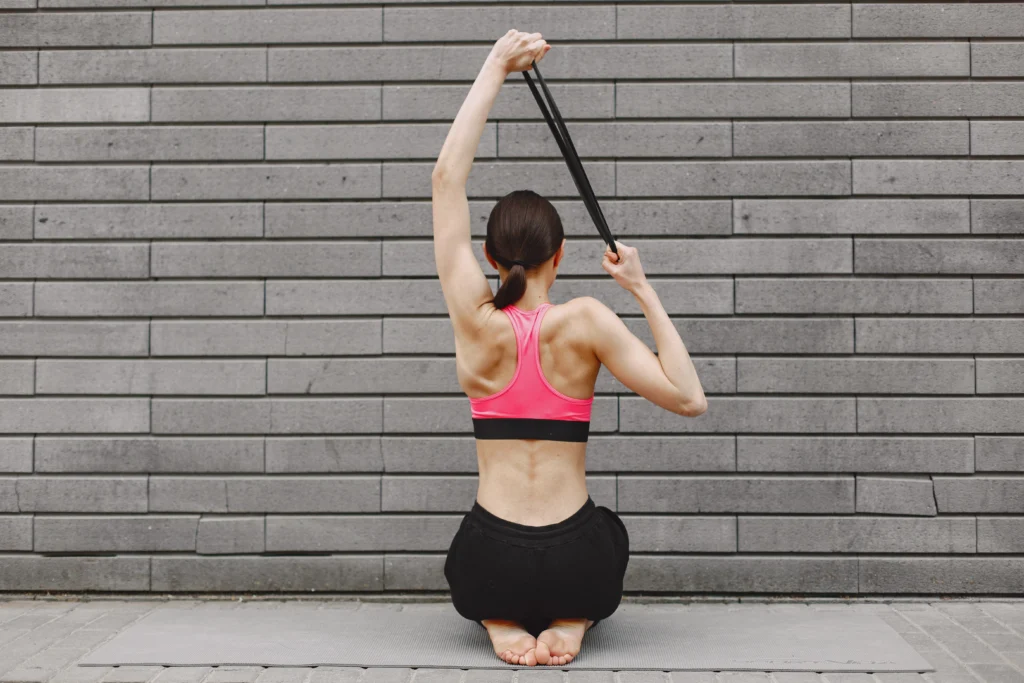
Unlike traditional weights, resistance bands provide variable resistance.
This means the tension increases as the band stretches, matching the natural strength curve of your muscles.
This is particularly beneficial for the shoulder joint because:
- It reduces stress at vulnerable joint angles
- It improves muscle activation throughout the range
- It enhances control rather than just strength
A study published in the Journal of Strength and Conditioning Research found that elastic resistance training can produce similar muscle activation levels to free weights when intensity is matched. (Research Gate)
Another study in Clinical Rehabilitation showed that resistance band exercises significantly improved rotator cuff strength and shoulder stability in patients recovering from injury. (Science Direct)
This makes resistance bands suitable not just for beginners, but also for rehabilitation and long-term joint health.
Benefits of Resistance Band Shoulder Exercises at Home
Resistance band training offers multiple advantages:
- Joint friendly and low impact
- Improves shoulder mobility
- Enhances muscle activation
- Strengthens stabilizing muscles
- Reduces injury risk
- Supports rehabilitation
- Builds muscle when programmed correctly
- Improves posture for desk workers
- Scalable for beginners to advanced
- Safe for older adults
A study in Sports Health highlighted that elastic resistance training improves neuromuscular coordination and reduces injury risk, especially in the shoulder complex. (Nature)
Because tension is constant, muscles remain engaged throughout the entire range of motion.
This increases time under tension, which plays a key role in muscle growth and endurance.
Types of Resistance Bands to Use
For a complete home setup, include:
- Loop bands for lateral raises and activation drills.
- Tube bands with handles for presses and rows.
- Therapy bands for rehabilitation work.
- Heavy power bands for advanced strength training.
Keep at least three resistance levels to allow progression over time.
Complete Resistance Band Shoulder Exercises
This section covers every essential resistance band shoulder exercise you need for strength, muscle growth, stability, posture correction, and injury prevention.
Each movement targets a specific portion of the shoulder complex to ensure balanced development.
For best results, move slowly, maintain tension throughout the rep, and focus on controlled breathing.
1. Resistance Band Overhead Shoulder Press
Primary Muscles Worked: Anterior deltoid, lateral deltoid, triceps
Secondary Muscles: Upper chest, core stabilizers
How to Perform
- Stand with both feet placed firmly on the band.
- Hold the handles at shoulder height with palms facing forward.
- Press upward until arms are straight overhead.
- Pause briefly at the top.
- Lower slowly to starting position.
Coaching Tips
- Keep ribs down and core engaged.
- Avoid leaning backward.
- Control the downward phase for 2 to 3 seconds.
This is your primary compound movement for overall shoulder strength.
2. Single Arm Resistance Band Press
Primary Muscles Worked: Deltoids
Additional Benefit: Core stability and imbalance correction
How to Perform
- Anchor band under one foot or use a door anchor.
- Press upward with one arm at a time.
- Keep torso upright and stable.
- Lower slowly and repeat.
Why It Matters
Unilateral training strengthens weaker sides and improves shoulder stability.
3. Resistance Band Lateral Raise
Primary Muscles Worked: Lateral deltoids
How to Perform
- Stand on the middle of the band.
- Hold handles at your sides.
- Lift arms out to shoulder height.
- Lower slowly with control.
Key Focus
- Slight bend in elbows.
- Do not shrug shoulders.
- Raise with control, not momentum.
This movement builds shoulder width and definition.
4. Lean Away Band Lateral Raise
Primary Muscles Worked: Lateral deltoids
How to Perform
- Hold a sturdy object with one hand.
- Lean slightly away from anchor point.
- Raise working arm laterally.
- Lower slowly.
Benefit
Increases tension in stretched position and improves muscle activation.
5. Resistance Band Front Raise
Primary Muscles Worked: Anterior deltoid
How to Perform
- Stand on band.
- Lift arms forward to shoulder height.
- Pause briefly.
- Lower under control.
Avoid swinging or jerking the band.
6. Resistance Band Face Pull
Primary Muscles Worked: Posterior deltoids, rhomboids, traps
How to Perform
- Anchor band at chest height.
- Pull handles toward your face.
- Lead with elbows wide.
- Squeeze shoulder blades.
Why It Is Essential
Corrects rounded shoulders and strengthens rear delts.
7. Resistance Band Reverse Fly
Primary Muscles Worked: Rear deltoids
How to Perform
- Bend slightly at hips.
- Hold band in front of you.
- Open arms outward.
- Return slowly.
Excellent for posture and shoulder balance.
8. Resistance Band External Rotation
Primary Muscles Worked: Rotator cuff
How to Perform
- Anchor band at elbow height.
- Keep elbow tucked to your side.
- Rotate forearm outward.
- Return slowly.
Move slowly and prioritize control.
9. Resistance Band Pull Apart
Primary Muscles Worked: Rear delts, rhomboids
How to Perform
- Hold band at shoulder height.
- Pull hands apart.
- Squeeze shoulder blades.
- Slowly return.
Perfect for daily posture maintenance.
10. Resistance Band Upright Row
Primary Muscles Worked: Lateral delts, upper traps
How to Perform
- Stand on band.
- Pull handles upward toward upper chest.
- Keep elbows slightly higher than wrists.
- Lower under control.
Avoid pulling too high if shoulder discomfort exists.
11. Resistance Band 90 Degree External Rotation
Primary Muscles Worked: Rotator cuff stabilizersHow to Perform
- Raise elbow to shoulder height.
- Bend elbow at 90 degrees.
- Rotate forearm upward.
- Slowly return.
Advanced stability drill for injury prevention.
Condition-Specific Physiotherapy Tips
Shoulder Pain Due to Poor Posture
Focus on:
- Pull-aparts
- Face pulls
- Scapular control exercises
Avoid excessive pushing exercises.
Rotator Cuff Weakness
Start with:
- External rotations
- Light resistance
Progress slowly.
Frozen Shoulder (Early Phase)
Focus on:
- Gentle mobility
- Pain-free range
Avoid aggressive strengthening.
Shoulder Pain After Workout
Often due to overload or poor form.
What to do:
- Reduce intensity
- Improve warm-up
- Correct technique
How to Use This Exercises Effectively
For balanced shoulder development:
- Include one pressing movement
- Include one lateral raise variation
- Include one rear delt movement
- Include one rotator cuff exercise
This ensures complete shoulder activation.
Rotate variations every 4 to 6 weeks to avoid plateaus and maintain muscle stimulus.
Structured Workout Plans
Beginner Routine
Train 3 times per week:
- Shoulder Press 3 sets of 12
- Lateral Raises 3 sets of 12
- External Rotations 3 sets of 15
- Pull Aparts 3 sets of 15
Rest 45 seconds between sets.
Intermediate Routine
- Press 4 sets of 10
- Lateral Raise 4 sets of 12
- Face Pull 3 sets of 15
- Upright Row 3 sets of 12
- External Rotation 3 sets of 15
Advanced Routine
Include supersets, tempo training, drop sets, and isometric holds to increase intensity without heavier equipment.
Muscle Building Strategy with Resistance Bands
Hypertrophy requires adequate volume and progression.
Aim for 10 to 20 total weekly sets for shoulders.
Train close to muscular fatigue.
Use slow controlled repetitions, especially during the lowering phase.
Increase difficulty by:
- Using thicker bands
- Increasing repetitions
- Increasing sets
- Reducing rest time
- Slowing tempo
- Adding pauses at peak contraction
Time under tension is critical for growth.
Fat Loss Shoulder Circuit
Perform four rounds with minimal rest:
- Shoulder press
- Lateral raise
- Squats
- Push ups
- Band rows
This increases heart rate while strengthening shoulders.
Shoulder Pain and Rehabilitation Protocol
If experiencing mild discomfort, begin with external rotations and pull aparts.
Gradually introduce compound movements as strength improves.
Avoid sudden heavy resistance and always maintain proper form.
Stop if sharp pain occurs.
Posture Correction Routine for Desk Workers
Daily 10 minute reset:
- Pull aparts 20 reps
- Face pulls 15 reps
- Wall slides 15 reps
- External rotations 15 reps
This strengthens posterior muscles and reduces forward shoulder posture.
Progressive Overload with Bands
To continue seeing results:
- Increase resistance
- Increase volume
- Slow down repetitions
- Increase training frequency
- Add advanced techniques
Track your sets and reps weekly.
Red Flag Symptoms You Should Not Ignore
Seek professional help if you experience:
- Pain radiating down the arm
- Numbness or tingling
- Severe weakness
- Persistent night pain
These may indicate nerve involvement or more serious conditions.
Science Behind Elastic Resistance Training
Research indicates elastic resistance training can produce muscle activation comparable to free weights when intensity and volume are matched.
Studies also highlight improvements in rotator cuff strength, joint stability, and rehabilitation outcomes.
Elastic resistance is particularly effective for individuals recovering from injury and for older adults seeking safe strength training options.
Advanced Training Techniques
- Drop sets increase metabolic stress.
- Tempo training increases time under tension.
- Isometric holds strengthen weak points.
- Mechanical advantage sets extend fatigue safely.
These methods allow progression without heavy loads.
4 Week Progressive Plan
- Week 1 Moderate resistance
- Week 2 Increase repetitions
- Week 3 Increase resistance
- Week 4 Add advanced techniques
Deload if needed before repeating cycle.
Nutrition and Recovery for Shoulder Growth
Consume 1.6 to 2.2 grams of protein per kilogram of bodyweight.
Maintain a slight calorie surplus for growth. Stay hydrated and prioritize 7 to 8 hours of sleep.
Recovery is where muscle repair and growth occur.
Most people notice improvements within 4 to 8 weeks.
Myth vs Reality
Myth: Resistance bands are only for beginners
Reality: They are widely used in rehabilitation and elite sports training
Final Thoughts
Consistent resistance band shoulder training builds not only muscle size but also resilience.
Over time, improved stability reduces the likelihood of impingement, tendon irritation, and posture related discomfort.
Many people underestimate how important scapular control is for shoulder health.
Bands uniquely allow slow, controlled movements that strengthen these small stabilizing muscles effectively.
Additionally, resistance band training improves mind muscle connection.
Because tension remains constant, you are forced to control each repetition rather than relying on momentum.
This enhances neuromuscular coordination and leads to better long term strength gains.
Another overlooked benefit is convenience.
When workouts are convenient, adherence improves.
A five minute activation session in the morning and a structured workout later in the day can fit easily into busy schedules.
Consistency over months delivers better results than occasional intense gym sessions.
Resistance band training also complements other forms of exercise.
Athletes can use band work as accessory training. Individuals who lift weights can use bands for warm ups and prehab.
Seniors can maintain shoulder mobility safely.
It is a versatile system suitable for nearly everyone.
Finally, long term shoulder health depends on balance.
Training only presses without rear delt and rotator cuff work creates imbalance.
A well structured resistance band shoulder workout addresses strength, mobility, endurance, and stability together.
Frequently Asked Questions
1. Are resistance band shoulder exercises effective?
Yes, resistance bands provide constant tension and can effectively build strength, improve mobility, and support shoulder rehabilitation.
2. Can I build muscle with resistance bands?
Yes, muscle growth is possible when you train with enough intensity, volume, and progressive overload.
3. How often should I train shoulders at home?
Train 2 to 3 times per week, allowing adequate recovery between sessions.
4. Which resistance band is best for shoulders?
Use a combination of light, medium, and heavy bands to target different exercises and progression levels.
5. Are resistance bands safe for shoulder pain?
Yes, they are generally safe if exercises are performed with proper form and pain-free range of motion.
6. What is the best exercise for shoulder stability?
External rotations and face pulls are among the best exercises for improving shoulder stability.
7. How many reps should I do?
Aim for 10 to 15 repetitions per exercise for strength and endurance.
8. Can beginners start with resistance band training?
Yes, resistance bands are ideal for beginners due to their low impact and adjustable resistance.
9. Do resistance bands replace weights?
They can be an effective alternative, especially for home workouts and rehabilitation training.
10. How long does it take to see results?
With consistent training, noticeable improvements can be seen within 3 to 6 weeks.
Stay tuned with us for more health related topics.
Follow us on LinkedIn and Instagram for more.
More Read


Medical Disclaimer!
This article has been reviewed and written under the guidance of our Head Physiotherapist, Dr. Kruti Raj (PT, MUHS,CPT,CMPT). The information shared is intended for educational purposes only and should not be considered a substitute for personalized medical advice, diagnosis, or treatment.
Please consult us or any other qualified healthcare professional before beginning any exercise program, especially if you are experiencing pain, recovering from injury, or managing a medical condition.