


If you feel headache at back of head, it rarely comes out of nowhere. In clinical practice, this is one of the most misunderstood complaints.
Many patients walk in thinking it is migraine or stress. But after assessment, the real issue often sits in the neck.
There is a strong anatomical reason behind this.
The upper cervical spine shares neural pathways with the head through a structure called the trigeminocervical complex.
Because of this, the brain cannot clearly differentiate whether the pain is coming from the neck or the head.
This is why a neck issue can feel like a headache and a headache can worsen when you move your neck.
Pareek et al. (2024), This study explains that cervicogenic headache is a secondary headache caused by dysfunction in the cervical spine and can mimic primary headaches.
Read: Cervicocephalic Syndrome: Simple Exercises For Neck Related Headaches
Quick Answer
Headache at the back of the head is most commonly caused by neck-related issues such as cervicogenic headache, muscle tension, or poor posture.
It can also be linked to occipital nerve irritation, stress, prolonged screen use, or muscle imbalance.
In most cases, improving posture, doing targeted exercises, and reducing strain on the neck can provide long-term relief. However, sudden or severe headaches should be medically evaluated.
Read: How to Manage Migraine Naturally and Effectively
Key Takeaways
- Most headaches at the back of the head originate from the neck, not the brain.
- Poor posture and prolonged screen use are leading modern causes.
- Muscle imbalance and joint stiffness play a major role in recurring headaches.
- Simple exercises like chin nods and posture correction can provide lasting relief.
- Ignoring posture and relying only on medication often leads to recurrence.
- Early physiotherapy intervention can prevent chronic headache patterns.
- Red flag symptoms such as sudden severe pain or neurological signs need medical attention.
Read: Atlantoaxial Osteoarthritis: Simple Fixes for Pain at Base of Skull When Turning Head
Why Pain at the Back of the Head Feels Heavy or Pulling
Patients often describe this pain as:
- A dragging sensation
- Tightness at the base of the skull
- A dull pressure that builds during the day
That pattern is not random.
It usually indicates mechanical loading of the cervical spine.
When posture is poor or muscles are fatigued, the load on the upper neck increases.
Over time, this creates a sustained tension pattern that the brain interprets as pain.
Recent research has even linked posture patterns in office workers with cervicogenic headache development.Hwang et al. (2025)
This study shows a strong association between posture and neck related headache patterns in working populations.
Read about: How to Relieve Morning Neck Stiffness Naturally
Symptoms of Headache at the Back of the Head
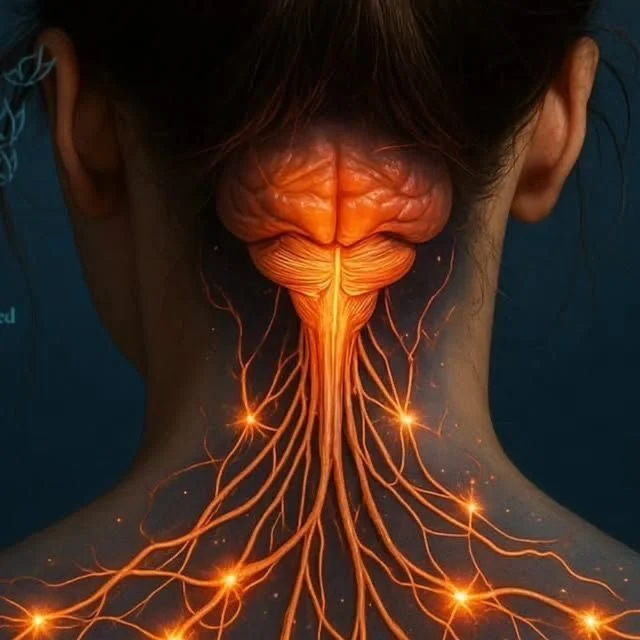
Not all headaches feel the same. The way your pain behaves gives important clues about the cause.
You may notice:
- A dull, heavy ache at the base of the skull
- Tightness that spreads toward the neck or shoulders
- Pain that increases after long sitting or screen use
- Stiffness when turning the neck
- Tenderness when pressing the back of the head
- Occasional sharp or shooting pain in some cases
One pattern I often hear from patients is that the pain builds gradually through the day and feels worst in the evening.
That usually points toward posture or muscle fatigue rather than a serious condition.
Read about : What is Cervical Facet Joint Pain, how it causes cervicogenic headaches and how to correct it naturally
Common Causes of Headache at the Back of the Head
Cervicogenic Headache
This is the most frequent cause I see clinically.
The pain originates in the neck and travels upward toward the back of the head. It is usually one-sided but can become bilateral over time.
Typical signs include:
- Pain triggered by neck movement
- Reduced neck mobility
- Stiffness in upper cervical region
Alshana et al. (2025), This prospective study shows that people with chronic neck pain have a higher risk of developing cervicogenic headache, especially when deep neck muscle function is impaired.
Read in detail: Neck Pain from Phone Use? Here’s How to Treat Text Neck Syndrome
Postural Strain and Tech Neck
This is becoming the most common modern cause.
When your head moves forward even slightly, the load on the neck increases significantly.
Over hours of sitting or mobile use, this creates continuous strain.
What most people do not realize is that the problem is not just muscle fatigue.
It is also reduced circulation and altered neuromuscular control.
This explains why:
- Pain increases by evening
- Relief comes when lying down
- Symptoms return the next day
Read about: What Is Cervical Myofascial Pain Syndrome And How To Relieve Trigger Points
Myofascial Trigger Points
These are tight, sensitive areas within muscles.
In the neck, trigger points in:
- Suboccipital muscles
- Upper trapezius
- Sternocleidomastoid
can refer pain directly to the back of the head.
Many patients are surprised that pressing a point in the neck reproduces their headache exactly.
Read: What is Sternocleidomastoid Syndrome, Trigger Points and Its Treatment
Occipital Neuralgia
This is less common but very distinct.
The pain is sharp, shooting, or electric. It often starts at the base of the skull and may radiate upward.
It occurs due to irritation of the occipital nerves, often from muscle tightness or cervical dysfunction.
Read more: Cervical Vertigo Explained: Why Neck Pain Make You Feel Dizzy
Tension Type Headache with Posterior Dominance
Not all tension headaches are frontal.
Some present predominantly at the back of the head, especially when neck muscles are heavily involved.
Read about: Neck And Jaw Pain Together? Here’s The Full Clinical Picture
TMJ and Jaw Dysfunction
A lesser-known contributor.
Jaw muscles and neck muscles are closely connected.
Dysfunction in the jaw can increase tension in the cervical region and trigger headaches at the back.
Quilghini et al. (2025), This study highlights that treating both jaw and cervical regions improves headache outcomes.
Read: How to Treat Trismus- A Jaw Stiffness Naturally with Exercises
Who Is More Likely to Get This Type of Headache
Some people are more prone to developing headaches at the back of the head due to their daily habits or physical condition.
Common risk factors include:
- Long hours of desk work or laptop use
- Frequent mobile phone usage in downward position
- Poor workstation ergonomics
- Weak neck and upper back muscles
- High stress levels
- Previous neck injury
- Sedentary lifestyle
If you recognize yourself in more than one of these, your headache is likely not random. It is your body responding to repeated strain.
Learn About: The Ultimate Neck Stretch Routine for Desk Workers in 2026
What Actually Happens Inside the Body
This is where things get interesting.
Pain is not only due to muscle tightness. It involves:
- Joint dysfunction in upper cervical spine
- Muscle imbalance between deep and superficial neck muscles
- Nervous system sensitization
- Reduced blood flow in sustained postures
Fahmy et al. (2025), This review highlights that most cervicogenic headaches respond well to conservative care such as physiotherapy, especially when mechanical factors are addressed early.
Read: Early Signs Of Cervical Fracture You Must Know
How to Identify the Cause Yourself
Here is a simple way to differentiate:
- Pain increases when you move your neck → likely cervicogenic
- Pain feels like tight pressure → likely tension type
- Sharp electric pain → possible nerve involvement
- Pain after long screen time → posture related
If pressing your neck reproduces the headache, that is a strong indicator of musculoskeletal origin.
Read: Lhermitte’s sign- An Electic Shock Sensation Down The Neck
How Is the Cause Diagnosed
Most people expect scans or tests, but in many cases, diagnosis is primarily clinical.
A physiotherapist or doctor will assess:
- Neck movement and stiffness
- Muscle tightness and trigger points
- Posture and alignment
- Pain reproduction with specific movements
If your headache can be reproduced by pressing certain areas in your neck or by moving your cervical spine, it strongly indicates a musculoskeletal cause.
Imaging like MRI is usually not required unless there are red flag symptoms.
Read: Trigger Point Injections for Neck Pain: Do They Really Work
Physiotherapy Treatment That Actually Works
This is where most online advice falls short. Treatment is not just about stretching.
Joint Mobilization
Targeting upper cervical joints improves mobility and reduces referred pain.
Xu and Ling (2025), This meta analysis confirms that manual therapy is effective in reducing cervicogenic headache symptoms.
Deep Neck Muscle Activation
Most patients overuse superficial muscles and underuse deep stabilizers.
This imbalance leads to poor control and overload.
Correcting this is essential for long-term relief.
Scapular Strengthening
The neck depends heavily on shoulder blade stability.
Weak scapular muscles increase strain on the cervical spine.
Trigger Point Release
Releasing tight muscle knots reduces referred pain and improves muscle function.
Posture Re-Education
Without correcting posture, symptoms keep returning.
This is not about sitting straight for a few minutes. It is about retraining how your body holds itself throughout the day.
Also Read: Ultimate 6 Weeks Neck Rehabilitation Exercises For Pain Relief
Exercises for Back of Head Headache
These are clinically effective and not random suggestions.
Chin Nod
Gently nod your head as if saying yes. Keep the movement small.
This activates deep cervical muscles without overloading superficial ones.
Suboccipital Release
Place your fingers at the base of the skull and apply gentle pressure.
Hold for 20 to 30 seconds.
You may feel a gradual release of tension.
Upper Trapezius Stretch
Tilt your head to one side and hold.
This reduces muscle tightness contributing to headache.
Thoracic Extension
Sit upright and gently arch backward.
A stiff upper back increases load on the neck, which many people overlook.
Scapular Retraction
Pull your shoulder blades back and hold.
This improves posture and reduces neck strain.
Read About: Best Sleeping Position for Neck Pain: A Physiotherapist’s Complete Guide
Best Sleeping Position for Relief
Sleep plays a bigger role than most people think.
If your pillow or sleeping position is not supportive, your neck remains under stress for hours.
What works best:
- Sleep on your back or side
- Keep your neck in a neutral position
- Use a pillow that supports the natural curve of your neck
- Avoid very high or very flat pillows
Many patients notice that their headache is worse in the morning.
That is often a sign that sleeping posture needs correction.
Read About: How to Choose the Right and Best Pillow for Neck Pain
Daily Habits That Make a Huge Difference
Simple changes often give the best results:
- Keep screen at eye level
- Avoid prolonged mobile use in downward position
- Take breaks every 30 to 40 minutes
- Use a pillow that supports natural neck curve
- Stay hydrated
Read in detail: Best Desk Setup to Reduce Neck and Back Pain
Simple Workstation Changes That Reduce Headaches
You do not need a perfect setup, just a practical one.
Small adjustments can make a big difference:
- Keep your screen at eye level
- Sit with your back supported
- Keep feet flat on the ground
- Avoid leaning forward toward the screen
- Use a chair that supports your lower back
Even correcting one or two of these can reduce the load on your neck significantly.
Read: Neck Pain from Poor Breathing Pattern? Correct Now!
Lesser Known Factors That Worsen This Headache
These are often missed:
- Shallow chest breathing increases neck muscle activity
- Eye strain indirectly increases neck tension
- Dehydration affects muscle function
- Emotional stress alters muscle tone
Read: The Morning Headache Causes and Easy Fixes
When You Should Be Careful
Seek medical attention if you notice:
Also Read: Neck Pain with Fever: When To Worry And How To Treat
Red Flag Symptoms You Should Not Ignore
While most headaches at the back of the head are harmless, some situations require immediate attention.
Seek medical help if you experience:
- A sudden, severe headache that feels different from usual
- Headache with fever or neck rigidity
- Vision problems or double vision
- Weakness, numbness, or difficulty speaking
- Headache after a fall or injury
- Persistent headache that keeps worsening
These are not typical of posture-related headaches and should not be ignored.
Read: How to Fix Neck Fatigue After Migraine Naturally
How Long Does It Take to Recover
This depends on the cause and how consistently you follow treatment.
- Mild cases may improve in a few days
- Posture-related headaches may take 2 to 3 weeks
- Chronic cases can take several weeks to months
The key factor is not just treatment but habit correction.
If posture and muscle imbalance are not addressed, the headache tends to return.
Read: Pain in the Back Side of the Neck: Causes and Treatment
Common Mistakes That Delay Recovery
This is something I see very often in practice.
People unintentionally slow down their recovery by:
- Relying only on painkillers
- Ignoring posture during work
- Doing random exercises without guidance
- Stopping exercises once pain reduces
- Using incorrect pillows
Understanding what not to do is just as important as knowing what to do.
Read: Neck Pain When Looking Up: What It Really Means and How to Fix It
Long Term Prevention
Relief is not just about treatment. It is about changing how your body functions daily.
Focus on:
- Strength
- Movement
- Posture awareness
- Stress control
Once these improve, recurrence reduces significantly.
Also Read : Neck Cracking: Benefits, Risks, and the Truth About Stroke
When Should You See a Physiotherapist
If your headache is recurring or linked with neck discomfort, it is a good idea to consult a physiotherapist.
You should consider it if:
- Pain keeps coming back
- Neck movement is restricted
- You feel stiffness or tightness regularly
- Headache affects your daily routine
Early intervention often prevents the condition from becoming chronic.
Read : Chiropractic for Neck Pain: Does It Really Work?
Conclusion
A headache at the back of the head is usually linked to the neck, not just the head.
In most cases, it comes from posture, muscle imbalance, or joint stiffness.
The good news is that it is highly manageable.
Simple steps like improving posture, doing the right exercises, and staying consistent with daily habits can bring lasting relief.
If the pain feels unusual, severe, or keeps getting worse, it is important to get it assessed early.
Listen to your body. Small changes done regularly can make a big difference.
Read: A Complete Guide To Sinuses Related Neck Pain
Frequently Asked Questions
1. What causes headache at the back of the head?
It is most commonly caused by neck related issues such as poor posture, muscle tension, or cervicogenic headache.
2. Is headache at the back of the head serious?
In most cases it is not serious and is related to muscle or posture issues, but severe or unusual headaches should be checked by a doctor.
3. Can poor posture lead to this type of headache?
Yes, prolonged forward head posture increases strain on the neck and commonly leads to pain at the back of the head.
4. Which exercise helps relieve this headache?
Exercises like chin nods, suboccipital release, and scapular strengthening are effective.
5. How do I know if my headache is from my neck?
If your headache increases with neck movement or improves with posture correction, it is likely neck related.
6. Can mobile phone usage cause back of head pain?
Yes, looking down at your phone for long periods places stress on the neck and triggers headaches.
7. When should I see a physiotherapist?
If your headaches are frequent, posture related, or associated with neck stiffness, physiotherapy can help.
8. How long does recovery take?
Mild cases improve in a few days, while posture related or chronic cases may take a few weeks with consistent care.
Stay tuned with us for more health related topics.
Follow us on LinkedIn and Instagram for more.
More Read


Medical Disclaimer!
This article has been reviewed and written under the guidance of our Head Physiotherapist, Dr. Kruti Raj (PT, MUHS,CPT,CMPT). The information shared is intended for educational purposes only and should not be considered a substitute for personalized medical advice, diagnosis, or treatment.
Please consult us or any other qualified healthcare professional before beginning any exercise program, especially if you are experiencing pain, recovering from injury, or managing a medical condition.


