


Understanding sternocleidomastoid syndrome, trigger points and associated headaches:
It usually starts with something that does not quite add up. In the clinic, these cases rarely come in a neat pattern.
Someone says their MRI is normal but they still feel dizzy.
Another person describes a strange pressure behind the eye.
Sometimes it sounds like sinus pain, but ENT reports are clear.
At that point, I usually check one muscle early.
The sternocleidomastoid.
Not because it is complicated, but because it is often missed.
Read about our Complete Neck Pain Guide : Causes, Symptoms, Exercises and Treatment
Quick Answer
Sternocleidomastoid syndrome is caused by trigger points in the SCM muscle, leading to headaches, dizziness, facial pain, and neck discomfort. It is commonly linked to posture, breathing patterns, and muscle overuse, and responds well to physiotherapy treatment.
Read about: Early Signs of Cervical Spine Damage You Should Never Ignore
Key Takeaways
- SCM trigger points can mimic headaches, sinus pain, and ear issues
- Dizziness can originate from neck muscle dysfunction
- Posture and breathing patterns are major contributors
- Stretching alone is often not enough for recovery
- Physiotherapy provides long-term relief when root causes are addressed
Read about : 15 Common Causes of Neck Pain You Should Know
The sternocleidomastoid
The sternocleidomastoid is simple in structure but not in function.
You can feel this muscle easily when you turn your head. It runs from behind the ear down to the collarbone and sternum.
But functionally, it is involved in much more than just movement.
- It helps rotate and flex the head
- It assists breathing during stress
- It contributes to proprioception
- It interacts with visual and balance systems
This combination is what makes its dysfunction so misleading.
Read in detail about: What is Cervical Spondylosis? The Truth Behind Chronic Neck Pain
What is sternocleidomastoid syndrome

It is not a diagnosis you confirm with a scan.
It is a pattern we recognize when the SCM develops trigger points and starts producing referred symptoms.
These symptoms often do not feel like they are coming from the neck.
That is where confusion begins.
Read about: What Is Cervical Myofascial Pain Syndrome And How To Relieve Trigger Points
Trigger points in this muscle are unusually deceptive
Unlike many muscles, the SCM tends to refer pain to distant areas.
That is why patients often describe symptoms that seem unrelated.
Sternal head involvement
- Pain around or behind the eye
- Frontal headache
- Dizziness or lightheadedness
Read about: Neck And Jaw Pain Together? Here’s The Full Clinical Picture
Clavicular head involvement
This overlap has been well described in myofascial pain literature, where trigger points can mimic other conditions (Simons et al., 1999).
Read: A Complete Guide To Sinuses Related Neck Pain
A subtle but important early sign
Not everyone reports pain first.
Some people describe:
- A floating sensation
- Visual fatigue
- Difficulty focusing
- Mild imbalance
These symptoms often precede obvious neck pain.
Research has shown that trigger points can alter sensory input and contribute to non-pain symptoms as well (Cagnie et al., 2015).
Read: What is Torticollis? How to treat neck tilt condition
How to Self-Check Your SCM at Home
This is something I often teach patients early on, especially when they are unsure if the muscle is involved.
You do not need any equipment. Just a bit of awareness.
Simple self-check steps
- Sit comfortably and gently turn your head to one side
- Use your fingers to feel the prominent rope-like muscle on the opposite side of the neck
- Slowly press along the length of the muscle
What you might notice
- A tender or tight band under your fingers
- Pain that feels familiar, not just local
- Referred sensation towards the eye, ear, or forehead
- Slight dizziness when pressing certain points
Read about : What is Cervical Facet Joint Pain, how it causes cervicogenic headaches and how to correct it naturally
A small caution
Do not press too hard or for too long. The SCM is sensitive, and excessive pressure can increase symptoms temporarily.
If pressing the muscle reproduces your usual headache or discomfort, it is often a strong indicator that the SCM is involved.
Read about: Which Is The Best Sitting Posture To Avoid Neck Pain And How To Achieve It
Why the SCM becomes overactive in the first place
When you look at daily habits, the pattern becomes clear.
Posture
Forward head posture increases load on superficial neck muscles. The SCM begins to compensate continuously.
This altered muscle recruitment pattern has been observed in patients with neck pain, where superficial muscles become overactive (Falla et al., 2004).
Learn how posture affects neck pain and correction exercises in our article on Simple Posture Correction Exercises for Forward Head Posture
Breathing
Under stress, breathing shifts from diaphragm to upper chest.
The SCM becomes an accessory breathing muscle and does not get enough rest.
Read: 10 Proven Home Remedies for Neck Pain from Anxiety
Screen use
Looking down at a phone for extended periods keeps the muscle in a strained position.
This is one of the most consistent contributors in modern lifestyles.
Read in detail: Neck Pain from Phone Use? Here’s How to Treat Text Neck Syndrome
Sleep habits
High pillows or rotated neck positions can maintain low-grade strain overnight.
Patients rarely connect this with their symptoms.
Read About: Best Sleeping Position for Neck Pain: A Physiotherapist’s Complete Guide
Previous minor trauma
Even small injuries like sudden jerks or old whiplash events can leave persistent trigger points.
Read in detail: Whiplash Injury After An Accident? Here’s Treatment And Expert Rehab Guide
The link between SCM and dizziness is gaining attention
This is an area where newer research is quite interesting.
The SCM plays a role in proprioception, helping the brain understand head position.
When trigger points are active, this input may become inaccurate.
Patients may experience:
- Imbalance
- Lightheadedness
- Difficulty stabilizing vision
Recent research has shown increased stiffness in the SCM in individuals with cervicogenic dizziness, supporting this relationship (Yang et al., 2025).
Read more: Cervical Vertigo Explained: Why Neck Pain Make You Feel Dizzy
What stands out during clinical examination
There is no single test, but patterns are very consistent.
- A tight band can be felt within the muscle
- Pressure reproduces familiar symptoms
- Neck movement may feel restricted
- Posture often shows forward head alignment
One of the most reliable findings is symptom reproduction during palpation.
This aligns with trigger point behavior described in clinical research (Cagnie et al., 2015).
Read: Trigger Point Injections for Neck Pain: Do They Really Work
Treatment is more than just releasing the trigger point
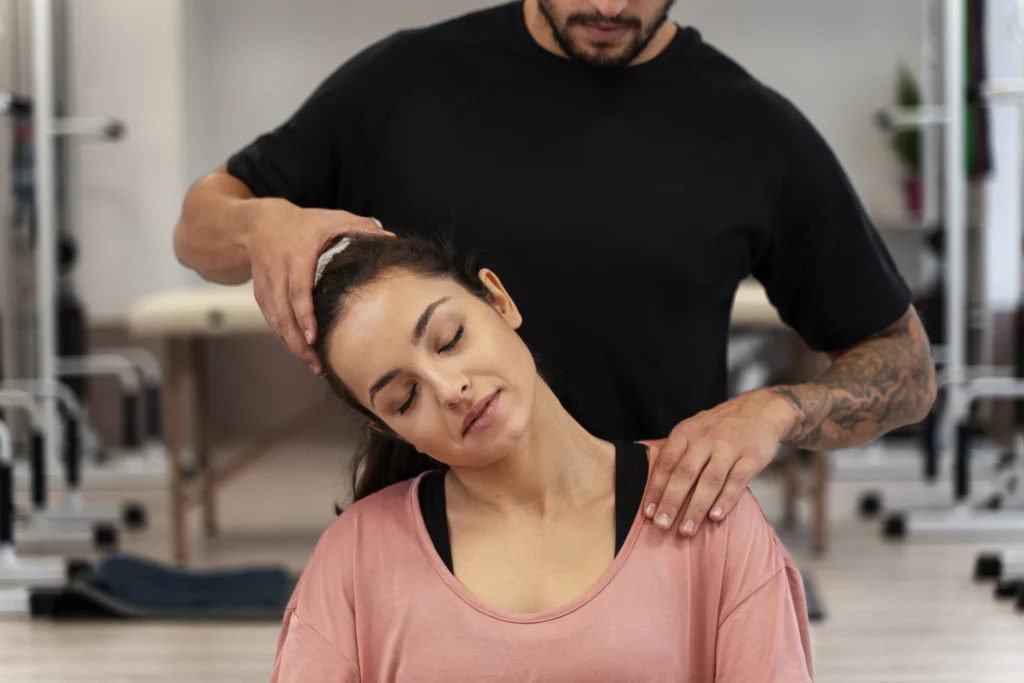
This is where long-term outcomes are decided.
Manual therapy
Direct pressure on trigger points can reduce sensitivity and referred pain.
Patients often notice immediate changes, especially in headache patterns.
Read more on : Manual Therapy for Neck Pain: A Physiotherapist’s Evidence Based Guide
Dry needling
Clinical trials have shown that dry needling of SCM trigger points can significantly reduce headache intensity and frequency (Fernández-de-las-Peñas et al., 2021).
Learn About: The Ultimate Neck Stretch Routine for Desk Workers in 2026
Postural correction
This is essential.
Without correcting posture, symptoms tend to return.
Read about: How to Relieve Morning Neck Stiffness Naturally
Breathing retraining
Teaching diaphragmatic breathing reduces unnecessary SCM activation.
This is often overlooked but makes a noticeable difference.
Read about: The Most Effective McKenzie Exercises For Neck Pain
Strengthening deep neck flexors
When deeper stabilizing muscles are weak, the SCM compensates.
Restoring this balance improves long-term outcomes.
Read about: Yoga for Neck Pain: Poses That Actually Work
A clinical point that patients often find surprising
Stretching alone is usually not enough.
Many patients try stretching regularly but still experience recurrence.
The reason is simple.
If the muscle is still being overused due to posture or breathing, the underlying cause remains.
Read about: Effective Neck Pain Exercises At Home: A Complete Guide to Relief and Improved Mobility
Daily adjustments that genuinely help
These are small but effective changes.
- Keep your screen at eye level
- Avoid prolonged downward gaze
- Use a supportive pillow
- Take regular movement breaks
- Practice slow, controlled breathing
Consistency matters more than intensity here.
Read in detail: Best Desk Setup to Reduce Neck and Back Pain
Red Flags You Should Not Ignore
While SCM-related symptoms are usually musculoskeletal, it is important not to overlook serious conditions.
There are certain signs where you should not assume it is just a muscle issue.
Seek medical attention if you notice
- Sudden, severe headache unlike anything before
- Persistent dizziness with vomiting or loss of balance
- Difficulty speaking or swallowing
- Numbness or weakness in the arm or face
- Visual disturbances that do not improve
Why this matters
In clinic, we always rule out non-musculoskeletal causes before confirming a diagnosis like SCM syndrome.
It is always better to be cautious when symptoms do not follow a typical pattern.
Read About: How to Choose the Right and Best Pillow for Neck Pain
When to seek help
It is worth consulting a physiotherapist if:
- Headaches are persistent and unexplained
- Dizziness continues despite normal reports
- Neck discomfort keeps returning
- Symptoms worsen with posture
Early intervention usually leads to better outcomes.
Also read: How to Relieve Neck Tightness Without Equipment
What recent research is highlighting
There is increasing recognition of the SCM’s role in complex symptom patterns.
A recent study found a strong association between SCM trigger points and headache severity, even more than some other neck muscles (Alghadir et al., 2025).
This reinforces what many clinicians observe in practice.
Read in detail about: How to Fix Upper Crossed Syndrome Naturally
Final thoughts
The sternocleidomastoid muscle does not usually present dramatically.
It quietly contributes to symptoms that feel unrelated.
That is why it is often overlooked.
But once identified, treatment tends to be effective.
The key is not just addressing the muscle, but understanding the habits and patterns that led to its overload.
That is where lasting improvement happens.
Also Read: Ultimate 6 Weeks Neck Rehabilitation Exercises For Pain Relief
Frequently Asked Questions
1. What is sternocleidomastoid syndrome?
It is a condition where the SCM muscle develops trigger points that cause pain and referred symptoms like headaches and dizziness.
2. Can SCM trigger points cause dizziness?
Yes, they can disrupt proprioception and contribute to imbalance or lightheadedness.
3. Why is SCM pain often misdiagnosed?
Because it mimics sinus issues, migraines, and ear pain, making diagnosis challenging.
4. Does posture affect the SCM muscle?
Yes, forward head posture significantly increases strain on the SCM.
5. Is physiotherapy effective?
Yes, it targets both the muscle and underlying causes like posture and breathing.
6. How long does recovery take?
It varies, but many patients improve within a few weeks with proper treatment.
7. Can stress worsen SCM pain?
Yes, stress increases accessory breathing, which overactivates the SCM.
8. What is the best sleeping position?
Sleeping on your back with proper neck support is generally recommended.
Stay tuned with us for more health related topics.
Follow us on LinkedIn and Instagram for more.
More Read


Medical Disclaimer!
This article has been reviewed and written under the guidance of our Head Physiotherapist, Dr. Kruti Raj (PT, MUHS,CPT,CMPT). The information shared is intended for educational purposes only and should not be considered a substitute for personalized medical advice, diagnosis, or treatment.
Please consult us or any other qualified healthcare professional before beginning any exercise program, especially if you are experiencing pain, recovering from injury, or managing a medical condition.


