


If you’re wondering how to reverse lumbar spondylosis, the most important first step is understanding what “reversal” actually means.
If you have been told that you have lumbar spondylosis, you may have immediately imagined your spine slowly “wearing out” until surgery becomes inevitable.
As a physiotherapist, this is one of the first fears I would want to correct.
Lumbar spondylosis does involve age-related and degenerative changes in the lumbar spine,
but degeneration on an X-ray or MRI does not automatically mean progressive back pain, disability or loss of movement.
In fact, structural changes and symptoms often do not match as neatly as patients are led to believe.
Quick Answer
Not completely at a structural level. Natural treatments cannot reliably erase osteophytes, restore lost disc height or return an aging spine to its original anatomy. However, pain, stiffness, weakness, mobility limitations and reduced physical capacity can often improve substantially through progressive exercise, walking, strength training, sleep improvement, weight management when appropriate and physiotherapy-led rehabilitation.
The realistic goal is not a “new spine” but a stronger, more capable and less painful body.
So, can lumbar spondylosis be reversed naturally?
The honest answer is partly yes, partly no.
You generally cannot make every osteophyte, disc-height change or facet-joint alteration disappear through exercise, diet or stretching.
However, you can often improve the things that matter most to your daily life: pain, stiffness, strength, mobility, walking tolerance, confidence, sleep and physical capacity.
And there is an important distinction here.
A spine can become functionally much healthier even when its X-ray still looks “degenerative.”
That is the approach I want you to understand before you spend money on supplements, traction devices, “spinal detoxes” or miracle cures.
Key Takeaways
- Lumbar spondylosis can improve functionally even when structural degeneration remains.
- MRI findings do not always predict pain or disability.
- Progressive exercise is one of the most important natural management strategies.
- Walking can be an effective starting point for rebuilding physical capacity.
- Hip, leg and trunk strengthening can be more useful than stretching alone.
- Excessive bed rest and fear-based movement avoidance can promote deconditioning.
- Vitamin D should not be marketed as a proven cure for lumbar spondylosis.
- Sleep quality, stress and physical activity can influence chronic pain outcomes.
- Manual therapy should complement active rehabilitation rather than replace it.
- Progressive weakness, bladder/bowel changes or saddle numbness require medical assessment.
What lumbar spondylosis actually means
Lumbar spondylosis is a broad term used to describe degenerative changes involving structures of the lower spine.
These may include the intervertebral discs, vertebral endplates and facet joints, along with the development of osteophytes or bone spurs.
These changes become more common with age.
But here is the lesser-known part: degenerative findings are extremely common even in people who do not have back pain.
A landmark systematic review of imaging studies found that disc degeneration, disc bulging and other degenerative findings become increasingly common with age in asymptomatic people.
In other words, an abnormal-looking scan is not automatically an explanation for your pain. (Brinjikji et al., AJNR)
This is why I do not want you to look at your MRI and think, “My spine is damaged, therefore I must protect it forever.”
Your MRI describes structure.
It does not fully describe how well you move, how strong you are, how sensitive your nervous system is, how well you sleep, how much you walk or how confident you feel using your back.
Those factors can change.
What You’ll Learn
Understand the difference between structural degeneration and functional recovery.
Learn why walking, strength training and progressive loading matter.
Identify common habits that encourage inactivity and fear of movement.
Recognize symptoms that require professional medical assessment.
So, can lumbar spondylosis actually be reversed?
Let us separate the question into two parts.
Can the structural degeneration disappear?
Usually, no.
If a disc has lost some height or a bony osteophyte has developed, natural exercise cannot be expected to simply erase that anatomical change.
This is where many online articles become misleading.
They use the word “reverse” as though a degenerative spine can be restored to the anatomy of a 20-year-old.
That is not what current evidence supports.
Can the consequences of lumbar spondylosis improve?
Absolutely.
Pain can improve.
Stiffness can improve.
Muscle strength can improve.
Walking tolerance can improve.
Balance can improve.
Your ability to bend, lift and work can improve.
Your sensitivity to everyday movements can decrease.
And your risk of becoming progressively inactive can be reduced.
This is a much more useful definition of recovery.
The World Health Organization recommends education, exercise, physical therapies, psychological approaches and appropriate medicines as part of non-surgical care for chronic primary low back pain. (WHO, 2023 guideline)
So rather than asking only, “How do I reverse the degeneration?”, I encourage my patients to ask:
“How can I make my spine stronger, my body more capable and my pain less controlling?”
That question leads to a much more productive treatment plan.
Your MRI may not be your biggest problem
This is one of the most important concepts I teach.
Imagine two people with almost identical lumbar MRI findings.
Person A has mild degenerative changes but walks daily, strength trains twice a week, sleeps reasonably well and is confident lifting objects.
Person B has similar changes but avoids bending, rarely exercises, sits for long periods, sleeps poorly and constantly worries that movement is damaging the spine.
Their scans may look similar.
Their experiences may be completely different.
Pain is influenced by much more than tissue appearance.
That does not mean your pain is imaginary.
It means the nervous system, muscles, sleep, stress, movement behaviour and physical capacity all influence how pain is experienced.
This is one reason modern guidelines emphasize self-management and continued activity rather than prolonged avoidance of normal movement. (NICE guideline NG59)
The first natural strategy: stop treating your spine like glass
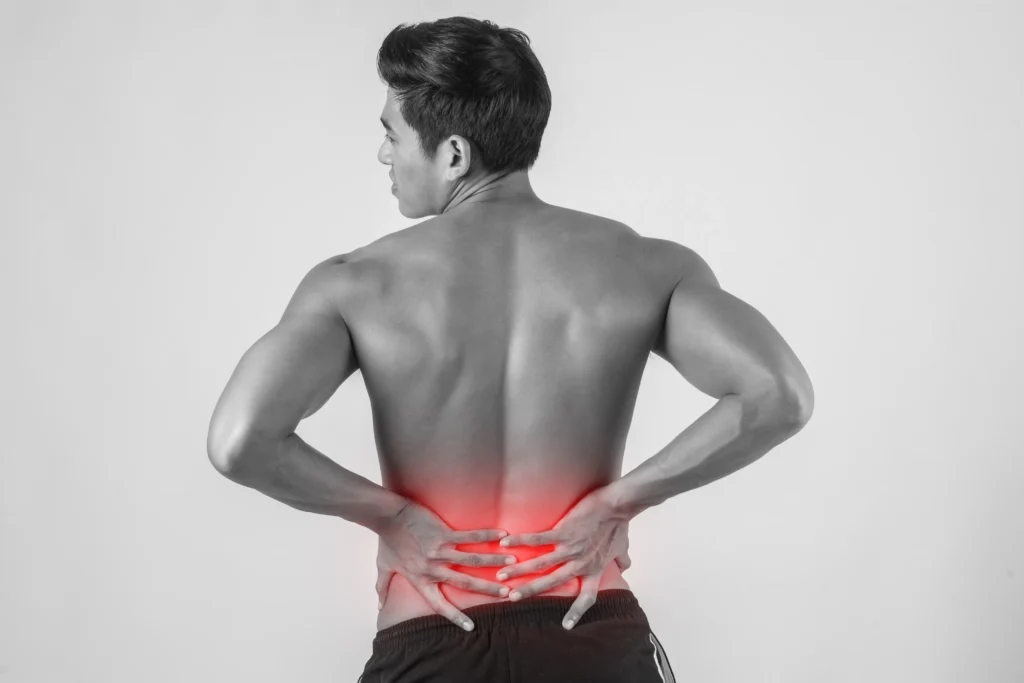
One of the most counterproductive responses to lumbar spondylosis is excessive protection.
A person feels pain while bending and decides:
“I should never bend.”
Then they stop lifting.
Then they avoid the floor.
Then they avoid walking uphill.
Then they become less active.
Eventually, ordinary movements feel more difficult because the body has lost capacity.
This creates a vicious cycle:
pain → fear → avoidance → deconditioning → reduced capacity → greater sensitivity to activity.
The answer is not to force painful movements aggressively.
The answer is graded exposure.
If bending is difficult, you might begin with a small range.
If walking for 30 minutes causes a flare, begin with a manageable duration and gradually build up.
Your goal is not to “challenge the damaged spine.”
Your goal is to teach the entire movement system that activity is safe and manageable again.
Exercise is probably the most important natural tool
If someone asks me for one natural strategy with the strongest practical value, I would put appropriately prescribed exercise near the top of the list.
But “exercise” is not one thing.
It can include walking, resistance training, trunk strengthening, hip strengthening, aerobic conditioning, mobility exercises, balance training and movement retraining.
Recent evidence continues to support exercise-based rehabilitation for chronic low back pain.
A 2025 network meta-analysis examined different exercise prescriptions and found that several forms of structured exercise can improve pain and disability,
reinforcing the importance of choosing an exercise approach that is practical and appropriate for the individual. (Zhao et al., 2025)
Even more interestingly, a 2025 systematic review and meta-analysis investigated whether exercise therapy changes lumbar muscle structure.
The research suggests that exercise can influence aspects of lumbar musculature,
which is clinically important because stronger and better-conditioned muscles can improve physical capacity even when spinal degeneration remains visible. (Karagiannopoulou et al., 2025)
This gives us a more realistic version of “natural reversal.”
You may not reverse every structural change.
You can reverse some of the weakness, inactivity and functional decline surrounding it.
Do not underestimate your hips
Here is a physiotherapy detail that is frequently missed in generic lumbar spondylosis articles.
Your lower back does not work independently.
Your hips and pelvis contribute to how loads are distributed during walking, stair climbing, squatting and lifting.
If your hip muscles are weak or your hip mobility is restricted, your lumbar region may have to contribute more during certain activities.
That does not mean “bad hips cause lumbar spondylosis.”
It means that rehabilitation should usually look beyond the painful location.
A useful program may therefore include:
- glute strengthening
- hip abductor strengthening
- controlled squatting
- step-ups
- hip mobility work
- trunk endurance
- functional lifting practice
The exact selection should depend on your symptoms and assessment.
Walking is a surprisingly powerful intervention
You do not necessarily need an expensive machine or complicated exercise routine to start improving your physical capacity.
Walking is accessible, scalable and easy to dose.
For someone who has become sedentary because of lumbar pain, even short bouts can be a starting point.
Instead of thinking:
“I need to walk for one hour.”
Think:
“What amount can I repeat consistently without creating a major flare?”
You might begin with 5 to 10 minutes and gradually increase duration.
The key is consistency rather than one heroic walk followed by three days of inactivity.
NICE specifically encourages people with low back pain to continue normal activities and use exercise as part of self-management. (NICE)
Strength training does not automatically damage a degenerative spine
This is another myth I regularly see.
People with lumbar spondylosis are sometimes told to avoid weights completely.
That is unnecessarily restrictive for many people.
The spine is designed to experience load.
The problem is usually not simply “load.”
It is the mismatch between current capacity and imposed demand.
If your body is currently deconditioned, jumping immediately into heavy deadlifts may be inappropriate.
But that does not mean you should never train.
You can begin with manageable resistance and gradually progress.
For example:
- sit-to-stand
- supported squats
- bridges
- step-ups
- light carries
- hip strengthening
- resistance-band exercises
- progressively loaded resistance exercises
A physiotherapist can help determine where you should start.
The objective is capacity building, not permanent avoidance.
A lesser-known target: muscle loss
As people age, maintaining muscle becomes increasingly important.
Sarcopenia, or age-related loss of muscle mass and strength, can make everyday physical tasks more difficult.
This matters in lumbar spondylosis because a person may blame spinal degeneration for every difficulty when part of the problem is actually reduced physical capacity.
Research has increasingly explored the relationship between muscle health and chronic low back pain, particularly in older adults. (Nakagawa et al.)
This is why I do not want an older patient with lumbar spondylosis to focus exclusively on stretching.
Strength is protective in a very practical sense.
If you can maintain leg, hip and trunk strength, everyday activities require a smaller percentage of your maximum capacity.
That can make life feel easier.
What about weight loss?
If you carry excess body weight, gradually improving body composition may be helpful.
But I would not tell you that weight loss “cures” lumbar spondylosis.
The evidence is more nuanced.
Obesity has been associated with increased risk of low back pain, and lifestyle interventions combining multiple components have been investigated in people with persistent low back pain who are overweight or obese. (Wolters Kluwer)
From a physiotherapy perspective, the most useful approach is not punishment.
It is increasing daily movement while gradually improving strength, aerobic fitness and overall health.
Even before major weight changes occur, becoming more physically capable can make a meaningful difference.
Do not fall for the vitamin D “cure”
Vitamin D deserves a particularly careful discussion because it is frequently marketed online as a treatment for degenerative back conditions.
If someone is genuinely deficient, correcting the deficiency may be appropriate for general health.
But that is different from saying vitamin D reverses lumbar spondylosis.
A systematic review and meta-analysis found insufficient evidence that vitamin D supplementation is superior to placebo or other interventions for reducing low back pain. (PMC)
A newer 2024 meta-analysis similarly found limited evidence for meaningful improvement in chronic low back pain with supplementation. (PubMed)
So please do not spend large amounts of money on “spine supplements” expecting an osteophyte to disappear.
Treat deficiencies when medically indicated.
Do not confuse correcting a deficiency with reversing spinal degeneration.
Sleep may be part of your back treatment
This is one of the most overlooked pieces of the puzzle.
If you sleep badly because your back hurts, your recovery can become more difficult.
And poor sleep can itself influence pain sensitivity, fatigue, mood and physical activity.
A systematic review found an association between sleep and chronic low back pain, while newer research continues to explore the relationship between sleep quality and pain-related outcomes. (Kelly et al.)
You do not necessarily need to find a magical “perfect” sleeping position.
Instead, aim for a position that allows you to sleep comfortably and consistently.
A 2025 systematic review specifically examined sleep posture and low back pain,
highlighting that the relationship is more complicated than simply declaring one universal sleeping position harmful. (Wiley)
That is an important practical point:
The best sleeping position is often the one that allows you to sleep well and does not repeatedly aggravate your symptoms.
Stress is not “all in your head”
This phrase has caused enormous confusion in pain care.
When I discuss stress with a patient, I am not saying:
“Your pain is psychological.”
I am saying that the nervous system is involved in pain.
Chronic pain can become more intrusive when someone is constantly worried, sleeping poorly, avoiding movement and monitoring every sensation.
Mindfulness-based approaches have shown benefits for some aspects of chronic low back pain,
although they should be considered one component of a broader rehabilitation strategy rather than a miracle cure. (Paschali et al., 2024)
This is why breathing exercises, relaxation, mindfulness or cognitive strategies can sometimes complement physiotherapy.
They are not replacing physical rehabilitation.
They are helping regulate the system around it.
What should you avoid if you want to slow functional decline?
There are several things I would actively discourage.
Avoid prolonged bed rest
Unless a specific medical condition requires it, spending days in bed is rarely the solution for ordinary chronic low back pain.
NICE recommends continuing normal activities as far as possible.
Avoid chasing pain-free movement at all costs
Some people become frightened whenever they feel any discomfort during exercise.
But rehabilitation is not always completely symptom-free.
A physiotherapist can help you understand which symptoms are acceptable and which indicate that an exercise needs modification.
Avoid random internet exercise programs
A video labelled “lumbar spondylosis cure” does not know your neurological status, strength, mobility, medical history or symptom behaviour.
Exercise should be selected based on the person, not just the diagnosis.
Avoid excessive passive treatment
Massage or manual therapy can sometimes help symptoms, but it should not become the entire rehabilitation program.
NICE recommends manual therapy only as part of a treatment package that includes exercise, with or without psychological therapy.
Avoid believing that traction will “stretch the spine back into place”
This is a particularly persistent misconception.
Current NICE guidance does not recommend traction for low back pain or sciatica.
Avoid catastrophizing your MRI
A scan can show degeneration without predicting exactly how you will feel tomorrow.
Your function matters.
A simple physiotherapy framework for natural management
If I were building a long-term plan for someone with uncomplicated lumbar spondylosis, I would think in five layers.
Layer 1: Movement
Walk regularly and avoid unnecessary inactivity.
Layer 2: Mobility
Maintain comfortable lumbar, hip and thoracic movement rather than aggressively forcing stretches.
Layer 3: Strength
Progressively strengthen the hips, legs and trunk.
Layer 4: Capacity
Gradually return to the activities you actually need for work, family life, recreation and independence.
Layer 5: Recovery
Address sleep, stress, physical activity levels and other lifestyle factors that influence pain.
This is much more sustainable than searching for one “natural cure.”
Can yoga help?
Yoga may be useful for some people with chronic low back pain, particularly when it is adapted to their ability and performed consistently.
Research has found benefits from yoga-based approaches for chronic low back pain, although the quality and characteristics of studies vary. (Holtzman & Beggs)
From my perspective, the important word is adapted.
You do not need to force yourself into deep spinal flexion, extreme twisting or advanced poses because someone online claims they “decompress the spine.”
A movement that improves mobility, confidence and physical capacity is more useful than an impressive-looking pose.
One of the best natural treatments is learning how to load your body again
This may sound strange, but I often find that people with lumbar spondylosis become experts at avoiding their backs.
They know which chair to avoid.
Which movement to avoid.
Which exercise to avoid.
Which side to sleep on.
Which object not to lift.
Eventually, their world becomes smaller.
Good physiotherapy should gradually make that world bigger again.
The aim is not to prove that your spine is indestructible.
The aim is to develop enough strength, coordination and confidence that normal activities stop feeling threatening.
That is a form of recovery that an MRI cannot measure.
When natural treatment is not enough
Not every case of lumbar spondylosis should be managed independently.
You should seek medical assessment if your symptoms are new, rapidly worsening, severe or associated with neurological changes.
Particular warning signs include:
- progressive leg weakness
- significant or worsening numbness
- loss of bladder or bowel control
- numbness around the saddle/groin region
- severe pain following significant trauma
- unexplained weight loss
- fever or systemic illness with severe back pain
- a history that raises concern for cancer, infection or fracture
These symptoms require appropriate medical evaluation rather than a home exercise program.
NICE specifically advises clinicians to consider alternative diagnoses such as cancer, infection, trauma and inflammatory disease when symptoms suggest them. (NICE assessment guidance)
The real meaning of “reversing” lumbar spondylosis
If by reversal you mean:
“Can I make every degenerative change disappear?”
I would not promise you that.
If by reversal you mean:
“Can I become stronger, move better, reduce pain, improve my walking, sleep better, regain confidence and prevent inactivity from taking over my life?”
Yes. That is a realistic goal.
And that distinction is incredibly important.
Your spine is not a photograph.
It is part of a living, adaptable movement system.
Bones and discs undergo structural changes over time, but muscles can become stronger.
Exercise tolerance can increase.
Movement confidence can return.
Sleep can improve. Pain sensitivity can change.
Physical capacity can be rebuilt.
That is why I would rather see a patient become stronger and more active with an unchanged MRI than become terrified of movement while obsessively monitoring every structural abnormality.
My physiotherapy takeaway
If you have lumbar spondylosis, do not make the mistake of thinking your only job is to “save your spine.”
Your job is to build a body that can support your spine.
Walk.
Strengthen your hips and legs.
Train your trunk progressively.
Maintain comfortable mobility.
Sleep adequately.
Address excess sedentary time.
Work on your confidence with movement.
Manage stress.
And seek individualized assessment when symptoms are persistent, severe or neurologically concerning.
Most importantly, do not let the word degeneration become a prediction about your future.
You may not be able to turn an aging spine into a brand-new spine.
But you can often make an aging spine far more capable, resilient and functional.
That is the kind of natural improvement I want my patients to aim for.
Frequently Asked Questions
Can lumbar spondylosis be reversed naturally?
Lumbar spondylosis cannot usually be completely reversed structurally, but pain, stiffness, weakness and functional limitations can often improve with exercise, physiotherapy and lifestyle changes.
Can exercise reverse lumbar spondylosis?
Exercise cannot reliably erase degenerative bone or disc changes, but progressive exercise can improve muscle strength, mobility, physical capacity and pain-related disability.
Is walking good for lumbar spondylosis?
Walking can be a useful low-cost way to maintain activity and gradually rebuild physical capacity. The duration should be increased according to individual tolerance.
Can weight loss help lumbar spondylosis?
For people carrying excess weight, improving body composition may reduce some of the physical burden associated with low back pain and improve overall physical capacity.
Can physiotherapy treat lumbar spondylosis without surgery?
Many people can be managed conservatively using exercise, education, activity modification and other physiotherapy strategies. The appropriate approach depends on symptoms and examination findings.
Should I avoid bending if I have lumbar spondylosis?
Not necessarily. Avoiding normal movement indefinitely can contribute to deconditioning. Bending should generally be reintroduced gradually and appropriately according to symptoms and physical capacity.
Can vitamin D cure lumbar spondylosis?
There is insufficient evidence that vitamin D supplementation reverses lumbar degeneration or reliably treats chronic low back pain. Deficiency should still be medically addressed when present.
When does lumbar spondylosis require urgent medical attention?
Progressive weakness, saddle-area numbness, loss of bladder or bowel control, severe trauma, fever, unexplained weight loss or other concerning symptoms require prompt medical assessment.
Stay tuned with us for more health related topics.
Follow us on LinkedIn and Instagram for more.
More Read


Medical Disclaimer!
This article has been reviewed and written under the guidance of our Head Physiotherapist, Dr. Kruti Raj (PT, MUHS,CPT,CMPT). The information shared is intended for educational purposes only and should not be considered a substitute for personalized medical advice, diagnosis, or treatment.
Please consult us or any other qualified healthcare professional before beginning any exercise program, especially if you are experiencing pain, recovering from injury, or managing a medical condition.


