


Have you noticed a hollow or dent-like appearance in your child’s chest? It may seem like a simple postural difference, but it could be a condition called pectus excavatum in children.
Does the breastbone seem to sink inward, particularly when your child stands straight or takes a deep breath?
One possible explanation is pectus excavatum, a chest wall condition commonly described as a sunken chest or funnel chest.
Quick Answer
Pectus excavatum is a chest wall condition in which the breastbone curves inward, creating a hollow or sunken appearance. Mild cases may not cause physical problems, but some children develop symptoms as they grow.
Parents should arrange a medical assessment if a child experiences:
- Unusual breathlessness during exercise.
- Reduced stamina compared with other children.
- Recurring chest discomfort or palpitations.
- A chest depression that becomes deeper during growth.
- Social withdrawal or significant distress about chest appearance.
Physiotherapy can support breathing mechanics, posture, mobility and fitness, but exercises cannot independently reverse the structural chest depression. Specialist assessment helps determine whether observation, vacuum bell therapy or surgery is appropriate.
For some children, the depression is shallow and causes no noticeable problems. They run, play, participate in sports and grow normally.
In other children, however, the deformity becomes more noticeable during puberty and may be associated with breathlessness during exercise, reduced stamina, chest discomfort or concerns about body image.
The important question is not simply how deep the chest looks.
It is whether the changing chest shape is affecting the child’s breathing, heart function, physical activity, comfort or emotional wellbeing.
As a physiotherapist, I would encourage parents not to panic when they notice a chest depression, but I would also advise against dismissing it as a cosmetic difference without an assessment.
Early evaluation can help identify children who need monitoring, rehabilitation support or specialist treatment.
Key Takeaways for Parents
- Pectus excavatum is a structural chest wall deformity that causes the breastbone to sink inward.
- It can become more noticeable during rapid growth and puberty.
- A mild-looking chest depression does not always mean that the condition has no psychological impact.
- Breathlessness, unusual exercise fatigue, palpitations and chest discomfort deserve medical assessment.
- The Haller index helps estimate deformity severity, but it should not determine treatment on its own.
- Physiotherapy can improve mobility, breathing control, postural endurance and physical conditioning.
- Vacuum bell therapy may help selected children with flexible, mild-to-moderate deformities.
- Surgery is considered according to the child’s symptoms, anatomical findings, progression and quality of life.
- Parents should never blame poor posture, sleeping position or lack of exercise for causing the condition.
- Fainting during exercise, collapse or severe breathing difficulty requires urgent medical attention.
What Exactly Is Pectus Excavatum?
Pectus excavatum is a structural chest wall deformity in which the breastbone (sternum) and adjoining sections of the ribs curve inward.
Instead of having a relatively outward chest contour, the front of the chest has a sunken appearance.
It is the most common congenital chest wall deformity.
Although it can be visible during infancy or early childhood, some cases become more apparent as the child grows, particularly during the rapid growth of adolescence.
The depression may appear in the middle of the chest or slightly towards one side. Some children have a symmetrical hollow, while others develop an uneven chest appearance.
The lower ribs may also flare outward, creating a combination of a sunken breastbone and prominent rib margins.
One detail parents should understand is that pectus excavatum is not simply a postural problem.
It is associated with the development and growth pattern of the chest wall, including the costal cartilage connecting the ribs to the sternum.
Slouching may make the appearance more noticeable, but correcting posture alone cannot reverse the structural depression.
The 2024 international pectus care guidelines discuss the condition as a chest wall deformity requiring individual assessment rather than treatment based on appearance alone.
Why Does a Child Develop a Sunken Chest?
There is no single explanation for every child with pectus excavatum.
Its development is thought to involve a combination of inherited susceptibility and differences in chest wall growth.
1. Abnormal growth of the chest wall
The sternum is connected to the ribs through cartilage.
During childhood and adolescence, these structures develop and change shape.
In pectus excavatum, the growth pattern of the chest wall can result in an inward depression of the sternum.
The exact biological mechanisms are not fully understood.
It is therefore inaccurate to blame a child’s posture, sleeping position, schoolbag or lack of exercise for causing the condition.
2. Family history and inherited susceptibility
Pectus excavatum can occur in more than one family member. A parent may notice that another relative has a similar chest shape.
A family history does not mean that every child will develop the condition, but it is useful information to share with the paediatrician.
3. Associated connective tissue conditions
Pectus excavatum can sometimes occur alongside connective tissue conditions, including Marfan syndrome and Ehlers-Danlos syndrome.
Scoliosis and other skeletal differences may also coexist.
This does not mean that a child with a sunken chest automatically has a genetic disorder.
However, when the chest deformity occurs alongside unusual joint flexibility, spinal curvature, disproportionate limb length or a relevant family history, the doctor may recommend a broader assessment.
What Does Pectus Excavatum Look Like in Children?
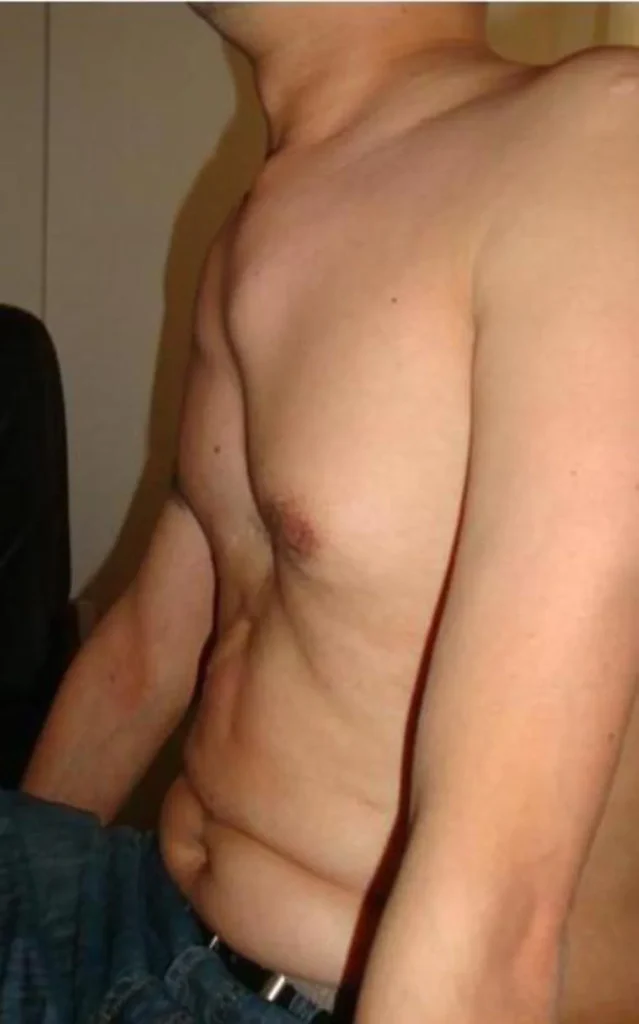
The appearance varies significantly.
Some children have a small central hollow that is difficult to notice under clothing.
Others have a deeper depression that changes the contour of the entire front of the chest.
Parents may notice:
- A visible dent in the breastbone.
- One side of the chest appearing deeper than the other.
- Outward-projecting lower ribs.
- A rounded shoulder appearance or forward-leaning posture.
- A noticeable difference between the right and left sides of the chest.
- A chest depression that becomes more obvious during adolescence.
A useful distinction is that a child’s shoulder position and chest shape are not necessarily caused by the same problem.
Rounded shoulders may occur alongside pectus excavatum, but they should be assessed separately rather than assuming that strengthening the upper back will correct the breastbone.
A changing chest contour during a growth spurt deserves attention, particularly when the depression appears to be deepening or becoming more asymmetric.
When Does a Sunken Chest Become a Medical Concern?
Not every child with pectus excavatum needs surgery or intensive treatment.
Many children have mild deformities without meaningful physical limitations.
The decision to investigate further depends on the child’s symptoms, the progression of the deformity, clinical examination findings and the effect on everyday life.
1. Breathlessness during physical activity
One of the symptoms worth investigating is breathlessness that seems disproportionate to the activity.
For example, a child may struggle to keep pace with classmates during running, repeatedly stop during sports or feel unusually breathless after climbing stairs.
Parents should not automatically attribute this to poor fitness. Asthma, anaemia, deconditioning and other conditions can also cause exercise-related breathlessness. A proper assessment helps distinguish between these possibilities.
The 2024 Pectus Care Guidelines recommend a structured assessment when exercise intolerance is suspected, including investigations of heart and lung function where clinically appropriate.
2. Reduced stamina compared with other children
Some children do not describe breathlessness clearly. Instead, parents notice that they avoid running, tire before their friends or struggle to complete activities they previously enjoyed.
A gradual reduction in exercise tolerance deserves investigation, especially when it develops alongside a visibly progressing chest depression.
A useful physiotherapy observation is to ask whether the child’s activity level has changed over the past six to twelve months.
A simple record of sports participation, walking tolerance and recovery after exercise can provide more useful information than a photograph alone.
3. Chest discomfort or palpitations
Chest pain and a sensation of a racing or irregular heartbeat should never be automatically blamed on pectus excavatum.
A child may experience discomfort for several different reasons, including musculoskeletal pain, respiratory conditions or cardiovascular problems. Recurrent symptoms, particularly during exercise, warrant medical assessment.
A 2026 retrospective study of 124 adolescents with pectus excavatum reported exercise-related ECG abnormalities in a selected group undergoing preoperative assessment.
The researchers found an association between ventricular premature beats and right ventricular compression, rather than a simple relationship with the Haller index.
This reinforces why anatomical measurements alone cannot explain every child’s symptoms. (MDPI)
4. Dizziness or fainting during exercise
Fainting during exercise is not a symptom parents should monitor at home. It requires prompt medical evaluation.
A child who experiences fainting, severe dizziness, chest pain or significant palpitations during physical activity should stop exercising and receive urgent medical attention.
Severe breathing difficulty at rest, blue lips or collapse requires emergency care.
These symptoms can have several causes, and it is important not to assume that the chest deformity is responsible without appropriate investigation.
5. Emotional distress and avoiding social activities
An aspect that parents sometimes overlook is the psychological effect of a visible chest deformity.
A child may avoid swimming, changing clothes in front of classmates, wearing fitted clothing or participating in activities where the chest becomes visible. Teenagers may become increasingly self-conscious during puberty.
A 2025 paediatric study involving 57 patients found impaired quality of life in 53%, positive anxiety screening in 42% and positive depression screening in 7%.
Importantly, these difficulties did not differ significantly between the study’s mild-to-moderate and severe anatomical groups. Parents and children also showed limited agreement about the child’s experience. (Elsevier)
This finding has an important practical message: a parent should not decide that a child is emotionally unaffected simply because the deformity looks mild.
Does Pectus Excavatum Become Worse During Puberty?
It can.
Some children have a relatively subtle chest depression in early childhood, which becomes more visible as their bodies grow.
During adolescence, changes in the ribs, sternum, height and chest proportions may make an existing deformity more noticeable.
This is one reason why a single assessment at age six or seven may not tell the entire story.
The 2024 pectus care consensus guidelines emphasise proper assessment and follow-up, taking account of symptoms and the progression of the deformity. PubMed
Parents can keep track of changes without repeatedly measuring the chest or making the child self-conscious.
A clinical photograph taken with the child’s consent, at an appropriate follow-up interval, may help a specialist compare changes in appearance.
The purpose is to document progression, not to encourage daily checking or body-image anxiety.
How Is Pectus Excavatum Diagnosed in Children?
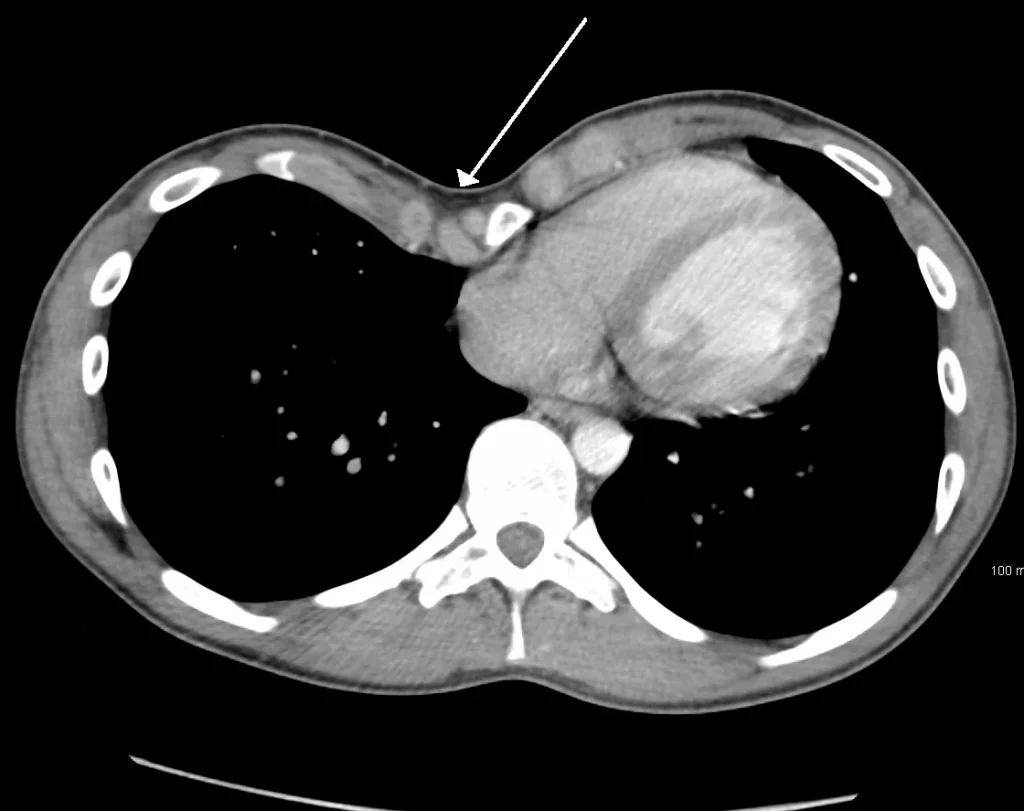
The diagnosis usually begins with a physical examination and a discussion of the child’s symptoms.
A paediatrician, paediatric surgeon or specialist chest wall team may assess the following:
Physical examination
The doctor examines the sternum, ribs, chest symmetry and depth of the depression.
They may also assess the spine, shoulders, posture and general skeletal development.
The child’s height, weight, growth pattern and family history can help provide additional context.
Haller index
One commonly used measurement is the Haller index.
It is calculated by dividing the widest internal transverse measurement of the chest by the shortest front-to-back distance between the sternum and spine.
A value around 3.25 or higher is commonly used as a marker of more significant pectus excavatum and may support consideration of surgical assessment.
However, it is not a stand-alone decision for surgery.
The index does not fully capture every feature of an asymmetric deformity or the degree of cardiac compression.
A measurement should always be interpreted alongside symptoms and other clinical findings.
Correction index
The correction index is another measurement used to estimate the degree of chest depression.
It can be particularly helpful when the shape of the chest makes the Haller index less representative.
Imaging and heart-lung investigations
Depending on the child’s age, symptoms and clinical findings, a specialist may request:
- Chest X-ray to assess the chest wall and general anatomy.
- CT scan or MRI to understand the chest shape and its relationship with internal structures.
- Echocardiography to assess heart structure and function.
- ECG when cardiac symptoms or concerns are present.
- Pulmonary function tests when breathing difficulty needs investigation.
- Cardiopulmonary exercise testing when exercise intolerance requires more detailed assessment.
A CT scan should not be requested simply because a parent notices a mild chest depression.
The clinician selects imaging according to the information needed, and MRI may be considered where appropriate to avoid ionising radiation.
The 2023 consensus paper, Pectus Excavatum: Consensus and Controversies in Clinical Practice, discusses the role of ECG, echocardiography and spirometry when cardiac or pulmonary impairment is suspected. PubMed
Can Physiotherapy Correct Pectus Excavatum?
This is one of the most important questions parents ask.
Physiotherapy cannot physically push a structurally depressed sternum back into its normal position. Exercises alone should not be presented as a cure for pectus excavatum.
However, physiotherapy can be valuable in improving movement, posture, breathing mechanics, physical conditioning and confidence.
The treatment plan should be based on what the child needs rather than following a fixed set of exercises for every case.
1. Improving thoracic mobility
Some children with pectus excavatum also demonstrate reduced thoracic extension or stiffness through the upper back.
A physiotherapist may prescribe age-appropriate thoracic mobility activities to encourage comfortable movement of the rib cage and spine.
Examples include controlled thoracic extension over a suitable support and gentle rotational mobility exercises.
These activities improve movement quality; they do not reverse the underlying chest wall deformity.
2. Breathing control and rib cage expansion
A physiotherapist may teach comfortable diaphragmatic breathing and lateral rib expansion.
The aim is to help the child understand how the rib cage moves during inhalation and exhalation, rather than repeatedly forcing deep breaths.
A simple activity is to ask the child to place their hands around the lower sides of the rib cage and feel the ribs gently expand while breathing normally.
Breathing exercises should remain comfortable. Stop and seek advice if they cause dizziness, chest pain or unusual breathlessness.
3. Scapular and upper-back strengthening
Children who demonstrate rounded shoulders or reduced upper-back endurance may benefit from:
- Gentle resistance-band rows.
- Scapular retraction exercises.
- Wall slides.
- Age-appropriate upper-back extensor strengthening.
These exercises can help improve shoulder control and postural endurance. They should not be marketed as a method of removing the chest depression.
4. Building aerobic capacity
Walking, cycling, swimming and other enjoyable activities can help children maintain general physical fitness.
The intensity should be appropriate to the child’s ability and symptoms.
A child who becomes unusually breathless, experiences chest discomfort or feels dizzy during exercise needs medical assessment rather than simply being pushed to exercise harder.
The 2025 review, An Overview of Pectus Deformities and Rehabilitation Approaches, discusses rehabilitation approaches for children with chest wall deformities, including the role of exercise and functional support. PMC
Is Vacuum Bell Therapy an Alternative to Surgery?
The vacuum bell is a non-surgical device that uses controlled suction to lift the depressed portion of the sternum.
It is placed over the affected area of the chest. The suction creates a lifting force that can gradually improve the chest contour in some selected patients.
It may be considered for children with suitable mild-to-moderate deformities, particularly when the chest wall is relatively flexible.
However, it is not suitable for every child. The outcome depends on factors such as age, depth, symmetry, chest wall flexibility and consistency of use.
A 2025 systematic review of 20 studies found that vacuum bell outcomes varied considerably.
Younger age, chest flexibility and treatment adherence appeared to influence results.
The authors also highlighted the lack of high-quality randomised trials. (Springer Link)
A more recent 2026 systematic review included 27 studies and 2,644 patients.
It reported overall improvement in approximately 60% to 80% of patients across the included studies, although definitions of success differed.
Younger patients, shallower and more symmetrical deformities, and consistent treatment were associated with better outcomes. (JIAPS)
Parents should remember that these results do not guarantee correction for an individual child.
Skin irritation, temporary discomfort and bruising can occur.
Vacuum bell treatment should be prescribed and monitored by a specialist rather than started with an unregulated device at home.
When Is Surgery Considered for Pectus Excavatum?
Surgery may be discussed when the deformity is substantial and associated with functional symptoms, cardiac compression, significant progression or considerable psychological distress.
One commonly used operation is the Nuss procedure, also called minimally invasive repair of pectus excavatum.
During this procedure, a curved metal bar is inserted beneath the sternum through small incisions on the sides of the chest. The bar is rotated to lift the depressed breastbone into a more typical position.
The bar remains in place for several years before being removed in a later procedure.
Surgery is not automatically necessary because the Haller index is high or the chest looks unusual.
The potential benefits must be weighed against pain, recovery time, complications, future bar removal and the child’s individual needs.
A 14-year retrospective study of 594 children undergoing the Nuss procedure reported a postoperative complication rate of 12.5%, with bar displacement being the most common complication.
The results demonstrate why surgical decisions and follow-up need specialist care. (Wolters Kluwer)
Psychological wellbeing should also be considered during surgical discussions.
A 2025 study of children undergoing minimally invasive repair reported improvements in physical activity and psychological wellbeing at 12 months, although it involved a small group of 20 patients. (PMC)
Things Parents Should Do and Avoid
A child with pectus excavatum needs appropriate support, not constant reminders about their chest appearance.
Do:
- Arrange a paediatric assessment when the depression is becoming deeper or more noticeable.
- Keep track of exercise tolerance and changes in sports participation.
- Encourage comfortable, age-appropriate physical activity.
- Follow a physiotherapist’s individualised breathing and strengthening programme when indicated.
- Discuss body-image concerns privately and without judgement.
- Attend follow-up appointments during periods of rapid growth.
Avoid:
- Assuming that poor posture caused the deformity.
- Trying to correct the sternum through forceful stretching or chest pressure.
- Purchasing a vacuum bell without specialist guidance.
- Forcing a child to perform intense exercise despite breathlessness or pain.
- Restricting normal sports activities without a medical reason.
- Comparing the child’s chest shape with photographs of other children.
- Assuming that the absence of pain means that every aspect of the condition has been assessed.
One lesser-known but important point is that a child can have significant emotional distress despite having a relatively mild-looking deformity.
The child’s own concerns should be part of the assessment.
Can Pectus Excavatum Be Prevented?
There is no established exercise, diet, sleeping position or posture routine that prevents pectus excavatum.
Because it is associated with the development of the chest wall, parents should not feel responsible for having caused it through a particular parenting habit.
A healthy diet, adequate sleep and regular physical activity support normal childhood development, but they should not be described as methods of preventing or reversing this deformity.
The practical goal is to recognise changes early, assess relevant symptoms and choose an appropriate management plan.
My Physiotherapy Advice: Look Beyond the Chest Appearance
When assessing a child with pectus excavatum, I would not focus only on how deep the chest depression looks.
I would want to understand how the child moves, breathes, plays and participates in everyday activities.
I would also ask whether the deformity has changed during growth and whether the child feels uncomfortable about their appearance.
For parents, three observations are particularly useful:
First, notice progression. A depression that becomes more obvious over a growth spurt deserves reassessment.
Second, pay attention to function. Unusual exercise intolerance, recurrent chest discomfort or a reduction in physical activity should not be ignored.
Third, listen to the child. Avoiding swimming, changing clothes or sports because of embarrassment is a real concern, even when the deformity does not appear severe.
Pectus excavatum does not mean a child cannot lead an active and healthy life. Many children with mild cases require only observation and reassurance.
Others benefit from more detailed cardiopulmonary assessment, physiotherapy support, vacuum bell treatment or surgery.
The best approach is individualised care, with the child’s physical health and emotional wellbeing considered together.
Medical note: This article is for educational purposes and does not replace an examination by a paediatrician or paediatric chest wall specialist. Exercise-related fainting, severe breathing difficulty, collapse or significant chest pain requires urgent medical attention.
Does a Child With Pectus Excavatum Need to Stop Playing Sports?
In most cases, a child with mild, asymptomatic pectus excavatum does not need to stop participating in normal physical activities simply because of the chest shape.
Walking, cycling, swimming and recreational sports can help maintain fitness, muscle strength and confidence.
The activity should be enjoyable and appropriate for the child’s abilities.
However, a child who experiences breathlessness beyond what would normally be expected, dizziness, chest discomfort or palpitations during activity should be assessed before continuing strenuous exercise.
A useful distinction is between being physically unfit and having a possible cardiopulmonary limitation.
A medical assessment can help identify the reason rather than assuming that the child simply needs more exercise.
What Should Parents Monitor Between Appointments?
Rather than repeatedly checking the depth of the chest depression, focus on changes that affect the child’s everyday life.
| What to monitor | Why it matters |
|---|---|
| Chest shape during growth | Helps identify possible progression |
| Running and sports tolerance | Identifies changes in exercise capacity |
| Breathlessness and recovery time | Helps document possible functional symptoms |
| Chest pain or palpitations | May indicate a need for further investigation |
| Shoulder and spinal alignment | Identifies associated musculoskeletal differences |
| Confidence and social participation | Highlights emotional or quality-of-life concerns |
Parents can write down when symptoms occur, how long they last and what activity triggers them.
This information can be useful during a paediatric or specialist consultation.
A child should not be made to feel that their chest is being constantly inspected.
Monitoring should be reassuring, respectful and focused on health rather than appearance.
Frequently Asked Questions
1. Is pectus excavatum in children dangerous?
Not necessarily. Many children have mild pectus excavatum without significant health problems. More severe cases may be associated with exercise intolerance or compression of nearby structures. Symptoms and clinical findings determine whether further investigation is necessary.
2. Why does my child have a sunken chest?
Pectus excavatum is associated with differences in chest wall development and growth. Genetic susceptibility may contribute. It is not generally caused by slouching, sleeping position or carrying a schoolbag.
3. Can pectus excavatum become worse during puberty?
Yes. An existing chest depression can become more noticeable during rapid adolescent growth. Parents should arrange reassessment if the deformity appears to deepen or symptoms develop.
4. Can physiotherapy correct a sunken chest?
Physiotherapy cannot independently reverse the structural depression of the sternum. However, an individualised programme can improve thoracic mobility, breathing control, posture, upper-back endurance and physical conditioning.
5. Does pectus excavatum affect the heart and lungs?
In some children, a deeper chest depression can affect the space available for the heart and lungs. This does not happen in every case. A specialist may recommend investigations such as echocardiography, pulmonary function testing or cardiopulmonary exercise testing when indicated.
6. What is the Haller index in pectus excavatum?
The Haller index is a measurement used to assess the shape and severity of the chest depression. A value around 3.25 or higher is commonly considered a marker of significant deformity, but the number alone does not decide whether a child needs surgery.
7. Can vacuum bell therapy treat pectus excavatum in children?
Vacuum bell therapy may improve chest shape in selected children, particularly those with relatively flexible, mild-to-moderate deformities. Its success depends on several factors, including age, chest wall flexibility, symmetry and treatment adherence. Specialist supervision is important.
8. Does every child with pectus excavatum need surgery?
No. Many children need only observation and appropriate support. Surgery may be considered when there are significant functional symptoms, cardiac compression, progressive deformity or substantial psychological distress.
9. Can children with pectus excavatum play sports?
Many children with mild, asymptomatic pectus excavatum can participate in normal sports and physical activities. Children experiencing unusual breathlessness, chest discomfort, palpitations or dizziness during exercise should receive medical assessment before continuing strenuous activity.
10. When should parents take a child with a sunken chest to a doctor?
Arrange an assessment if the chest depression is progressing, the child has reduced exercise tolerance, recurring chest symptoms or concerns about body image. Fainting during exercise, collapse or severe breathing difficulty requires urgent medical attention.
Stay tuned with us for more health related topics.
Follow us on LinkedIn and Instagram for more.
More Read


Medical Disclaimer!
This article has been reviewed and written under the guidance of our Head Physiotherapist, Dr. Kruti Raj (PT, MUHS,CPT,CMPT). The information shared is intended for educational purposes only and should not be considered a substitute for personalized medical advice, diagnosis, or treatment.
Please consult us or any other qualified healthcare professional before beginning any exercise program, especially if you are experiencing pain, recovering from injury, or managing a medical condition.


