

Why Childhood Scoliosis Can Go Unnoticed for Months
Your child stands in front of the mirror, but something looks slightly different. One shoulder appears higher than the other. A T-shirt hangs unevenly.
When your child bends forward to pick up a toy or schoolbag, one side of the back seems more prominent.
You may initially dismiss these changes as poor posture, a habit of standing on one leg or simply a result of carrying a heavy schoolbag.
However, certain patterns of body asymmetry can indicate an early spinal condition called scoliosis.
One reason childhood scoliosis deserves attention is that it can develop without obvious pain.
Children with mild curves frequently continue playing, running, attending school and participating in sports without experiencing any discomfort.
Quick Answer
Early signs of scoliosis in children include uneven shoulders, one prominent shoulder blade, an uneven waistline, one hip appearing higher, a sideways body lean and a rib hump that becomes visible when bending forward. Scoliosis often develops without pain, particularly during childhood and adolescence. Parents can observe these changes at home, but a clinical examination and appropriate spinal X-ray are needed to confirm the diagnosis. Early assessment is particularly important during rapid growth.
The problem is that the spine may continue developing its abnormal curvature while the child grows.
According to the National Institute of Arthritis and Musculoskeletal and Skin Diseases (NIAMS), many children with mild scoliosis do not experience pain or noticeable symptoms.
Changes in posture may be the first clues noticed by parents or healthcare professionals. (NIAMS).
As a physiotherapist, I encourage parents to pay attention to repeated differences in shoulder height, waist shape, hip alignment and rib-cage appearance rather than concentrating only on whether their child complains of back pain.
The purpose of noticing these changes is not to diagnose scoliosis at home. It is to recognise when a proper assessment may be needed.
An important distinction: early detection does not mean every child with uneven shoulders has scoliosis.
It means understanding which changes deserve further examination.
Key Takeaways for Parents
- Uneven shoulders, prominent shoulder blades and hip asymmetry can be early signs of childhood scoliosis.
- A rib hump during forward bending is an important sign of spinal rotation.
- Many children with scoliosis do not experience back pain.
- Growth spurts can increase the risk of progression in children with existing spinal curves.
- Family history is relevant when assessing a child with suspected scoliosis.
- A Cobb angle greater than 10 degrees on an appropriate spinal X-ray meets the diagnostic definition of scoliosis.
- Physiotherapeutic scoliosis-specific exercises may help selected children, but programmes must be individualised.
- Some growing children require specialist-prescribed spinal bracing.
- Regular monitoring is important even when the child feels completely comfortable.
- Early assessment can help identify children who need observation or treatment during growth.
What Exactly Is Scoliosis in Children?
Scoliosis is a three-dimensional spinal deformity in which the spine curves sideways and also undergoes rotation.
On an X-ray, the spinal curve generally appears C-shaped or S-shaped rather than following its usual alignment.
A radiographic Cobb angle greater than 10 degrees is the accepted diagnostic threshold for scoliosis.
A child cannot be diagnosed simply by looking at a photograph or noticing a postural difference. (SRS)
Different Types of Childhood Scoliosis
The age at which scoliosis develops is important because the child’s remaining growth can influence the condition.
- Infantile scoliosis: Develops between birth and 3 years.
- Juvenile scoliosis: Develops between 4 and 10 years.
- Adolescent idiopathic scoliosis: Develops during adolescence, generally between 11 and 18 years.
These age categories are commonly used by the Scoliosis Research Society.
Adolescent idiopathic scoliosis is the most commonly recognised form in growing children. The word idiopathic means that no definite cause has been identified.
Other forms may be associated with congenital spinal abnormalities, neuromuscular disorders or particular genetic conditions.
A lesser-known clinical fact: Scoliosis beginning before the age of 10 deserves particularly careful assessment.
The spine and rib cage still have substantial growth ahead of them, and more complex underlying causes may need to be investigated.
9 Early Signs of Scoliosis Parents Can Spot at Home
The following observations can help parents recognise possible spinal asymmetry.
They are not diagnostic tests, but persistent or progressive differences should not be ignored.
1. One Shoulder Appears Higher Than the Other
One of the earliest visible signs can be unequal shoulder height.
When your child stands naturally, one shoulder may appear slightly elevated while the opposite shoulder sits lower.
Parents may notice this when:
- The child wears a fitted T-shirt.
- Both arms hang naturally beside the body.
- The child stands in front of a mirror.
- The shoulder line looks tilted in family photographs.
A persistent difference may be associated with spinal curvature or trunk rotation.
However, shoulder asymmetry can also occur because of habitual positioning, muscular imbalance or other postural variations.
Physiotherapist’s observation: Look at the shoulder line when your child is relaxed.
Do not ask the child to pull both shoulders backwards or consciously stand straight, as this can temporarily hide the natural asymmetry.
The American Academy of Orthopaedic Surgeons identifies uneven shoulders and a protruding shoulder blade among recognised signs of childhood scoliosis. (OrthoInfo)
2. One Shoulder Blade Sticks Out More
Another important sign is a noticeable difference between the shoulder blades.
One scapula may appear more prominent, elevated or positioned differently from the opposite side.
Sometimes, parents mistake this for a muscular problem or believe that the child simply has one stronger shoulder.
However, scoliosis can involve rotation of the vertebrae, which changes the position of the ribs and the appearance of the shoulder blades.
This is particularly noticeable when the child bends forward.
A useful observation: Rather than comparing shoulder blade size, observe how far each shoulder blade projects from the back. A persistent difference deserves assessment. (Scoliosis Research Society)
3. One Side of the Waist Looks More Curved
This is a subtle sign that parents frequently overlook.
Ask your child to stand naturally with both arms relaxed.
Look at the space between each arm and the waist.
In some children with scoliosis, the gap between the arm and waist is noticeably larger on one side. The waistline may also look flatter on the opposite side.
There may be differences in the natural skin folds around the waist.
This happens because spinal curvature and trunk rotation can alter the alignment of the torso.
One interesting clinical point is that scoliosis does not always present with dramatically uneven shoulders. Sometimes, the waistline is where the asymmetry becomes easiest to notice.
4. One Hip Appears Higher or More Prominent
Have you noticed that your child’s trousers consistently appear slightly tilted?
Does one side of the pelvis look higher?
Does one hip seem to project outward more than the other?
Pelvic asymmetry can occur in children with scoliosis because the trunk and pelvis may shift in relation to each other.
However, an important alternative explanation is an apparent or actual leg-length discrepancy.
For example, differences in leg length can cause pelvic obliquity and create a functional appearance of spinal curvature.
This is why a physiotherapist or orthopaedic specialist needs to examine the lower limbs and pelvis rather than assuming that every uneven hip is caused by a structural spinal curve. (Royal Children’s Hospital).
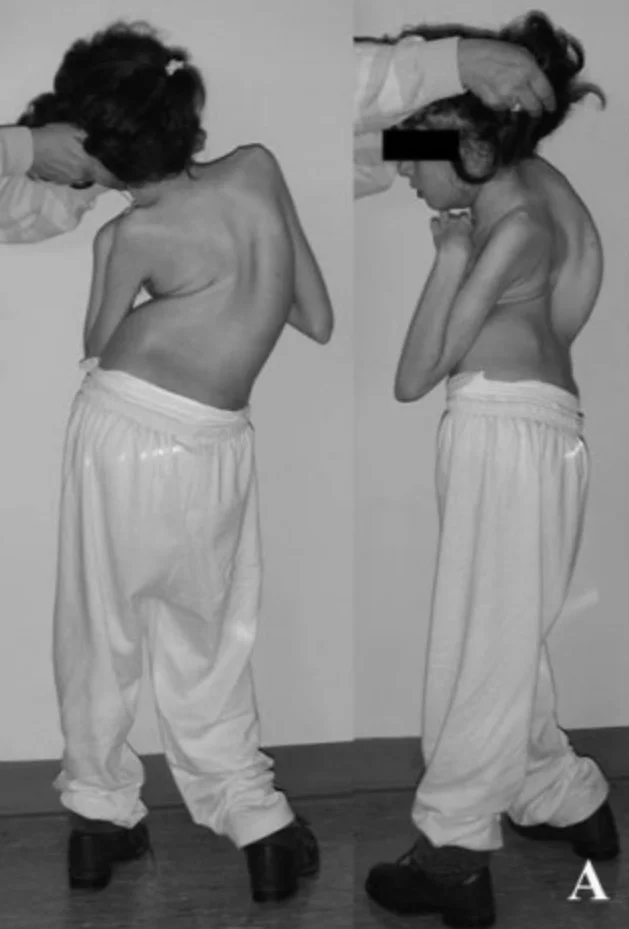
5. A Rib Hump Appears When Your Child Bends Forward
This is one of the most useful observations parents can make.
Ask your child to stand with feet together and gradually bend forward at the waist, allowing the arms to hang freely.
Look at the back from behind.
In some children, one side of the rib cage appears higher than the other, creating a rounded prominence.
This is commonly called a rib hump.
Why does it happen?
Scoliosis is not just a sideways bend. Vertebral rotation can also rotate the rib cage, making one side of the back appear more elevated when the child bends forward.
Healthcare professionals use the Adams forward bend test to look for this type of trunk asymmetry.
A useful distinction: A general postural difference may become less obvious when the child changes position. A rotational prominence during forward bending deserves particular attention.
Nevertheless, this test cannot confirm or exclude scoliosis on its own. (AAOS)
6. Your Child Appears to Lean Towards One Side
Another possible early sign is a sideways shift of the trunk.
When your child stands, their head may not appear centred over the pelvis.
The body may seem to lean towards one side even when both feet are placed equally on the floor.
Parents sometimes describe this as their child standing crooked.
Observe whether the trunk shift appears repeatedly during relaxed standing, walking or photographs taken over time.
However, leaning can also result from pain, muscle guarding, leg-length differences or habitual posture.
A physiotherapy examination can help distinguish these possibilities.
7. Clothes Suddenly Start Hanging Unevenly
This is an everyday clue worth noticing.
For instance:
- One side of a T-shirt hangs lower.
- The waistline of trousers appears tilted.
- One sleeve seems to sit differently.
- A fitted dress looks asymmetrical around the waist.
- The waistband repeatedly shifts towards one side.
Clothing differences are not specific to scoliosis, but repeated changes may reflect an underlying difference in trunk or pelvic alignment.
The important word here is repeated.
A single photograph or poorly fitted garment should not cause concern. A consistent difference across different clothes and standing positions may justify an assessment.
8. The Head Does Not Appear Centred Over the Body
Look at your child from behind.
Imagine a vertical line running down from the centre of the back of the head towards the pelvis.
The head may appear shifted towards one side rather than naturally aligned above the trunk.
This is sometimes associated with a lateral shift in the spine.
However, head positioning is influenced by neck posture, vision, muscle control and other factors.
A physiotherapist will examine the entire alignment of the body rather than assessing the head independently.
9. One Side of the Back Looks Different During Walking
Scoliosis is usually assessed in standing and forward-bending positions, but observing the child walking can provide additional information.
Notice whether:
- The trunk consistently shifts to one side.
- One shoulder appears to move differently.
- The pelvis rotates unevenly.
- The child repeatedly leans to one side.
- There is an unusual difference in balance.
These findings are not sufficient to diagnose scoliosis. A normal walking pattern does not rule it out either.
The purpose is to understand whether the visible asymmetry is present in different functional positions.
How Parents Can Check for Scoliosis at Home: A Simple Physiotherapy-Inspired Observation
Parents do not need special equipment to observe possible spinal asymmetry.
The following approach can help you identify visible differences without turning the process into a stressful examination for your child.
Step 1: Observe Natural Standing Posture
Ask your child to stand comfortably, with feet approximately parallel and arms relaxed.
Observe from behind.
Look at the shoulder line, shoulder blades, waistline and pelvis.
Do not ask your child to correct their posture.
Step 2: Compare Both Sides of the Waist
Check whether one side appears more indented or whether the space between the arm and waist differs.
Notice whether the difference remains when your child relaxes.
Step 3: Perform a Gentle Forward-Bending Observation
Ask your child to bend forward comfortably with knees straight, feet together and arms hanging down.
Observe from behind.
Look for a difference in the height of the rib cage or lower back.
Never force the child into the position or push down on their back.
Step 4: Observe the Body From the Side
Check whether the head, trunk and pelvis appear reasonably aligned.
This is useful for general postural observation, although scoliosis itself cannot be determined from a side-view inspection.
Step 5: Record Changes Without Creating Anxiety
When an asymmetry is noticeable, you may record the date and your observations.
A photograph taken with the child’s comfort and consent, using a consistent standing position, may help you describe changes during a clinical consultation.
Do not repeatedly photograph, measure or compare the child’s body every day.
My advice: If you notice a persistent rib prominence, shoulder asymmetry or trunk shift, arrange a professional evaluation rather than spending weeks trying to determine whether the curve is increasing.
The home observation approach is based on the principles of the Adams test and clinical posture assessment, not a substitute for them.
Why Growth Spurts Matter So Much in Childhood Scoliosis
One of the most important things parents should understand is that scoliosis can behave differently during periods of rapid growth.
A child may have a very small curve that is barely noticeable at one stage. During a subsequent growth spurt, the curve may become more apparent.
This is particularly important around puberty.
The vertebral column, muscles, ribs and surrounding connective tissues are developing rapidly.
When a child has scoliosis and considerable skeletal growth remaining, the possibility of curve progression becomes an important part of treatment planning.
A systematic review published in European Spine Journal examined 28 investigations involving 8,255 patients and identified several factors associated with curve progression, including younger age at diagnosis, family history, growth velocity, skeletal immaturity and the initial Cobb angle. (PMC)
The Height-Growth Clue Parents Should Not Ignore
Parents often monitor their children’s height during annual health check-ups but may not realise that height velocity is also relevant when assessing scoliosis progression.
A rapid increase in height can indicate that the child is passing through a period of accelerated skeletal growth.
For example, a child who has grown noticeably over a few months may be entering a phase when a pre-existing spinal curve requires closer monitoring.
This does not mean that rapid growth causes scoliosis. Rather, rapid growth can create a period in which an existing curve has greater potential to progress.
A longitudinal study published in Spine examined the relationship between growth velocity and scoliosis development in children and highlighted the association between the adolescent growth spurt and the appearance of scoliosis. (PubMed)
Why Girls May Need Particular Attention During Adolescence
Adolescent idiopathic scoliosis is more frequently identified in girls, particularly when considering curves that progress to clinically important magnitudes.
The Scoliosis Research Society highlights the sex-related differences in adolescent idiopathic scoliosis.
Parents should therefore pay attention to visible spinal asymmetry in girls approaching puberty and throughout their growth period.
However, boys can also develop scoliosis, and they should not be excluded from observation.
What Causes Scoliosis in Children? Are Parents Accidentally Contributing to It?
This is one of the most common concerns I encounter when discussing childhood posture.
Parents often wonder whether their child’s schoolbag, mobile phone use, sleeping position or habit of sitting crookedly has caused the spinal curve.
The answer is important.
Most adolescent idiopathic scoliosis does not have a clearly established single cause.
It is not considered a condition caused simply by poor sitting posture or carrying a schoolbag on one shoulder.
Research suggests that genetic, biological and developmental factors may contribute to its development.
Factors Associated With Childhood Scoliosis
1. Family history
Scoliosis can run in families. If a parent or sibling has scoliosis, informing the child’s healthcare professional is sensible.
Family history does not mean that the child will automatically develop the condition.
2. Rapid skeletal growth
Periods of rapid growth are particularly relevant to progression in children who already have a curve.
3. Congenital spinal abnormalities
Some children are born with vertebral formation or segmentation abnormalities that can contribute to spinal curvature.
4. Neuromuscular conditions
Conditions that affect muscle control and neurological function, including cerebral palsy and certain muscular disorders, can be associated with scoliosis.
5. Genetic or syndromic conditions
Certain connective tissue and genetic disorders can be associated with spinal deformities. (NIH)
Things That Do Not Automatically Cause Structural Scoliosis
Parents should not blame themselves for allowing their child to:
- Carry a schoolbag on one shoulder.
- Sit with rounded shoulders occasionally.
- Sleep on one particular side.
- Use a mobile phone.
- Participate in sports.
- Spend time studying at a desk.
These habits may influence comfort, general posture or musculoskeletal symptoms, but they are not established causes of adolescent idiopathic scoliosis.
Correcting sitting posture is beneficial for general musculoskeletal health, but it should not be presented as a treatment that reverses structural scoliosis.
Scoliosis or Poor Posture? How Can Parents Tell the Difference?
This distinction is particularly important because not every child with an uneven back has structural scoliosis.
There are two broad concepts worth understanding.
Postural or Functional Asymmetry
Sometimes the appearance of spinal curvature changes depending on how the child stands, sits or moves.
Potential contributing factors include:
- Pelvic obliquity.
- Leg-length discrepancy.
- Muscle tightness.
- Pain-related muscle guarding.
- Habitual weight shifting.
- Differences in movement control.
For example, a child with a leg-length discrepancy may develop a tilted pelvis, making the trunk appear asymmetrical.
A physiotherapist can examine whether the asymmetry changes with positioning, movement or correction of the suspected contributing factor.
Structural Scoliosis
Structural scoliosis involves a more established spinal deformity with vertebral rotation.
It is not simply corrected by asking the child to stand straight.
An X-ray is used to measure the Cobb angle and confirm the diagnosis.
One important clinical distinction is that the appearance of the spine during forward bending can reveal rotational prominence, which makes the examination more informative than looking at standing posture alone.
When Should Parents Take Their Child to a Doctor?
Not every difference in shoulder or hip height requires an emergency appointment. However, persistent asymmetry should not be ignored.
Consider arranging a paediatric or orthopaedic assessment when you notice:
- One shoulder consistently higher than the other.
- A visible rib hump when the child bends forward.
- Progressive waistline or pelvic asymmetry.
- A persistent sideways trunk shift.
- A spinal curve that appears increasingly noticeable.
- An unexplained change in posture during a period of rapid growth.
Children younger than 10 years with suspected scoliosis deserve timely specialist assessment because early-onset curves can have different causes and management requirements from adolescent idiopathic scoliosis.
Warning Signs That Need More Urgent Medical Assessment
Scoliosis itself is usually painless in children. Significant or unusual pain should therefore not automatically be attributed to the spinal curve.
Seek prompt medical assessment when a child has:
- Persistent or worsening back pain.
- Pain that repeatedly wakes the child at night.
- Fever or unexplained weight loss alongside back pain.
- New weakness in the legs.
- Numbness, tingling or altered sensation.
- Unusual walking difficulties or problems with coordination.
- New bladder or bowel control problems.
Sudden leg weakness, saddle-area numbness or new loss of bladder or bowel control requires emergency evaluation.
Persistent pain, neurological symptoms and systemic symptoms can indicate another underlying condition that requires investigation.
How Is Scoliosis Diagnosed in Children?
When parents report suspicious changes, a clinician usually begins with a detailed assessment rather than immediately recommending exercises or a brace.
1. Clinical Postural Assessment
The clinician examines the child from the front, back and side.
The examination may include shoulder height, pelvic alignment, waistline symmetry, trunk shift and rib-cage prominence.
2. Adams Forward Bend Test
The child bends forward while the clinician looks for asymmetry in the rib cage and lower back.
A scoliometer may be used to measure the angle of trunk rotation.
This provides a screening measurement, not the final Cobb angle.
3. Neurological and Musculoskeletal Examination
The clinician may examine muscle strength, reflexes, sensation, balance, walking pattern, leg length and joint mobility.
This is particularly important when the child has unusual symptoms or signs suggesting an underlying neuromuscular or congenital condition.
4. Standing Spinal X-ray
When scoliosis is suspected, an appropriate standing spinal radiograph helps confirm and measure the curve.
The Cobb angle is calculated using the vertebrae at the upper and lower ends of the curve.
A measurement greater than 10 degrees meets the radiographic definition of scoliosis.
The results are interpreted alongside the child’s age, growth remaining, curve location and clinical findings. (NIAMS)
An Important Point About Scoliosis Screening
Parents may come across conflicting information about routine school scoliosis screening.
The US Preventive Services Task Force (USPSTF) maintains an insufficient-evidence recommendation for universal screening of asymptomatic children aged 10 to 18 years.
Its evidence surveillance reported no new evidence sufficient to update the recommendation as of January 2025.
This does not mean that children with visible asymmetry should be left unassessed.
The recommendation concerns the balance of benefits and harms of screening all asymptomatic children, not children who already have concerning signs.
The USPSTF also notes that combining clinical screening methods can improve detection accuracy compared with relying on a single test. (USPSTF)
Can Physiotherapy Help Children With Scoliosis?
This is where early assessment becomes especially valuable.
Physiotherapy has an important role in the conservative management of selected children with scoliosis.
However, the treatment must be based on the child’s spinal curve, age, remaining growth, functional ability and likelihood of progression.
One point I want parents to understand is that general back-strengthening exercises and scoliosis-specific physiotherapy are not the same thing.
A child with scoliosis does not simply need stronger back muscles.
The rehabilitation approach may need to address three-dimensional spinal alignment, trunk rotation, breathing mechanics, muscular control and the ability to maintain a corrected posture during everyday activities.
1. Physiotherapeutic Scoliosis-Specific Exercises
Physiotherapeutic scoliosis-specific exercises (PSSE) are specialised rehabilitation approaches designed for children with scoliosis.
Depending on the child’s curve pattern and treatment requirements, programmes may incorporate:
- Three-dimensional postural self-correction.
- Controlled breathing techniques.
- Trunk stabilisation.
- Spinal elongation and active alignment.
- Neuromuscular control.
- Training to maintain corrected posture during everyday movements.
The Schroth method is one recognised approach to scoliosis-specific rehabilitation.
Rather than prescribing identical exercises to every child, a trained physiotherapist selects techniques according to the individual curve pattern.
What does research say?
A 2024 systematic review and network meta-analysis published in the American Journal of Physical Medicine & Rehabilitation evaluated 17 randomised controlled trials involving 857 patients with adolescent idiopathic scoliosis.
The findings suggested that physiotherapeutic scoliosis-specific exercise programmes could improve Cobb angle, trunk rotation and quality-of-life outcomes compared with conventional rehabilitation. (NCBI)
These findings are encouraging, but exercise results vary between children, and they should not be interpreted as a guarantee that physiotherapy will straighten every spinal curve.
2. Schroth-Based Rehabilitation
The Schroth method uses individualised three-dimensional correction strategies.
A therapist teaches the child how to recognise their spinal asymmetry and actively work towards a more corrected position.
Treatment may include:
- Specific breathing patterns.
- Rotational correction.
- Postural awareness.
- Muscle activation.
- Stabilisation in corrected positions.
A randomised controlled study published in 2015 compared supervised Schroth exercises, home exercises and a control group.
The supervised clinic-based exercise group demonstrated improvements in Cobb angle, vertebral rotation and certain trunk appearance measurements compared with the other groups. (Sage Journals)
An important takeaway is that merely watching exercise videos and copying movements at home is not equivalent to receiving individually prescribed scoliosis rehabilitation.
3. Bracing Combined With Physiotherapy
Some growing children need spinal bracing when the curve reaches a clinically concerning magnitude or shows a risk of progression.
Bracing is not required for every child with scoliosis.
For selected adolescents with moderate curves and substantial growth remaining, a specialist may recommend a rigid spinal brace.
The purpose is to reduce the risk of further curve progression while the child is growing.
The landmark BrAIST study, published in the New England Journal of Medicine in 2013, examined adolescents with idiopathic scoliosis who were at risk of progression.
Treatment success was reported in 72% of participants in the bracing group compared with 48% in the observation group when the randomised and preference cohorts were analysed together.
In the randomised intention-to-treat analysis, success was 75% with bracing versus 42% with observation.
The study also found that longer brace-wearing time was associated with better outcomes. (PMC)
Physiotherapy can complement bracing by helping children understand postural correction, maintain physical activity and develop appropriate muscular control.
The brace prescription, wearing schedule and follow-up must be guided by the treating specialist.
4. Maintaining Functional Strength and Mobility
Children with scoliosis should not be discouraged from moving.
Depending on their individual presentation, physiotherapy may include appropriate work on:
- Trunk endurance.
- Hip and pelvic control.
- Balance.
- Thoracic mobility.
- General strength.
- Breathing and exercise tolerance.
These exercises support physical function and participation in everyday activities.
However, they should not be confused with a universal scoliosis-correction programme.
What Parents Should Do to Support a Child With Scoliosis
The goal is not to make a child constantly conscious of their posture.
It is to support appropriate medical care, physical confidence and long-term spinal health.
1. Keep track of growth. Record height during routine health check-ups. Inform the treating specialist about rapid growth because skeletal maturity influences treatment decisions.
2. Attend scheduled reviews. A child who requires observation should not be lost to follow-up simply because there is no pain.
3. Encourage normal physical activity. Walking, swimming, cycling and age-appropriate sports can support general health and fitness. No particular sport should be treated as a cure for scoliosis.
4. Follow the prescribed exercise programme. Consistency and correct technique are more useful than doing large numbers of random exercises.
5. Support brace compliance without embarrassment. If a brace is prescribed, work with the clinical team to manage school, clothing, comfort and daily routines.
6. Protect the child’s confidence. Avoid repeatedly commenting on shoulder height, body shape or visible differences. Explain that scoliosis is a medical condition, not something the child has done wrong.
7. Ask about the treatment goal. Understand whether the plan is observation, reducing progression risk, improving posture and function, or preparing for another treatment.
Things Parents Should Avoid
There are several common misconceptions that can delay appropriate treatment.
- Do not force the child to stand straight throughout the day.
- Do not use aggressive spinal manipulation or repeated forceful twisting as a scoliosis treatment.
- Do not purchase a spinal brace without specialist assessment.
- Do not prescribe side-specific stretching exercises based only on a photograph.
- Do not stop sports or physical education automatically.
- Do not assume that improvement in back discomfort means that the spinal curve has improved.
- Do not replace scheduled clinical follow-ups with home posture photographs.
Most importantly, avoid believing that poor posture is the main cause of adolescent idiopathic scoliosis or that correcting posture alone will reverse the condition.
The appropriate treatment should be guided by the diagnosis, not by assumptions.
Can Childhood Scoliosis Be Prevented?
This is a question worth answering honestly.
At present, there is no established home exercise routine, sleeping position, diet or posture correction programme proven to prevent adolescent idiopathic scoliosis from developing.
Since the cause of idiopathic scoliosis is not fully understood, parents should be cautious about products and programmes promising prevention or permanent spinal straightening.
However, early recognition, appropriate monitoring and timely intervention can help manage the risk of curve progression in children who have scoliosis.
This is particularly relevant during periods of rapid growth.
The best practical strategy is not to obsess over the child’s posture but to notice persistent changes and seek an assessment when appropriate.
A Final Physiotherapy Perspective
One of the most important aspects of childhood scoliosis is that the visible spinal curve is only part of the clinical picture.
Two children may have similar Cobb angle measurements but very different remaining growth, curve patterns, physical abilities and treatment requirements.
This is why an individual assessment matters.
As a physiotherapist, I would encourage parents to pay particular attention to three things:
First, observe whether the child’s body asymmetry is persistent rather than judging a single photograph.
Second, consider the child’s growth stage. A noticeable change during a growth spurt deserves timely attention.
Third, do not wait for pain before seeking an assessment. Many children with scoliosis do not experience pain in the early stages.
Scoliosis does not mean that a child must stop playing, exercising or enjoying childhood.
With appropriate assessment and a treatment plan suited to the individual, many children continue their normal activities while receiving the care they need.
The most valuable thing a parent can do is recognise a change, ask the right questions and seek help at the right time.
Frequently Asked Questions
1. What are the first signs of scoliosis in a child?
The first signs may include uneven shoulders, one shoulder blade sticking out, an uneven waistline, one hip appearing higher and a rib hump during forward bending. Many children do not experience pain.
2. How can I check whether my child has scoliosis at home?
Observe your child standing naturally from behind. Compare shoulder height, shoulder blades, waistline and hips. You can also ask your child to bend forward gently and look for a difference in rib-cage height. These observations cannot diagnose scoliosis and should be followed by professional assessment when abnormalities persist.
3. Can scoliosis develop without back pain?
Yes. Many children with mild or moderate scoliosis do not experience pain. Visible postural changes may be the first indication. Persistent or unusual back pain requires medical assessment.
4. Can poor posture or carrying a heavy schoolbag cause scoliosis?
Poor sitting posture and carrying a schoolbag on one shoulder are not established causes of adolescent idiopathic scoliosis. The exact cause of this condition remains unknown, although genetic and developmental factors are thought to contribute.
5. Can physiotherapy correct scoliosis in children?
Individualised scoliosis-specific physiotherapy may help improve spinal alignment, trunk rotation, muscular control and quality of life. The effectiveness depends on the curve, growth stage and treatment programme. Physiotherapy is not guaranteed to completely straighten every structural curve.
6. Does every child with scoliosis need a brace?
No. Mild curves may only require regular monitoring. Bracing is generally considered for selected growing children with curves at risk of progression. An orthopaedic specialist determines the need and wearing schedule.
7. Can children with scoliosis participate in sports?
Most children with scoliosis can continue age-appropriate sports and physical activities. Activity restrictions are not routinely necessary, although individual recommendations may depend on the curve, symptoms, treatment and specialist advice.
8. When should a child with suspected scoliosis see a specialist?
Seek an assessment when you notice persistent shoulder or hip asymmetry, a rib hump, a visible spinal curve or progressive sideways leaning. Children younger than 10 years with suspected scoliosis should receive timely specialist assessment.
Stay tuned with us for more health related topics.
Follow us on LinkedIn and Instagram for more.
More Read


Medical Disclaimer!
This article has been reviewed and written under the guidance of our Head Physiotherapist, Dr. Kruti Raj (PT, MUHS,CPT,CMPT). The information shared is intended for educational purposes only and should not be considered a substitute for personalized medical advice, diagnosis, or treatment.
Please consult us or any other qualified healthcare professional before beginning any exercise program, especially if you are experiencing pain, recovering from injury, or managing a medical condition.


