


If your child is walking on tiptoes instead of placing their heels on the ground, you may wonder whether this is a normal developmental phase or a sign of an underlying condition.
Toe walking is a walking pattern in which a child moves on the balls of their feet without regularly placing their heels on the ground.
Quick Answer: Why Does My Child Walk on Tiptoes?
Children may walk on their toes while learning to walk, but persistent toe walking can sometimes be associated with tight calf muscles, restricted ankle movement, sensory differences or neurological and muscular conditions.
Occasional toe walking in toddlers is not always concerning. However, children who continue toe walking frequently after age two, walk predominantly on one side, cannot comfortably place their heels down or show other movement difficulties should receive a professional assessment.
Pediatric physiotherapy can assess ankle flexibility, muscle strength, balance and walking mechanics to develop an individualized treatment plan.
It can occur when children are learning to walk, but persistent toe walking may sometimes be associated with tight calf muscles, restricted ankle movement or an underlying developmental or neurological condition.
The important question is not simply how often a child walks on their toes, but why they are doing it, whether they can walk with their heels down, and whether other movement difficulties are present.
Understanding these signs can help parents decide when to seek an assessment and how pediatric physiotherapy may help.
Key Takeaways for Parents
- Toe walking can occur during early walking development.
- Persistent toe walking after two years of age deserves professional assessment.
- Tight calf muscles and restricted ankle movement can contribute to toe walking.
- Neurological, muscular and neurodevelopmental conditions may also influence walking patterns.
- One-sided toe walking or a sudden change in walking pattern should not be ignored.
- Pediatric physiotherapy can address flexibility, strength, balance and gait mechanics.
- Not every child who walks on their toes needs treatment. Management depends on individual assessment findings.
What Is Toe Walking in Children?
Toe walking occurs when a child walks with their heels raised and most of their body weight supported through the front of their feet.
Some children walk on their toes occasionally, particularly when excited, playing or exploring movement.
Others use this pattern during most of their daily activities.
A useful observation is whether the child can voluntarily place both heels on the floor and walk with a heel-to-toe pattern when asked.
Toe walking can be part of early walking development.
However, persistent toe walking, especially after independent walking is established, deserves attention.
Is Toe Walking Normal in Toddlers?
Many children briefly walk on their toes while learning to stand and walk.
Their balance, ankle control, coordination and walking mechanics are still developing.
As walking becomes more established, most children gradually develop a heel-to-toe pattern.
The following guide provides a general overview:
- During early walking: Occasional toe walking can be part of movement exploration.
- Around 18 months to 2 years: A more consistent heel-to-toe pattern generally develops, although some children may still walk on their toes occasionally.
- After 2 years: Persistent toe walking should be discussed with a healthcare professional, particularly if the child cannot comfortably place their heels down.
- In older children: Continued toe walking, restricted ankle movement, pain or difficulty with everyday activities warrants assessment.
These ages are general guides, not diagnostic deadlines.
A child’s developmental history, walking pattern and physical examination are more important than age alone.
The 2024 consensus statement from the British Society for Children’s Orthopedic Surgery and the Association of Pediatric Chartered Physiotherapists defines idiopathic toe walking as:
bilateral toe walking that begins when independent walking starts, continues beyond two years of age and is not associated with a known neurological condition. (BSCOS and APCP, 2024)
Why Does My Child Walk on Tiptoes?
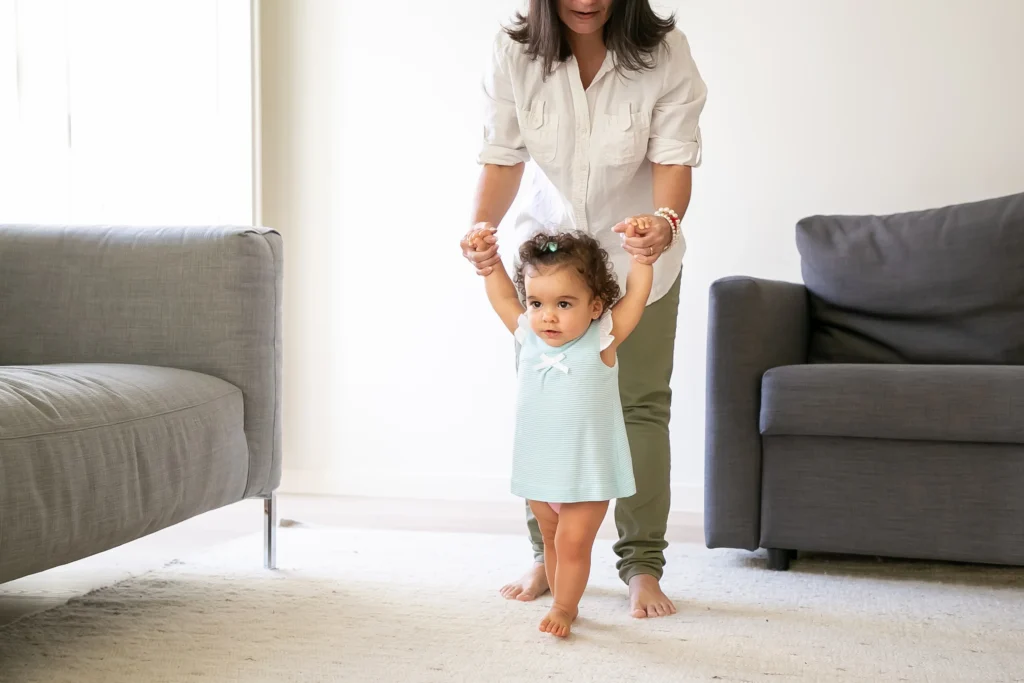
Toe walking can have several causes.
Understanding the underlying reason is important because treatment differs depending on the child’s physical abilities and clinical findings.
1. Habitual or Idiopathic Toe Walking
Idiopathic toe walking refers to persistent toe walking without an identifiable neurological or orthopedic explanation following an appropriate assessment.
It usually affects both feet and begins when the child first starts walking.
Some children can walk with their heels down when reminded but return to toe walking during everyday activities.
Idiopathic toe walking is a diagnosis of exclusion. It should not be assumed simply because a child appears otherwise healthy.
2. Tight Calf Muscles and Achilles Tendon
The calf muscles and Achilles tendon play an important role in ankle movement during walking.
When these structures become tight or shortened, the ankle may not move sufficiently towards the position needed for the heel to reach the floor.
Parents may notice that their child:
- Struggles to stand with both heels flat.
- Has difficulty squatting while keeping the heels down.
- Walks predominantly on the front of the feet.
- Experiences discomfort around the calves or ankles.
Persistent toe walking can contribute to reduced ankle flexibility, making calf muscle length and ankle movement important parts of a physiotherapy assessment.
3. Cerebral Palsy and Other Neurological Conditions
Neurological conditions can affect muscle tone, coordination, balance and voluntary movement.
For example, some children with cerebral palsy experience increased muscle tone in the calf muscles.
This can make it difficult to bring the foot towards the shin and achieve a normal heel-to-toe walking pattern.
Other neurological conditions may also affect walking mechanics.
However, toe walking alone does not indicate cerebral palsy.
A clinical assessment of muscle tone, reflexes, strength and movement symmetry is needed to investigate possible neurological involvement.
4. Muscular and Neuromuscular Conditions
Conditions affecting the muscles or nerves can sometimes change the way a child walks.
For example, muscular dystrophy can cause progressive muscle weakness, which may affect running, climbing stairs, getting up from the floor and walking.
Toe walking accompanied by frequent falls, difficulty keeping up with other children or increasing weakness should be medically assessed.
5. Sensory and Neurodevelopmental Differences
Toe walking is reported more frequently in some children with autism spectrum disorder and other neurodevelopmental differences.
Some children may have differences in sensory processing, movement preferences or motor control that influence their walking pattern.
However, toe walking does not automatically mean a child has autism.
It is not a standalone diagnostic sign, and children should be assessed according to their overall developmental profile.
A clinical review of idiopathic toe walking discusses the importance of distinguishing habitual toe walking from neurological, muscular and developmental causes. (Bauer et al., 2022)
When Should Parents Worry About Toe Walking?
Not every child who walks on their toes needs treatment.
However, certain signs suggest that a professional assessment is important.
Consider arranging an assessment if your child:
- Continues to walk on their toes frequently after two years of age.
- Has been toe walking for more than six months after independent walking became established.
- Walks on one foot or one side more than the other.
- Cannot comfortably place both heels on the floor.
- Has tight calf muscles or restricted ankle movement.
- Frequently trips, falls or struggles with balance.
- Has difficulty running, squatting or climbing stairs.
- Shows unusual muscle stiffness, weakness or floppy movements.
- Has delays in other developmental milestones.
New-onset toe walking is particularly important.
If a child previously walked with a normal heel-to-toe pattern and suddenly begins walking on their toes, the change should be assessed rather than assumed to be a habit.
Seek prompt medical attention if toe walking is accompanied by loss of previously acquired skills, new weakness, significant pain or a sudden deterioration in movement.
A 2025 clinical review identifies persistent toe walking, its appearance after walking is established and associated clinical findings as important warning signs that require further investigation. (Baldo et al., 2025)
Toe Walking in Children: Myth vs Fact
MYTH: Every child who walks on their toes has a medical condition.
FACT: Some children toe walk without an identifiable neurological or orthopedic condition. However, persistent toe walking should be assessed when appropriate.
MYTH: Toe walking always means autism.
FACT: Toe walking can occur for many reasons. Although it is more common in some children with autism, it is not a diagnostic sign on its own.
MYTH: Children will always outgrow toe walking.
FACT: Some children stop toe walking naturally, while others continue. Persistent toe walking, especially with restricted ankle movement, deserves assessment.
MYTH: Toe walking only affects the feet.
FACT: Persistent toe walking may influence ankle flexibility, calf muscle length, balance and overall walking mechanics.
MYTH: Parents should force their child’s heels to touch the floor.
FACT: Forcing the feet down can cause discomfort. A physiotherapist should first assess ankle mobility, muscle flexibility and the child’s walking pattern.
How Is Toe Walking Assessed?
A pediatrician or pediatric physiotherapist will usually begin by understanding the child’s developmental history and observing their walking pattern.
The assessment may include the following areas.
1. Walking Pattern and Gait Analysis
The clinician observes how the child walks, runs, turns and changes direction.
They may check:
- Whether toe walking affects one or both feet.
- Whether it happens occasionally or consistently.
- Whether the child can walk with their heels down.
- Whether the walking pattern changes when the child runs.
This helps identify differences in gait, weight distribution and lower-limb movement.
2. Ankle Range of Motion
Ankle dorsiflexion is the movement that brings the top of the foot towards the shin.
A physiotherapist assesses ankle movement with the knee both bent and straight.
This helps identify whether calf muscle tightness or shortening is restricting movement.
Restricted ankle dorsiflexion may make heel contact difficult during walking.
3. Muscle Strength and Balance
The assessment may include age-appropriate activities such as standing, squatting, walking on heels, rising from the floor and stepping.
These movements help identify difficulties with lower-limb strength, postural stability and coordination.
4. Neurological and Musculoskeletal Examination
The healthcare professional may examine muscle tone, reflexes, sensation, spinal alignment and movement symmetry.
They may also compare calf muscle size and check for differences between the two legs.
If the examination suggests an underlying neurological, muscular or orthopedic condition, further investigations or specialist referral may be necessary.
The Royal Children’s Hospital Melbourne includes gait, calf length, calf size, functional movement and neurological examination among the important components of toe-walking assessment. (Royal Children’s Hospital Melbourne)
How Can Pediatric Physiotherapy Help?
Pediatric physiotherapy plays an important role in assessing movement difficulties and supporting children with persistent toe walking.
The treatment plan depends on the child’s age, ankle flexibility, muscle strength, walking pattern and underlying diagnosis.
1. Improving Calf Muscle Flexibility
When calf muscle tightness is present, a physiotherapist may introduce appropriate stretching and ankle mobility exercises.
The aim is to improve ankle dorsiflexion and help the child achieve a comfortable heel-down position.
Stretching should be guided by the child’s assessment rather than performed forcefully.
2. Lower-Limb Strengthening
Age-appropriate strengthening activities can improve control around the hips, knees, ankles and feet.
Depending on the child’s abilities, activities may include:
- Supported squatting.
- Sit-to-stand exercises.
- Step-ups on a low, stable step.
- Controlled heel raises when appropriate.
These activities help develop functional strength for standing, stepping and walking.
3. Balance and Postural Control
Children need adequate balance and postural control to distribute their weight effectively through their feet.
A physiotherapist may introduce supervised reaching, stepping, weight-shifting and obstacle activities.
These exercises help children practice controlled movement while maintaining stability.
4. Gait Training
Gait training focuses on improving the child’s walking pattern through supervised movement practice.
Depending on the assessment, this may include stepping exercises, walking activities, movement cues and practicing heel contact.
The aim is to develop a comfortable and functional walking pattern, not simply force the child’s heels towards the floor.
5. Orthoses and Serial Casting
Some children may benefit from ankle-foot orthoses or serial casting.
- Ankle-foot orthoses: These devices help support ankle positioning and can encourage a more controlled walking pattern.
- Serial casting: A series of casts may be used to gradually improve ankle range of motion when significant muscle or tendon tightness is present.
These interventions are not necessary for every child.
Their suitability depends on the child’s clinical findings and should be decided by the treating healthcare team.
A review of idiopathic toe walking describes treatment options such as stretching, casting, gait retraining and bracing, with management guided by ankle range of motion and the child’s individual needs. (Freiman et al., 2022)
What Can Parents Do at Home?
Parents can encourage healthy movement through supervised and enjoyable activities.
Some practical approaches include:
- Encourage safe barefoot play indoors when appropriate.
- Provide opportunities for supervised walking on safe, varied surfaces.
- Encourage squatting to pick up toys.
- Use age-appropriate games involving stepping, reaching and balance.
- Observe whether toe walking happens on one or both feet.
- Notice whether the child can place their heels comfortably on the floor.
Avoid repeatedly forcing the child’s heels down or performing aggressive calf stretches.
If toe walking is persistent, seek professional advice before starting a structured exercise program.
Can Toe Walking Affect a Child’s Development?
Persistent toe walking may affect more than the appearance of a child’s walking pattern.
Depending on its severity and underlying cause, it may be associated with:
- Reduced ankle flexibility.
- Difficulty standing with the heels down.
- Changes in walking efficiency.
- Balance and coordination difficulties.
- Calf or foot discomfort.
- Difficulty participating in certain physical activities.
Not every child experiences these problems.
However, monitoring ankle movement, walking ability and participation in everyday activities can help determine whether intervention is needed.
Will My Child Outgrow Toe Walking?
Some children gradually stop toe walking as their movement patterns mature.
Others continue, particularly when toe walking has become an established habit or when ankle flexibility is restricted.
A systematic review of idiopathic toe walking reported that the natural history is not fully understood and that treatment studies have limitations.
Therefore, parents should avoid assuming that every child will outgrow the pattern without assessment.
The decision to monitor or treat depends on the child’s age, ability to walk with their heels down, ankle flexibility, symptoms and functional difficulties. (van Kuijk et al., 2014)
Final Thoughts: Helping Your Child Develop a Healthy Walking Pattern
Watching your child learn to walk is an exciting part of their development. Occasional toe walking can be part of early movement exploration, but persistent toe walking deserves attention, especially when it affects balance, ankle flexibility or everyday activities.
If your child frequently walks on their toes, struggles to place their heels down or shows differences between their two feet, consider arranging a professional assessment. Identifying the reason early can help guide appropriate support.
With individualized assessment, appropriate pediatric physiotherapy and parental support, children can work towards improved ankle movement, balance, coordination and functional walking.
Conclusion
Toe walking can occur during early walking development, but persistent toe walking should not always be dismissed as a habit.
Children who continue walking on their toes after two years of age, develop one-sided toe walking, show calf muscle tightness or experience other movement difficulties may benefit from professional assessment.
Pediatric physiotherapy can help evaluate ankle flexibility, muscle strength, balance, coordination and walking mechanics.
With an appropriate assessment and individualized support, children can work towards a more comfortable and functional walking pattern.
Frequently Asked Questions About Toe Walking in Children
1. Is it normal for toddlers to walk on their toes?
Occasional toe walking can occur when toddlers are learning to walk. However, persistent toe walking, particularly after two years of age, should be discussed with a healthcare professional.
2. Does toe walking mean my child has autism?
No. Although toe walking is reported more frequently in some children with autism, it can occur for several other reasons. Toe walking alone cannot diagnose autism.
3. Can tight calf muscles cause toe walking?
Yes. Tight calf muscles or a shortened Achilles tendon can restrict ankle dorsiflexion, making it difficult for a child to place their heels comfortably on the ground.
4. When should I worry about my child’s toe walking?
Seek an assessment if toe walking continues frequently after age two, affects one side more than the other, is associated with restricted ankle movement or occurs alongside weakness, frequent falls or other developmental concerns.
5. Can physiotherapy correct toe walking?
Pediatric physiotherapy can help address calf muscle tightness, ankle mobility, strength, balance and walking mechanics. The outcome depends on the underlying cause and the child’s individual assessment findings.
6. Will my child outgrow toe walking?
Some children naturally develop a heel-to-toe walking pattern as they grow. Others continue toe walking, particularly when ankle flexibility is restricted. Persistent toe walking should be assessed rather than automatically assumed to resolve.
7. Can toe walking cause long-term problems?
Persistent toe walking may contribute to reduced ankle flexibility, difficulty achieving heel contact and discomfort in some children. The effects vary, so assessment is important when the pattern continues.
Remember: Toe walking has several possible explanations. An individual assessment helps determine whether your child needs monitoring, physiotherapy or further medical investigation.
Stay tuned with us for more health related topics.
Follow us on LinkedIn and Instagram for more.
More Read


Medical Disclaimer
This article is intended for general educational and informational purposes only. It does not replace professional medical advice, diagnosis or treatment. Toe walking in children can have different causes, and every child’s developmental needs are unique. If your child has persistent toe walking, restricted ankle movement, weakness, frequent falls or other developmental concerns, consult a qualified pediatrician or pediatric physiotherapist. Seek prompt medical attention if your child develops sudden weakness, loses previously acquired skills or experiences a significant change in walking ability.


