


Does your baby consistently uses one hand while rarely using the other?
A baby may reach for toys with the same hand repeatedly, keep the other hand closed, or seem less interested in using one arm.
Parents sometimes assume this is an early sign of being right-handed or left-handed.
However, a consistent hand preference during infancy can sometimes indicate a difference in movement development.
Quick Answer: Is Early Hand Preference Normal?
Babies may occasionally reach for toys with one hand more often than the other. However, a consistent preference for one hand before 12 months should not automatically be considered normal right- or left-handedness.
Early hand preference can sometimes be a sign of asymmetric movement development, including possible unilateral cerebral palsy. It does not confirm a diagnosis, but it deserves assessment by a pediatrician.
When to seek help: If one hand is consistently less active, remains tightly fisted, or appears stiff or weak, arrange a developmental assessment. Early pediatric physiotherapy may help support functional movement and coordination.
Babies need time to develop coordinated use of both hands.
Although occasional differences in reaching are common, a clear preference for one hand before 12 months is recognized as a developmental warning sign that deserves assessment.
It does not automatically mean a baby has cerebral palsy, but it should not be dismissed as normal hand dominance.
Understanding the difference between occasional variation and persistent movement asymmetry can help parents seek the right support at the right time.
Key Takeaways for Parents
- Babies should have opportunities to explore and use both hands during infancy.
- A consistent preference for one hand before 12 months is a developmental warning sign that deserves assessment.
- Persistent hand asymmetry can sometimes be associated with unilateral cerebral palsy, but hand preference alone cannot confirm this condition.
- Watch for a tightly fisted hand, reduced arm movement, stiffness, weakness, or difficulty grasping toys.
- Paediatric assessment may include neurological examination and specialised tools such as HAI, HINE, or GMA.
- Paediatric physiotherapy can support upper-limb movement, postural control, bilateral coordination, and functional play.
- Do not force your baby to use the less-preferred hand or restrain the preferred hand without professional guidance.
- Early assessment can help identify movement difficulties and guide appropriate intervention.
Remember: The goal is to support comfortable, functional use of both arms, not to make both hands perform identically.
When Do Babies Develop Hand Preference?
Hand preference, also known as hand dominance, describes the tendency to use one hand more often for activities such as reaching, grasping, pointing, drawing, and manipulating objects.
A consistent preference generally becomes clearer as children grow and develop more complex hand skills.
During infancy, babies are still learning to control their shoulders, arms, wrists, and fingers.
They should have opportunities to explore and use both hands.
A baby may occasionally reach with one hand first because a toy is closer to that side, the body is turned in a particular direction, or the baby is still learning to coordinate movements.
This is different from repeatedly relying on one hand while the other remains inactive or difficult to use.
The Canadian Pediatric Society identifies hand preference before 12 months as an early clinical sign that should prompt further assessment.
This is a reason to investigate movement development, not a diagnosis of cerebral palsy (Mishaal et al., 2026)
What Does Typical Hand Development Look Like?
Hand skills develop alongside visual control, posture, balance, and whole-body movement.
The following are broad developmental patterns, not strict deadlines.
Birth to 3 Months
Newborns often keep their hands close to their bodies.
Movements may appear jerky or uncoordinated because early movement is still influenced by developing nervous system control and primitive reflexes.
As babies approach three months, they may bring their hands towards their face and mouth, open their fingers more often, and begin making more purposeful arm movements.
Parents should mention persistent differences in arm movement, unusual stiffness, or one hand that is consistently difficult to open.
3 to 6 Months
Babies gradually develop better control of their arms and begin reaching towards nearby objects.
They may start to:
- Reach towards toys with either hand.
- Bring both hands together near the chest.
- Hold and explore toys.
- Bring their hands towards their mouth.
- Push through their arms during tummy time.
The aim is not perfectly equal performance in every movement.
What matters is whether both arms are available for movement and exploration.
6 to 9 Months
Reaching and grasping become more purposeful. Babies may hold toys with both hands, move objects between their hands, and explore objects using different grips.
They also begin using their hands to support themselves during sitting and other movement activities.
A baby who consistently uses one hand while the other remains fisted, tucked against the body, or noticeably less active should be assessed.
9 to 12 Months
Babies increasingly use their fingers to pick up and explore smaller objects.
They may point, release toys, and use both hands together during play.
A strong preference for one hand at this stage should not automatically be labelled right- or left-handedness.
Persistent asymmetry is more important than which hand appears stronger.
Why Does My Baby Uses One Hand More Than the Other?
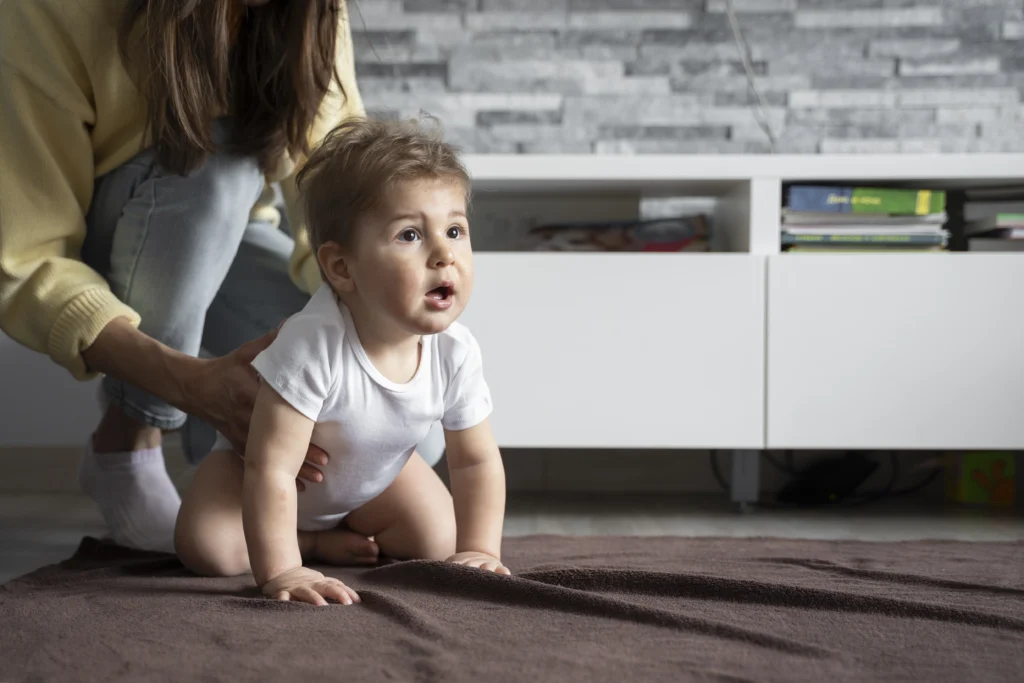
There are several possible explanations. Some relate to positioning or developing coordination, while others involve the muscles, nerves, or brain.
1. Differences in Positioning and Play
A baby may reach more often with one hand because toys are repeatedly placed on that side.
Feeding position, how the baby is carried, and the direction in which the baby usually looks may also influence movement opportunities.
Changing play positions and offering toys from different directions can encourage exploration.
However, positioning should not be assumed to explain a persistent difference between the arms.
2. Differences in Muscle Tone or Strength
Muscle tone refers to the natural tension in muscles when the body is at rest.
Some babies may have increased tone, making an arm appear stiff or difficult to move.
Others may have reduced muscle activation or weakness, making one arm less active.
These differences can affect reaching, grasping, releasing objects, and supporting body weight through the arms.
3. Unilateral Cerebral Palsy
One important condition clinicians consider when a baby shows persistent one-sided movement is unilateral cerebral palsy, sometimes called hemiplegic cerebral palsy.
It affects movement and muscle control predominantly on one side of the body. Early signs may include:
- Reaching more often with one hand.
- Keeping the opposite hand tightly fisted.
- Holding one arm close to the body.
- Having difficulty opening the fingers on one side.
- Using one arm less during tummy time or supported sitting.
Early hand preference alone cannot confirm cerebral palsy.
A clinician needs to assess the baby’s movement patterns, neurological function, developmental history, and other relevant signs.
4. Birth-Related or Neurological Injury
Some differences in arm movement can be associated with an injury or condition affecting the brain, nerves, or structures around the shoulder and arm.
For example, a previous brain injury or a brachial plexus injury can affect movement on one side.
The possible cause depends on the baby’s history and clinical examination.
This is why persistent asymmetry should be assessed rather than treated as a simple preference.
Warning Signs Parents Should Not Ignore
Look at how your baby uses both arms during ordinary activities, rather than judging hand preference from a single reach.
Arrange a developmental assessment if you notice:
- One hand is consistently used while the other rarely reaches.
- One hand remains tightly closed or fisted beyond four months.
- One arm appears stiff, unusually floppy, or difficult to move.
- One hand struggles to grasp or release toys.
- One arm is frequently held close to the body.
- Your baby has difficulty bringing both hands together.
- There is a persistent difference in arm movement, posture, or weight-bearing.
- Other motor skills, such as rolling or sitting, are also delayed.
Persistent asymmetry in posture or movement is important even if your baby was born at full term and has no known medical risk factors.
Seek urgent medical attention if your baby suddenly develops weakness, loses previously acquired movement skills, or experiences an abrupt change in arm movement.
Sudden neurological symptoms need immediate assessment.
How Is Early Hand Preference Assessed?
A pediatrician and pediatric physiotherapist may work together to understand why one hand is being used less.
Assessment usually looks beyond hand preference alone.
1. Observation of Spontaneous Movement
The clinician observes how the baby moves without being prompted.
This may include reaching, grasping, opening the fingers, bringing the hands together, and transferring toys.
The quality, variety, and symmetry of movement can provide useful information.
2. Muscle Tone, Strength, and Range of Movement
The clinician checks whether either arm appears unusually stiff or floppy and whether the baby can move it against gravity.
Shoulder, elbow, wrist, and finger movements may also be examined to identify restrictions or differences.
3. Posture and Movement Symmetry
Head position, trunk control, shoulder alignment, and the way the baby supports weight through the arms are assessed.
A baby who consistently turns towards one side or has difficulty shifting weight may find it harder to reach with the opposite hand.
4. Standardized Developmental and Neurological Assessments
Depending on the baby’s age and clinical history, trained professionals may use tools such as:
- Hand Assessment for Infants (HAI): Evaluates how infants use each hand individually and both hands together.
- Hammersmith Infant Neurological Examination (HINE): Assesses neurological function, including posture, tone, and movement.
- General Movements Assessment (GMA): Examines the quality of spontaneous movements in young infants.
These tools help clinicians identify movement difficulties and determine whether further investigation or early intervention is needed.
They must be administered and interpreted by appropriately trained professionals (Royal Children’s Hospital Melbourne)
How Can Pediatric Physiotherapy Help?
Pediatric physiotherapy focuses on helping babies develop comfortable, effective movement through age-appropriate, play-based activities.
When one hand is less active, therapy aims to understand the reason and encourage the baby’s functional use of both arms.
The program should be individualized rather than based on a fixed set of exercises.
1. Improving Upper-Limb Movement
A physiotherapist may use supported reaching, toy exploration, and age-appropriate activities to encourage movement at the shoulder, elbow, wrist, and fingers.
The therapist observes how the baby initiates movement and whether one arm needs additional support.
2. Encouraging Two-Handed Play
Bimanual activities involve using both hands together. Examples may include holding a larger toy, touching an object with both hands, or stabilizing a toy while exploring it.
These activities help develop coordination and functional participation during play.
3. Developing Trunk Control and Postural Stability
Babies need sufficient trunk control to reach without losing balance.
A physiotherapist may work on supervised tummy-time activities, supported sitting, and age-appropriate weight shifting.
Better postural control can create more opportunities for reaching in different directions.
4. Supporting Weight-Bearing and Symmetrical Movement
When appropriate, supported positions can encourage the baby to place weight through both arms.
This may be incorporated into tummy time, floor play, or other developmental activities.
The position and level of support should be selected according to the baby’s abilities and comfort.
5. Task-Specific Hand Therapy
If unilateral cerebral palsy is diagnosed or strongly suspected, a specialist team may recommend structured upper-limb interventions.
These can include bimanual therapy, which practices activities using both hands, or constraint-induced movement therapy (CIMT), which involves carefully supervised practice with the more-affected hand while temporarily limiting use of the less-affected hand.
These are specialist treatment approaches, not exercises parents should start independently. The choice depends on the child’s assessment, abilities, age, and individual goals (Greaves & Hoare, 2024)
What Can Parents Do at Home?
Parents can support movement development through ordinary, supervised play.
These activities should encourage exploration rather than force the baby to use a particular hand.
- Offer toys from both sides: Place safe, age-appropriate toys within comfortable reach on the left and right.
- Encourage midline play: Offer a toy near the center of the baby’s body to encourage both hands to move towards it.
- Use larger toys: Lightweight toys that are easy to hold may encourage two-handed exploration.
- Change play positions: Include supervised tummy time and floor play appropriate to the baby’s developmental stage.
- Observe everyday movements: Notice whether both hands open, reach, grasp, and release objects.
Do not restrain the preferred hand, pull the less-active arm, or force movements.
If one arm appears weak, stiff, painful, or consistently unused, seek professional guidance before trying targeted exercises.
Should You Wait Until Your Baby Is Older?
No, not when there is a persistent and clear difference in hand use.
Early assessment does not mean that a serious condition will necessarily be diagnosed.
It helps clinicians determine whether the difference is part of normal variation or a sign that further investigation and support are needed.
The earlier a movement difficulty is recognized, the sooner an appropriate intervention plan can be considered.
Early, goal-directed therapy can help infants at risk of unilateral cerebral palsy develop better hand function and participation in everyday activities (Boychuck et al., 2020)
Myth vs Fact: Early Hand Preference
MYTH: Using the right hand more means my baby is naturally right-handed.
FACT: Consistent hand preference during infancy should be assessed. It should not automatically be considered normal hand dominance.
MYTH: Early hand preference always means cerebral palsy.
FACT: It can be an early warning sign, but several factors may influence hand use. A clinical assessment is needed to understand the cause.
MYTH: Babies will naturally start using both hands equally as they grow.
FACT: Persistent differences in movement should not be ignored. Early assessment can identify whether additional support is needed.
MYTH: Parents should hold back the preferred hand to strengthen the other one.
FACT: Do not restrain or force a baby’s hand without professional guidance. Activities should be safe, comfortable, and individually recommended.
MYTH: Physiotherapy is only needed after a baby starts walking.
FACT: Pediatric physiotherapy can support movement development during infancy. Persistent asymmetry can be assessed before crawling or walking begins.
When Should You Consult a Pediatrician?
Arrange an assessment if your baby consistently favors one hand before 12 months, particularly if the other hand is less active, remains fisted, or appears stiff.
You should also discuss persistent differences in reaching, grasping, arm posture, or weight-bearing with your pediatrician.
A referral to a pediatric physiotherapist or developmental specialist may be appropriate.
If your baby was born prematurely, clinicians may consider corrected age when interpreting developmental progress.
Do not wait for your baby to start crawling or walking before raising concerns about obvious movement asymmetry.
Final Thoughts
Every baby develops at an individual pace, but persistent differences in how the two hands are used deserve attention. A baby who consistently relies on one hand during infancy may benefit from an early developmental assessment.
Parents do not need to wait for more obvious difficulties before seeking advice. Understanding movement patterns early can help identify the right support and make everyday play more meaningful.
At VCure Healthcare: Pediatric physiotherapy focuses on supporting each child’s movement, coordination, and functional development through individualized, age-appropriate care.
Conclusion
Babies need time to develop coordinated hand movements, and occasional differences in reaching can occur during normal development.
However, a consistent preference for one hand before 12 months should not automatically be considered early right- or left-handedness.
Persistent one-sided hand use can be an early sign of an underlying movement difficulty, including unilateral cerebral palsy.
A timely assessment by a pediatrician and pediatric physiotherapist can help identify the reason and guide appropriate support.
The goal is not to make both hands perform identically.
It is to help your baby develop the best possible movement, coordination, and independence through safe, age-appropriate activities.
Frequently Asked Questions
1. Is it normal for a 6-month-old baby to use one hand more?
A baby may occasionally reach with one hand first, depending on toy position and body posture. However, a consistent preference for one hand during infancy should be assessed, particularly if the other hand is rarely used or remains fisted.
2. At what age should babies develop hand dominance?
A clear and consistent hand preference generally develops later in childhood. During infancy, babies should have opportunities to explore and use both hands. Strong hand preference before 12 months warrants assessment rather than being assumed to represent normal dominance.
3. Can early hand preference be a sign of cerebral palsy?
Yes. Consistent early hand preference can be an early sign of unilateral cerebral palsy, particularly when accompanied by reduced movement, stiffness, or a tightly fisted hand on the opposite side. It is not diagnostic on its own and requires professional assessment.
4. Why does my baby keep one hand closed?
Young babies may naturally keep their hands closed at times. However, if one hand remains consistently fisted, especially after four months or alongside reduced arm movement, discuss it with a paediatrician.
5. Can physiotherapy help a baby who uses one hand less?
Pediatric physiotherapy can help address movement asymmetry, postural control, upper-limb function, and coordination. Treatment depends on the underlying cause and may be combined with occupational therapy or specialist upper-limb programs.
6. Should I encourage my baby to use the less-preferred hand?
You can offer toys from both sides and encourage comfortable two-handed play. Do not restrain the preferred hand, pull the other arm, or force activities. Seek professional guidance if the difference is persistent.
7. What is the Hand Assessment for Infants?
The Hand Assessment for Infants (HAI) is a specialized assessment that examines how babies use each hand separately and both hands together. It can help clinicians identify differences in hand function.
8. When should I take my baby to a doctor for hand preference?
Arrange an assessment if your baby consistently favors one hand before 12 months, particularly if the other hand is less active, stiff, weak, or frequently closed. Sudden weakness or loss of movement requires urgent medical attention.
Stay tuned with us for more health related topics.
Follow us on LinkedIn and Instagram for more.
More Read


Medical Disclaimer
This article is intended for general educational and informational purposes only. It does not replace professional medical advice, diagnosis, or treatment. Early hand preference or differences in arm movement do not independently confirm cerebral palsy or any other medical condition. Every baby develops differently, and concerns about movement, muscle tone, or developmental milestones should be discussed with a qualified pediatrician or pediatric physiotherapist. Seek urgent medical attention if your baby develops sudden weakness or loses previously acquired movement skills. Do not begin restrictive or specialized hand therapy without professional assessment.


