


Finding the right treatment for a meniscus tear can be confusing, especially when you are told that surgery is the only way to fix a torn knee.
A knee that suddenly twists during football, a sharp pain when getting up from a squat, or a knee that repeatedly catches can make you wonder, “Did I tear my meniscus?”
Possibly.
But there is an important clinical detail many people do not know:
having a meniscus tear on an MRI does not automatically mean the tear is the cause of your pain, and it does not automatically mean you need surgery.
Quick Answer
A meniscus tear can cause knee pain, swelling, catching, clicking and difficulty with twisting or deep bending. Treatment depends on whether the tear is traumatic, degenerative, stable or mechanically obstructive. Many people improve with physiotherapy, progressive strengthening and activity modification, while selected unstable or locked tears may require surgery. An MRI alone does not determine the best treatment.
As a physiotherapist, this is one of the first things I explain to patients with suspected meniscus injuries.
The treatment decision should be based on the whole clinical picture:
how the injury happened, where the pain is, whether the knee is actually locking, your age, activity level, examination findings, MRI findings when appropriate, and how the knee responds to rehabilitation.
The modern approach to meniscus injuries has changed considerably.
The 2024 American Academy of Orthopaedic Surgeons clinical practice guideline specifically addresses acute isolated meniscal injuries,
while a major 2024 EU-US consensus involving orthopaedic surgeons, sports medicine specialists and physiotherapists emphasizes rehabilitation, individualized decision-making and criterion-based return to sport. (AAOS)
So, if you have been told you have a “meniscus tear,” don’t immediately assume that your knee is permanently damaged.
Let’s look at what actually matters.
Key Takeaways
- A meniscus tear does not automatically mean you need surgery.
- MRI findings must be interpreted alongside symptoms and physical examination.
- Many degenerative meniscus tears respond well to structured physiotherapy.
- Quadriceps and lower-limb strengthening are central to rehabilitation.
- True knee locking is different from occasional clicking and deserves prompt assessment.
- Recovery time depends on tear type, location, treatment and individual factors.
- Return to sport should depend on strength, function and movement quality, not just time.
- Preserving meniscal tissue is an important long-term consideration.
What Is a Meniscus Tear?
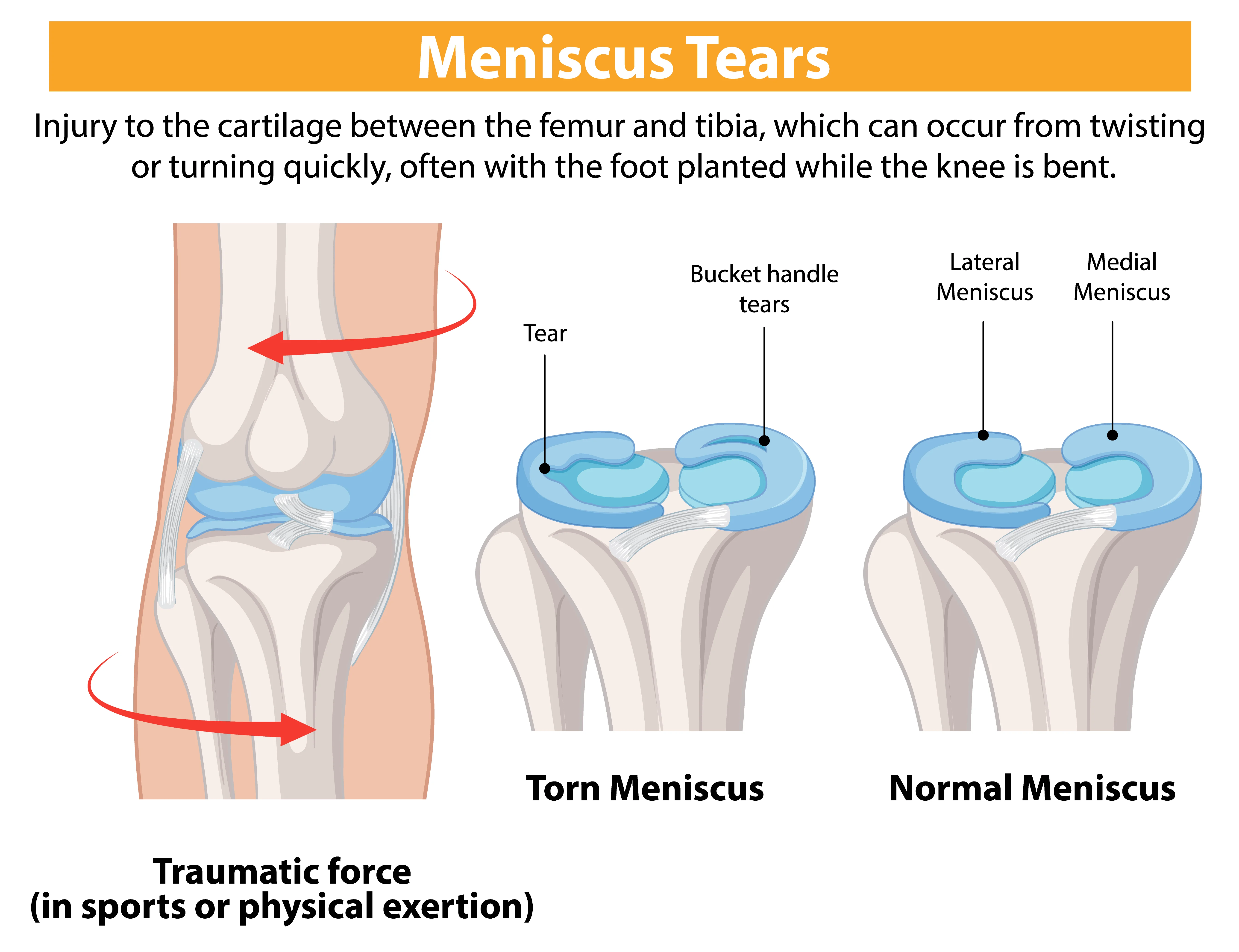
Each knee contains two crescent-shaped pieces of fibrocartilage called the medial and lateral menisci.
The medial meniscus sits on the inner side of the knee, while the lateral meniscus sits on the outer side.
They help distribute load between the thigh bone and shin bone, contribute to shock absorption, improve joint stability and assist with the mechanics of knee movement.
One lesser-known fact is that the meniscus is not equally supplied with blood throughout its entire structure.
The outer portion has a better blood supply, while the inner portion is relatively poorly vascularized.
This difference matters because the location and pattern of a tear can influence its healing potential.
This is one reason why saying “a meniscus tear takes X weeks to heal” is misleading.
Two people can have meniscus tears of completely different types and experience very different recovery times.
What Does a Meniscus Tear Feel Like?
A meniscus tear can produce several symptoms, but the pattern varies considerably.
Common symptoms include:
- Pain along the inner or outer joint line
- Swelling, particularly after activity
- Difficulty fully bending or straightening the knee
- Clicking or catching
- Pain with twisting or pivoting
- Discomfort during squatting
- Pain when getting up from a low chair
- A sensation that the knee is unstable
- Stiffness after sitting for a long time
- Reduced confidence while changing direction
One useful clinical clue is joint-line tenderness.
If pressing along the joint line reproduces your familiar pain, a meniscal injury becomes more plausible.
However, this finding alone cannot diagnose a tear because several other knee conditions can produce similar symptoms.
A particularly important distinction is between painful clicking and true mechanical locking.
A knee that occasionally clicks but still moves through its full range is very different from a knee that becomes physically stuck and cannot fully straighten.
That distinction can change the urgency of assessment.
Can You Have a Meniscus Tear Without Knowing It?
Yes.
This is one of the most important and least appreciated facts about meniscus injuries.
MRI studies have demonstrated that meniscal abnormalities can occur in people who do not have significant knee symptoms.
In middle-aged and older adults, meniscal changes may coexist with normal aging and osteoarthritis.
That means an MRI report saying “meniscal tear” should not automatically be interpreted as “this tear is causing all of your pain.”
Research comparing arthroscopic surgery with conservative treatment has repeatedly demonstrated this problem.
In degenerative meniscal disease, physical therapy and exercise can provide outcomes comparable to surgery for many patients.
This is why I encourage patients not to treat the MRI report instead of treating the person.
Acute Meniscus Tear vs Degenerative Meniscus Tear
Not all meniscus tears are the same.
Acute traumatic meniscus tear
This typically occurs after a specific event.
Examples include:
- Twisting while playing football
- Pivoting during basketball
- Suddenly changing direction
- Landing awkwardly
- Deep squatting under load
- A sports collision
A younger person may remember the exact moment the knee twisted.
An acute tear may occur alongside other injuries such as an ACL injury, which is why a proper clinical assessment is important.
The 2024 AAOS guideline specifically separates acute isolated meniscal pathology from chronic or degenerative tears and from meniscal injuries associated with ACL tears, fractures or cartilage injuries. (AAOS)
Degenerative meniscus tear
This is different.
The meniscus gradually changes with age and repeated loading. A person may develop a tear without remembering a specific injury.
They might simply notice:
“I started getting pain when climbing stairs.”
Or:
“My knee hurts after sitting and then standing.”
Or:
“I can squat, but twisting out of the squat hurts.”
Degenerative meniscal lesions are especially common in middle-aged and older adults and often coexist with early osteoarthritis.
This distinction is extremely important because the best treatment strategy for a degenerative tear is often not the same as the strategy for an unstable acute tear in a young athlete.
Meniscus Tear Symptoms That Should Not Be Ignored
Certain symptoms deserve faster medical evaluation.
Seek assessment if:
- Your knee is genuinely locked
- You cannot fully straighten the knee
- Significant swelling developed rapidly after an injury
- You cannot comfortably bear weight
- The knee repeatedly gives way
- There was a major twisting injury
- You suspect an associated ligament injury
- Pain is severe or progressively worsening
- The knee becomes hot, very swollen or you develop fever
A locked knee is particularly important.
A large displaced meniscal fragment can interfere mechanically with knee motion.
This is different from simply feeling stiff because the knee is swollen.
Do You Need an MRI for a Meniscus Tear?
Not necessarily.
A physiotherapist or sports medicine clinician can often identify whether your symptoms are consistent with meniscal pathology through history and physical examination.
MRI is useful when the diagnosis is uncertain, when symptoms persist despite appropriate conservative treatment, when significant structural injury is suspected, or when surgical planning may be required.
The key point is that MRI should answer a clinical question rather than simply confirm that something exists inside the knee.
This is particularly important with degenerative tears because structural abnormalities can be present without being the primary pain generator.
How Long Does a Meniscus Tear Take to Heal?
There is no single recovery time.
For a minor symptomatic tear managed conservatively, meaningful improvement may occur over several weeks, although strength and confidence can take considerably longer to restore.
After meniscus repair, rehabilitation commonly takes several months because the goal is not simply to reduce pain but to protect the repaired tissue while progressively restoring movement, strength and function.
After partial meniscectomy, recovery may be faster because the damaged portion has been removed rather than repaired, but “faster” does not automatically mean “better.”
This is a crucial distinction.
Removing meniscal tissue can reduce mechanical symptoms in selected patients, but preserving meniscal tissue is generally an important long-term consideration because the meniscus contributes to load distribution.
The 2024 EU-US rehabilitation consensus recommends combining time-based and criterion-based progression after surgery rather than using the calendar alone to decide when an athlete is ready to return to sport. (Orthopaedic Journal of Sports Medicine)
What Actually Determines Meniscus Tear Recovery Time?
Recovery depends on several factors.
Tear location
Tears in better-vascularized regions may have greater healing potential than tears in poorly vascularized areas.
Tear pattern
A small stable tear behaves differently from a large displaced or unstable tear.
Age and tissue quality
A traumatic tear in a healthy young athlete is biologically different from a degenerative meniscal lesion in an older adult with osteoarthritis.
Muscle strength
This is often underestimated.
A painful knee can quickly lead to reduced quadriceps activation.
Once strength falls, everyday activities can become more demanding, which may perpetuate symptoms.
Knee swelling
Persistent swelling can inhibit quadriceps activation and alter movement.
Rehabilitation quality
A patient who simply rests for six weeks may feel less irritated but still have poor strength, balance and load tolerance.
The goal is not merely to make the knee “feel okay.”
The goal is to make the knee capable again.
The Best Non-Surgical Treatment for a Meniscus Tear
For many stable tears, particularly degenerative meniscal lesions, structured rehabilitation is the foundation of treatment.
This does not mean being told to “do some exercises.”
Good physiotherapy should be individualized.
A typical rehabilitation program may include:
- Pain and swelling management
- Restoration of knee extension
- Gradual restoration of flexion
- Quadriceps strengthening
- Hamstring strengthening
- Gluteal strengthening
- Calf strengthening
- Balance and proprioception training
- Movement retraining
- Progressive loading
- Sport-specific drills when appropriate
Recent research strongly supports this approach for degenerative meniscal pathology.
A 2024 systematic review and network meta-analysis in Physical Therapy found that:
physical therapist interventions based on exercise produced superior short-term improvements in pain and knee extensor strength compared with arthroscopic partial meniscectomy, supporting physical therapy as a first-choice treatment for nontraumatic degenerative meniscal pathology. (Oxford Academics)
A separate 2024 meta-analysis of randomized trials involving 1,078 participants found no meaningful differences in several patient-reported outcomes between exercise therapy and arthroscopic partial meniscectomy,
while exercise therapy was associated with a lower risk of osteoarthritis progression. (Elsevier)
That is a significant finding.
Why Strengthening Matters More Than Many People Realize
When a patient tells me, “My meniscus is torn, so I shouldn’t strengthen my leg,” I usually correct that misconception.
The knee needs capacity.
The quadriceps help control the knee during walking, stair climbing, landing and deceleration.
Strong hip muscles can also improve lower-limb control during functional activities.
But strengthening should be progressive rather than aggressive.
During an irritable phase, I may begin with simpler exercises such as:
- Quadriceps contractions
- Straight-leg raises
- Controlled sit-to-stands
- Supported mini-squats
- Step-ups
- Calf raises
As symptoms settle, resistance and complexity can increase.
The eventual goal is not to keep performing “meniscus exercises” forever.
It is to rebuild the capacity required for the person’s actual lifestyle.
Exercises to Avoid During an Irritable Meniscus Tear
There is no universal list of forbidden exercises because the appropriate loading level depends on the individual.
However, if a particular activity repeatedly produces sharp joint-line pain, swelling or catching, temporarily reducing it makes sense.
Potentially provocative activities can include:
- Deep loaded squats
- Deep lunges
- Repetitive twisting
- Pivoting sports
- High-impact jumping
- Rapid direction changes
- Heavy knee flexion under load
This does not mean these movements are permanently dangerous.
A common rehabilitation mistake is turning temporary movement modification into lifelong fear.
As the knee improves, appropriately dosed exposure to bending, loading and rotation can become part of rehabilitation.
Does Walking Make a Meniscus Tear Worse?
Usually, ordinary walking is not automatically harmful.
In fact, completely avoiding movement can contribute to stiffness, muscle weakness and reduced confidence.
The better question is:
How does your knee respond to walking?
If a 10-minute walk causes mild symptoms that settle quickly, the load may be tolerable.
If walking causes substantial swelling or increasing pain that persists into the following day, the dose may currently be too high.
This is where physiotherapy becomes less about finding a magical exercise and more about managing load intelligently.
Ice, Heat and Pain Relief: Do They Heal the Meniscus?
Ice may temporarily reduce pain and the sensation of swelling.
Heat may feel comfortable for stiffness.
But neither repairs a torn meniscus.
They are symptom-management tools.
Likewise, pain medication may make activity easier but does not restore strength or knee function.
Use these strategies as supportive measures rather than the primary rehabilitation plan.
When Is Meniscus Surgery Necessary?
Surgery is sometimes appropriate.
But the phrase “I have a meniscus tear, therefore I need surgery” is outdated.
Surgery may be considered when there is:
- A displaced tear causing true mechanical locking
- A repairable traumatic tear with a favorable pattern
- Persistent disabling symptoms despite appropriate rehabilitation
- Certain unstable tears in active individuals
- Associated injuries requiring operative management
- Specific structural situations where surgical treatment offers a meaningful advantage
The decision should be individualized.
For degenerative meniscal tears, the evidence is particularly important.
The BMJ clinical practice guideline strongly recommends against arthroscopy for nearly all patients with degenerative knee disease,
including those with degenerative meniscal tears, because benefits are generally small and do not outweigh the burdens and risks for most people. (BMJ)
A five-year systematic review and meta-analysis similarly found no meaningful overall advantage of arthroscopic partial meniscectomy plus exercise over exercise therapy for knee function in degenerative meniscal tears. (Springer Link)
Meniscus Repair vs Meniscectomy
These operations are not the same.
Meniscus repair
The surgeon attempts to preserve and repair the damaged meniscal tissue.
This is attractive because preserving the meniscus can help maintain its load-sharing function.
However, repair requires biological healing and usually involves a longer rehabilitation process.
Partial meniscectomy
The unstable damaged portion is trimmed.
Recovery can be quicker, but some meniscal tissue is permanently removed.
This is why the decision should not be based solely on which procedure gets you back to walking faster.
The long-term health of the knee matters too.
A Lesser-Known Point: “Faster Recovery” Isn’t Always the Better Outcome
Patients understandably want the quickest solution.
But in musculoskeletal medicine, the fastest short-term improvement does not necessarily equal the best long-term strategy.
A 2024 meta-analysis reported comparable patient-reported outcomes between exercise therapy and arthroscopic partial meniscectomy while finding a lower risk of osteoarthritis progression with exercise therapy. (PMC)
So when discussing treatment, I would ask:
What will help this knee function well five years from now, not just five weeks from now?
That question can completely change the treatment conversation.
Can a Meniscus Tear Heal Without Surgery?
Sometimes, yes.
But “heal” needs to be defined carefully.
A tear may become less symptomatic even if the anatomical appearance on imaging does not completely normalize.
The body can adapt, symptoms can settle, strength can improve and function can return.
For many degenerative tears, the clinically important goal is not necessarily to make the MRI look perfect. It is to restore a comfortable, strong and functional knee.
A 2024 systematic review of exercise rehabilitation for degenerative tibial meniscal lesions found potential benefits for pain, lower-limb strength and mobility, reinforcing the role of exercise-based rehabilitation. (NCBI)
The Most Important Physiotherapy Mistake to Avoid
One of the biggest mistakes is progressing based purely on pain reduction.
Imagine your knee feels 80% better.
You immediately return to running, jumping and twisting.
The problem?
Your pain may have improved faster than your strength and load tolerance.
This is why return to sport should involve more than asking, “Does it hurt?”
The 2024 international meniscus rehabilitation consensus recommends combining patient-reported outcomes with performance-based measures and using both time and clinical criteria when returning to sport after surgery. (Wiley)
Your physiotherapist may therefore assess:
- Single-leg strength
- Squat control
- Step-down quality
- Hop performance
- Balance
- Change-of-direction control
- Sport-specific tolerance
- Swelling response
- Confidence
How to Reduce the Risk of Another Meniscus Injury
You cannot eliminate every risk.
However, you can improve your knee’s ability to handle demanding movements.
Useful strategies include:
Build leg strength consistently
Don’t wait until your knee hurts.
Strength training should be part of long-term joint health, especially if you participate in running or pivoting sports.
Train movement quality
A strong muscle is useful, but coordination matters too.
Your knee should tolerate deceleration, landing and directional changes without excessive uncontrolled movement.
Warm up before intense activity
A progressive warm-up prepares the cardiovascular system, muscles and nervous system for the demands ahead.
Increase training gradually
Suddenly doubling running volume or returning to competitive sport after weeks of inactivity can overload tissues.
Don’t ignore repeated swelling
A knee that repeatedly swells after activity deserves assessment rather than repeated cycles of rest and reinjury.
The 2024 EU-US consensus specifically notes that meniscus injury prevention can involve general knee injury-reduction programs and avoiding certain high-risk activities or situations.
What Should You Do Immediately After a Suspected Meniscus Injury?
If you twist your knee and develop pain:
Stop the activity that caused the injury.
Avoid repeatedly testing the knee with deep squats or twisting movements.
Use comfortable relative rest rather than complete inactivity.
If swelling is significant, temporarily reduce weight-bearing demands according to your symptoms.
Do not attempt to “push through” a knee that is genuinely locked.
Then arrange an appropriate clinical assessment.
The objective during the early stage is not to diagnose yourself from an internet symptom checklist.
It is to determine whether the knee has a stable injury that can be rehabilitated conservatively or whether further assessment is necessary.
Meniscus Tear: What I Would Tell a Patient in My Clinic
If you came to me with a meniscus tear, I would not begin by asking, “How do we get rid of the tear?”
I would ask:
What is your knee currently unable to do?
Can you walk?
Can you climb stairs?
Can you squat?
Can you straighten your knee?
Does it swell?
Does it lock?
Can you participate in your sport?
What movements reproduce the symptoms?
And perhaps most importantly:
Is the knee improving with appropriate rehabilitation?
Those answers often tell us far more about the treatment direction than the word “tear” on an MRI report.
Final Word
A meniscus tear can sound frightening, but it does not automatically mean permanent damage or surgery.
Some acute traumatic tears require specialist assessment and sometimes repair.
Some displaced tears can create true mechanical problems.
But many degenerative meniscal tears respond well to structured rehabilitation, progressive strengthening and sensible load management.
The strongest modern evidence increasingly supports this individualized approach.
Research shows that exercise therapy can provide outcomes comparable to arthroscopic partial meniscectomy for many degenerative meniscal tears,
while newer international consensus recommendations emphasize rehabilitation, objective testing and appropriate return-to-sport criteria.
My biggest advice as a physiotherapist is simple:
Don’t treat your MRI report. Treat the knee in front of you.
If your knee is painful, swollen, weak or mechanically restricted, get it assessed properly.
The right rehabilitation plan can often do much more than simply reduce pain: it can restore strength, confidence, movement quality and the ability to use your knee normally again.
And if surgery is genuinely indicated, good physiotherapy remains essential before and after the procedure.
A meniscus injury is not the end of an active life.
With the right diagnosis, appropriate loading and a rehabilitation plan matched to the actual injury, many people can return to the activities they love.
Frequently Asked Questions
Can a meniscus tear heal without surgery?
Yes. Many stable and degenerative meniscal tears can be managed successfully with physiotherapy, progressive strengthening and activity modification. Surgery may be considered for selected unstable or mechanically obstructive tears.
How long does a meniscus tear take to heal?
Recovery varies according to the tear type, location, severity, age, symptoms and treatment. Conservative rehabilitation may improve symptoms over several weeks, while recovery after meniscus repair commonly takes several months.
Can I walk with a meniscus tear?
Many people can walk with a meniscus tear. However, significant swelling, severe pain, inability to bear weight or a locked knee requires clinical assessment.
Is surgery always needed for a torn meniscus?
No. Surgery is not automatically required, particularly for many degenerative meniscal tears. Exercise-based physiotherapy is an important first-line treatment for many patients.
What exercises are best for a meniscus tear?
Exercises are individualized, but rehabilitation commonly includes quadriceps, hamstring, gluteal and calf strengthening, balance training and progressive functional exercises.
Is cycling good for a meniscus tear?
Low-resistance cycling may be suitable for some people because it provides controlled knee movement without the impact of running. However, resistance, seat height and knee symptoms should be considered before adding it.
What does a meniscus tear feel like?
Symptoms may include joint-line pain, swelling, catching, clicking, stiffness, pain with twisting or difficulty fully bending or straightening the knee.
Is a meniscus tear serious?
Some tears are minor and respond well to rehabilitation, while displaced or unstable tears can require specialist treatment. A genuinely locked knee or major traumatic injury should be assessed promptly.
Can physiotherapy fix a torn meniscus?
Physiotherapy may not anatomically repair every type of tear, but it can substantially improve pain, strength, movement, function and load tolerance. Many patients do well without surgery.
Can I exercise with a meniscus tear?
Often yes, but exercises should be adjusted according to symptoms and injury characteristics. A physiotherapist can help determine which movements should initially be modified and how to progressively reload the knee.
More Read


Medical Disclaimer!
This article has been reviewed and written under the guidance of our Head Physiotherapist, Dr. Kruti Raj (PT, MUHS,CPT,CMPT). The information shared is intended for educational purposes only and should not be considered a substitute for personalized medical advice, diagnosis, or treatment.
Please consult us or any other qualified healthcare professional before beginning any exercise program, especially if you are experiencing pain, recovering from injury, or managing a medical condition.


