


Greater trochanteric pain syndrome (GTPS) can cause pain on the outside of the hip when walking upstairs, standing on one leg, exercising, or lying on the affected side.
Quick Answer: Which Exercises Help GTPS?
Greater trochanteric pain syndrome (GTPS) often involves the gluteal tendons on the outside of the hip. Individualised strengthening, appropriate activity modification, and gradual progression are central to physiotherapy management.
Depending on your symptoms, suitable exercises may include gluteal isometric contractions, standing hip abduction, sit-to-stand, bridges, and supported step-ups. Not every exercise suits every stage of recovery.
The discomfort can interfere with sleep and everyday activities.
The exercises that help most are usually those that gradually improve hip strength and tendon load tolerance without repeatedly aggravating symptoms.
Effective physiotherapy combines progressive strengthening with activity modification and education, rather than relying on stretching alone.
Key Takeaways
- GTPS often involves gluteal tendinopathy, not just inflammation of the bursa.
- Exercise-based rehabilitation can improve pain and function, but no single exercise is best for everyone.
- Gluteal isometrics, hip abduction, bridges, sit-to-stand, and step-ups are possible options when appropriately selected.
- Reduce positions that repeatedly compress or aggravate the outer hip.
- Start with manageable resistance and progress according to strength and symptom response.
- Exercise selection should reflect the person’s symptoms, assessment findings, and functional goals.
- Persistent or worsening hip pain warrants professional assessment.
What Is Greater Trochanteric Pain Syndrome?
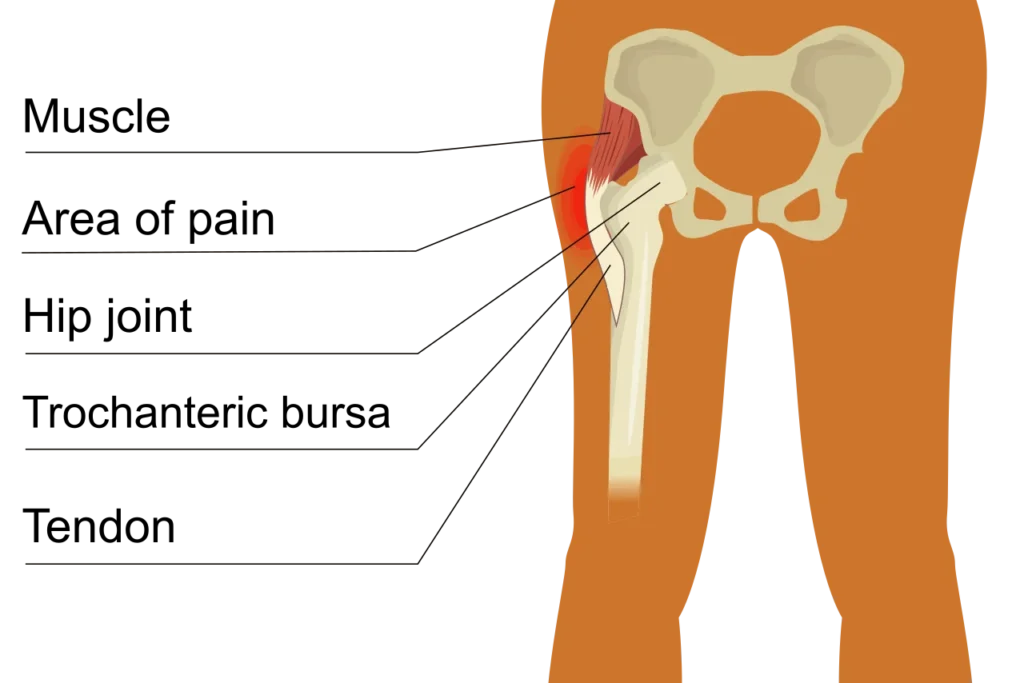
GTPS describes pain around the greater trochanter, the bony prominence on the outside of the upper thigh bone.
It commonly involves the gluteus medius and gluteus minimus tendons, although the nearby bursa and other structures may also contribute.
GTPS is often called trochanteric bursitis, but bursitis is not the only cause.
Gluteal tendinopathy is a common contributor and can make activities involving hip loading or compression uncomfortable.
Typical symptoms include:
- Pain or tenderness on the outside of the hip.
- Discomfort when lying on the affected side.
- Pain when climbing stairs or walking uphill.
- Difficulty standing on one leg.
- Pain during prolonged standing or certain sitting positions.
Similar symptoms can occur with hip osteoarthritis, lower-back problems, and other conditions.
An assessment can help determine whether GTPS is the most likely explanation. (Pianka et al., 2021)
Do Exercises Really Help GTPS?
Exercise is a key part of conservative treatment for many people with GTPS. It can improve muscle strength, functional capacity, and tolerance for everyday activities.
A 2024 systematic review and meta-analysis found that exercise produced modest long-term improvements in pain and physical function compared with control conditions.
The authors supported exercise as a first-line treatment, although the available studies had limitations and did not establish one universally superior program. (Kjeldsen et al., 2024)
The goal is to start with a manageable load and increase the challenge as your symptoms and strength improve.
Best Exercises for Greater Trochanteric Pain Syndrome
The following exercises are examples used in hip rehabilitation.
You do not need to perform every exercise, and the best starting point depends on your pain level, strength, and assessment findings.
1. Gluteal Isometric Contractions
Purpose: Introduce gentle gluteal muscle activation when more demanding movements are uncomfortable.
- Lie on your back with your knees bent comfortably.
- Gently tighten your buttock muscles without lifting your pelvis.
- Hold for about 5 seconds while breathing normally.
- Relax fully before repeating.
Start with 5 to 8 repetitions if comfortable.
This is a possible starting option, not a treatment that works better for everyone.
2. Standing Hip Abduction
Purpose: Strengthen the muscles that help stabilize the pelvis.
- Stand beside a sturdy chair or countertop for support.
- Keep your trunk upright and pelvis level.
- Move one leg a short distance out to the side without leaning.
- Return slowly to the starting position.
Try 6 to 10 controlled repetitions if tolerated.
If standing on the painful leg aggravates symptoms, choose an easier exercise or ask a physiotherapist for an alternative.
3. Sit-to-Stand
Purpose: Improve strength for everyday activities such as getting out of a chair.
- Sit on a stable chair at a comfortable height.
- Place your feet on the floor, roughly hip-width apart.
- Lean forward slightly and stand up with control.
- Slowly lower yourself back onto the chair.
Begin with 5 to 8 repetitions. Use a higher chair or your hands for assistance if necessary.
4. Gluteal Bridge
Purpose: Strengthen the gluteal muscles and hip extensors.
- Lie on your back with your knees bent and feet flat.
- Gently tighten your buttock muscles.
- Lift your pelvis a comfortable distance without excessively arching your back.
- Lower slowly.
Start with 6 to 10 repetitions if comfortable. If the position increases outer-hip pain, modify it or select a different exercise.
5. Supported Step-Ups
Purpose: Build strength for stairs and other weight-bearing activities.
- Stand in front of a low, stable step with support nearby.
- Place one foot on the step.
- Step up slowly, keeping your pelvis as level as comfortable.
- Step down with control.
Begin with a small number of repetitions.
This exercise may be too demanding during a painful early stage, so introduce it only when simpler movements are tolerated.
How Often Should You Do These Exercises?
There is no single schedule suitable for everyone with GTPS.
A physiotherapist can adjust the frequency, resistance, repetitions, and rest periods according to your symptoms and goals.
For a gentle starting program:
- Choose two or three suitable exercises rather than starting all five.
- Begin with a small number of controlled repetitions.
- Allow recovery between strengthening sessions, especially when the exercises are new.
- Increase repetitions or resistance gradually when the current level is well tolerated.
These suggested repetitions are starting examples, not a validated universal prescription.
If pain increases substantially during exercise, remains worse afterwards, or disturbs your sleep more than usual, reduce the load and reassess your program.
Exercises and Stretches That May Aggravate GTPS
Some positions increase compression around the gluteal tendons on the outside of the hip. If they aggravate your symptoms, temporarily modify:
- Crossing your legs: This moves the thigh towards the body’s midline and may increase compression around sensitive tendons.
- Standing with your weight on one hip: Prolonged single-leg loading may increase demand on the gluteal muscles.
- Aggressive outer-hip stretches: Pulling the thigh across the body may increase tendon compression.
- Lying on the painful side: Direct pressure may irritate a sensitive outer hip.
- Repeated stairs or deep squats: Reduce the volume or range if these activities cause a flare-up.
These movements are not permanently forbidden. The aim is to reduce unnecessary irritation while gradually restoring your ability to tolerate them.
Why Load Management Matters as Much as Exercise
Strengthening may be less effective if everyday activities repeatedly aggravate the affected tendons.
Physiotherapy therefore combines exercise with practical changes to movement and daily routines.
Consider the following adjustments:
- Sleep on your back with a pillow under your knees, or on the unaffected side with a pillow between your knees.
- Sit down when putting on trousers or shoes rather than balancing on one leg.
- Break up prolonged standing and avoid repeatedly resting your weight on one hip.
- Temporarily reduce steep hills or repeated stair climbing if these cause symptoms to flare.
In a randomized clinical trial, education about tendon load management combined with a structured exercise program improved outcomes in people with gluteal tendinopathy compared with a wait-and-see approach.
This supports combining exercise with advice on daily activities rather than focusing on strengthening alone. (Mellor et al., 2018)
How Physiotherapists Progress GTPS Exercises
A physiotherapist assesses your hip movement, strength, tenderness, walking pattern, and response to specific tasks.
The assessment also considers whether symptoms may be coming from the hip joint or lower back.
Rehabilitation may progress through several stages:
- Early stage: Comfortable muscle activation, manageable daily activity, and reduced aggravating compression.
- Strengthening stage: Gradual increases in resistance, repetitions, and weight-bearing exercises.
- Functional stage: More challenging activities such as stairs, longer walks, and controlled single-leg tasks.
- Return to sport: Sport-specific loading when strength, movement control, and symptom response allow.
Not everyone needs every stage, and progression should depend on clinical findings rather than a fixed calendar.
The International Society for Hip Preservation physiotherapy consensus supports individualized exercise, education, and adjustments to activities that increase compression around the outer hip. (Disantis et al., 2023)
How Long Does GTPS Take to Improve?
Recovery varies according to symptom severity, tendon involvement, general health, and daily activity demands.
Some people notice gradual improvement within several weeks, while persistent gluteal tendinopathy may need a structured rehabilitation period of several months.
Rather than judging recovery by pain alone, look for practical changes such as sleeping more comfortably, walking farther, climbing stairs more easily, and tolerating exercise without a prolonged flare-up.
If symptoms continue to worsen or fail to improve despite appropriate adjustments, arrange a clinical review.
When Should You Seek Medical Advice?
Arrange an assessment if outer-hip pain keeps returning, disturbs sleep, limits walking, or interferes with everyday activities.
Seek urgent medical attention if you experience sudden severe hip pain, cannot bear weight after an injury, or have a hot, swollen hip accompanied by fever or feeling seriously unwell.
New significant weakness or concerning numbness also requires prompt assessment.
Do not assume every case of outer-hip pain is GTPS. Other hip, spinal, or medical conditions may need investigation.
GTPS Exercises: Myth vs Fact
MYTH: GTPS is always bursitis.
FACT: Gluteal tendinopathy is a common contributor. The bursa may also be involved, but it is not the only possible source of symptoms.
MYTH: One exercise works best for everyone.
FACT: Exercises should be chosen according to pain levels, strength, movement tolerance, and rehabilitation goals.
MYTH: Stretching the outer hip is always helpful.
FACT: Some stretches increase compression around sensitive gluteal tendons and may aggravate symptoms.
MYTH: More repetitions mean faster recovery.
FACT: Appropriate loading, recovery, and gradual progression are more useful than repeatedly pushing through pain.
Lesser-Known Fact: More Exercise Is Not Always Better
Gluteal tendons need an appropriate amount of loading to improve their capacity, but increasing exercise intensity too quickly can exceed what they currently tolerate.
Doing more repetitions is not automatically a faster route to recovery.
A consistent program with suitable loading, adequate recovery, and gradual progression is usually more useful than repeatedly pushing through painful movements.
Final Thoughts: Build Strength Gradually
Greater trochanteric pain syndrome often responds to a combination of progressive strengthening, activity modification, and education about tendon compression. The best starting exercises are those that suit your current symptoms and can be progressed without repeatedly aggravating the hip.
Consistency matters, but recovery is not about completing the most repetitions or pushing through pain. A physiotherapist can help you adjust the program as your strength and activity tolerance improve.
Conclusion
Greater trochanteric pain syndrome exercises are most useful when they are selected according to your symptoms and progressed gradually.
Gluteal strengthening, functional exercises, and education about tendon compression can help improve pain and everyday function.
Start with manageable movements, modify activities that repeatedly aggravate the outer hip, and increase your exercise load as tolerance improves.
If pain persists, a physiotherapist can assess the likely cause and develop a programme suited to your needs.
Frequently Asked Questions
1. What is the best exercise for greater trochanteric pain syndrome?
There is no single best exercise for everyone. Gluteal isometrics, standing hip abduction, bridges, and sit-to-stand exercises may be useful depending on symptoms, strength, and functional goals.
2. Should I stretch my hip if I have GTPS?
Not necessarily. Some stretches that pull the thigh across the body can increase compression around sensitive gluteal tendons. Choose comfortable movements and seek individual guidance if stretching increases pain.
3. Is walking good for GTPS?
Walking can help maintain activity, but distance, speed, hills, and frequency should match your tolerance. Temporarily reduce the load if walking causes a sustained increase in symptoms.
4. Can GTPS improve without physiotherapy?
Some symptoms improve with time and activity modification. Persistent pain may benefit from a structured exercise program and professional assessment, particularly when it affects sleep or daily activities.
5. Should I exercise through hip pain?
Do not push through sharp or escalating pain. If symptoms are repeatedly worse after exercise or at night, reduce the challenge and seek advice about modifying your program.
Stay tuned with us for more health related topics.
Follow us on LinkedIn and Instagram for more.
More Read


Medical Disclaimer
This article is for general educational purposes only and does not replace professional medical advice, diagnosis, or treatment. Greater trochanteric pain syndrome can have different contributing causes, and suitable exercises vary between individuals. Consult a qualified healthcare professional for persistent, severe, or worsening symptoms. Seek urgent medical attention for sudden severe hip pain, inability to bear weight after an injury, or a hot, swollen hip accompanied by fever.


