


Does outer hip pain wake you up at night or make it difficult to lie on your side?
One common cause is greater trochanteric pain syndrome (GTPS), which affects the tissues around the bony prominence on the outside of the hip.
Quick Answer: Why Does My Outer Hip Hurt at Night?
Pain on the outside of the hip when sleeping is commonly associated with greater trochanteric pain syndrome (GTPS), which often involves the gluteal tendons and sometimes the nearby bursa.
- Common trigger: Direct pressure on the outer hip or certain side-sleeping positions.
- What may help: Supporting the upper leg with a pillow, changing sleeping positions, and modifying aggravating activities.
- Physiotherapy: Individualised activity modification and progressive hip strengthening may improve function.
Important: Hip osteoarthritis, lower-back problems, and other conditions can cause similar pain. Persistent or worsening symptoms deserve clinical assessment.
The pain may worsen when you lie on the affected side, climb stairs, walk uphill, or stand on one leg.
Although GTPS is a frequent explanation, hip osteoarthritis, lower-back problems, and other conditions can cause similar symptoms.
Understanding the likely cause can help you adjust your sleeping position and choose appropriate physiotherapy.
Key Takeaways
Greater trochanteric pain syndrome often involves the gluteal tendons and may cause pain when lying on the side.
Direct pressure and unsupported upper-leg positioning can aggravate sensitive tissues around the outer hip.
Adjust activities that repeatedly increase symptoms while maintaining comfortable movement where possible.
Individualised strengthening, load management, and movement advice can help restore hip function.
Do not assume every case is bursitis. Other hip and lower-back conditions can produce similar symptoms.
What Causes Outer Hip Pain at Night?
1. Greater trochanteric pain syndrome
The greater trochanter is the bony prominence you can feel on the outside of your upper thigh.
The gluteus medius and gluteus minimus tendons attach around this area, while small bursae help reduce friction between moving tissues.
GTPS describes a group of conditions that cause pain around the outside of the hip.
It often involves gluteal tendinopathy, although bursal irritation and other soft-tissue problems may also contribute.
Pain commonly increases when pressure is applied to the outer hip. Walking, climbing stairs, and standing on one leg may also aggravate symptoms. (Pianka et al., 2021)
2. Gluteal tendinopathy
The gluteus medius and gluteus minimus muscles help stabilize the pelvis during walking and other single-leg activities.
Their tendons may become painful when the demands placed on them exceed their current capacity.
Lying on the affected side compresses the tissues around the greater trochanter.
Sleeping on the opposite side may also aggravate symptoms if the upper leg drops across the body, increasing compression around the painful tendons.
This explains why simply switching sides does not always resolve the problem. (Grimaldi & Fearon, 2015)
3. Trochanteric bursitis
A bursa is a small fluid-filled sac that helps reduce friction between tissues. Irritation of a bursa near the greater trochanter may contribute to outer hip pain.
However, the term trochanteric bursitis is often used too broadly. Many people with pain in this region have gluteal tendon problems rather than isolated bursal inflammation.
This distinction matters because treatment should address the structures contributing to the symptoms, not just the name used to describe the pain.
Why Does Sleeping Make Hip Pain Worse?
Direct pressure on the painful hip
Lying on the affected side places pressure directly over the greater trochanter.
If the surrounding tendons or bursa are sensitive, this pressure may increase discomfort and interrupt sleep.
Hip position during side sleeping
When the upper leg crosses towards the middle of the body, the hip moves into adduction.
This position can increase compression around the gluteal tendons.
Supporting the upper leg with a pillow may help reduce this compression.
Increased sensitivity after a busy day
Long walks, demanding workouts, or repeated stair climbing may increase symptoms later in the evening.
Night-time pain can reflect the combined effects of daytime loading and pressure during sleep.
Difficulty finding a comfortable position
Some people experience pain when lying on either side.
This may occur when both hips are affected or when the upper leg places additional stress on the painful side.
Persistent pain in multiple positions deserves assessment rather than repeated attempts to find a perfect sleeping posture.
What Are the Symptoms of GTPS?
Common symptoms include:
- Pain or tenderness over the outside of the hip.
- Discomfort when lying on the affected side.
- Pain while climbing stairs or walking uphill.
- Discomfort when standing on one leg or getting up from a chair.
- Aching that spreads down the outer thigh, sometimes towards the knee.
- Pain during resisted hip movements or after prolonged activity.
The pain is often concentrated around the outer hip rather than deep in the groin.
However, symptoms overlap with other conditions, so these features cannot establish a diagnosis by themselves.
Could Something Else Be Causing the Pain?
Outer hip pain does not always originate from the gluteal tendons or bursa.
| Possible cause | Features that may help distinguish it |
|---|---|
| GTPS or gluteal tendinopathy | Outer hip tenderness and pain during side sleeping, stair climbing, or single-leg activities |
| Hip osteoarthritis | Groin pain, stiffness, and restricted hip movement, often aggravated by activity |
| Lower-back or nerve-related pain | Back pain, tingling, numbness, or symptoms extending further down the leg |
| Hip joint or labral problems | Deeper groin pain, sometimes with catching or pain during twisting |
| Muscle strain | Symptoms following an injury or sudden increase in activity |
These patterns are clues, not definitive diagnoses.
More than one condition may contribute to the pain, particularly when hip and lower-back problems coexist.
A physiotherapist can assess the hip, surrounding muscles, and lumbar spine to help identify the likely source of symptoms. (Kinsella et al., 2024)
How to Sleep With Outer Hip Pain
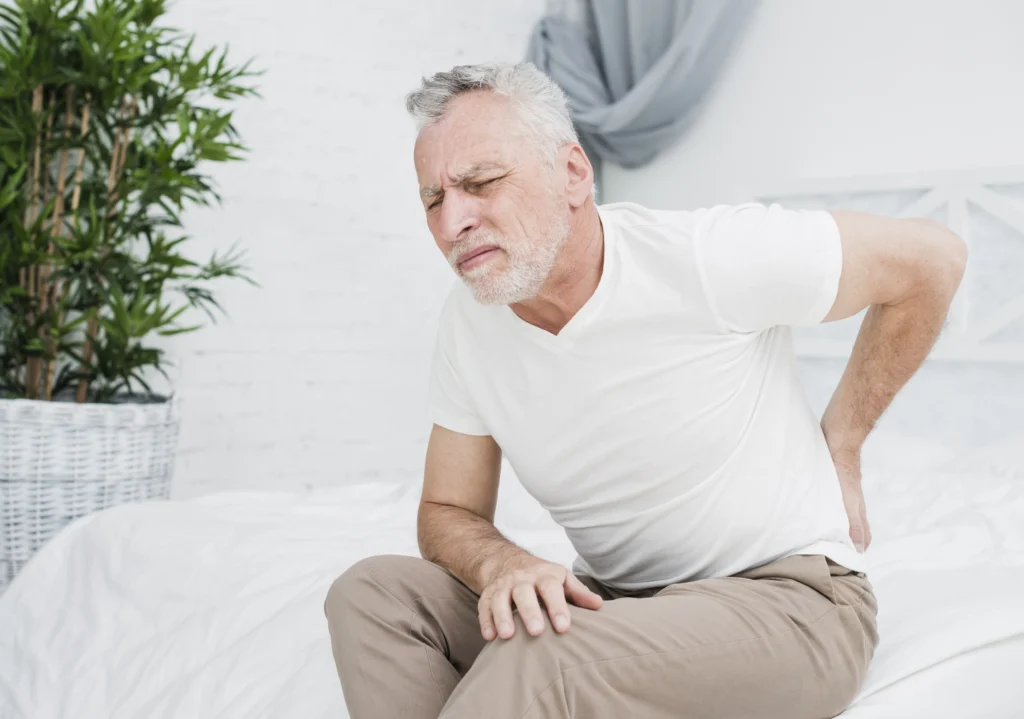
Small changes to your sleeping position may reduce pressure on sensitive tissues.
Sleep on your unaffected side
If one hip is painful, try lying on the opposite side with a pillow between your knees.
The pillow should support the upper leg and help prevent it from dropping across the body.
Avoid forcing this position if it increases pain.
Try sleeping on your back
Sleeping on your back may reduce direct pressure on the outer hip. A pillow beneath your knees can make this position more comfortable for some people.
Adjust your pillow support
A pillow that is too thin may allow the upper leg to fall into a position that aggravates symptoms.
Experiment with comfortable support that keeps your hips from twisting or crossing excessively.
Avoid repeatedly lying on the painful side
If direct pressure consistently reproduces symptoms, temporarily limit time spent on that side.
You do not need to avoid side sleeping forever, but changing positions may help while symptoms settle.
Review your daytime activities
Sleep positioning is only one part of management.
If walking, gym sessions, or stair climbing repeatedly aggravate the hip, adjusting these activities may help reduce the overall symptom burden.
Physiotherapy for Outer Hip Pain at Night
Physiotherapy aims to reduce aggravating compression, restore comfortable movement, and improve the capacity of the gluteal muscles and tendons.
1. Manage activity and tendon loading
A physiotherapist can help identify activities that aggravate symptoms.
Temporary adjustments may include reducing steep uphill walking, repeated stair climbing, running intensity, or prolonged standing on one leg.
Complete rest is not usually the goal. The aim is to maintain comfortable activity while reducing excessive loading.
2. Begin appropriate strengthening
Depending on the assessment, a program may start with low-load gluteal exercises and progress towards resistance exercises that improve hip strength and pelvic control.
Exercise selection should reflect symptom irritability.
A movement that is appropriate for one person may be too demanding for another.
3. Progress exercise gradually
As tolerance improves, strengthening can progress towards functional movements such as controlled step-ups, squats, and single-leg activities.
The goal is to improve the hip’s ability to tolerate everyday demands without repeatedly provoking symptoms.
4. Improve movement habits
A physiotherapist may help you modify positions that increase compression around the lateral hip.
Examples include crossing your legs for prolonged periods, standing with most of your weight on one hip, and sleeping with the upper leg unsupported.
The International Society for Hip Preservation’s physiotherapy consensus supports combining education, activity modification, and progressive strengthening for GTPS. (International Society for Hip Preservation, 2023)
Which Exercises Should You Modify?
There is no single list of exercises that everyone with outer hip pain must avoid.
However, temporarily modifying movements that reproduce sharp pain or cause a prolonged flare may help.
Depending on your symptoms, a physiotherapist may adjust:
- Deep side-lying hip stretches that compress the painful area.
- Repeated single-leg exercises that exceed your current capacity.
- High-volume stair climbing or uphill walking.
- Heavy hip exercises performed through a painful range.
Avoid aggressive stretching into pain.
With gluteal tendinopathy, excessive compression can aggravate symptoms, while appropriately progressed strengthening can help restore capacity.
How Long Does Outer Hip Pain Take to Improve?
Recovery depends on the underlying condition, symptom duration, activity demands, and response to treatment.
Mild symptoms may improve after adjusting sleeping positions and aggravating activities.
Persistent gluteal tendinopathy may require a longer period of progressive rehabilitation.
A randomized clinical trial involving people with gluteal tendinopathy found that education combined with exercise produced better overall improvement than a wait-and-see approach at both short-term and longer-term follow-up.
This supports structured rehabilitation, although individual recovery varies. (Mellor et al., 2018)
How Can You Reduce the Risk of Recurring Pain?
Although not every episode can be prevented, a few habits may help manage repeated irritation.
- Increase exercise gradually: Avoid sudden increases in walking distance, running intensity, or strength-training volume.
- Break up prolonged positions: Change position regularly instead of remaining in one posture for hours.
- Build hip strength progressively: Improve the capacity of the gluteal muscles with an appropriate program.
- Manage sleep pressure: Use pillows to support your legs and avoid positions that consistently aggravate the hip.
- Respond to early symptoms: Adjust activities when pain repeatedly appears rather than pushing through escalating discomfort.
Prevention is not about maintaining one perfect posture.
It is about managing pressure and gradually building tolerance for the activities you need to perform.
Myth vs Fact: Outer Hip Pain
MYTH: Outer hip pain at night always means bursitis.
FACT: Gluteal tendinopathy is a common contributor to greater trochanteric pain syndrome. Hip joint and lower-back conditions can also cause similar symptoms.
MYTH: Sleeping on the opposite side always solves the problem.
FACT: The upper leg may still fall across the body and increase compression around the painful hip. A pillow between the knees may help.
MYTH: Complete rest is the best treatment.
FACT: Adjusting aggravating loads while maintaining comfortable movement and progressing strength appropriately is often more useful than prolonged inactivity.
MYTH: Stretching the hip harder speeds up recovery.
FACT: Aggressive stretches that compress the gluteal tendons may worsen symptoms. Exercise selection should reflect the person’s diagnosis and tolerance.
When Should You Seek Medical Advice?
Arrange an assessment if hip pain repeatedly interrupts your sleep, gets worse, limits normal activities, or does not improve after around two weeks of sensible self-management.
Seek urgent medical attention if you develop severe, sudden hip pain, cannot bear weight after an injury, or have a hot, swollen hip accompanied by fever or feeling unwell.
Persistent pain at rest, unexplained weight loss, a new lump, or progressive weakness also deserves medical evaluation.
Imaging is not always necessary. A clinician may recommend ultrasound, X-rays, or MRI when the symptoms and examination suggest that further investigation is needed.
A Lesser-Known Fact About Outer Hip Pain
Sleeping on the opposite side can still aggravate the painful hip.
If the upper leg drops towards the mattress, the hip may move into adduction and increase compression around the gluteal tendons.
Supporting the upper leg with a pillow can sometimes help more than simply switching sides.
The most comfortable position varies, so use your symptom response as a guide.
Final Thoughts
Pain on the outside of your hip when sleeping is often associated with greater trochanteric pain syndrome, particularly gluteal tendinopathy. Direct pressure, certain hip positions, and excessive daytime loading can contribute to discomfort.
Supporting your upper leg with a pillow, adjusting aggravating activities, and gradually rebuilding hip strength may help improve comfort. Physiotherapy can guide these changes according to your symptoms and functional needs.
Remember: Not all outer hip pain is bursitis. If symptoms persist, worsen, or repeatedly disturb your sleep, seek an assessment to identify the cause and choose appropriate treatment.
Conclusion
Pain on the outside of the hip when sleeping is commonly associated with greater trochanteric pain syndrome, particularly gluteal tendinopathy.
Direct pressure, certain hip positions, and excessive daytime loading can all contribute to discomfort.
Adjusting your sleeping position, supporting the upper leg with a pillow, and modifying aggravating activities may help.
Physiotherapy can guide progressive strengthening and a return to normal activity.
If the pain persists, worsens, or is accompanied by concerning symptoms, seek medical assessment to identify the cause and choose appropriate treatment.
Frequently Asked Questions
1. Why does my hip hurt only at night?
Pressure from side sleeping may aggravate sensitive tissues around the outer hip. Daytime activity can also contribute to symptoms that become noticeable at night. Persistent night pain should be assessed rather than automatically attributed to bursitis.
2. Is walking good for outer hip pain?
Gentle walking may be appropriate if it does not significantly worsen symptoms. Adjust distance, speed, and hills according to your tolerance, and gradually increase activity as symptoms improve.
3. Should I use ice or heat?
Either may provide temporary comfort. Use whichever feels helpful, protect your skin, and do not rely on either treatment as a substitute for assessment when pain persists.
4. Can physiotherapy help hip pain when sleeping?
Yes. When the cause is GTPS or gluteal tendinopathy, physiotherapy may help through activity modification, sleep-position advice, and progressive strengthening. The programme should be tailored to the diagnosis.
5. When should I see a doctor for outer hip pain?
Arrange an assessment if pain repeatedly interrupts sleep, worsens, or limits daily activities. Seek urgent medical attention for severe sudden pain, inability to bear weight after an injury, or a hot, swollen hip with fever.
Stay tuned with us for more health related topics.
Follow us on LinkedIn and Instagram for more.
More Read


Medical Disclaimer
This article is intended for general educational purposes only and does not replace professional medical advice, diagnosis, or treatment. Outer hip pain can have several causes, and the information provided here cannot confirm that you have greater trochanteric pain syndrome, bursitis, or another condition.
Consult a qualified healthcare professional if your symptoms persist, worsen, or interfere with daily activities. Seek urgent medical attention for severe sudden hip pain, inability to bear weight after an injury, or a hot, swollen hip accompanied by fever or feeling unwell. Do not delay assessment because of information in this article.


