


The best sleeping position during pregnancy for back pain can help reduce spinal strain and improve nighttime comfort.
Pregnancy back pain has a strange habit of becoming worse at night.
Many women feel relatively okay during the day, then suddenly struggle to turn in bed, wake up with one-sided hip pain, or feel stiffness shooting across the lower back around 3 AM.
Some even describe it as a deep pulling sensation near the pelvis that makes rolling over feel like work.
Quick Answer
The best sleeping position during pregnancy for back pain is supported side sleeping, preferably on the left side, with a pillow placed between the knees and another supporting the belly. This position helps reduce pressure on the lower back, improves pelvic alignment, decreases hip strain, and supports better blood circulation during pregnancy. Physiotherapists also recommend avoiding long periods of unsupported back sleeping and using proper pillow support for improved comfort at night.
As a physiotherapist, I see this pattern constantly.
And surprisingly, it is not always the baby’s weight causing the problem.
In many cases, the real issue is how the body is positioned during sleep.
Tiny changes in sleeping posture can completely change how the spine, pelvis, hips, and surrounding muscles behave overnight.
Sometimes just adding a pillow between the knees reduces pain within a few nights.
The problem is that most pregnancy sleep articles repeat the same generic advice:
“Sleep on your left side.”
That advice is incomplete.
What actually matters is:
- how your pelvis is positioned,
- whether your belly is supported,
- if your mattress sinks unevenly,
- how you turn in bed,
- and whether your muscles stay relaxed during sleep.
This guide explains the best sleeping position during pregnancy for back pain from a real physiotherapy perspective using :
recent evidence, practical clinical observations, and lesser-known tips women often wish they knew earlier.
Key Takeaways
- Left-side sleeping is usually the most comfortable sleep position during pregnancy.
- A pillow between the knees can reduce pelvic twisting and lower back stress.
- Supporting the belly while sleeping may decrease nighttime spinal strain.
- Soft mattresses sometimes worsen pregnancy back pain by increasing pelvic sinking.
- Turning incorrectly in bed can trigger hip and pelvic pain during pregnancy.
- Pregnancy pillows help improve posture and reduce pressure on the hips and spine.
- Not all pregnancy back pain comes directly from the lower back. Hip muscles and pelvic joints are often involved.
- Small sleep posture adjustments can significantly improve morning stiffness and sleep quality.
Why Pregnancy Back Pain Gets Worse at Night
Pregnancy changes the body faster than most people realize.
By the second trimester, posture already starts shifting:
- the lower back arches more,
- abdominal muscles stretch,
- rib movement changes,
- and pelvic joints become looser.
The hormone relaxin plays a major role here.
It helps prepare the pelvis for childbirth, but it also reduces joint stability.
What many women notice first is not daytime pain.
It is nighttime discomfort.
They often say:
- “I cannot find a comfortable position.”
- “One hip hurts more than the other.”
- “Turning in bed suddenly became painful.”
- “I wake up stiff every morning.”
That usually happens because muscles stay under tension for hours during sleep.
If the pelvis rotates unevenly overnight, the lower back muscles continue working instead of relaxing.
This is one reason pregnancy-related pelvic girdle pain can seriously affect sleep quality and daily functioning.
The Best Sleeping Position During Pregnancy for Back Pain
For most pregnant women, the best sleeping position is:
Side Sleeping With Proper Support
Not just side sleeping randomly.
Supported side sleeping.
There is a huge difference.
The ideal setup usually includes:
- sleeping on the left side,
- a pillow between the knees,
- support under the belly,
- and slight back support behind the body.
When these supports are missing, the pelvis tends to twist forward during sleep.
That twisting creates stress around:
- the SI joints,
- lower back muscles,
- hip rotators,
- and sometimes the sciatic nerve.
A newer biomechanical analysis found that supported side-lying positions reduced muscular strain around the spine and pelvis compared to unsupported positions. (Zhang et al. 2025)
Why Left-Side Sleeping Is Usually Recommended
The “left side” recommendation is not just an internet trend.
There is anatomy behind it.
Sleeping on the left side may:
- improve circulation,
- reduce pressure on major blood vessels,
- support kidney function,
- and decrease swelling in the legs and feet.
From a physiotherapy perspective, left-side sleeping also tends to create better spinal unloading compared to flat back sleeping.
But here is something many women are relieved to hear:
You do not need to panic if you wake up on your right side.
The body naturally changes position during sleep.
The goal is simply to avoid spending long periods flat on the back after mid-pregnancy.
The Pillow Trick That Changes Everything
Honestly, this is the advice many women remember most after physiotherapy sessions.
Put a pillow between your knees.
Not under the knees.
Between them.
That small change often reduces:
- hip pulling,
- pelvic twisting,
- lower back tension,
- and nighttime stiffness.
Without knee support, the top leg drops forward during sleep.
That rotation travels directly into the pelvis and lumbar spine.
Women with SI joint irritation usually notice this immediately.
Some describe waking up with:
- one-sided pelvic pain,
- sharp pain while standing,
- or difficulty walking the first few steps in the morning.
A pillow helps keep the hips aligned so muscles can finally relax.
And it does not need to be expensive.
Even a folded blanket works.
Belly Support
Belly Support Is More Important Than Most Women Realize
As the belly grows, it starts pulling the spine downward during side sleeping.
This creates subtle strain across the lower back overnight.
A small pillow tucked under the abdomen can reduce that pull dramatically.
Many women say:
“I didn’t realize my belly needed support until I tried it.”
That extra support decreases rotational stress through the pelvis.
It also helps some women feel more stable while sleeping.
Why Soft Mattresses Sometimes Make Pain Worse
This surprises many pregnant women.
A very soft mattress may feel comfortable initially, but after a few hours it often increases discomfort.
Why?
Because the pelvis sinks unevenly.
That uneven sinking causes:
- pelvic rotation,
- hip compression,
- and muscle guarding around the lower back.
Women with pelvic girdle pain usually feel worse on overly soft surfaces.
Medium-firm mattresses generally provide better spinal support during pregnancy.
Some women notice improvement simply by adding:
- a firmer mattress topper,
- extra hip support,
- or better pillow positioning.
The Most Common Mistake During Pregnancy Sleep
It is not sleeping on the wrong side.
It is twisting while turning in bed.
Many women suddenly feel pain while rolling over at night.
That usually happens because:
- the knees separate,
- the pelvis rotates,
- and the abdominal muscles lose support during movement.
Physiotherapists often recommend:
- squeezing a pillow between the knees while turning,
- moving the shoulders and hips together,
- and avoiding sudden twisting.
These tiny movement changes protect the pelvis more than people expect.
Back Sleeping During Pregnancy
Many women become anxious after hearing:
“Never sleep on your back.”
The reality is more balanced.
Prolonged flat back sleeping later in pregnancy can:
- increase lumbar pressure,
- compress blood vessels,
- worsen breathlessness,
- and sometimes increase dizziness.
But accidentally waking up on your back occasionally is common.
The bigger goal is reducing long periods in unsupported positions.
Some women actually feel temporary relief lying slightly reclined with pillow support behind the upper body.
This can help:
- rib discomfort,
- acid reflux,
- and breathing pressure.
The Connection Between Hip Pain and Back Pain
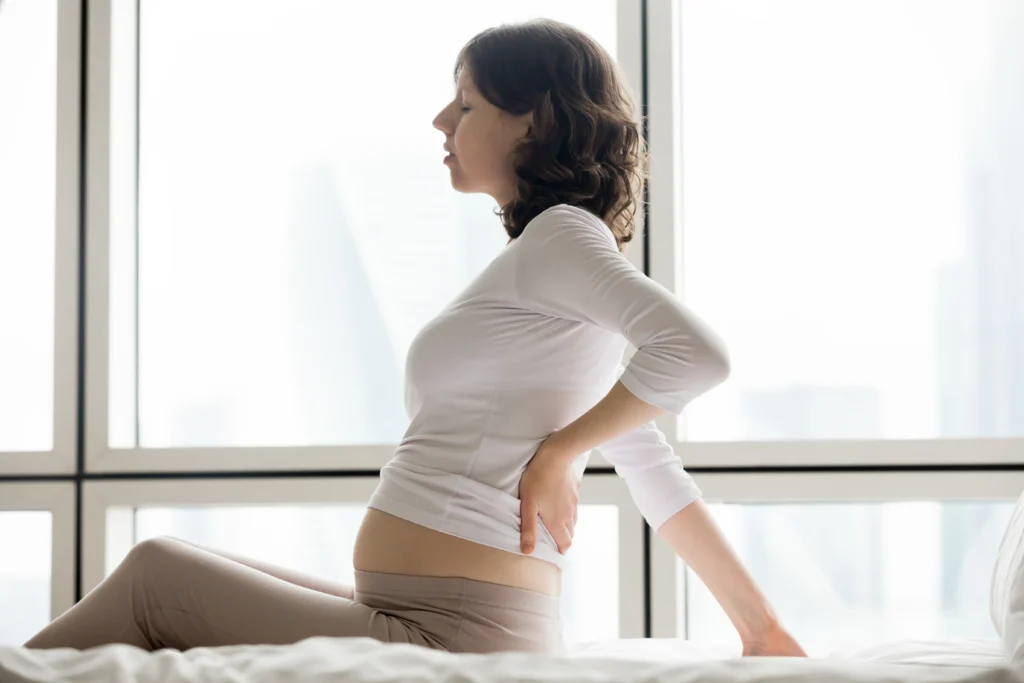
One of the biggest misconceptions in pregnancy is assuming all pain comes from the spine.
Often, the hips are involved.
During pregnancy:
- glute muscles weaken,
- hip flexors tighten,
- and pelvic stabilizers become overloaded.
This creates pain patterns that mimic:
- sciatica,
- tailbone pain,
- or lower back pain.
Sometimes the “back pain” is actually coming from irritated hip muscles.
This is why women often feel relief after correcting sleeping posture instead of only stretching the back.
A Lesser-Known Reason Morning Pain Happens
Some women feel worse after resting.
That feels confusing because sleep is supposed to help recovery.
But if muscles stay under low-grade tension all night, they become stiff by morning.
Research suggests sleeping posture can influence spinal symptoms and morning stiffness. (Cary et al. 2019)
This is especially common in women who:
- sleep twisted,
- collapse into the mattress,
- or lack pelvic support.
Best Pregnancy Pillows for Back Pain
Not every woman needs a giant pregnancy pillow.
But strategic support helps.
U-Shaped Pregnancy Pillow
Helpful for:
- full-body support,
- frequent position changes,
- and back support.
C-Shaped Pillow
Often useful for:
- hip pain,
- pelvic discomfort,
- and side sleeping stability.
Wedge Pillow
One of the most underrated options.
Small wedge pillows work well for:
- belly support,
- lumbar support,
- and reflux relief.
Real Physiotherapy Advice Most Articles Ignore
Here are things physiotherapists actually notice clinically.
Your Blanket Can Pull the Pelvis
Heavy blankets sometimes drag the top leg downward during sleep.
Women with pelvic pain occasionally feel better after switching to lighter bedding.
One Swollen Leg Changes Sleep Mechanics
Late pregnancy swelling can subtly change pelvic positioning.
Sometimes one hip hurts simply because the body unconsciously shifts away from swelling.
Tight Rib Muscles Can Feel Like Back Pain
As breathing mechanics change during pregnancy, rib muscles often become tight.
Some women think they have “upper back pain” when the issue is actually rib restriction.
Slight upper-body elevation may help.
Poor Neck Support Can Trigger Mid-Back Tension
Many pregnancy articles completely ignore neck posture.
But a high pillow pushes the neck forward and increases upper back strain overnight.
Simple Bedtime Habits That Actually Help
These are realistic strategies many women tolerate well.
Before Bed:
- do gentle pelvic tilts,
- avoid sinking into the couch for hours,
- support the feet while sitting,
- and avoid sudden twisting movements.
While Sleeping:
- keep knees aligned,
- support the belly,
- avoid twisting,
- and change sides slowly.
When Getting Out of Bed:
Roll to the side first.
Then push up with the arms.
This reduces strain through the abdomen and pelvis.
What About Sciatica During Pregnancy?
True sciatica is less common than people think.
Often the pain comes from:
- pelvic instability,
- irritated glute muscles,
- or piriformis tightness.
Symptoms may include:
- burning pain,
- buttock tightness,
- or pain down one leg during sleep.
Poor sleeping posture often aggravates these symptoms overnight.
When Back Pain Should Not Be Ignored
Not all pregnancy pain is “normal.”
Seek medical attention if pain is:
- severe,
- sudden,
- associated with fever,
- accompanied by bleeding,
- causing numbness,
- or associated with significant weakness.
Final Thoughts From a Physiotherapist
Pregnancy sleep is rarely perfect.
Most women wake up uncomfortable at some point, especially in the third trimester.
But posture changes can genuinely reduce pain.
And usually the most effective changes are surprisingly small:
- one pillow,
- better hip alignment,
- belly support,
- slower turning,
- or correcting mattress softness.
The goal is not sleeping in a “perfect” position all night.
The goal is reducing unnecessary strain so the muscles and joints finally get a chance to rest.
That alone can completely change how the body feels the next morning.
Frequently Asked Questions
Which sleeping position is best during pregnancy for back pain?
Supported side sleeping, especially on the left side with pillows between the knees and under the belly, is considered the best sleeping position for reducing pregnancy-related back pain.
Why does pregnancy back pain feel worse at night?
Pregnancy hormones, pelvic instability, muscle fatigue, and poor sleeping posture can increase stress on the lower back and hips during nighttime.
Does placing a pillow between the knees really help?
Yes. A pillow between the knees helps keep the pelvis aligned and reduces twisting pressure on the lower back and hips while sleeping.
Can sleeping on the back during pregnancy cause problems?
Long periods of flat back sleeping later in pregnancy may increase pressure on blood vessels and worsen back discomfort, although briefly waking up on the back is common.
Which type of mattress is best for pregnancy back pain?
A medium-firm mattress usually provides better spinal and pelvic support compared to very soft mattresses.
Can physiotherapy help with pregnancy back pain?
Yes. Physiotherapy may help improve posture, pelvic stability, muscle balance, movement patterns, and pain relief during pregnancy.
Why do my hips hurt while sleeping during pregnancy?
Pregnancy changes pelvic alignment and muscle balance, which can increase pressure on the hips during side sleeping.
Are pregnancy pillows worth buying?
Many pregnant women find pregnancy pillows helpful because they support the belly, knees, hips, and lower back during sleep.
Stay tuned with us for more health related topics.
Follow us on LinkedIn and Instagram for more.
More Read


Medical Disclaimer!
This article has been reviewed and written under the guidance of our Head Physiotherapist, Dr. Kruti Raj (PT, MUHS,CPT,CMPT). The information shared is intended for educational purposes only and should not be considered a substitute for personalized medical advice, diagnosis, or treatment.
Please consult us or any other qualified healthcare professional before beginning any exercise program, especially if you are experiencing pain, recovering from injury, or managing a medical condition.


