


Deep groin pain can make walking, climbing stairs and lifting the knee uncomfortable.
Quick Answer: Can Iliopsoas Bursitis Cause Groin Pain?
Yes. Iliopsoas bursitis can cause deep groin pain because the iliopsoas bursa lies at the front of the hip, close to the hip joint and tendon. Symptoms may become more noticeable when lifting the knee, climbing stairs or changing positions.
Treatment depends on the underlying cause and may include activity modification, appropriate physiotherapy and medical treatment when necessary.
Important: Persistent groin pain or a new lump should be medically assessed because several other conditions can cause similar symptoms.
One possible cause is iliopsoas bursitis, a condition involving a fluid-filled sac located deep at the front of the hip.
Because the bursa lies close to the hip joint, muscles, tendons and major blood vessels, identifying the true source of pain is important.
Physiotherapy may help restore movement and function, but treatment depends on why the bursa has become irritated or enlarged.
Key Takeaways
- Iliopsoas bursitis involves irritation or enlargement of a fluid-filled sac at the front of the hip.
- It can cause deep groin pain, discomfort during hip movement and, occasionally, a noticeable lump.
- Hip osteoarthritis, tendon irritation, inflammatory conditions and previous hip surgery may contribute.
- Ultrasound or MRI may be needed when the diagnosis is uncertain or swelling is present.
- Physiotherapy may include activity modification, comfortable mobility and gradual strengthening tailored to the individual.
- Persistent pain, a new groin lump or worsening symptoms require medical assessment.
What Is Iliopsoas Bursitis?
A bursa is a small, fluid-filled sac that reduces friction between tissues as they move.
The iliopsoas bursa sits between the iliopsoas tendon and the front of the hip joint capsule.
The iliopsoas muscle group includes the psoas major and iliacus.
Together, these muscles help lift the thigh towards the body and contribute to hip movement during walking, running and climbing stairs.
Normally, the iliopsoas bursa is a collapsed space that allows smooth movement.
When it becomes distended with fluid or its lining thickens, it may cause pain or pressure in the front of the hip and groin.
This is known as iliopsoas bursitis.
The condition may occur independently, but it can also be associated with hip joint disease, iliopsoas tendon irritation or inflammatory conditions.
Imaging research confirms that an enlarged iliopsoas bursa can sometimes resemble a mass in the groin. (Corvino et al., 2020)
Can a Deep Hip Bursa Cause Groin Pain?
Yes.
Although the iliopsoas bursa is located deep beneath the tissues at the front of the hip, enlargement or irritation can produce pain felt in the groin.
Some people describe a dull ache, deep pressure or discomfort where the upper thigh meets the pelvis.
Others notice symptoms mainly during movement.
Pain may become more noticeable when:
- Lifting the knee towards the chest.
- Climbing stairs or walking uphill.
- Getting up from a low chair.
- Moving from sitting to standing.
- Extending the hip behind the body.
- Performing repeated hip-flexion movements during sport or exercise.
These symptoms do not confirm bursitis.
Hip joint disorders, iliopsoas tendinopathy and muscle injuries can cause similar pain, so a clinical assessment is needed to distinguish between them.
What Causes Iliopsoas Bursitis?
Several factors may contribute to irritation or enlargement of the iliopsoas bursa.
Repetitive movement and overload
Repeated hip flexion during running, cycling, dancing or kicking sports may increase the demands on the iliopsoas region.
A sudden increase in training intensity or volume may aggravate symptoms, particularly when recovery is insufficient.
However, not every case is caused by exercise. Avoid assuming that all groin pain is an overuse injury.
Hip osteoarthritis and joint inflammation
Hip osteoarthritis and other joint conditions may be associated with iliopsoas bursitis.
In some people, the bursa communicates with the hip joint, allowing joint-related fluid and inflammation to contribute to its enlargement.
This is one reason persistent symptoms may require assessment of the hip joint itself rather than treatment focused exclusively on the bursa.
Iliopsoas tendon irritation
The iliopsoas tendon and bursa are close together.
Tendon irritation and bursitis may occur at the same time, making it difficult to identify which structure is contributing most to pain.
Previous hip replacement
Some people develop persistent groin pain after total hip replacement because the iliopsoas tendon is mechanically irritated near the artificial joint.
Bursal symptoms may coexist, but the underlying cause needs assessment by an orthopedic specialist.
Inflammatory conditions, injury or infection
Inflammatory diseases, gout, trauma and, less commonly, infection can affect the bursa.
A painful hip accompanied by fever or significant swelling needs urgent medical evaluation rather than a routine exercise program. (Johnston et al., 1998)
What Are the Symptoms of Iliopsoas Bursitis?
Symptoms vary depending on the amount of bursal enlargement and whether other hip structures are involved.
Common features include:
- Deep groin pain: Discomfort near the front of the hip that may spread into the upper thigh.
- Pain during hip movement: Lifting the knee, climbing stairs or changing positions may aggravate symptoms.
- Stiffness: The hip may feel uncomfortable after prolonged sitting or when movement resumes.
- Reduced activity tolerance: Walking, exercise or everyday tasks may become more difficult.
- A feeling of pressure or fullness: A significantly enlarged bursa can sometimes produce a noticeable lump in the groin.
- Clicking or snapping: This can occur with iliopsoas tendon movement, although snapping alone does not establish a diagnosis of bursitis.
A visible or palpable groin lump deserves particular attention.
Hernias, enlarged lymph nodes and vascular abnormalities can resemble a distended bursa and require different management.
Iliopsoas Bursitis vs Iliopsoas Tendinopathy
These conditions affect neighbouring structures, but they are not identical.
| Feature | Iliopsoas bursitis | Iliopsoas tendinopathy |
|---|---|---|
| Structure affected | Fluid-filled bursa | Iliopsoas tendon |
| Possible symptoms | Deep groin pain, pressure or swelling | Pain with loading of the hip flexors |
| Visible lump | Possible if the bursa is enlarged | Not a typical feature |
| Relationship to movement | Pain may occur with hip movement | Pain may increase during resisted hip flexion |
| Confirmation | Clinical assessment and, when indicated, imaging | Clinical assessment, with imaging when needed |
Both conditions can occur together.
Symptoms alone may not reliably distinguish them, which is why the assessment should consider the hip joint and surrounding structures as well.
How Is Iliopsoas Bursitis Diagnosed?
Physiotherapy assessment
A physiotherapist may ask about the onset of pain, changes in activity, previous injuries, hip surgery and the movements that aggravate symptoms.
The assessment may include:
- Observing walking and everyday movements.
- Checking hip mobility and movement tolerance.
- Assessing hip flexor strength.
- Examining the surrounding muscles and tendons.
- Screening for signs that require medical investigation.
These findings help guide rehabilitation, but physical examination alone may not confirm that the bursa is the source of pain.
Ultrasound and MRI
Ultrasound can identify bursal enlargement and assess nearby soft tissues.
Dynamic ultrasound may also help investigate snapping around the iliopsoas tendon.
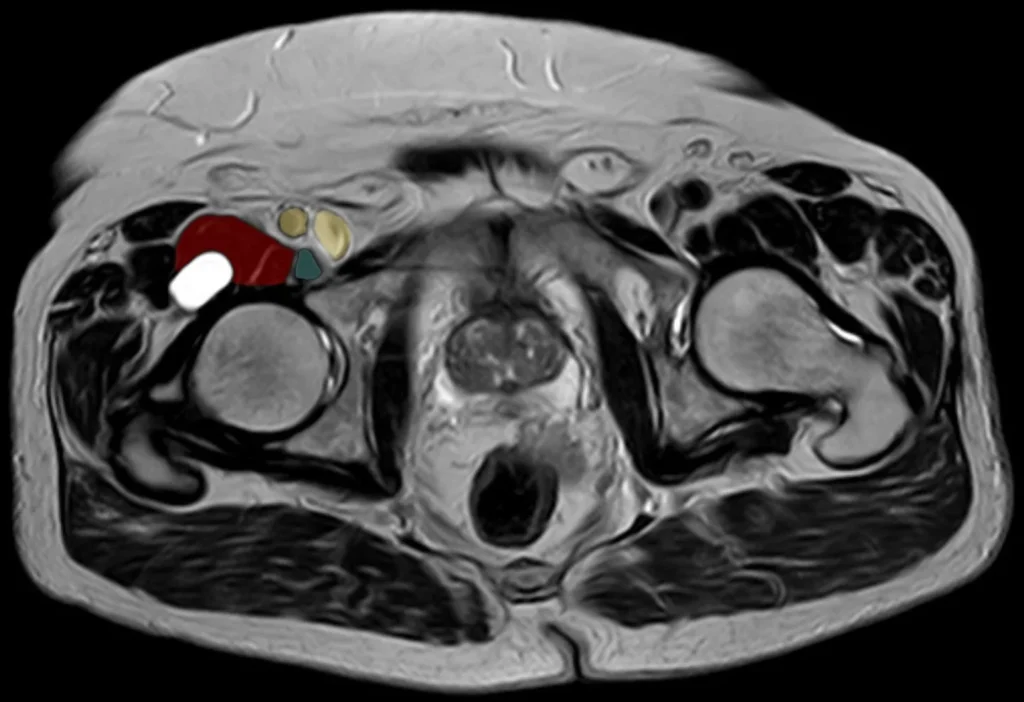
MRI may be useful when the diagnosis remains uncertain, when the extent of bursal enlargement needs assessment or when another hip joint or soft-tissue condition is suspected.
The choice of imaging depends on the clinical findings.
A scan should not be interpreted in isolation because an enlarged bursa may not necessarily explain every symptom. (Wunderbaldinger et al., 2002)
Physiotherapy Treatment for Iliopsoas Bursitis
Physiotherapy aims to improve comfortable movement, manage aggravating loads and restore strength and everyday function.
The plan should reflect the underlying cause, the severity of symptoms and the person’s response to movement.
1. Modify aggravating activities
Temporarily reduce activities that consistently worsen pain, such as steep uphill walking, repeated high-knee exercises or intense cycling.
Complete rest is not always necessary.
Comfortable walking and other tolerable activities may help maintain function, provided they do not significantly aggravate symptoms.
2. Restore comfortable hip movement
Gentle, pain-limited movement may help maintain hip mobility.
A physiotherapist can select suitable movements based on the assessment.
Avoid forcing deep hip flexion or aggressive hip-flexor stretching when these movements reproduce groin pain.
More stretching is not automatically better, particularly when the source of symptoms has not been established.
3. Progress strengthening gradually
When symptoms allow, rehabilitation may include:
- Gentle hip movement within a comfortable range.
- Progressive strengthening of the gluteal muscles.
- Trunk and pelvic control exercises where relevant.
- Gradual hip-flexor strengthening when tolerated.
- Functional practice for walking, stairs and sit-to-stand movements.
Exercises should be introduced according to symptoms and function, rather than following a fixed program for everyone.
If pain consistently increases during or after exercise, the load and technique should be reviewed.
4. Address the underlying cause
If hip osteoarthritis, inflammatory disease or irritation following hip replacement contributes to the problem, treating the underlying condition is essential.
Exercise alone may not resolve symptoms caused by a structural or medical problem.
Research on iliopsoas assessment highlights the potential role of ultrasound in evaluating the tendon and surrounding structures, helping clinicians make better-informed decisions about rehabilitation. (Manske et al., 2024)
5. When are injections or surgery considered?
If symptoms persist despite appropriate conservative treatment, a clinician may consider an image-guided injection or other interventions, depending on the diagnosis.
Aspiration of bursal fluid may be appropriate in selected cases, particularly when the cause of a swelling needs clarification.
If infection is suspected, medical investigation and treatment take priority.
Surgery is uncommon for uncomplicated cases and is generally reserved for selected patients with persistent symptoms or an identifiable structural problem.
How Long Does Iliopsoas Bursitis Take to Heal?
There is no reliable recovery timeline that applies to everyone.
Symptoms may settle with appropriate management when irritation is mild, while cases associated with joint disease, significant bursal enlargement or previous surgery may take longer.
Progress should be assessed by changes in pain, walking tolerance, hip movement and the ability to perform everyday tasks.
If symptoms persist, repeatedly return or interfere with normal activities, seek reassessment instead of continuing the same exercise plan indefinitely.
Iliopsoas Bursitis: Myth vs Fact
Myth: All groin pain comes from bursitis.
Fact: Hip joint problems, iliopsoas tendinopathy, muscle injuries and hernias can produce similar symptoms.
Myth: Stretching harder will fix the problem faster.
Fact: Aggressive stretching can aggravate symptoms in some people. Movement should be selected according to the assessment and pain response.
Myth: Every case needs an MRI.
Fact: Imaging depends on the clinical findings. Ultrasound or MRI may be useful when symptoms are unexplained, persistent or associated with swelling.
Myth: Rest alone is always enough.
Fact: Some cases need treatment of an underlying hip or medical condition, alongside suitable activity modification and rehabilitation.
When Should You Seek Medical Attention?
Arrange a medical assessment if groin pain persists, worsens or limits daily activities.
A new lump in the groin should also be examined, especially if it is growing or painful.
Seek urgent medical care if you experience:
- Severe or rapidly worsening hip or groin pain.
- Fever, chills or a hot, red or swollen area.
- Sudden inability to bear weight after an injury.
- A painful groin lump accompanied by vomiting or abdominal pain.
- New leg swelling, significant numbness or weakness.
These symptoms may indicate a condition other than uncomplicated bursitis and should not be managed with exercises alone.
A Lesser-Known Fact About Iliopsoas Bursitis
The iliopsoas bursa can sometimes become enlarged enough to resemble a cyst or other mass in the groin.
Because it lies close to major blood vessels and other important structures, identifying its exact location is essential.
Ultrasound and MRI can help distinguish bursal enlargement from other causes of groin swelling.
This is particularly important because the treatment for a bursa, a hernia and a vascular abnormality can be very different.
Final Thoughts: Treat the Cause, Not Just the Pain
Iliopsoas bursitis can contribute to deep groin pain, but it is only one possible explanation. Identifying whether the bursa, tendon, hip joint or another structure is responsible helps guide appropriate care.
With a suitable assessment and individualized rehabilitation, many people can work towards more comfortable movement and better daily function. Persistent pain or a new groin lump should never be ignored.
Conclusion
Iliopsoas bursitis can cause deep groin pain, discomfort during hip movement and, in some cases, noticeable swelling.
However, similar symptoms may arise from iliopsoas tendinopathy, hip joint disease, muscle injuries or other conditions affecting the groin.
A proper assessment helps identify the likely cause and determine whether imaging or medical treatment is needed.
When appropriate, physiotherapy can support recovery through activity modification, comfortable mobility and progressive strengthening tailored to the individual.
The most important step is to establish what is causing the pain before deciding which treatment or exercises are suitable.
Medical disclaimer: This article is for general educational purposes and does not replace an individual assessment by a qualified healthcare professional. Persistent groin pain, a new lump or worsening symptoms should be medically evaluated.
Frequently Asked Questions
1. Can iliopsoas bursitis cause deep groin pain?
Yes. Enlargement or irritation of the iliopsoas bursa can cause pain or pressure at the front of the hip and deep in the groin. Similar symptoms can occur with other hip and groin conditions.
2. What movements can aggravate iliopsoas bursitis?
Lifting the knee, climbing stairs, walking uphill and some hip movements may aggravate symptoms. The pattern varies, and these movements alone cannot confirm the diagnosis.
3. Can physiotherapy help iliopsoas bursitis?
Physiotherapy may help improve movement and function through activity modification, comfortable mobility and gradual strengthening. Treatment should be tailored to the cause of the symptoms.
4. How is iliopsoas bursitis diagnosed?
A clinician considers the symptoms and examination findings. Ultrasound or MRI may be recommended when the diagnosis is uncertain, a lump is present or another condition needs investigation.
5. How long does iliopsoas bursitis take to heal?
Recovery varies according to the cause, symptom severity and response to treatment. Persistent symptoms or difficulty with daily activities warrant reassessment.
6. When should I seek medical attention for groin pain?
Seek assessment for persistent pain or a new groin lump. Severe pain, fever, inability to bear weight or a painful lump accompanied by vomiting or abdominal pain requires urgent medical care.
Stay tuned with us for more health related topics.
Follow us on LinkedIn and Instagram for more.
More Read


Medical Disclaimer
This article is intended for general educational purposes only and does not replace professional medical advice, diagnosis or treatment. Groin pain can have several causes, and not all cases are due to iliopsoas bursitis. Consult a qualified healthcare professional for an appropriate assessment. Seek urgent medical care for severe or rapidly worsening pain, fever, inability to bear weight or a painful groin lump accompanied by vomiting or abdominal pain. Do not delay medical care because of information read online.


