


Best Exercises For Hip impingement
Hip pain during squats, lunges, or prolonged sitting can make exercise frustrating.
If you have femoroacetabular impingement syndrome (FAIS), certain hip positions may trigger groin pain, stiffness, or a pinching sensation, particularly when the hip bends deeply.
Quick Answer: Which Hip Impingement Exercises Should You Avoid?
If you have symptomatic femoroacetabular impingement (FAIS), temporarily modify exercises that repeatedly cause hip or groin pain, pinching, or catching.
- Deep squats and deep lunges that provoke symptoms
- Forced knee-to-chest stretches
- Deep hip rotation exercises that cause pinching
- Prolonged cross-legged sitting if uncomfortable
- Cycling positions or resistance levels that aggravate pain
- Rapid pivoting and cutting drills during a flare-up
Physiotherapy tip: You do not necessarily need to stop exercising. Adjust the range, resistance, and duration of movements while maintaining comfortable activity and gradually rebuilding strength.
However, avoiding all exercise is rarely the best long-term strategy.
Physiotherapy can help you modify aggravating movements, strengthen the muscles around your hip, and gradually return to your usual activities.
The important question is not simply which exercises to avoid, but how to recognize your symptom triggers and choose safer alternatives without unnecessarily restricting movement.
Key Takeaways for Hip Impingement
Deep squats, lunges, and rotational movements may need adjustment if they reproduce symptoms.
Aggressive stretching into a pinching sensation is not a reliable way to improve hip function.
Individualized gluteal, hip, and trunk strengthening can support movement and everyday activities.
Persistent groin pain, repeated catching, or difficulty with daily activities warrants professional assessment.
What Is Hip Impingement?
Femoroacetabular impingement (FAI) describes a situation in which the shape of the hip bones can contribute to abnormal contact during movement.
It is commonly associated with two structural variations:
- Cam morphology: An extra prominence or loss of the normal rounded shape at the junction between the femoral head and neck.
- Pincer morphology: Increased coverage of the femoral head by the hip socket.
- Combined morphology: Features of both cam and pincer types.
Not everyone with these bone shapes experiences pain.
A diagnosis of FAIS considers symptoms, clinical examination findings, and relevant imaging together.
Symptoms can include deep groin pain, hip stiffness, reduced movement, and discomfort during squatting, pivoting, or prolonged sitting.
Clicking or catching may occur, but these symptoms can also have other causes. (Griffin et al., 2016)
Hip Impingement Exercises to Modify
There is no single list of exercises that everyone with hip impingement must permanently avoid.
The following movements may need temporary modification if they repeatedly reproduce your familiar hip or groin pain.
1. Deep Squats
Deep squats require considerable hip flexion. For some people with symptomatic impingement, the bottom position can provoke pain or pinching.
How to modify the exercise:
- Squat to a comfortable depth rather than forcing a full squat.
- Use a chair or box as a depth guide.
- Keep your movement controlled and avoid bouncing at the bottom.
- Increase the depth gradually if your symptoms remain manageable.
A shallow squat can still help build lower-body strength without repeatedly pushing the hip into an uncomfortable position.
2. Deep Forward Lunges
Deep lunges can place the front hip into substantial flexion, particularly when taking a long step or lowering the body close to the floor.
Try a shorter step, reduce the depth, or use a supported split squat.
Keep your pelvis controlled and avoid pushing through sharp groin pain.
3. Knee-to-Chest Stretches
Pulling your knee tightly towards your chest places the hip into deep flexion.
This may reproduce anterior hip discomfort in some people with FAIS.
Avoid forcing the knee towards your chest to improve flexibility.
Choose comfortable mobility exercises instead. Stretching harder does not correct the underlying shape of the hip bones.
4. Cross-Legged Sitting
Cross-legged sitting combines hip flexion with inward movement and rotation.
Holding this position for long periods may aggravate symptoms in some individuals.
Try sitting with both feet supported and your hips slightly higher than your knees.
Change positions regularly rather than remaining in one posture for extended periods.
5. Deep Hip Rotation Exercises
Some mobility drills combine a bent hip with inward rotation.
This position, commonly used in clinical testing for hip impingement, may reproduce familiar symptoms.
Avoid repeatedly pushing into a painful end range.
Gentle rotation within a comfortable range may be more suitable while symptoms settle.
6. Cycling With Excessive Hip Flexion
Cycling is not automatically unsuitable for people with hip impingement.
However, a low handlebar position, an unsuitable saddle height, or a high-resistance workout may aggravate symptoms.
Consider adjusting the bike setup, reducing resistance, and starting with shorter sessions.
If cycling continues to cause pain, discuss alternative cardiovascular activities with your physiotherapist.
7. Rapid Pivoting and Cutting Drills
Sports involving sudden changes of direction, rapid pivots, and deep rotational positions may aggravate symptoms, particularly during a flare-up.
Temporarily reduce the intensity and volume of these drills.
Progress towards sport-specific movements as your strength, movement control, and tolerance improve.
The goal is to modify movements that trigger symptoms, not permanently eliminate every exercise involving hip flexion or rotation.
Why Can These Movements Trigger Hip Pain?
Many symptom-provoking positions combine hip flexion, adduction, and internal rotation.
Clinicians refer to this combination as the flexion-adduction-internal rotation, or FADIR, position.
In symptomatic FAIS, these positions may increase contact around sensitive structures in the hip joint.
However, pain does not depend on bone shape alone. Muscle capacity, training load, movement habits, and the sensitivity of joint tissues can also influence symptoms.
A movement that hurts one person may be comfortable for another.
This is why an individual assessment is more useful than following a rigid list of forbidden exercises.
Which Exercises May Help Instead?
Exercise selection should reflect your symptoms, strength, mobility, and daily goals.
The following movements are potential starting options, not a universal treatment plan.
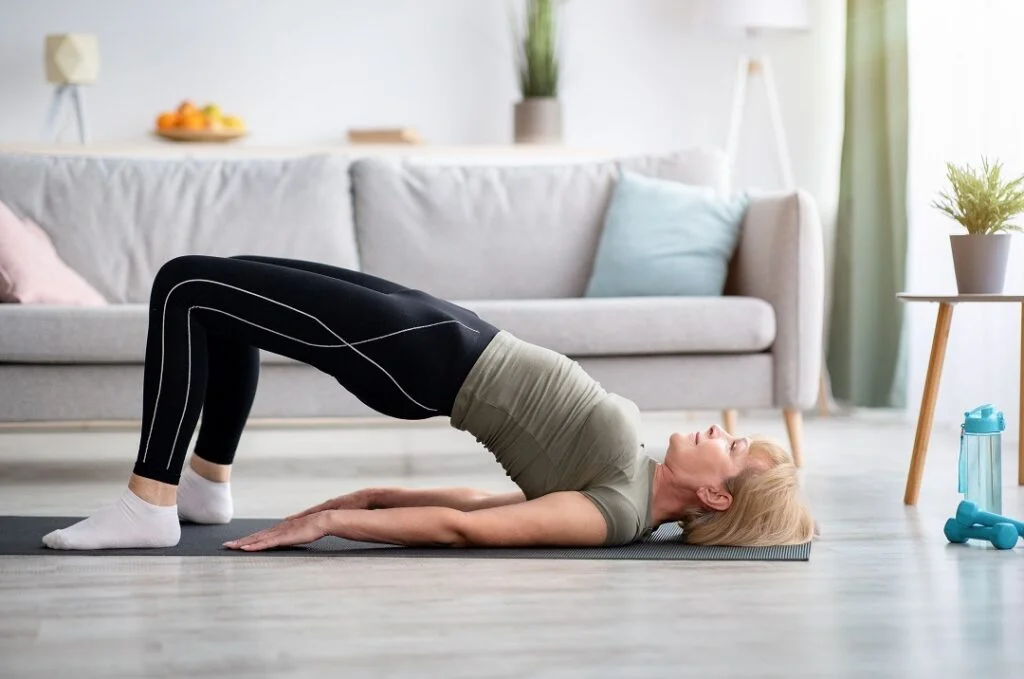
1. Gluteal Bridges
Lie on your back with your knees bent and feet flat.
Gently tighten your abdominal muscles, lift your pelvis, and lower it slowly without arching your lower back.
Physiotherapy benefit: Bridges strengthen the gluteal muscles while allowing you to control the amount of hip flexion.
2. Side-Lying Hip Abduction
Lie on your side with your lower leg bent for stability.
Keep the upper leg straight, lift it a comfortable distance, and lower it slowly without rolling your pelvis backwards.
Physiotherapy benefit: This exercise targets the hip abductors, which help control pelvic movement during walking and single-leg activities.
3. Sit-to-Stand
Sit on a firm, relatively high chair. Lean forwards slightly and stand up in a controlled manner, then slowly return to sitting.
Adjust the chair height or use your hands for support if needed.
Physiotherapy benefit: This functional exercise builds lower-body strength while allowing you to regulate hip depth.
4. Gentle Core Strengthening
Try a modified dead bug or another comfortable trunk-control exercise. Keep breathing normally and avoid movements that reproduce hip pain.
Physiotherapy benefit: Trunk and pelvic control can support coordinated movement during walking, stairs, and other everyday activities.
5. Walking or Comfortable Swimming
Short walks or gentle swimming may help maintain fitness while you modify aggravating exercises.
Choose a duration and style that feel comfortable, as some swimming strokes can also require substantial hip movement.
A useful rule: Stop or modify an exercise that causes sharp pain, catching, or a lasting increase in symptoms.
If even gentle movements are painful, seek an assessment rather than pushing through. (Takla et al., 2021)
How Physiotherapy Rehabilitation Works
Physiotherapy aims to improve function, manage symptom-provoking loads, and help you return to meaningful activities.
Your physiotherapist may assess your hip range of motion, strength, walking pattern, single-leg control, and the movements that reproduce your familiar symptoms.
The assessment may also consider the lower back and other potential causes of groin pain.
Treatment can include:
- Activity modification: Adjusting exercise depth, sitting positions, training volume, and sports drills.
- Progressive strengthening: Building hip and trunk muscle capacity according to your current ability.
- Movement retraining: Improving control during squats, stairs, walking, and other functional activities.
- Comfortable mobility work: Maintaining available movement without aggressive stretching into painful ranges.
- Graded return to activity: Reintroducing more demanding movements as your tolerance improves.
A supervised program that emphasizes active hip and core strengthening may be more useful than relying only on passive treatments or an unsupervised exercise list.
Rehabilitation should still be tailored to the individual. (Pasculli et al., 2023)
How to Progress Without Aggravating Symptoms
Returning to exercise is not simply about waiting until all discomfort disappears.
It involves finding a suitable starting level and increasing activity according to your response.
Start With a Manageable Range
Choose a version of the exercise that does not reproduce sharp or escalating pain.
For squats, this may mean reducing depth; for lunges, it may mean shortening the step.
Increase One Variable at a Time
When an exercise becomes comfortable, gradually adjust one factor, such as repetitions, resistance, duration, or range of motion.
Avoid increasing everything at once.
Monitor Your Response Afterwards
Notice whether symptoms settle after exercise or remain noticeably worse later that day or the following morning.
If an activity repeatedly causes a flare-up, reduce its intensity or range and reassess.
Build Towards Your Actual Goals
Someone who wants to walk comfortably may need a different program from a runner or a person who regularly performs heavy squats.
Progression should reflect the activities you want to resume.
There is no single recovery timeline that applies to everyone with FAIS.
Common Hip Impingement Rehabilitation Mistakes
Forcing Painful Stretches
Trying to force more hip flexibility may aggravate symptoms when the position involves deep flexion.
Mobility exercises should suit your available range and symptom response.
Stopping All Physical Activity
Complete inactivity can reduce strength and fitness.
Where possible, maintain comfortable activities while modifying the movements that cause problems.
Assuming Every Click Means Impingement
Hip clicking can occur for several reasons, including tendon movement or problems within the joint.
Clicking alone does not confirm FAIS, especially without pain or other symptoms.
Continuing Despite Worsening Pain
Sharp pain, repeated catching, or symptoms that consistently worsen after exercise are reasons to modify the activity and seek assessment if they persist.
Expecting Exercise to Change Bone Shape
Physiotherapy can improve strength, movement control, and function, but it does not reshape cam or pincer bone morphology.
Some people improve with non-surgical care; others may require specialist review if symptoms remain limiting. (Terrell et al., 2020)
Hip Impingement: Myth vs Fact
MYTH: Everyone with hip impingement must stop squatting.
FACT: Squat depth, resistance, and repetitions may need modification, but comfortable variations can remain part of rehabilitation.
MYTH: More stretching will fix hip impingement.
FACT: Forcing deep hip flexion may aggravate symptoms. Treatment should focus on comfortable movement, strength, and function.
MYTH: A hip click always means joint damage.
FACT: Clicking has several possible causes. Its significance depends on accompanying pain, catching, movement restriction, and clinical findings.
MYTH: Resting completely is always best.
FACT: When tolerated, appropriate activity and progressive strengthening can help maintain fitness and improve function.
When Should You Seek Medical Advice?
Arrange a medical or physiotherapy assessment if hip or groin pain persists, limits walking or exercise, causes repeated catching, or does not improve after reasonable activity modification.
Seek urgent medical attention if you develop sudden severe hip pain, cannot bear weight after an injury, or have a hot, swollen hip accompanied by fever.
These symptoms may indicate a condition that needs prompt investigation.
A clinician may recommend X-rays or other imaging when appropriate.
Imaging results should be interpreted alongside symptoms and examination findings rather than used alone to explain pain.
Final Thoughts: Move Smarter, Not Less
Living with hip impingement does not automatically mean giving up exercise. The right approach is to recognize which movements trigger your symptoms, modify them when necessary, and build strength progressively within your current tolerance.
A physiotherapist can help you choose suitable exercises, improve movement control, and work towards returning to walking, gym training, or sport with greater confidence.
Remember: Your rehabilitation should be based on your symptoms, assessment findings, and personal goals, rather than a universal list of exercises to avoid.
Conclusion
Hip impingement does not mean you must stop exercising.
Deep squats, deep lunges, forced knee-to-chest stretches, prolonged cross-legged sitting, and rapid pivoting may need modification when they reproduce your symptoms.
A physiotherapy-led plan can combine activity modification, progressive strengthening, movement retraining, and a gradual return to exercise.
The most useful approach is to identify your individual triggers rather than follow a rigid list of forbidden movements.
If hip pain persists or interferes with everyday activities, seek a professional assessment to confirm the cause and develop a rehabilitation plan suited to your needs.
Frequently Asked Questions About Hip Impingement Exercises
1. Should I stop squatting if I have hip impingement?
Not necessarily. Reduce squat depth, resistance, or repetitions if the movement causes symptoms. A physiotherapist can help identify a suitable range and progression.
2. Are hip flexor stretches bad for hip impingement?
Not all hip flexor stretches are unsuitable. Avoid forcing stretches that produce groin pinching or worsen your symptoms.
3. Can walking make hip impingement worse?
Walking is often manageable, but long distances, hills, or sudden increases in activity may aggravate symptoms. Adjust your duration and pace according to your response.
4. Can physiotherapy cure hip impingement?
Physiotherapy may improve pain, strength, movement control, and daily function. It cannot change the underlying shape of the hip bones, and outcomes vary between individuals.
5. When should I see an orthopedic specialist?
Consider a specialist assessment if symptoms significantly limit daily activities or sport, or if an appropriate non-surgical rehabilitation program has not helped enough.
Stay tuned with us for more health related topics.
Follow us on LinkedIn and Instagram for more.
More Read


Medical Disclaimer
This article is intended for general educational and informational purposes only. It does not replace individual medical advice, diagnosis, or treatment from a qualified healthcare professional.
Exercise suitability varies according to the cause and severity of hip symptoms. Stop movements that cause sharp or worsening pain and consult a qualified physiotherapist or doctor for personalized guidance.
Seek urgent medical attention for sudden severe hip pain, inability to bear weight after an injury, or a hot, swollen hip accompanied by fever.


