


Sitting all day causing shoulder pain may sound harmless.
But your daily posture habits could be slowly damaging your shoulders.
By the time people come in, they usually say:
“I think I slept wrong.”
But when you ask a few questions, a pattern shows up:
- 7 to 10 hours sitting
- laptop slightly below eye level
- no real breaks
- same posture for long stretches
And here is the interesting part.
Most of them do not feel pain in the morning.
It builds slowly.
Around 2 to 4 PM, something starts:
- a pulling sensation near the neck
- a dull ache in one shoulder
- a need to keep rotating or cracking the joint
That is not random.
That is accumulated strain.
Quick Answer
Yes, sitting all day can cause shoulder pain. It usually happens because your body stays in one position for too long, leading to muscle imbalance, reduced movement, and strain on the shoulder and upper back.
The pain often builds gradually during the day and feels worse by evening. The most effective solution is not just posture correction, but a combination of regular movement, strengthening exercises, and small ergonomic changes.
Key Takeaways
- Shoulder pain from sitting develops gradually, not suddenly.
- Lack of movement is a bigger problem than posture alone.
- Muscle imbalance affects how your shoulder moves and stabilizes.
- Laptop and desk setup play a major role in long-term strain.
- Stretching alone is not enough; strengthening is essential.
- Short, frequent movement breaks reduce pain significantly.
- Consistency in small habits gives better results than occasional effort.
Why Sitting Affects the Shoulder More Than You Think
People assume sitting only affects the lower back.
But the shoulder is actually more sensitive to stillness.
Here is why.
When you sit and work:
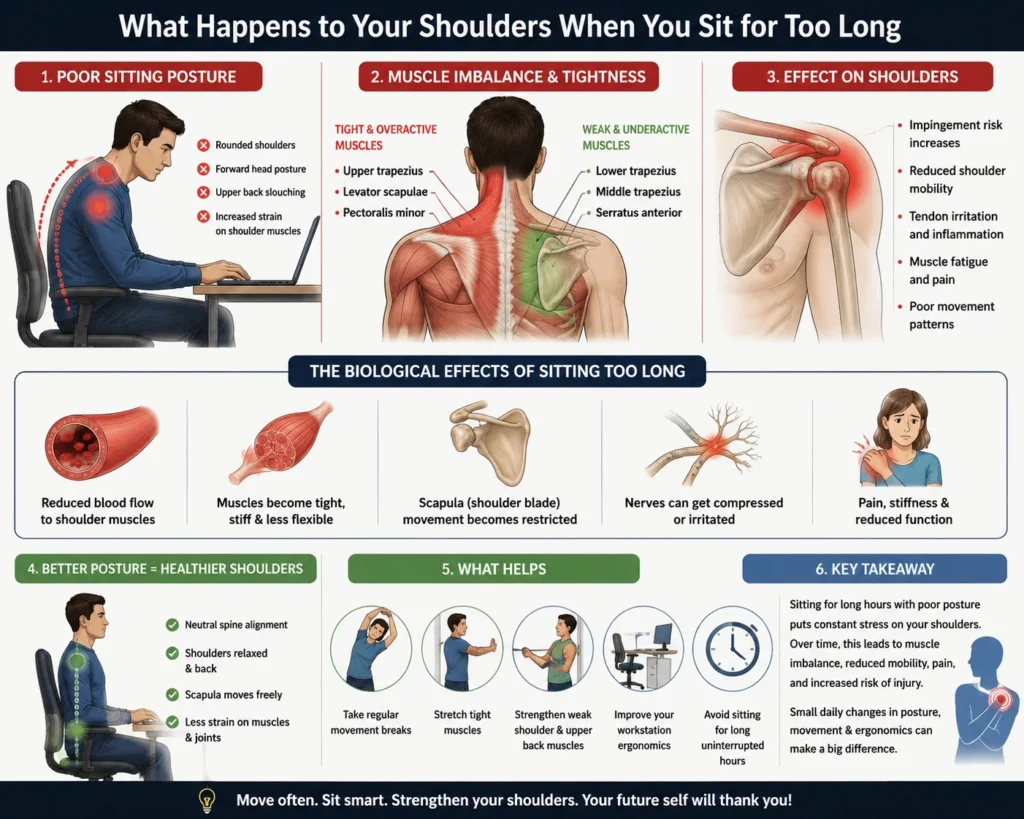
- your shoulders drift forward
- your head moves slightly ahead
- your upper back becomes stiff
You may not notice it.
But your shoulder blade stops moving the way it should.
And when that happens, the shoulder joint starts taking extra load.
Over time, this leads to pain.
Research consistently shows that prolonged sitting increases upper body discomfort, especially in the neck and shoulder region. (Waongenngarm et al. 2020)
The Problem Is Not Just Posture.
It Is Lack of Movement
A lot of people try to “sit straight” all day.
That rarely works.
Because the real issue is not one bad posture.
It is staying in any posture for too long.
Recent ergonomics research has shifted focus from posture correction to movement variability.
In simple words:
Your body does not like stillness.
Even a decent posture becomes harmful if you hold it for hours. (Barrett et al. 2024)
What Is Happening Inside Your Shoulder
This is where things get interesting.
Your shoulder does not work alone.
It depends heavily on the shoulder blade.
When you sit for long periods:
- chest muscles become tight
- upper neck muscles become overactive
- stabilizing muscles become weaker
This creates an imbalance.
The shoulder blade stops gliding smoothly.
This condition is often referred to as scapular dyskinesis.
And it is strongly linked to shoulder pain and reduced function. (Kibler et al. 2013)
Why Your Shoulder Feels Worse in the Evening
You might have noticed this pattern.
Morning feels fine.
By evening, the discomfort is obvious.
This happens because of something called cumulative load.
Your muscles are working the entire time.
But they are not moving.
Think of it like holding a light object for hours.
Not heavy.
But exhausting over time.
Muscle fatigue increases gradually and shows up later in the day. (Straker et al. 2009)
The Laptop Factor Nobody Takes Seriously

If you work on a laptop, this matters a lot.
Most setups cause:
- downward gaze
- forward leaning
- rounded shoulders
This creates continuous strain on the neck and shoulder muscles.
Even small angles matter when repeated for hours.
Computer users have shown increased shoulder muscle activity linked to pain development. (Szeto et al. 2002)
Small Signs Your Body Gives Before Pain Starts
People often ignore early signals.
But they are very clear once you know what to look for:
- one shoulder feels heavier than the other
- you keep adjusting your sitting position
- your bra strap feels tighter on one side
- you feel relief when you press or massage the area
- you stretch your neck without realizing it
These are early warning signs.
Ignoring them is what turns discomfort into pain.
Something Most Articles Do Not Talk About
There are a few lesser-known contributors.
1. Your Breathing Pattern
If you breathe shallow from your chest:
- neck muscles work more
- shoulder tension increases
Over time, this adds to discomfort.
2. Your Eyes Affect Your Posture
When your eyes strain:
You lean forward.
Even slightly.
That increases load on the neck and shoulders.
3. Stress Tightens Your Shoulders
Deadlines.
Long meetings.
Mental load.
All of this increases muscle tension, especially in the upper trapezius. (Lundberg et al. 1994)
Why Stretching Alone Does Not Fix It
This is important.
Many people try:
- neck stretches
- shoulder rolls
- random exercises from videos
They feel temporary relief.
But the pain comes back.
Because stretching does not fix the underlying imbalance.
You also need to strengthen specific muscles.
Especially:
- lower trapezius
- serratus anterior
Scapular-focused rehabilitation has been shown to improve shoulder function significantly. (Cools et al. 2014)
Physiotherapy Exercises That Help Shoulder Pain from Sitting
You do not need 20 exercises.
You need the right ones, done consistently.
Start with these.
1. Scapular Retraction
Foundation Exercise
This is the most important one.
Most people do it incorrectly by forcing their chest out.
Do it gently.
How to do it:
- Sit or stand relaxed
- Pull your shoulder blades slightly back
- Do not lift your shoulders
- Hold for 5 seconds
Reps: 10 repetitions, 2-3 times daily
What you should feel:
A mild activation between your shoulder blades, not strain.
If you feel it in your neck, you are overdoing it.
2. Wall Slides
Improves Shoulder Control
This helps your shoulder blade move properly again.
How to do it:
- Stand against a wall
- Keep your back and arms touching the wall
- Slowly slide your arms upward
- Go only as high as comfortable
Reps: 10 slow repetitions
Tip:
Move slowly. Fast movement defeats the purpose.
3. Chest Opening Stretch
Reverses Sitting Posture
Sitting tightens your chest more than you realize.
How to do it:
- Stand near a doorway
- Place your arm at 90 degrees
- Gently turn your body away
Hold: 20 to 30 seconds
Repeat: 2 to 3 times
What you should feel:
A stretch across the front of your shoulder and chest.
4. Serratus Activation
Most Ignored but Critical
This muscle stabilizes your shoulder blade.
Weak here means ongoing pain.
How to do it:
- Stand facing a wall
- Place your hands on the wall
- Push slightly forward without bending elbows
Reps: 10 to 12
Tip:
Think of pushing your body away from the wall, not just your hands.
5. Resistance Band Pull-Apart
Strengthens Upper Back
This balances tight chest muscles.
How to do it:
- Hold a resistance band in front
- Pull it apart slowly
- Keep arms straight
Reps: 10 to 15
Important:
Do not shrug your shoulders.
How Often Should You Do These?
Simple rule:
- Daily is ideal
- Even 5 to 10 minutes is enough
- Consistency matters more than intensity
What Most People Do Wrong
This is important.
People:
- do exercises for 3 days
- stop when pain reduces
- return to same habits
And the pain comes back.
Improvement happens when:
- exercises + movement + setup changes happen together
When You Will Start Seeing Results
If done correctly:
- mild relief in 5 to 7 days
- noticeable improvement in 2 to 3 weeks
- long-term change in 4 to 6 weeks
One Practical Tip From Clinic Experience
Do not wait for pain to start.
Attach exercises to your routine.
For example:
- after brushing teeth
- during work breaks
- before sleep
That is how consistency builds.
Mistakes That Keep Your Shoulder Pain Coming Back
This is something I see very often.
People do the right exercises, but still struggle.
Because of these small mistakes.
1. Doing exercises only when pain starts
Most people wait for discomfort.
By then, the muscles are already fatigued.
Consistency matters more than timing.
2. Overstretching instead of strengthening
Stretching feels good.
But if you only stretch:
- the weak muscles stay weak
- the imbalance remains
And pain keeps returning.
3. Sitting “perfectly” for too long
Trying to hold a perfect posture all day backfires.
Your muscles get tired.
You end up slouching even more later.
4. Ignoring small discomfort signals
That slight tightness you feel?
That is the early stage.
Most people ignore it until it becomes painful.
5. Fixing posture but not the setup
Even good posture cannot compensate for:
- low screen height
- poor chair support
- awkward keyboard position
Your desk setup environment matters.
Clinical Insight
The people who recover faster are not the ones doing more exercises.
They are the ones who:
- move more often
- respond early to discomfort
- stay consistent
What Actually Works in Real Life
You do not need a complicated routine.
But you do need consistency.
1. Change Your Setup Slightly
Not perfectly. Just better.
- screen closer to eye level
- elbows relaxed
- sit back in the chair
Small adjustments reduce strain.
2. Stop Sitting Non-Stop
You do not need long breaks.
Just move often.
Every 30 minutes:
- stand
- stretch
- reset your posture
Even 30 seconds helps.
3. Strengthen What Is Weak
This is the missing piece for most people.
Focus on:
- shoulder blade control
- upper back strength
Simple exercises like:
- scapular retractions
- wall slides
- resistance band pulls
done regularly can make a big difference.
4. Do Not Chase Perfect Posture
This is a common mistake.
There is no perfect posture you can hold all day.
Movement matters more.
Even standing exercises in between work helps a lot. Trust me!
A Simple Daily Routine to Prevent Shoulder Pain
You do not need a complicated plan.
Just a few habits placed at the right time.
Here’s a simple daily routine to prevent shoulder pain from sitting all day:
Morning (2 minutes)
- 10 scapular retractions
- 10 wall slides
This “activates” your upper back before the day starts.
During Work
Every 30 to 45 minutes:
- stand up
- roll shoulders gently
- take a few deep breaths
This resets muscle tension.
Midday Reset (2 to 3 minutes)
- chest stretch
- quick walk
- posture reset
This is where most people skip and regret later.
Evening (5 minutes)
- resistance band pulls
- light mobility exercises
This helps undo the day’s stiffness.
Before Sleep
Just one thing:
- relax your shoulders consciously
Most people go to sleep still holding tension.
Why This Routine Works
It spreads movement across the day.
Instead of trying to fix everything in one session.
That is how real improvement happens.
When It Is Not Just Sitting
Sometimes the symptoms are different.
Be careful if you notice:
- pain going down the arm
- numbness or tingling
- weakness
- severe night pain
In these cases, get it checked.
Final Thoughts
Your shoulder is not failing you.
It is adapting to what you do every day.
Sitting itself is not the problem.
Sitting without movement is.
The good news is this:
You do not need drastic changes.
You just need better habits repeated consistently.
Ignoring shoulder pain from sitting all day can quietly turn temporary stiffness into long-term pain and weakness.
Frequently Asked Questions
Can sitting all day really cause shoulder pain?
Yes, prolonged sitting leads to reduced movement, muscle imbalance, and increased strain on the shoulder, which can gradually cause pain.
Why does shoulder pain feel worse in the evening?
Pain builds due to cumulative muscle fatigue from holding the same posture for long hours during the day.
Is shoulder pain from sitting permanent?
No, most cases improve with regular movement, strengthening exercises, and better workstation setup.
How often should I take breaks while working?
Taking a short break every 30 minutes helps reduce muscle strain and improves circulation.
Does laptop use increase shoulder pain?
Yes, laptops often encourage forward leaning and rounded shoulders, which increases stress on the shoulder muscles.
Are exercises really necessary for recovery?
Yes, strengthening weak muscles is essential to correct imbalance and prevent pain from returning.
What is the fastest way to reduce shoulder pain?
Combining movement breaks, posture correction, and targeted exercises gives the best results.
When should I consult a physiotherapist?
If pain persists, worsens, or includes numbness or weakness, professional evaluation is recommended.
Stay tuned with us for more health related topics.
Follow us on LinkedIn and Instagram for more.
More Read


Medical Disclaimer!
This article has been reviewed and written under the guidance of our Head Physiotherapist, Dr. Kruti Raj (PT, MUHS,CPT,CMPT). The information shared is intended for educational purposes only and should not be considered a substitute for personalized medical advice, diagnosis, or treatment.
Please consult us or any other qualified healthcare professional before beginning any exercise program, especially if you are experiencing pain, recovering from injury, or managing a medical condition.


