


Climbing stairs is an important movement skill that requires more than leg strength.
Children need balance, coordination, postural control and the ability to transfer their body weight from one leg to the other.
Quick Answer: Why Does My Child Have Difficulty Climbing Stairs?
Children may struggle to climb stairs because of developing leg strength, poor balance, reduced postural control, coordination difficulties or problems with motor planning. Some children simply need more time and practice to develop this skill.
However, persistent difficulty, frequent falls, unusual walking patterns, significant differences between the legs or muscle weakness may require professional assessment.
How can physiotherapy help?
Pediatric physiotherapy can assess leg strength, balance, coordination, joint movement and stair-climbing technique. Individualized exercises and functional practice can help children improve movement control and confidence.
Some children take longer to become confident on stairs, particularly while developing their walking and climbing skills.
However, persistent difficulty, unusual movement patterns or a noticeable difference between the two legs may indicate that further assessment is needed.
Pediatric physiotherapy can help identify which movement skills are affecting stair climbing and support children in developing safer, more confident movement.
Key Takeaways for Parents
Stair climbing requires leg strength, balance, coordination and postural control.
Climbing with both feet on each step is common during early development. Alternating feet develops progressively.
Going downstairs can be more challenging because children must control their body weight while lowering themselves.
Persistent difficulty, unusual movement patterns and differences between the legs should be assessed.
Pediatric physiotherapy can help improve strength, balance, coordination and functional stair-climbing skills.
Sudden weakness, loss of previously acquired skills or inability to bear weight needs prompt medical attention.
Why Is Climbing Stairs Difficult for Some Children?
Walking on a flat surface allows children to keep their feet relatively close to the ground.
Climbing stairs is more demanding because they must lift their body against gravity and maintain balance while standing on one leg.
Several abilities work together during this activity:
- Lower-limb strength: The hip, thigh and calf muscles help lift and support the body.
- Balance: Children need to remain stable while transferring their weight between their legs.
- Postural control: The trunk and pelvis must remain controlled as each leg moves.
- Coordination: Both legs need to work in the correct sequence.
- Motor planning: Children must organize their movements and judge where to place their feet.
- Joint mobility: Adequate movement at the hips, knees and ankles helps them step comfortably.
A difficulty in one or more of these areas can make climbing stairs tiring, awkward or uncomfortable.
At What Age Should Children Be Able to Climb Stairs?
Stair climbing develops gradually. Children generally progress from crawling or climbing with assistance to standing upright, using a handrail and eventually alternating their feet.
The following table provides a broad developmental guide:
| Approximate age | Common stair-climbing progression |
|---|---|
| 12-18 months | May explore steps by crawling or climbing with close adult assistance |
| 18-24 months | Often begins climbing upright with support, placing both feet on each step |
| 2-3 years | Becomes more confident climbing stairs, usually with a step-to pattern |
| 3-4 years | Alternating feet while climbing develops progressively; support may still be needed |
| 4-5 years | Many children can climb and descend stairs with alternating feet and improved control |
These are approximate expectations, not strict deadlines.
Development varies with experience, confidence, opportunities to practice and individual motor development.
Going downstairs may also take longer to master because it requires controlled lowering of the body. (AAP, 2013)
Common Reasons Why Children Struggle to Climb Stairs
Difficulty climbing stairs does not automatically mean that a child has a developmental or neurological condition. Several factors may contribute.
1. Reduced Leg Muscle Strength
Climbing stairs requires the leg muscles to generate enough force to lift the body onto the next step.
Children with reduced strength may pull heavily on the handrail, push their hands against their thighs or struggle to raise themselves onto higher steps.
Parents may also notice difficulty with:
- Getting up from the floor.
- Standing from a low chair.
- Squatting and standing.
- Running, jumping or climbing playground equipment.
- Walking longer distances without tiring.
When weakness affects several everyday activities, a medical assessment is important.
2. Poor Balance and Postural Control
During stair climbing, the child must briefly support their body weight on one leg while moving the other.
Children with reduced balance may hesitate before stepping, hold the railing tightly or appear afraid of falling.
Limited trunk and pelvic stability can also make it harder to control the body during weight transfer.
3. Coordination Difficulties
Some children find it difficult to coordinate their legs during stair climbing.
They may pause between steps, repeatedly bring both feet together on each step or struggle to alternate their legs.
Coordination difficulties may also appear during running, hopping, jumping, catching a ball or learning unfamiliar physical activities.
4. Developmental Coordination Disorder
Children with Developmental Coordination Disorder (DCD) may find activities involving balance, timing and movement sequencing more challenging.
Stair climbing can be difficult because it requires several movements to happen in the correct order.
However, difficulty climbing stairs alone does not indicate DCD. Diagnosis requires a broader assessment of motor skills and their impact on everyday activities. (Blank et al., 2019)
5. Low Muscle Tone or Hypotonia
Children with hypotonia have reduced resistance to passive movement. Some may also experience reduced muscle strength or difficulty maintaining stable postures.
They may appear floppy, tire easily or struggle with activities requiring sustained muscle effort.
Stair climbing can become challenging when the child has difficulty maintaining trunk stability or supporting their body weight during each step.
Hypotonia and muscle weakness are different clinical findings, although they can occur together.
6. Joint or Musculoskeletal Problems
Pain, restricted joint movement, muscle tightness or certain lower-limb conditions can affect stair climbing.
For example, a child with hip, knee or ankle discomfort may avoid putting full weight on one leg.
Persistent limping, joint swelling, pain or refusal to bear weight should be medically assessed rather than treated as a simple developmental delay.
Why Does My Child Climb Stairs One Step at a Time?
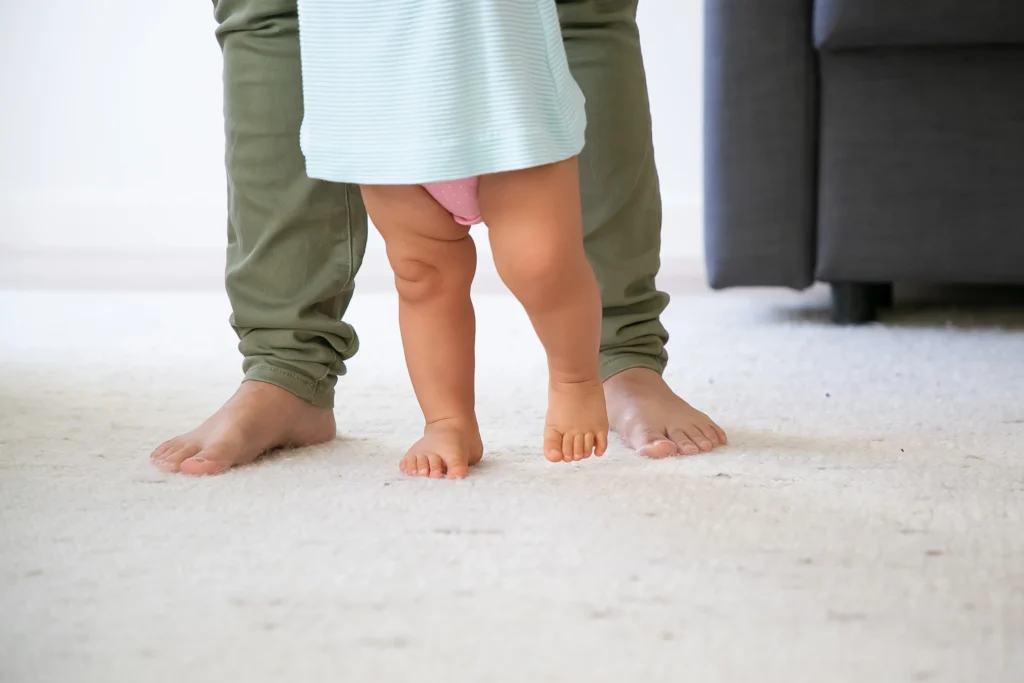
Many toddlers initially use a step-to pattern. This means they place one foot on a step and bring the other foot onto the same step before moving forward.
This is a normal part of learning to climb stairs.
Alternating feet requires greater balance, strength, coordination and confidence. Children gradually develop these abilities through everyday movement and practice.
However, parents should pay attention if an older child:
- Always leads with the same leg.
- Consistently avoids putting weight on one leg.
- Pulls themselves upwards using the railing.
- Has difficulty lowering themselves when going downstairs.
- Shows a noticeable difference between the two legs.
Persistent asymmetry or unusual movement patterns deserve assessment, particularly when accompanied by other motor difficulties.
Why Is Going Downstairs More Difficult Than Going Upstairs?
Some children can climb stairs but struggle when coming down. This is not unusual because descending requires a different type of muscle control.
When climbing upwards, the leg muscles generate force to lift the body. During descent, the muscles must control the lowering of body weight against gravity.
This requires:
- Controlled knee bending.
- Adequate quadriceps strength.
- Balance during single-leg support.
- Accurate foot placement.
- Confidence when moving towards a lower surface.
Children who struggle with descending may turn sideways, hold the railing tightly, bring both feet onto each step or hesitate before lowering themselves.
A physiotherapist can assess whether the difficulty relates to strength, balance, movement control, pain or confidence.
Myths vs Facts: Children and Stair Climbing
Myth: Every child should climb stairs independently by age two.
Fact: Stair-climbing skills develop gradually. Many toddlers still need support and use a step-to pattern.
Myth: If a child can walk, they should be able to climb stairs easily.
Fact: Stair climbing requires greater strength, balance and controlled weight transfer than walking on level ground.
Myth: Using the railing means the child has weak legs.
Fact: Holding a railing is a normal safety strategy. However, excessive pulling or persistent difficulty may deserve assessment.
Myth: Going upstairs and downstairs require exactly the same skills.
Fact: Descending requires controlled lowering, balance and eccentric muscle control, which can make it more challenging.
Myth: More stair practice will always solve the problem.
Fact: Practice can help, but persistent difficulty may need an individual assessment and targeted physiotherapy intervention.
Signs That Your Child May Need an Assessment
Occasional hesitation or a preference for holding the railing is not necessarily concerning.
However, consider seeking professional advice if your child:
- Consistently struggles with stairs compared with other everyday movements.
- Continues to crawl up stairs when they are otherwise a confident independent walker.
- Relies heavily on pulling with their arms to climb.
- Always leads with the same leg or avoids using the other.
- Has difficulty getting up from the floor or standing from a low position.
- Falls frequently or appears unusually unsteady.
- Becomes tired very quickly during ordinary physical activities.
- Shows little improvement in stair-climbing ability over time.
These signs do not establish a diagnosis. They indicate that the child’s overall movement development may benefit from assessment.
Seek prompt medical attention if difficulty develops suddenly, particularly with new weakness, severe pain, inability to walk or bear weight, or loss of previously acquired movement skills.
How Does a Pediatric Physiotherapist Assess Stair-Climbing Difficulties?
A pediatric physiotherapist examines how the child performs the activity, not simply whether they can climb stairs.
The assessment may include the following:
1. Stair-Climbing Movement Analysis
The physiotherapist observes how the child approaches the stairs, places their feet, transfers weight and uses the handrail.
They may assess whether the child climbs independently, uses a step-to pattern or alternates their feet.
2. Lower-Limb Strength
The hip, thigh and calf muscles are assessed through age-appropriate functional activities, such as squatting, standing and stepping onto a low platform.
3. Balance and Weight Transfer
The physiotherapist observes how well the child maintains stability while standing on one leg and shifting their weight.
4. Postural Control
Trunk and pelvic stability are assessed during standing, walking, stepping and other functional movements.
5. Joint Mobility and Muscle Flexibility
The physiotherapist checks hip, knee and ankle movement, looking for restrictions or discomfort that may affect stepping.
6. Coordination and Movement Symmetry
Both legs are observed to identify differences in strength, movement quality, timing and control.
Depending on the findings, the physiotherapist may recommend further medical or developmental assessment.
The 2026 American Physical Therapy Association clinical practice guideline for DCD also describes the importance of observing functional activities, identifying movement limitations and selecting assessment measures according to the child’s participation goals. (Sargent et al., 2026)
How Can Pediatric Physiotherapy Help?
Treatment depends on the child’s age, assessment findings and specific movement difficulties. The aim is to improve the physical abilities needed for safe and confident stair climbing.
1. Functional Leg Strengthening
Activities may target the quadriceps, gluteal muscles and calf muscles.
Examples include:
- Sit-to-stand practice.
- Supported squats.
- Step-ups on low, stable platforms.
- Standing up from a child-sized chair.
These activities help develop the strength needed to lift and support the body.
2. Balance Training
Balance activities help children maintain stability while shifting weight between their legs.
A physiotherapist may introduce supported single-leg standing, stepping over low obstacles and controlled weight-shifting activities.
3. Step-Up and Step-Down Practice
Practicing on low steps allows children to develop confidence and control before attempting a full staircase.
The physiotherapist may gradually increase step height or reduce assistance as the child’s abilities improve.
4. Coordination and Motor Planning Activities
Games involving stepping over objects, following movement sequences and changing directions can help develop coordination.
These activities encourage children to organize movements and use both legs more effectively.
5. Trunk and Postural Control Training
Activities that encourage trunk stability and controlled weight transfer can improve the child’s ability to remain upright while climbing.
6. Functional Stair-Climbing Practice
Children practice climbing and descending steps using appropriate support.
The physiotherapist may gradually reduce assistance as the child develops better control, confidence and independence.
For children with DCD, current physiotherapy guidance supports task-oriented practice, meaningful functional goals and activities that can be used in everyday life. (Sargent et al., 2026)
Simple Activities Parents Can Try at Home
Parents can encourage movement development through supervised play and everyday activities.
- Low-step practice: Encourage the child to step onto a low, stable platform with appropriate support.
- Squat-and-stand games: Place toys at different heights to encourage controlled squatting and standing.
- Obstacle stepping: Let the child step over soft, low obstacles placed on the floor.
- Ball kicking: Encourage kicking a stationary ball with either leg.
- Supported weight shifting: Help the child shift their weight from one leg to the other while standing.
- Playground activities: Age-appropriate climbing and stepping activities can provide opportunities to practice different movement patterns.
Always supervise closely. Keep stairs clear, use a secure handrail or appropriate adult support, and avoid slippery surfaces.
Do not force a child to climb independently or continue an activity that causes pain, distress or excessive fatigue.
When Should Parents Consult a Paediatrician?
Consider consulting a pediatrician if your child has persistent difficulty climbing stairs, particularly when it occurs alongside other developmental or movement concerns.
Medical evaluation is especially important if you notice:
- Progressive muscle weakness.
- Frequent falls with worsening balance.
- Difficulty rising from the floor.
- Unusual walking patterns.
- Significant differences between the two legs.
- Loss of previously acquired motor skills.
The pediatrician may recommend further investigations or referrals depending on the clinical findings. Physiotherapy can support movement and function, but it should not replace medical evaluation when an underlying condition is suspected.
Final Thoughts
Learning to climb stairs is an important part of a child’s physical development. Every child progresses at a different pace, and needing support during the early stages does not automatically mean something is wrong.
However, persistent difficulty, unusual movement patterns, frequent falls or weakness should not be overlooked. Understanding the reason behind the difficulty is more important than simply encouraging a child to practice more.
With appropriate assessment, supportive guidance and individualized pediatric physiotherapy, children can work towards better balance, strength, coordination and confidence in everyday activities.
Conclusion
Difficulty climbing stairs can result from several factors, including developing leg strength, balance, coordination and postural control.
Some children simply need more time and opportunities to practice, while others may have underlying developmental or physical difficulties.
Parents should consider the child’s overall movement abilities rather than judging stair climbing in isolation. Persistent difficulty, marked asymmetry, unusual weakness or regression deserves professional attention.
Paediatric physiotherapy can help identify the skills affecting stair climbing and provide individualised activities to improve strength, balance, coordination and functional independence.
Frequently Asked Questions
1. At what age should a child be able to climb stairs?
Many children begin climbing stairs with support during the toddler years. Alternating feet develops progressively, often between three and four years. Development varies, so age should be considered alongside the child’s overall movement abilities.
2. Why does my child climb stairs one step at a time?
Using a step-to pattern, where both feet come together on each step, is common during early stair-climbing development. Children gradually develop the balance, strength and coordination needed to alternate their feet.
3. Why can my child climb upstairs but struggle to come downstairs?
Going downstairs requires controlled lowering of the body, balance and adequate muscle control. These skills can take longer to develop than those needed for climbing upwards.
4. Can weak leg muscles make climbing stairs difficult?
Yes. Reduced strength in the hip, thigh and calf muscles can make it harder for a child to lift and support their body while climbing. Difficulty with other activities, such as standing from the floor or jumping, may also need assessment.
5. Can developmental coordination disorder affect stair climbing?
Yes. Children with developmental coordination disorder may find balance, timing and movement sequencing challenging. However, difficulty climbing stairs alone is not enough to diagnose DCD.
6. Can physiotherapy help a child who struggles to climb stairs?
Paediatric physiotherapy can assess leg strength, balance, postural control, coordination and stair-climbing technique. Individualised exercises and functional practice may help improve movement control and confidence.
7. What exercises can help children improve stair climbing?
Depending on the child’s abilities, supervised activities may include supported squats, sit-to-stand practice, stepping onto low platforms, obstacle stepping and balance games. Activities should be age-appropriate and safe.
8. When should parents worry about difficulty climbing stairs?
Persistent difficulty, significant differences between the legs, frequent falls, progressive weakness or problems with other motor activities should be assessed. Sudden weakness, loss of skills or inability to bear weight needs prompt medical attention.
Stay tuned with us for more health related topics.
Follow us on LinkedIn and Instagram for more.
More Read


Medical Disclaimer
This article is intended for general educational and informational purposes only. It does not replace professional medical advice, diagnosis or treatment.
Every child’s development and physical abilities are different. Difficulty climbing stairs may have several causes, and an appropriate assessment is necessary to understand the reason.
Consult a qualified paediatrician or paediatric physiotherapist if your child has persistent difficulty, unusual movement patterns, weakness, pain or frequent falls. Seek prompt medical attention for sudden weakness, loss of previously acquired skills or inability to bear weight.


