


A child who struggles to tie shoelaces, use cutlery, catch a ball or follow a sequence of movements may be experiencing more than ordinary childhood clumsiness.
Some children have persistent difficulties planning, organizing and coordinating movements, which can affect their independence at home, participation at school and confidence during play.
Quick Answer: What Is Dyspraxia in Children?
Dyspraxia is a commonly used term for difficulties with movement planning, coordination and learning new motor skills. It is often used interchangeably with developmental coordination disorder (DCD), the recognised clinical diagnosis.
Children may struggle with balance, running, jumping, handwriting, dressing, using utensils and organizing movements during everyday activities.
How can physiotherapy help? Pediatric physiotherapy uses individualized, goal-based activities to develop balance, coordination, motor skills and confidence. Early assessment can help identify a child’s needs and guide appropriate support.
These difficulties are commonly described as dyspraxia.
In children, the term is often associated with Developmental Coordination Disorder (DCD), a neurodevelopmental condition that affects the ability to acquire and perform coordinated motor skills.
Dyspraxia-related difficulties can affect large movements, such as running and jumping, as well as everyday tasks involving handwriting, dressing and using objects.
Recognizing these signs can help parents seek an appropriate assessment and understand how pediatric physiotherapy and occupational therapy can support their child.
Key Takeaways for Parents
- Dyspraxia can affect how children plan, coordinate and perform everyday movements.
- Common difficulties include poor balance, frequent stumbling, handwriting challenges and problems with dressing.
- Not every child who appears clumsy has dyspraxia. Persistent difficulties that affect daily life deserve assessment.
- Dyspraxia is commonly associated with developmental coordination disorder (DCD).
- A formal assessment may involve a pediatrician, occupational therapist and physiotherapist.
- Task-specific practice and individualized physiotherapy can help children develop functional motor skills.
- Positive encouragement, appropriate adaptations and support at school can improve participation and confidence.
What Is Dyspraxia in Children?
Dyspraxia is a term commonly used to describe difficulties with motor planning and coordination.
A child may understand what they want to do but struggle to organize the movements needed to complete the activity.
For example, a child may know how to put on a shirt but find it difficult to coordinate their arms, position the fabric and fasten the buttons in the correct sequence.
In children, these difficulties are frequently associated with Developmental Coordination Disorder (DCD). DCD is the recognised clinical diagnosis when specific criteria involving motor skills and everyday functioning are met.
However, the terms are not always interchangeable.
International clinical recommendations favor using DCD as the formal diagnostic term because dyspraxia can have broader meanings and is not recognized as a separate diagnostic category or subgroup of DCD.
Dyspraxia-related difficulties are not caused by laziness, poor parenting or a lack of intelligence. (Blank et al., 2019)
What Are the Signs of Dyspraxia in Children?
The signs can vary depending on the child’s age, movement abilities and everyday activities.
Some children mainly struggle with gross motor coordination, while others experience difficulties with handwriting, dressing, sequencing or learning new physical skills.
1. Frequent Clumsiness and Poor Coordination
One commonly noticed sign is difficulty coordinating movements during everyday activities.
Parents may observe that their child:
- Frequently trips or bumps into furniture.
- Drops objects while carrying them.
- Struggles to move smoothly through crowded spaces.
- Has difficulty changing direction while running.
- Appears awkward when performing familiar movements.
- Needs additional time to complete physical activities.
Occasional clumsiness is common during childhood.
Persistent difficulties that affect daily functioning deserve further assessment.
2. Difficulty With Balance and Postural Control
Balance helps children maintain stability while standing, walking, climbing and playing.
Children with coordination difficulties may struggle with:
- Standing on one foot.
- Walking along a narrow pathway.
- Climbing playground equipment.
- Walking up and down stairs.
- Hopping and jumping.
- Maintaining balance while changing direction.
These challenges may become more noticeable during playground activities and physical education classes.
3. Problems With Running, Jumping and Sports
Gross motor coordination involves organizing movements of the arms, legs and trunk.
A child may find it difficult to:
- Run without frequently losing balance.
- Jump with both feet.
- Hop on one leg.
- Skip or perform movement sequences.
- Catch or throw a ball accurately.
- Kick a moving ball.
- Learn cycling or swimming movements.
Repeated difficulty with these activities may lead some children to avoid sports or group games.
4. Difficulty With Handwriting and Fine Motor Skills
Dyspraxia-related difficulties can also affect smaller, more precise movements.
Parents and teachers may notice:
- Slow or poorly controlled handwriting.
- Difficulty holding and controlling a pencil.
- Trouble using scissors.
- Difficulty coloring within boundaries.
- Problems assembling small objects.
- Difficulty managing buttons and zips.
Handwriting challenges may become more noticeable when classroom activities require children to write quickly or complete several tasks within a limited time.
5. Problems With Dressing and Self-Care
Everyday self-care activities involve several movements that must be organized in the correct order.
Children may find it difficult to:
- Put on clothes correctly.
- Fasten buttons and zips.
- Tie shoelaces.
- Brush their teeth.
- Use a knife and fork.
- Pour water without spilling.
- Manage school bags and personal belongings.
These challenges may make children more dependent on parents or caregivers than expected for their age.
6. Difficulty Learning New Movement Skills
Some children need additional demonstrations, practice and guidance when learning unfamiliar movements.
Activities such as riding a bicycle, learning dance steps, swimming or following playground games may take longer to master.
They may also find it difficult to reproduce a movement consistently after watching someone demonstrate it.
For example, learning a dance routine may involve difficulty coordinating the arms and legs while following the correct rhythm.
7. Difficulty With Organization and Sequencing
Some children experience difficulties organizing activities that involve multiple steps.
Parents may notice challenges with:
- Following a sequence of physical instructions.
- Organizing school materials.
- Completing tasks in the correct order.
- Managing activities involving several objects.
- Moving smoothly between different tasks.
These difficulties can overlap with attention and executive-function challenges.
They should not automatically be attributed to dyspraxia without considering the child’s broader development.
8. Avoiding Physical and Social Activities
Repeated difficulties with movement can affect a child’s confidence.
Some children may avoid sports, playground games, dancing or activities that require coordination.
They may become frustrated when they cannot perform movements as easily as their classmates.
Over time, this can affect participation, friendships and their willingness to try unfamiliar activities.
What Causes Dyspraxia in Children?
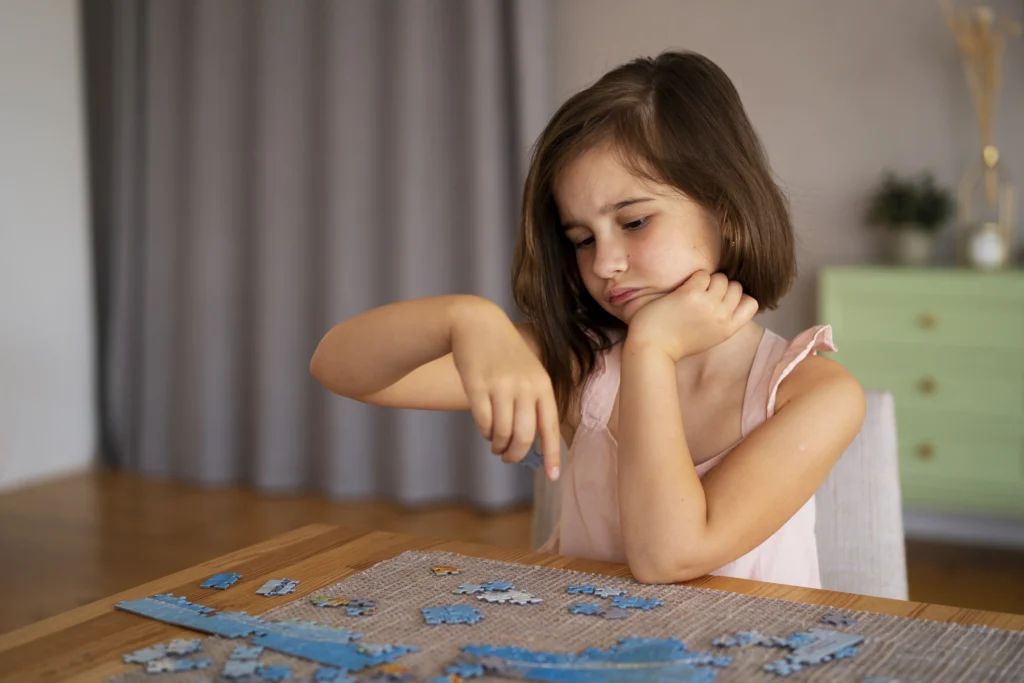
The exact causes of dyspraxia-related movement difficulties and DCD are not fully understood.
Research suggests that differences in neurodevelopmental processes involved in motor coordination, movement planning, sensory feedback and motor learning contribute to these difficulties.
There is no single confirmed cause that explains every child’s presentation.
1. Differences in Neurodevelopment
The brain coordinates movement by combining information about posture, balance, body position, timing and sensory feedback.
Differences in how these systems develop and work together may make it harder for a child to organize and perform coordinated movements.
However, there is no specific brain scan or biomarker that independently confirms DCD.
2. Genetic and Familial Factors
Motor coordination difficulties may occur more frequently in some families.
This suggests that genetic factors may contribute to susceptibility, although no single genetic explanation accounts for most children with DCD.
3. Prematurity and Early Developmental Factors
Children born prematurely or with certain early developmental complications may have an increased likelihood of motor difficulties.
However, being born prematurely does not automatically mean that a child will develop dyspraxia or DCD.
A professional assessment is necessary to understand the child’s individual movement difficulties.
4. Co-occurring Developmental Conditions
Dyspraxia-related difficulties can occur alongside other neurodevelopmental conditions, including:
- Attention-deficit/hyperactivity disorder (ADHD).
- Autism spectrum disorder (ASD).
- Specific learning difficulties.
- Speech and language difficulties.
Some children may also experience anxiety or reduced self-confidence because of repeated difficulties with everyday tasks.
These conditions need individual assessment. Their presence does not automatically explain all motor coordination problems.
How Is Dyspraxia Different From Normal Childhood Clumsiness?
Children develop movement skills at different rates.
Some may need more time to learn cycling, handwriting, catching a ball or fastening buttons.
The important difference is whether the difficulties are persistent, substantially below age expectations and affecting everyday functioning.
| Normal childhood variation | Possible DCD-related difficulties |
|---|---|
| Occasional tripping during play | Frequent and persistent coordination difficulties |
| Needs some practice to learn a new activity | Requires substantially more practice than expected |
| Gradually becomes more independent | Continues to struggle with age-appropriate tasks |
| Manages most daily activities | Needs additional help with dressing and self-care |
| Participates comfortably in most activities | Avoids activities because of movement difficulties |
A child should not be labelled as having dyspraxia based on one or two symptoms.
A comprehensive assessment helps determine whether the difficulties are consistent with DCD or another condition.
How Is Dyspraxia Diagnosed in Children?
When dyspraxia is suspected, healthcare professionals assess the child’s developmental history, movement abilities and everyday functioning.
If the presentation is consistent with DCD, diagnosis generally involves four main criteria.
1. Motor Coordination Is Below Age Expectations
The child’s ability to learn and perform coordinated movements must be substantially below what is expected for their age and opportunities to practice.
Standardized assessments may examine balance, manual dexterity and ball skills.
Common assessment tools include:
- Movement Assessment Battery for Children, Second Edition (MABC-2): Evaluates manual dexterity, aiming and catching, and balance.
- Bruininks-Oseretsky Test of Motor Proficiency, Second Edition (BOT-2): Assesses several aspects of motor proficiency.
- Developmental Coordination Disorder Questionnaire (DCDQ): A parent-completed questionnaire that helps identify everyday coordination difficulties. It is a screening tool, not a diagnostic test.
2. Difficulties Affect Everyday Activities
Motor difficulties must significantly and persistently interfere with activities such as:
- Dressing and personal care.
- Handwriting and schoolwork.
- Sports and physical education.
- Playground activities.
- Learning new motor skills.
- Independent participation in daily routines.
3. Difficulties Begin During Childhood
The difficulties must originate during the developmental period.
Some children show early movement challenges, while others become noticeably affected when school and everyday activities require more complex coordination.
4. Other Conditions Are Considered
The difficulties must not be better explained by another medical, neurological or developmental condition.
Assessment may consider cerebral palsy, neuromuscular disorders, significant visual impairment and other conditions affecting movement.
A pediatrician or appropriately qualified multidisciplinary team may coordinate the diagnostic process.
Physiotherapists and occupational therapists can contribute important information about motor performance and everyday functioning.
Can dyspraxia be diagnosed before age five?
DCD may be suspected in younger children, but a formal diagnosis is generally approached cautiously because motor skills are still developing.
International recommendations suggest that children under five should generally only receive a diagnosis when motor difficulties are severe and confirmed through at least two assessments separated by three months.
The NHS also explains that a definite DCD diagnosis is not usually made before the age of five. (NHS, 2023)
How Can Pediatric Physiotherapy Help Children With Dyspraxia?
Pediatric physiotherapy can help children develop functional movement skills, improve coordination and participate more confidently in everyday activities.
Treatment should be based on an individual assessment rather than using the same exercise program for every child.
The physiotherapist identifies the movements causing difficulty and develops practical goals based on the child’s needs.
1. Improving Balance and Postural Control
Balance is essential for walking, climbing, running and participating in physical activities.
Physiotherapy activities may include:
- Standing on one foot.
- Walking along marked pathways.
- Stepping over low obstacles.
- Reaching for objects while standing.
- Practicing controlled changes in direction.
- Age-appropriate balance games.
These activities help children practice maintaining stability during movement.
2. Developing Motor Planning and Coordination
Motor planning involves organizing the movements required to complete an activity.
A child may know what they want to do but struggle to perform the movements in the correct sequence.
Physiotherapists may use:
- Obstacle courses.
- Movement imitation.
- Jumping sequences.
- Ball activities.
- Stepping patterns.
- Structured movement games.
Activities can be broken into smaller steps before the child practises the complete movement.
3. Improving Gross Motor Skills
Gross motor skills involve larger movements of the arms, legs and trunk.
Depending on the child’s needs, physiotherapy may focus on:
- Running and changing direction.
- Jumping and hopping.
- Climbing activities.
- Stair negotiation.
- Throwing and catching.
- Kicking a ball.
- Learning cycling movements.
Practising meaningful activities helps children develop skills that can be used outside the therapy environment.
4. Building Strength and Endurance
Some children with coordination difficulties may have reduced physical fitness or endurance, particularly if they avoid physical activities.
A physiotherapist may introduce age-appropriate activities such as:
- Squatting during play.
- Step-ups.
- Modified animal walks.
- Climbing activities.
- Repeated sit-to-stand movements.
- Walking and cycling.
Strengthening should support functional movement rather than replace practicing the activities the child finds difficult.
5. Improving Hand-Eye and Foot-Eye Coordination
Coordinating movements with visual information can be challenging for some children.
Activities may include:
- Catching and throwing different-sized balls.
- Kicking a stationary ball.
- Rolling a ball towards a target.
- Stepping towards visual markers.
- Following simple movement sequences.
These activities provide opportunities to practice visual tracking, timing and movement control.
6. Using Task-Specific Motor Training
Task-specific training involves practicing the actual activities a child wants to improve.
For example:
- A child struggling with stairs practices appropriate stair movements.
- A child who finds catching difficult practices graded catching activities.
- A child struggling with jumping practices the movement in manageable stages.
- A child who finds cycling difficult practices the component movements before progressing to the complete task.
This approach focuses on functional skills rather than relying only on general exercises.
The 2026 American Physical Therapy Association clinical practice guideline updates recommendations for physical therapy assessment and intervention in children with coordination difficulties, including those at risk of or diagnosed with DCD.
It supports an individualized approach focused on improving activity and participation. (Sargent et al., 2026)
7. Setting Individualized Therapy Goals
Physiotherapy goals should reflect the activities that matter to the child and family.
Examples include:
- Improving balance while walking.
- Climbing stairs more independently.
- Catching a ball during playground activities.
- Riding a bicycle.
- Participating in physical education.
- Developing confidence during movement-based play.
Progress should be reviewed regularly, with activities adjusted as the child’s abilities change.
A 2025 systematic review of physical therapy interventions found evidence supporting task-oriented interventions for children with DCD.
It also identified supplemental approaches, although the quality and strength of evidence vary between interventions. (Iwamoto et al., 2025)
Physiotherapy vs Occupational Therapy for Dyspraxia
Children with dyspraxia-related difficulties may benefit from both physiotherapy and occupational therapy.
The two professions have complementary roles, and their responsibilities may overlap depending on the child’s needs.
| Pediatric physiotherapy | Occupational therapy |
|---|---|
| Balance and postural control | Handwriting and fine motor skills |
| Running, jumping and hopping | Dressing and self-care |
| Gross motor coordination | Using cutlery and classroom tools |
| Ball skills and functional movement | Hand function and everyday task adaptations |
| Physical fitness and movement confidence | Independence in daily routines |
For example, physiotherapy may help a child improve balance and playground movement, while occupational therapy may focus on handwriting, fastening buttons and using classroom materials.
Some children benefit from a coordinated program involving both professionals.
Dyspraxia in Children: Myth vs Fact
MYTH: Children with dyspraxia are simply clumsy.
FACT: Dyspraxia involves persistent difficulties with motor coordination and movement planning that can affect everyday activities and participation.
MYTH: Dyspraxia means a child is less intelligent.
FACT: Motor coordination difficulties do not automatically indicate lower intelligence. Children have different strengths and learning needs.
MYTH: Children will automatically outgrow dyspraxia.
FACT: Difficulties can continue as children grow, although appropriate intervention, practice and adaptations can improve everyday functioning.
MYTH: Physiotherapy only involves stretching and strengthening.
FACT: Physiotherapy often focuses on practicing meaningful activities such as balancing, jumping, catching, climbing and learning movement skills.
MYTH: A child who struggles with handwriting must have dyspraxia.
FACT: Handwriting difficulties can have several causes. A comprehensive assessment is needed to understand the underlying difficulties.
How Can Dyspraxia Affect School and Emotional Wellbeing?
Dyspraxia can affect more than a child’s ability to perform physical movements.
Repeated difficulties with handwriting, sports, classroom tasks and social activities may affect confidence and participation.
At school, children may struggle with:
- Completing written work within the allotted time.
- Using scissors and classroom tools.
- Changing clothes for physical education.
- Following movement-based instructions.
- Participating in playground games.
- Organizing books and school materials.
Teachers can support children by providing additional time, breaking complicated tasks into smaller steps and offering clear demonstrations.
Emotional wellbeing also matters. Some children may become anxious, frustrated or reluctant to participate after repeated experiences of difficulty.
The international clinical recommendations for DCD emphasize considering self-concept and psychosocial factors when planning intervention.
Support should therefore address not only motor performance but also the child’s confidence and participation.
How Can Parents Support a Child With Dyspraxia at Home?
Parents can help children practice movement and everyday skills through enjoyable activities.
Encourage Regular Physical Play
Offer opportunities for swimming, cycling, dancing, ball games and playground activities.
Choose activities that match the child’s abilities and interests rather than focusing on competition.
Break Complicated Tasks Into Smaller Steps
Activities involving several movements may feel difficult.
For example, learning to tie shoelaces can be divided into smaller steps and practiced gradually.
Demonstrate Movements Clearly
Some children benefit from watching an activity before attempting it.
Simple instructions, visual demonstrations and repeated practice can make unfamiliar movements easier to understand.
Allow Additional Time
Children with coordination difficulties may need more time to complete everyday activities.
Avoid rushing them or repeatedly taking over tasks they are learning to perform independently.
Encourage Progress Without Comparison
Comparing a child’s movement abilities with siblings or classmates can reduce confidence.
Recognize small improvements and encourage activities that the child enjoys.
Can Children Outgrow Dyspraxia?
Children do not necessarily outgrow dyspraxia or DCD as they get older.
Motor coordination difficulties can continue into adolescence and adulthood, although the way they affect everyday life may change.
With appropriate intervention, practice and environmental support, children can learn effective strategies and improve their ability to perform meaningful activities.
Progress varies depending on individual difficulties, associated conditions and opportunities for practice.
The aim of intervention is to improve functional independence, participation and confidence rather than expecting every child to perform all activities exactly like their peers.
When Should Parents Seek Professional Assessment?
Parents should consider seeking professional advice when a child consistently struggles with movement, coordination or everyday activities.
Signs that deserve assessment include:
- Frequent tripping and falling.
- Persistent balance difficulties.
- Difficulty learning new motor skills.
- Problems with handwriting and fine motor activities.
- Trouble dressing or using utensils independently.
- Avoidance of sports and playground activities.
- Coordination difficulties affecting school participation.
Important: Sudden clumsiness, new weakness, loss of previously acquired skills, significant pain or new walking difficulties should not automatically be attributed to dyspraxia.
These symptoms need prompt medical assessment.
Final Thoughts
Dyspraxia can make everyday activities more challenging for children, but coordination difficulties do not define their abilities or potential. With the right assessment, practical strategies and consistent support, children can develop skills that make daily life easier.
Pediatric physiotherapy can support balance, movement planning, coordination and participation through activities tailored to each child’s needs. Occupational therapy and school-based support may also help with handwriting, dressing and other everyday tasks.
Every child learns differently. The goal is not perfect movement, but greater independence, confidence and participation in everyday life.
Conclusion
Dyspraxia-related difficulties can affect how children plan, organize and perform everyday movements.
From running and jumping to handwriting, dressing and using cutlery, these challenges can influence several aspects of childhood.
Although coordination difficulties may continue as children grow older, appropriate assessment and intervention can help children develop practical movement strategies and greater independence.
Pediatric physiotherapy focuses on balance, gross motor coordination, functional movement and task-specific practice.
Occupational therapy can provide additional support for handwriting, fine motor skills and daily activities.
Recognizing persistent difficulties, encouraging regular practice and providing a supportive environment can help children participate more confidently at home, at school and during play.
Frequently Asked Questions About Dyspraxia in Children
1. What are the early signs of dyspraxia in children?
Early signs may include frequent stumbling, difficulty learning new movements, poor balance, trouble using utensils, challenges with dressing and difficulties coordinating both hands. The pattern and impact of these difficulties matter more than any single sign.
2. Is dyspraxia the same as developmental coordination disorder (DCD)?
Dyspraxia is a commonly used term for motor planning and coordination difficulties. Developmental coordination disorder (DCD) is the recognized clinical diagnosis used in international clinical recommendations. The terms are often used interchangeably in everyday healthcare discussions.
3. At what age can dyspraxia be diagnosed?
A formal DCD diagnosis is generally not made before the age of five because motor skills are still developing. However, significant coordination difficulties can be assessed and supported earlier.
4. Can physiotherapy help children with dyspraxia?
Yes. Pediatric physiotherapy can help children practice balance, coordination, motor planning and functional movement skills. Treatment is tailored to the child’s difficulties and everyday goals.
5. Does dyspraxia affect handwriting and school performance?
It can. Difficulties with fine motor coordination, pencil control and organizing movements may make handwriting and classroom tasks more demanding. Appropriate teaching strategies and occupational therapy support may help.
6. Can a child outgrow dyspraxia?
Some children improve their motor skills considerably with practice and support. However, coordination difficulties associated with DCD may continue into adolescence and adulthood. Strategies and adaptations can make everyday activities easier.
7. Which specialist should assess a child with suspected dyspraxia?
A pediatrician or developmental specialist can coordinate an assessment. Depending on the child’s needs, a physiotherapist and occupational therapist may also assess motor coordination, balance, functional movement and daily living skills.
Stay tuned with us for more health related topics.
Follow us on LinkedIn and Instagram for more.
More Read


Medical Disclaimer
The information in this article is intended for general educational purposes only. It is not a substitute for professional medical advice, diagnosis or treatment.
Every child’s development and movement abilities are different. Difficulties with coordination or motor planning should be assessed by an appropriately qualified healthcare professional before a diagnosis or treatment plan is considered.
Parents and caregivers should consult a pediatrician or qualified pediatric physiotherapist if they have concerns about a child’s movement, coordination or development. Sudden weakness, loss of previously acquired skills or sudden changes in walking require prompt medical assessment.


