

Scheuermann’s kyphosis in teenagers causes a rigid, forward-rounded upper back that develops during adolescence as the spine grows.
A teenager who constantly appears to be slouching may not always have a posture problem.
Sometimes, the rounded upper back is a sign of a structural spinal condition that develops during the growing years.
One condition parents should know about is Scheuermann’s kyphosis in teenagers, also called Scheuermann’s disease or juvenile kyphosis.
Imagine a 14-year-old boy who suddenly seems to have a more prominent upper back.
His shoulders look rounded, his head appears slightly forward, and his mother repeatedly reminds him to sit straight.
He tries correcting his posture, but the curve remains.
After some time, he begins complaining of discomfort between his shoulder blades, particularly after sitting through long school hours or participating in sports.
This is an important situation to recognise.
Quick Answer
Scheuermann’s kyphosis is a structural spinal condition that causes an excessive forward curve of the upper or middle back during adolescence. It develops when several vertebrae grow with an abnormal wedge-shaped appearance.
Unlike ordinary postural rounding, this deformity does not completely correct when the teenager consciously stands straight. Treatment may include physiotherapy, monitoring and a specialised spinal brace during growth. Severe progressive cases may require surgical assessment.
The problem may not be poor posture, excessive mobile phone use or a lack of back exercises.
The shape of the vertebrae themselves may be contributing to the appearance.
Scheuermann’s kyphosis in teenagers develops when several vertebrae grow with an abnormal wedge-shaped appearance, creating an increased forward curvature of the thoracic or thoracolumbar spine.
Unlike ordinary postural rounding, this deformity is relatively rigid and cannot be completely corrected simply by asking the teenager to stand upright.
According to the 2023 review Scheuermann Kyphosis:
Current Concepts and Management, the condition affects up to approximately 8% of children in the United States, although reported prevalence varies between populations and diagnostic criteria. (Springer)
As a physiotherapist, I consider early recognition particularly important because adolescence is a period when the spine is still developing.
Identifying a structural deformity while considerable growth remains may provide an opportunity for appropriate monitoring, bracing and rehabilitation.
The most important message for parents is this: not every rounded back is caused by slouching, and not every teenager with Scheuermann’s kyphosis needs surgery.
Key Takeaways
- Scheuermann’s kyphosis is a structural spinal deformity that commonly becomes noticeable during adolescence.
- Abnormal vertebral growth creates wedge-shaped vertebrae and an excessive forward spinal curve.
- It is different from ordinary postural kyphosis because the structural curve is relatively rigid.
- Persistent rounded shoulders, thoracic discomfort and restricted spinal extension can be warning signs.
- Standing spinal X-rays help assess vertebral wedging and measure the kyphotic angle.
- Physiotherapy improves strength, movement, function and symptoms, but cannot reliably reverse established vertebral wedging.
- Bracing may help selected teenagers who still have considerable skeletal growth remaining.
- Most teenagers do not require surgery. Severe, progressive or symptomatic deformities need specialist assessment.
What Exactly Happens Inside the Spine?
The thoracic spine naturally curves forwards.
This backward-facing rounded appearance is called kyphosis, and a certain degree of it is completely normal.
Problems arise when this curvature becomes excessive.
In Scheuermann’s disease, the front portion of certain vertebral bodies develops more slowly or differently than the back portion.
Consequently, the vertebrae become wedge-shaped rather than maintaining their usual rectangular appearance.
When several neighbouring vertebrae develop this shape, their combined effect produces a more noticeable forward spinal curve.
The most commonly affected area is the middle thoracic spine, particularly around T7 to T9.
However, some teenagers develop a lower thoracic or thoracolumbar pattern.
A useful way to understand the condition is to imagine stacking rectangular building blocks.
When the blocks are properly shaped, the stack remains relatively straight.
However, if several blocks become wedge-shaped, the entire structure gradually bends forwards.
This is essentially what happens during the development of structural kyphosis.
Why are the vertebral endplates important?
Vertebral endplates are the thin interfaces between the vertebral body and the intervertebral disc.
They play an important role in distributing mechanical loads and supporting normal spinal growth.
Researchers have investigated whether disturbances in endplate development, mineralisation and ossification contribute to Scheuermann’s disease.
Abnormalities in these areas may interfere with the normal growth of the vertebral bodies, encouraging anterior wedging.
This is also why some teenagers with Scheuermann’s disease have irregular vertebral endplates and small depressions called Schmorl’s nodes.
These represent disc material extending into the adjacent vertebral body through an endplate.
Interestingly, Schmorl’s nodes can occur in people without symptoms, so their presence alone does not establish the diagnosis. (O’Donnell et al., 2023)
Why Does a Teenager Develop Scheuermann’s Kyphosis?
One of the most important facts parents should understand is that Scheuermann’s kyphosis in teenagers is not simply caused by sitting incorrectly.
Its exact cause remains uncertain.
Researchers believe that a combination of inherited susceptibility and developmental or mechanical factors may contribute.
1. Rapid growth during puberty
The condition commonly becomes noticeable during the prepubertal or adolescent growth spurt.
During this period, bones grow rapidly, and the spine undergoes considerable developmental changes.
A disturbance in vertebral growth may become more apparent as the teenager gains height.
This explains why a parent may notice a rounded back developing over several months rather than being present from early childhood.
The condition is commonly diagnosed between 12 and 17 years of age.
2. Genetic susceptibility
Family history may play a role.
Research into familial Scheuermann’s disease suggests that inherited factors can contribute to susceptibility. Studies of twins have also supported a possible genetic component.
However, inheritance patterns are not fully established, and having a parent with Scheuermann’s kyphosis does not mean that a child will necessarily develop it.
An important distinction is that genetic susceptibility cannot be changed through exercises, posture correction or lifestyle modifications. (BMJ)
3. Abnormal vertebral growth and endplate development
One proposed explanation involves abnormal development of the vertebral endplates.
When the vertebral body does not grow evenly, the front portion may become shorter relative to the back portion.
This contributes to the characteristic wedge shape.
Researchers have also investigated the influence of altered mechanical loading and hormonal factors during skeletal development.
However, there is no single proven mechanism that explains every case.
4. Mechanical loading during growth
The developing spine constantly adapts to mechanical forces.
Researchers have explored whether abnormal load distribution across the growing vertebral endplates contributes to the progression of the deformity.
This does not establish that schoolbags, gym workouts, sitting at desks or playing sports directly cause Scheuermann’s disease.
Parents should avoid blaming teenagers for their spinal shape or assuming that removing a backpack will correct the condition.
The relationship between mechanical loading and disease development remains an area of research.
How Can Parents Recognise the Early Signs?
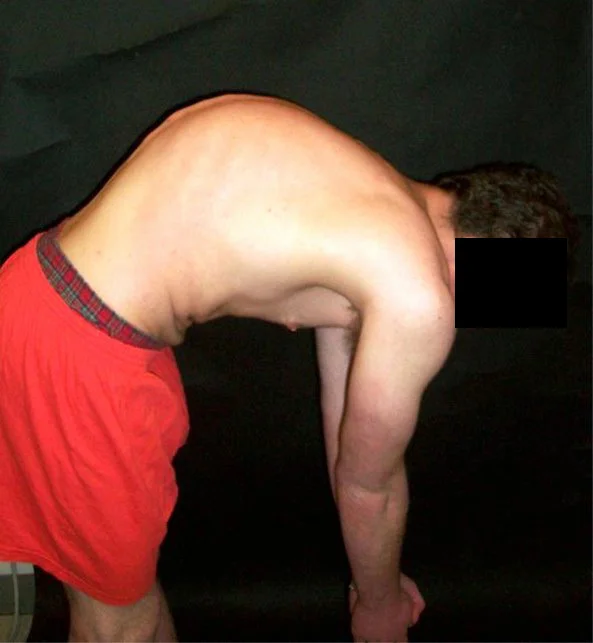
The first indication is often visual rather than painful.
Parents may notice that their teenager’s upper back appears unusually rounded, particularly when standing sideways.
However, several additional features can help identify a possible structural problem.
1. A persistent rounded upper back
This is one of the most recognisable features.
The curve may appear more pronounced when the teenager bends forwards.
Unlike ordinary slouching, it does not disappear completely when they are reminded to straighten their back.
Some teenagers also develop a more angular appearance around the middle of the thoracic spine.
2. Shoulders that appear rounded forwards
The shoulders may rest in a forward position, creating the appearance of a closed chest.
This can occur alongside increased thoracic curvature and changes in shoulder mechanics.
One lesser-known finding is that some patients experience restricted overhead shoulder movement because the altered thoracic position affects the mechanics of the shoulder complex.
A physiotherapist should assess actual shoulder flexion rather than assuming every limitation originates from tight chest muscles.
3. Head appearing forward
A teenager may gradually develop a forward head position.
This can be part of the body’s attempt to maintain the eyes looking horizontally despite increased forward spinal curvature.
The neck may develop compensatory extension or lordosis.
It is important to assess the entire spine rather than focusing only on the most visible rounded area.
4. Back pain after prolonged sitting
Some teenagers experience discomfort around the apex of the thoracic curve.
Pain may become noticeable after:
- Sitting through long classroom sessions.
- Studying without movement breaks.
- Participating in repetitive physical activities.
- Standing for prolonged periods.
- Performing exercises that repeatedly load an already sensitive back.
Not every teenager experiences pain. In some cases, the rounded appearance is the primary reason parents seek an assessment.
5. Increased lower-back arch
An interesting feature is the development of compensatory lumbar lordosis.
When the upper spine curves forwards, the lower back and neck may adjust their alignment to maintain balance.
This can increase lower-back muscle demand and contribute to discomfort in a different spinal region.
Therefore, a teenager complaining of lower-back pain may also need an assessment of thoracic alignment.
6. Tight hamstrings
Hamstring tightness is frequently reported in patients with Scheuermann’s kyphosis.
Some teenagers find it difficult to bend forwards while keeping their knees straight.
However, hamstring tightness should not automatically be considered the cause of the spinal deformity.
It may coexist with the condition and contribute to movement limitations or compensatory spinal mechanics. (Asian Spine Journal)
Scheuermann’s Kyphosis vs Ordinary Postural Kyphosis: What Is the Difference?
This is probably the most important distinction for parents.
Both conditions can produce a rounded upper back, but their underlying mechanisms are different.
| Feature | Postural kyphosis | Scheuermann’s kyphosis |
|---|---|---|
| Main cause | Flexible postural positioning | Structural vertebral growth changes |
| Vertebrae | Usually normally shaped | Wedge-shaped vertebrae |
| Flexibility | Generally flexible | Relatively rigid |
| Standing upright | Curve often reduces | Curve persists |
| Pain | May occur | May occur around the curve |
| X-ray | No characteristic vertebral wedging | Characteristic vertebral abnormalities |
| Treatment | Posture education and exercise when needed | Monitoring, physiotherapy and sometimes bracing |
A teenager with postural kyphosis may improve the appearance of their upper back when instructed to stand upright.
In Scheuermann’s kyphosis, the underlying vertebral shape limits how much the curve can be corrected voluntarily.
One important clinical detail: early Scheuermann’s disease can sometimes appear more flexible than established disease. Therefore, flexibility alone cannot rule it out.
A proper physical assessment and, when indicated, radiographic evaluation are needed. (Pediatric Orthopaedic Society of North America)
How Is Scheuermann’s Kyphosis Diagnosed?
Diagnosis involves understanding the teenager’s growth history, symptoms, physical examination findings and spinal imaging.
Physical assessment
A physiotherapist or orthopaedic specialist may examine:
- Thoracic spinal alignment.
- Shoulder position and overhead movement.
- Cervical and lumbar compensatory curves.
- Hamstring flexibility.
- Thoracic extension mobility.
- Core and spinal extensor strength.
- Balance and functional movement.
- Lower-limb neurological function.
The Adam’s forward bend test may also be used to examine spinal alignment from different directions.
A clinical examination can suggest structural kyphosis, but it cannot confirm vertebral wedging.
What does an X-ray reveal?
A standing lateral spine X-ray is commonly used to assess the curvature and vertebral shape.
One established diagnostic criterion is the presence of at least 5 degrees of anterior wedging in three consecutive vertebrae.
Other findings can include:
- Irregular vertebral endplates.
- Increased thoracic kyphosis.
- Reduced disc space.
- Schmorl’s nodes.
A thoracic Cobb angle greater than approximately 45 degrees is commonly used in defining abnormal thoracic kyphosis, although diagnostic criteria vary between publications.
The radiologist or treating specialist considers the complete appearance rather than relying on one measurement.
Is an MRI necessary?
MRI is not routinely required for every teenager with Scheuermann’s disease.
It may be recommended when the medical history is unusual, neurological signs are present, pain is unexplained or other spinal conditions need to be excluded.
MRI may also help identify associated disc abnormalities and spinal cord pathology.
Can Scheuermann’s Kyphosis Become Worse as the Teenager Grows?
Yes, progression can occur, particularly during periods of significant growth.
However, progression varies between individuals.
A teenager with a relatively mild curve and substantial remaining growth may require a different management approach from someone who has almost reached skeletal maturity.
This is why age alone is not enough to determine treatment. The specialist also considers skeletal maturity, curve magnitude, flexibility, symptoms and evidence of progression.
A particularly useful recent publication is David M. Bennett’s 2025 review, The Natural History of Scheuermann’s Kyphosis.
The review discusses long-term observations and highlights that some curvature progression may continue after skeletal maturity, although the average rate is generally gradual.
It also emphasises that radiographic curvature alone does not reliably predict an individual’s pain or disability. (Elsevier)
This finding is important because parents should not interpret every change in posture as an emergency, but neither should a rapidly changing deformity be dismissed as normal teenage development.
Physiotherapy for Teenagers With Scheuermann’s Kyphosis
Physiotherapy has an important role in managing Scheuermann’s kyphosis.
However, treatment goals need to be realistic.
Exercise cannot reliably reverse established vertebral wedging.
The purpose of rehabilitation is to improve movement quality, muscular capacity, discomfort, daily function and the teenager’s confidence in physical activity.
I would approach rehabilitation by considering the teenager’s movement limitations rather than simply giving everyone the same set of posture-correction exercises.
1. Thoracic extensor strengthening
The muscles responsible for supporting and extending the thoracic spine need adequate strength and endurance.
Exercises may include:
- Controlled prone thoracic extension.
- Supervised back extensor strengthening.
- Resistance-band pulling exercises.
- Modified bird-dog exercises.
- Appropriate trunk endurance exercises.
The goal is to improve muscular support without repeatedly forcing the spine into painful or excessive extension.
2. Pectoral muscle mobility
Some teenagers develop restricted anterior chest mobility alongside rounded shoulders.
Gentle pectoral stretching can help improve shoulder movement and comfort.
Doorway stretches may be appropriate when they do not reproduce pain.
The teenager should avoid aggressively forcing the shoulders backwards, particularly when doing so creates discomfort around the apex of the deformity.
3. Abdominal and trunk conditioning
Abdominal strengthening is useful for improving trunk control and overall movement capacity.
A physiotherapist may prescribe:
- Modified dead-bug exercises.
- Controlled abdominal bracing.
- Modified side planks.
- Bird-dog variations.
- Functional trunk stability exercises.
The intensity should be adjusted to the teenager’s exercise tolerance.
4. Hamstring flexibility
Hamstring stretching can be beneficial where a genuine flexibility restriction exists.
However, aggressive stretching is unnecessary.
I prefer controlled stretches with comfortable tension rather than forcing the teenager to touch their toes.
Importantly, increasing hamstring flexibility does not directly reshape the vertebral bodies.
5. Scapular control and shoulder mechanics
Thoracic alignment influences how the shoulder blades move during arm elevation.
Exercises targeting the middle and lower trapezius, serratus anterior and other scapular stabilising muscles may help improve functional shoulder control.
Examples include:
- Wall slides.
- Resistance-band rows.
- Serratus punches.
- Controlled scapular retraction.
- Wall-based shoulder mobility exercises.
The objective is improved shoulder function, not holding the shoulder blades squeezed together all day.
6. Schroth-based rehabilitation
Schroth therapy involves three-dimensional postural correction, breathing strategies, muscular activation and specific exercise positioning.
A randomised controlled trial published in the Asian Spine Journal in 2019 compared Schroth therapy with traditional antigravity exercises in 50 young adults with Scheuermann’s disease.
Participants followed an exercise programme over 12 months. The researchers reported greater improvements in thoracic kyphosis measurements in the Schroth group compared with the control group.
This is encouraging evidence, but there are limitations: the trial was relatively small and studied young adults rather than a large group of growing adolescents.
Therefore, Schroth therapy should be considered a potentially useful rehabilitation approach, not a guaranteed correction method.
7. Breathing and rib-cage mobility
An often-overlooked rehabilitation component is comfortable thoracic expansion.
The thoracic spine and rib cage work together during breathing. When spinal movement is restricted, some teenagers may develop less efficient movement patterns around the chest.
Gentle breathing exercises and rib-cage mobility work may help improve movement awareness and exercise tolerance.
These techniques are supportive rehabilitation tools, not methods of correcting vertebral wedging.
Can a Brace Correct Scheuermann’s Kyphosis In Teenagers?
Bracing may be recommended for selected teenagers who are still growing and have a moderate structural deformity.
This is one of the most important reasons early diagnosis matters.
A brace applies corrective forces to the spine. During skeletal growth, these forces may help improve the spinal curve and encourage better vertebral development.
The objective is not simply to make the teenager stand straight while wearing the brace.
The long-term aim is to minimise progression and obtain the best achievable correction while the spine is still developing.
The exact brace depends on the location and characteristics of the curve.
A thoracolumbosacral orthosis (TLSO) or another specifically designed antikyphotic brace may be prescribed.
The treatment plan depends on:
- The measured kyphosis angle.
- The amount of remaining skeletal growth.
- Vertebral wedging.
- Curve flexibility.
- Pain and functional limitations.
- The teenager’s ability to tolerate and consistently wear the brace.
There is encouraging evidence for bracing during growth.
A 2023 observational controlled cohort study followed 158 patients receiving conservative brace treatment.
Mean kyphosis decreased from approximately 57.6 degrees before treatment to 43.3 degrees at treatment completion.
At around ten years of follow-up, the mean was approximately 44.5 degrees.
The researchers reported that the correction remained relatively stable during follow-up.
These results are encouraging, but an observational cohort cannot guarantee the same outcome for every teenager.
Treatment selection, skeletal maturity and adherence are important considerations. (European Journal of Physical and Rehab Medicine)
Physiotherapy tip: Do not allow a teenager to independently purchase a posture corrector or rigid back brace online.
Ordinary posture supports are not equivalent to a medically prescribed antikyphotic orthosis.
What Should Teenagers Avoid?
The objective is to keep the teenager active without unnecessarily aggravating symptoms.
Some common mistakes deserve attention.
Avoid treating every rounded back as poor posture. Repeated reminders to sit straight do not address structural vertebral changes.
Avoid aggressive back-bending exercises. Forcing spinal extension against pain may irritate sensitive structures.
Avoid unsupervised heavy spinal loading.
Weight training is not automatically prohibited, but exercises should be adapted to the teenager’s symptoms, control and clinical findings.
Avoid prolonged static positions. Encourage short movement breaks during homework, gaming and studying.
Avoid excessive stretching. More stretching does not necessarily mean better spinal alignment.
Avoid stopping all sports without medical advice.
Most teenagers should remain physically active, with modifications based on their individual symptoms and specialist recommendations.
Avoid comparing X-ray angles without considering positioning.
Changes in measurement can be influenced by imaging technique and standing position. Serial films should be interpreted appropriately by the treating specialist.
Can Scheuermann’s Kyphosis In Teenagers Be Prevented?
There is currently no proven method of preventing Scheuermann’s kyphosis in teenagers.
Because the condition is associated with developmental changes in vertebral growth and possible inherited susceptibility, parents should not assume that ordinary posture habits caused it.
However, families can support spinal health and reduce avoidable discomfort.
Encourage regular physical activity, age-appropriate strengthening, adequate recovery and a comfortable study environment.
Teach teenagers to change positions regularly rather than maintaining one posture for several hours.
A balanced diet supports normal growth and bone health, but there is no specific vitamin, supplement or food that has been shown to reverse Scheuermann’s vertebral changes.
Most importantly, seek assessment when a rounded back is becoming increasingly prominent.
When Should Parents Consult an Orthopaedic Specialist?
A persistent or progressively increasing rounded upper back deserves professional evaluation.
Seek an orthopaedic or paediatric spine assessment, particularly when:
- The spinal curve appears increasingly prominent over a short period.
- Back pain repeatedly interrupts school, sleep or physical activity.
- The curve does not improve with ordinary postural correction.
- The teenager has significant stiffness or movement restriction.
- There is a noticeable change in spinal balance.
- A previous examination or X-ray has suggested vertebral wedging.
More urgent medical assessment is needed for progressive limb weakness, numbness, difficulty walking, loss of bladder or bowel control, fever with back pain, unexplained weight loss or severe persistent night pain.
These symptoms should not automatically be attributed to Scheuermann’s kyphosis, as they may suggest another condition requiring investigation.
Does Scheuermann’s Kyphosis In Teenagers Require Surgery?
Most teenagers with Scheuermann’s Kyphosis do not require surgery.
Conservative treatment, regular follow-up and bracing when appropriate are sufficient for many patients.
Surgery may be considered when the curve is severe, progressively worsening, associated with substantial persistent pain, causing significant functional or cosmetic difficulties, or accompanied by neurological compromise.
A kyphosis measurement around 70-80 degrees is commonly discussed as approaching the surgical consideration range, but this is not an automatic surgical threshold.
The surgeon must consider the complete clinical picture, skeletal maturity, curve progression, spinal balance and the benefits and risks of surgery.
Spinal fusion is one surgical option for appropriately selected severe cases.
Families should understand that spinal surgery is a major intervention and that decisions are individualised.
What Happens When Scheuermann’s Kyphosis In Teenagers Is Left Untreated?
The long-term outlook is not identical for everyone.
Some individuals experience relatively mild symptoms and maintain good daily function. Others experience persistent back discomfort or increasing functional limitations.
A particularly valuable study published in European Spine Journal examined patients approximately 37 years after diagnosis.
The researchers found that individuals with untreated Scheuermann’s disease had higher odds of constant back pain and some everyday functional difficulties compared with the general population.
However, an important finding was that the measured degree of thoracic kyphosis did not directly correspond to back pain, disability or general health in that study.
This reinforces an important clinical principle: the X-ray appearance is only one part of the patient’s health.
A teenager’s pain, strength, activity tolerance, spinal balance and quality of life must also be evaluated. (European Spine Journal)
A more recent review published in 2025 also examined the natural history of the condition, highlighting the importance of individualised assessment rather than assuming every curve will progress to severe deformity. (JPOSNA)
A Physiotherapist’s Perspective: Look Beyond the Rounded Back
When assessing a teenager with a suspected structural kyphosis, I would not focus exclusively on how far the shoulders appear to sit forwards.
I would want to understand how the entire body is adapting to the spinal curve.
Does the teenager develop lower-back discomfort after standing? Is overhead arm movement restricted? Does the lumbar spine compensate excessively? Is hamstring flexibility limited? Can the teenager participate comfortably in sports?
These questions often reveal more about the functional consequences of the condition than appearance alone.
Another important consideration is confidence.
Teenagers are particularly conscious of changes in their body during puberty.
A visible spinal deformity may cause embarrassment, avoidance of fitted clothing, reluctance to participate in swimming or sports, and anxiety about how other people perceive them.
Parents should avoid repeatedly commenting on their child’s posture or making them feel responsible for the shape of their spine.
Instead, explain that this is a recognised spinal development condition and that appropriate treatment is available.
Rehabilitation should focus on improving physical capability, not making the teenager feel that their body needs to be constantly corrected.
The best treatment plan is one that protects spinal health while allowing the teenager to continue enjoying school, sport and everyday activities.
Final Word
Scheuermann’s kyphosis is more than a rounded-back appearance. It is a structural spinal condition that commonly becomes noticeable during the adolescent growth years.
Although its exact cause remains uncertain, inherited susceptibility and abnormal vertebral development are important areas of research.
The distinction between postural kyphosis and structural kyphosis is particularly important because the two conditions do not respond to treatment in exactly the same way.
For parents, the most useful step is early assessment rather than repeatedly asking their teenager to straighten their back.
For physiotherapists, the priority is to improve spinal function, muscle endurance, mobility and pain while coordinating with an orthopaedic specialist when bracing or further investigation is required.
A rounded back in a growing teenager should not automatically be dismissed as bad posture.
Recognising the difference early can help families make better decisions about spinal health and long-term function.
Lesser-Known Facts About Scheuermann’s Kyphosis In Teenagers
There are several aspects of this condition that receive less attention in ordinary discussions about teenage posture.
1. It can affect more than the middle of the back
Although the classic presentation involves the thoracic spine, Scheuermann’s disease can also affect the thoracolumbar or lumbar region.
This is sometimes described as atypical Scheuermann’s kyphosis.
The location of the curve can influence the symptoms, clinical assessment and brace selection.
2. Mild scoliosis can coexist with kyphosis
Some teenagers with Scheuermann’s kyphosis also have a sideways spinal curve.
POSNA reports an associated mild scoliosis in approximately 20-30% of patients. However, this additional curve does not necessarily progress or require separate treatment.
This is why examining the spine from the front, back and side is important.
3. The teenager may have no back pain at all
Parents sometimes assume that a spinal deformity must produce pain.
That is not necessarily true. Some teenagers first present because of the visible appearance of their upper back, and discomfort may be absent.
A lack of pain does not exclude Scheuermann’s kyphosis.
4. A smaller curve does not automatically mean fewer symptoms
Two teenagers may have similar Cobb angles but completely different experiences.
One may participate in competitive sports without significant difficulty, while another may experience discomfort during prolonged sitting or overhead activities.
The 37-year follow-up study is particularly interesting because the measured kyphosis angle was not directly associated with back pain or general health outcomes. (SpringerLink)
5. Growth remaining may matter more than the teenager’s exact age
A 14-year-old who has considerable growth remaining may have different treatment opportunities from a 14-year-old who is nearing skeletal maturity.
This is especially relevant when deciding whether an orthopaedic brace is appropriate.
The treatment window is related to skeletal development, not just the number of birthdays a teenager has had. (PMC)
A Practical Physiotherapy and Parent Checklist
During follow-up, I would encourage parents to focus on changes in function rather than repeatedly checking the teenager’s back in the mirror.
| What to monitor | Why it matters |
|---|---|
| Change in back appearance | May indicate progression |
| Pain after studying | Helps identify activity-related symptoms |
| Ability to raise both arms | Evaluates shoulder and thoracic movement |
| Sports participation | Measures functional tolerance |
| Standing and walking comfort | Helps assess overall spinal function |
| Brace tolerance, when prescribed | Supports treatment adherence |
| Growth and skeletal maturity | Influences treatment decisions |
Photographs taken at consistent intervals may help families notice visual changes, but they cannot replace clinical examination or appropriately indicated imaging.
A useful practical approach is to maintain a simple symptom diary.
Record when discomfort occurs, which activities aggravate it, whether it settles with rest and whether it affects school or sports.
This information can make physiotherapy and orthopaedic appointments more productive.
Can Teenagers With Scheuermann’s Kyphosis Play Sports?
In most cases, a diagnosis of Scheuermann’s kyphosis does not mean that teenagers must give up sports.
Physical activity supports general fitness, muscular strength, coordination and psychological well-being.
Completely restricting activity without a medical reason may unnecessarily affect the teenager’s confidence and social life.
However, activity should be selected according to the severity of the curve, symptoms and any treatment restrictions.
Which activities may be suitable?
Swimming, walking, cycling, recreational sports and appropriately supervised resistance training may be suitable for many teenagers.
The important consideration is how the teenager responds to the activity.
For example, a teenager experiencing discomfort after repeated trunk extension may need temporary modifications to particular gym exercises.
Someone with significant pain during impact activities may need an individual assessment before returning to competitive sport.
Does weightlifting make the condition worse?
There is no good evidence that all weight training causes Scheuermann’s kyphosis or that every teenagers with this condition must avoid weights.
The more relevant issues are exercise technique, load selection, movement control and symptom response.
I would assess the teenager’s ability to maintain comfortable spinal control during basic movements before progressing to heavier resistance.
Exercises such as squats, deadlifts and overhead presses should be introduced or modified according to individual capacity, not prescribed or prohibited simply because the teenager has a rounded back.
How should a teenager return to sports after a painful episode?
A graded return is generally more sensible than immediately returning to the previous training volume.
A physiotherapist may initially focus on comfortable mobility, trunk endurance and basic conditioning. Sport-specific drills can then be introduced before increasing practice duration and intensity.
The teenager should be able to participate without a significant increase in symptoms during or after activity.
New neurological symptoms, progressive pain or a noticeable deterioration in spinal alignment require reassessment rather than simply reducing exercise intensity.
How Often Should a Teenager Be Monitored?
Follow-up should be individualised.
A teenager with a small, stable curve and no significant symptoms may need a different monitoring schedule from someone experiencing rapid growth, increasing deformity or persistent pain.
The orthopaedic specialist may assess:
- Changes in spinal appearance.
- Growth velocity and skeletal maturity.
- Cobb angle and vertebral wedging where imaging is indicated.
- Pain and activity limitations.
- Response to bracing.
- Neurological examination findings when clinically appropriate.
Repeated X-rays should not be performed unnecessarily.
Imaging frequency should be decided by the treating specialist, taking into account the clinical findings and the need to monitor progression or treatment response.
For parents, the most helpful approach is to attend scheduled appointments rather than waiting until pain becomes severe.
A teenager who feels comfortable and participates normally in everyday activities can still require monitoring if a structural curve has been diagnosed.
The objective is not to medicalise every aspect of the teenager’s life. It is to recognise meaningful changes early and intervene when there is a clinical reason.
Frequently Asked Questions
1. At what age does Scheuermann’s kyphosis develop?
Scheuermann’s kyphosis commonly develops during the preteen and teenage growth years. It is frequently diagnosed between 12 and 17 years of age, when changes in vertebral development become more noticeable.
2. Is Scheuermann’s kyphosis caused by bad posture?
No. Scheuermann’s kyphosis is a structural spinal condition involving abnormal vertebral growth. Poor posture alone does not explain the characteristic vertebral wedging found in this condition.
3. Can physiotherapy correct Scheuermann’s kyphosis?
Physiotherapy can improve muscular strength, spinal mobility, shoulder function, exercise tolerance and pain. However, exercise alone cannot reliably reverse established vertebral wedging. Treatment should be individually planned.
4. Can Scheuermann’s kyphosis become worse during puberty?
Yes. The deformity may progress during periods of rapid growth. The risk and rate of progression vary between individuals, making clinical monitoring important.
5. Does every teenager with Scheuermann’s kyphosis need a brace?
No. Bracing is generally considered for selected patients with moderate deformities who have sufficient skeletal growth remaining. The decision depends on spinal curvature, symptoms and skeletal maturity.
6. Can teenagers with Scheuermann’s disease play sports?
Many teenagers can continue participating in sports. Activities may need modification depending on pain, curve severity and treatment recommendations. A physiotherapist can help plan a graded return to exercise.
7. Is Scheuermann’s kyphosis a permanent condition?
The structural vertebral changes may persist after skeletal maturity. However, symptoms and functional limitations can improve with appropriate management. Long-term outcomes vary according to the severity and individual circumstances.
8. When does Scheuermann’s kyphosis require surgery?
Surgery may be considered for severe progressive deformity, persistent disabling pain or neurological complications. A curve around 70–80 degrees may prompt surgical consideration, but there is no single threshold that applies to every patient.
Stay tuned with us for more health related topics.
Follow us on LinkedIn and Instagram for more.
More Read


Medical Disclaimer!
This article has been reviewed and written under the guidance of our Head Physiotherapist, Dr. Kruti Raj (PT, MUHS,CPT,CMPT). The information shared is intended for educational purposes only and should not be considered a substitute for personalized medical advice, diagnosis, or treatment.
Please consult us or any other qualified healthcare professional before beginning any exercise program, especially if you are experiencing pain, recovering from injury, or managing a medical condition.


