


When can you exercise after Copper-T insertion?
Getting a Copper-T can raise a very practical question: when is it safe to get back to exercise?
Walking, running, strength training, yoga and abdominal exercises may all feel different after insertion, especially if you experience cramping, pelvic discomfort or spotting.
For most women, gentle activity can be resumed as soon as they feel comfortable, while strenuous exercise or heavy lifting may need to wait until cramps and discomfort have settled.
Quick Answer
There is no universal number of days you must wait before exercising after Copper-T insertion. If the insertion was uncomplicated and you feel well, gentle movement can usually be resumed according to comfort. Running, strength training, abdominal exercises and other workouts can be introduced gradually as symptoms settle. Severe pain, heavy bleeding, fever, unusual discharge or suspected IUD displacement should be medically assessed before returning to exercise.
There is no single recovery timeline that applies to every woman.
Your return to exercise depends on how you feel after insertion, whether the procedure was uncomplicated and the aftercare advice provided by your healthcare professional.
A Copper-T sits inside the uterus and provides long-term contraception.
Normal physical activity is not generally considered a typical cause of IUD expulsion, although direct research specifically examining strenuous exercise immediately after insertion is limited (World Health Organization, 2026).
Key Takeaways
- There is no universal exercise waiting period after Copper-T insertion.
- Let your symptoms and your healthcare provider’s aftercare advice guide your return to activity.
- Walking and gentle movement can be useful starting points when you feel comfortable.
- Running, weightlifting, core exercises and yoga can be gradually reintroduced.
- Routine exercise is not generally considered a typical cause of IUD expulsion.
- Severe pain, heavy bleeding, fever or suspected IUD displacement requires medical assessment.
- Physiotherapy may help with pelvic-floor, movement or musculoskeletal symptoms after medical causes have been assessed.
Can You Exercise Immediately After Copper-T Insertion?
There is no universal rule that every woman must completely avoid exercise for a fixed number of hours or days after Copper-T insertion.
However, the insertion procedure can temporarily cause cramping, pelvic discomfort or light bleeding.
Copper IUD users may also experience stronger cramps and heavier or longer periods, particularly during the first few months.
This means your symptoms are more useful than an arbitrary waiting period when deciding how quickly to resume activity.
If you feel comfortable, gentle movement such as walking may be reasonable.
If you are experiencing significant pain, dizziness, unusual bleeding or feeling unwell, rest and seek appropriate medical advice.
When Can You Start Walking?
Walking is one of the simplest activities to resume after insertion.
If you feel well, a short, relaxed walk can help you return to normal movement without placing a high physical demand on your body.
You do not need to make your first walk a workout.
Start at an easy pace and see how your body responds.
If walking increases pelvic pain or bleeding, stop and give yourself more time.
When Can You Go Back to the Gym?
Returning to the gym is less about a specific number of days and more about your symptoms and recovery.
If the insertion was uncomplicated and your cramps have settled, you can gradually return to your normal training routine.
For the first few sessions, consider reducing the duration or intensity rather than immediately returning to your previous workload.
This is particularly relevant if your routine involves high-intensity cardio, heavy resistance training or exercises requiring strong abdominal bracing.
Can You Run After Copper-T Insertion?
Having a Copper-T does not mean that you need to permanently avoid running.
Immediately after insertion, however, the main consideration is usually comfort rather than the idea that running will physically push the IUD out of position.
If walking feels comfortable, you can gradually progress towards jogging and then your normal running routine.
If running causes new or worsening pelvic pain, heavy bleeding, significant cramping or unusual pelvic pressure, stop rather than trying to push through the symptoms.
Can You Lift Weights After Copper-T Insertion?
Strength training can remain part of an active lifestyle after Copper-T insertion.
However, returning directly to maximal lifts immediately after a procedure may not be comfortable for everyone.
A sensible approach is to begin with lighter loads, controlled repetitions and familiar exercises.
If your symptoms remain settled, gradually increase the training demand.
There is limited direct evidence showing that heavy resistance exercise immediately after Copper-T insertion causes expulsion.
Therefore, it would be inaccurate to say that heavy lifting definitely causes an IUD to move or that it can never be associated with symptoms.
Can You Do Abdominal Exercises?
You do not automatically need to avoid abdominal exercises because you have a Copper-T.
Controlled core exercises can generally be reintroduced according to comfort.
However, intense abdominal bracing may feel uncomfortable soon after insertion if you are already experiencing pelvic cramping.
Instead of focusing only on whether an exercise is technically allowed, pay attention to how you are breathing, bracing and responding to the movement.
If an exercise repeatedly increases pelvic pain or pressure, reduce the intensity or temporarily choose another movement.
Can You Swim After Copper-T Insertion?
Swimming is not permanently restricted because you have a Copper-T.
The timing immediately after insertion can depend on your healthcare provider’s specific aftercare instructions and whether you are experiencing bleeding, discomfort or other symptoms.
Because post-insertion recommendations can vary, follow the advice given by the clinician who inserted the device rather than assuming that one waiting period applies to everyone.
Once you have recovered and have no symptoms requiring medical attention, having a Copper-T does not normally prevent you from swimming.
What About Yoga and Stretching?
Gentle yoga and stretching can be useful when gradually returning to normal activity.
Choose movements that feel comfortable and avoid forcing deep stretches if your pelvis feels sore.
Breathing-based movement may also be helpful if you notice that you are unconsciously tightening your abdominal or pelvic-floor muscles because of discomfort.
The goal is not to aggressively stretch the pelvis. It is to restore comfortable movement and confidence.
Is Cramping After Exercise Normal?
Some cramping can occur after Copper-T insertion, particularly during the early adjustment period.
Copper IUDs can also cause stronger menstrual cramps and heavier or longer periods, particularly during the first few months (Godfrey et al., 2013).
Mild, short-lived discomfort that settles with rest is different from severe or progressively worsening pain.
Pain that is intense, persistent or associated with heavy bleeding, fever, unusual vaginal discharge, dizziness or pregnancy symptoms should not simply be attributed to exercise.
These symptoms require medical assessment.
Can Exercise Cause Copper-T Expulsion?
This is one of the most common concerns, but the evidence needs to be interpreted carefully.
IUD expulsion is a recognized complication of IUD use.
However, exercise is not established as a routine cause of expulsion.
WHO describes expulsion as a possible complication and also notes that IUDs do not normally move to other parts of the body (World Health Organization, 2026).
Research examining other potential contributors to IUD expulsion also demonstrates why strong conclusions should be avoided when evidence is limited.
For example, a systematic review examining menstrual cup use found that evidence regarding a possible association with IUD expulsion was scarce and inconsistent (Bowman & Thwaites et al., 2023).
This does not establish a link between exercise and expulsion.
The more accurate message is that routine physical activity is not generally considered a typical cause of IUD expulsion, while direct evidence about strenuous exercise immediately after insertion remains limited.
What Are the Signs That a Copper-T Has Moved?
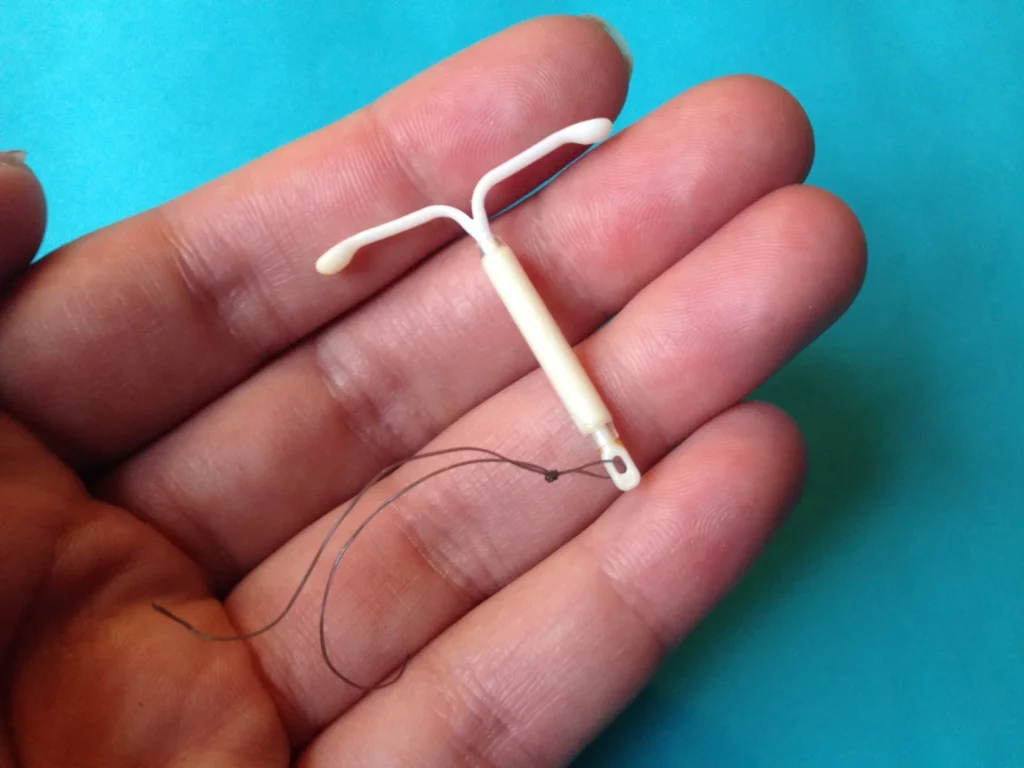
You should seek medical advice if you notice symptoms that could indicate expulsion or another complication.
These may include:
- New or severe pelvic pain
- Heavy or unusual bleeding
- Pain during sex
- A noticeable change in the IUD strings
- Being unable to feel the strings when you previously could
- Feeling part of the device in the vagina
- Fever or unusual vaginal discharge
- Symptoms suggesting pregnancy
Changes in string length do not automatically prove that an IUD has moved.
If you are concerned about the position of your Copper-T, a healthcare professional can assess it.
Physiotherapy should not be used to diagnose, remove or reposition an IUD.
When Should You Stop Exercising?
Stop your workout and seek appropriate medical advice if exercise is followed by:
- Severe or increasing pelvic pain
- Heavy bleeding
- Fainting or significant dizziness
- Fever
- Unusual or foul-smelling discharge
- New severe pain during sex
- A suspected expelled or displaced IUD
The important distinction is between ordinary exercise-related fatigue and symptoms that could indicate a gynaecological problem.
Do not try to train through unexplained pelvic symptoms after an IUD insertion.
How Should You Return to Exercise?
A gradual return is often more comfortable than trying to resume everything at once.
Start with comfortable movement
Walking and gentle daily activities allow you to see how your body responds.
Add familiar exercise
If symptoms remain settled, gradually reintroduce your usual cardio, resistance or mobility exercises.
Increase intensity gradually
Instead of immediately returning to maximum weights, sprinting or very high-intensity sessions, build your workload over several sessions.
Pay attention to symptoms
A temporary reduction in intensity does not mean that something is wrong.
It simply allows you to adjust your activity according to how your body feels.
Does Copper-T Affect Exercise Performance?
The Copper-T does not contain hormones and works locally within the uterus.
However, some women experience heavier or longer menstrual bleeding and stronger cramps, particularly during the first few months (Godfrey et al., 2013).
For someone who exercises regularly, heavier periods may make certain workouts feel more difficult.
This does not necessarily mean that the Copper-T is reducing physical fitness.
Instead, symptoms such as bleeding, cramps, fatigue or pelvic discomfort may temporarily affect how a workout feels.
If heavy or prolonged bleeding continues to interfere with exercise or daily activities, discuss it with a healthcare professional.
Can Heavy Periods Affect Your Workouts?
Yes.
Copper-containing IUDs can be associated with heavier or prolonged menstrual bleeding, particularly among some new users.
This can make high-intensity training feel more demanding during symptomatic days.
You may find it useful to temporarily reduce exercise intensity, choose lower-impact activities or allow additional recovery time.
Persistent heavy bleeding should be medically evaluated, particularly if it is accompanied by unusual tiredness, dizziness or reduced exercise tolerance.
Where Does Physiotherapy Fit In?
Physiotherapy does not determine whether a Copper-T is correctly positioned.
That is a medical assessment.
Where physiotherapy can become useful is when a woman continues to experience pelvic-floor or musculoskeletal symptoms after medical causes have been assessed.
Some women may develop increased pelvic-floor muscle tension because they are guarding against pain or repeatedly tightening their muscles.
A pelvic-health physiotherapist can assess movement, breathing, pelvic-floor coordination and musculoskeletal contributors to symptoms.
Research suggests that pelvic-floor physiotherapy approaches may help some women with chronic pelvic pain, although the evidence base is still limited and treatment needs to be individualized (Bittelbrunn et al., 2023).
The important distinction is that physiotherapy addresses associated physical and movement-related problems.
It does not treat the Copper-T itself.
Do You Need Kegel Exercises After Copper-T Insertion?
No.
Having a Copper-T does not automatically mean that you need Kegel exercises.
Kegel exercises strengthen the pelvic-floor muscles, but strengthening is not appropriate for every pelvic-floor problem.
If the pelvic floor is already excessively tense or overactive, repeatedly performing contractions without assessment may not be helpful.
A pelvic-health physiotherapist can determine whether the pelvic floor appears weak, overactive, poorly coordinated or functioning appropriately.
Treatment may involve strengthening, relaxation, breathing strategies, coordination exercises or movement modification depending on the individual’s findings.
Can Exercise Help With Copper-T-Related Discomfort?
Exercise should not be considered a treatment for the Copper-T itself.
However, once a healthcare professional has ruled out complications, gentle movement may help some women feel more comfortable and return to normal activity.
If discomfort persists, the more important question is why it is continuing.
Pelvic-floor tension, altered breathing patterns, movement-related guarding and musculoskeletal factors can sometimes contribute to persistent pelvic pain.
Physiotherapy may have a role in these situations, although systematic reviews have found that research on physiotherapy for chronic pelvic pain is heterogeneous and further high-quality research is needed (Fuentes-Márquez et al., 2019).
Myth vs Fact
Myth
Exercise can easily push a Copper-T out of place.
Fact
Routine physical activity is not generally considered a typical cause of IUD expulsion. However, direct research on strenuous exercise immediately after insertion is limited, so unusual symptoms should not be ignored.
Lesser-Known Fact: The Copper-T Does Not Travel Around the Body
One common fear is that an IUD could become loose during exercise and travel somewhere else in the body.
That is not how an IUD normally behaves.
IUDs remain within the uterus.
Rare complications such as uterine perforation can occur during insertion, but this is different from an IUD being pushed around the body by exercise (World Health Organization, 2026).
This distinction is important because pelvic discomfort after exercise does not automatically mean that the Copper-T has moved.
Unusual, severe or persistent symptoms should instead be medically assessed.
When Should You See a Physiotherapist?
Consider pelvic-health physiotherapy if you continue to experience:
- Pelvic or lower abdominal discomfort after medical causes have been assessed
- Pelvic-floor tightness
- Difficulty relaxing the pelvic floor
- Pain associated with exercise or movement
- Pain during sexual activity
- Difficulty coordinating breathing and abdominal pressure during exercise
- Difficulty returning to exercise because of persistent pelvic symptoms
The physiotherapist’s role is to address physical and movement-related factors contributing to symptoms.
They do not check whether the Copper-T is sitting correctly, and they do not replace gynaecological assessment when IUD displacement or another medical complication is suspected.
Final Thoughts
There is no universal “X-day” rule for returning to exercise after Copper-T insertion. For many women, the most useful guide is how they feel, combined with the aftercare advice provided by their healthcare professional.
Gentle movement can be followed by a gradual return to running, strength training, abdominal exercises, yoga and other activities. If pelvic symptoms continue after medical causes have been addressed, physiotherapy can provide additional support for pelvic-floor function, breathing, movement patterns and exercise tolerance.
Final Thoughts
There is no universal “X-day” rule for returning to exercise after Copper-T insertion.
For many women, the most useful guide is how they feel, combined with the aftercare advice provided by their healthcare professional.
Gentle movement can be reintroduced according to comfort, followed by a gradual return to running, strength training, abdominal exercises, yoga and other activities.
The important part is not to confuse normal post-insertion cramping with symptoms that require medical assessment.
If pelvic symptoms continue after medical causes have been addressed, physiotherapy can provide additional support by addressing pelvic-floor function, breathing, movement patterns and exercise tolerance.
Frequently Asked Questions
1. How soon can I exercise after Copper-T insertion?
There is no universal waiting period. If you feel well and the insertion was uncomplicated, you can gradually resume activity according to comfort and your healthcare provider’s advice.
2. Can exercise dislodge a Copper-T?
Routine physical activity is not generally considered a typical cause of IUD expulsion. However, evidence specifically examining strenuous exercise immediately after insertion is limited.
3. Can I run after getting a Copper-T?
Running can generally be resumed gradually according to comfort. If running causes significant pelvic pain, heavy bleeding or unusual symptoms, stop and seek medical advice.
4. Can I lift weights after Copper-T insertion?
Strength training can generally remain part of your routine. Consider returning gradually rather than immediately attempting maximal loads, particularly if you are still experiencing cramping or pelvic discomfort.
5. Can I do abdominal exercises with a Copper-T?
You do not automatically need to avoid core exercises. Reintroduce them according to comfort and reduce or modify exercises that cause pelvic pain or pressure.
6. Does Copper-T cause heavier periods?
Copper IUDs can cause heavier or longer menstrual bleeding and stronger cramps, particularly during the first few months.
7. Can physiotherapy help after Copper-T insertion?
Physiotherapy may help with pelvic-floor tension, movement-related pain, breathing, coordination and return to exercise after medical causes of persistent symptoms have been assessed.
Stay tuned with us for more health related topics.
Follow us on LinkedIn and Instagram for more.
More Read


Medical Disclaimer
This article is intended for general educational purposes only and does not replace individual medical advice, diagnosis or treatment. Exercise recommendations after Copper-T insertion may vary depending on the insertion procedure, individual symptoms and medical history. If you experience severe pain, heavy bleeding, fever, unusual discharge, suspected IUD displacement or pregnancy symptoms, seek medical assessment promptly.


