Persistent difficulties with drawing in children may sometimes reflect challenges with fine motor coordination, visual-motor integration or other developmental skills.
Drawing, coloring and scribbling are common childhood activities.
They help children explore creativity while developing the hand control and coordination needed for everyday tasks and, eventually, writing.
Quick Answer: Why Does My Child Avoid Drawing or Using a Pencil?
A child may avoid drawing, coloring or using a pencil because the activity feels difficult, tiring, uncomfortable or frustrating. Possible reasons include developing fine motor skills, limited hand strength, hand-eye coordination difficulties, sensory preferences, attention challenges or low confidence.
What parents can do: Offer enjoyable, age-appropriate activities such as playdough, chunky crayons, large drawing surfaces and simple puzzles. Avoid forcing the child to draw. If avoidance persists or affects other everyday activities, speak with a pediatrician or occupational therapist.
However, some children consistently avoid these activities.
They may refuse to hold a crayon, become frustrated when asked to color, leave drawings unfinished or prefer playing with toys rather than using pencils and paper.
For parents, this can raise an important question: Is my child simply not interested in drawing, or is something making these activities difficult?
There can be several reasons.
Some children have not yet developed the required fine motor skills, while others may find visual-motor tasks challenging, experience hand fatigue or feel discouraged when their drawings do not look the way they imagined.
Understanding the reason behind the avoidance can help parents provide the right support without putting unnecessary pressure on the child.
Key Takeaways for Parents
Avoiding drawing does not automatically mean a child has a developmental delay.
Fine motor control, hand strength and visual-motor integration can influence drawing and pencil use.
Difficulties may also appear during dressing, eating, puzzles and other hand-based activities.
Play-based activities can help children practise hand control without making drawing feel like a test.
Occupational therapy may help with fine motor and drawing difficulties in children. Physiotherapy may be relevant when broader movement or postural difficulties are present.
Remember
The goal is not perfect coloring or beautiful drawings. It is helping children develop the skills and confidence needed for everyday activities.
Why Are Drawing and Coloring Important for Child Development?
Drawing and coloring involve more than creativity. They require several developing skills to work together.
When a child holds a crayon, makes marks or colors a picture, they practice:
- Fine motor control: Using the small muscles of the fingers and hands to control a drawing tool.
- Hand strength: Maintaining a comfortable grip and applying appropriate pressure.
- Hand-eye coordination: Coordinating what the eyes see with how the hand moves.
- Visual-motor integration: Turning visual information into controlled movements.
- Bilateral coordination: Using one hand to draw while the other stabilizes the paper.
- Attention and planning: Deciding what to draw, following a shape and completing an activity.
These abilities also contribute to other everyday activities, such as using cutlery, fastening buttons, handling small objects and learning to write.
The National Curriculum Framework for the Foundational Stage in India also recognizes activities such as scribbling, coloring, clay work and drawing as opportunities to develop fine motor skills and eye-hand coordination.
Why Does a Child Avoid Drawing, Coloring or Using a Pencil?
Avoidance does not always mean a child has a developmental delay.
It may reflect personal preferences, limited experience, frustration or an underlying difficulty with the skills required for the activity.
Some common reasons include:
1. Difficulty With Fine Motor Skills
Fine motor skills allow children to make controlled movements using their hands and fingers.
A child who finds these movements difficult may struggle to hold a crayon, control its direction or make simple shapes.
You may notice that your child:
- Holds crayons with the whole fist for longer than expected.
- Drops drawing tools frequently.
- Uses excessive pressure or makes very light marks.
- Finds small objects difficult to handle.
- Avoids activities involving fingers and hands.
These difficulties can make drawing feel tiring or frustrating.
2. Poor Hand Strength and Endurance
Drawing requires children to maintain a comfortable grip and move their fingers and hands repeatedly.
Some children may have difficulty sustaining this effort.
They might start an activity but stop after a short time, complain that their hands hurt or repeatedly change their grip.
Hand fatigue can also occur when a child uses an inefficient grip or has difficulty maintaining a stable sitting position.
3. Difficulty With Hand-Eye Coordination
Hand-eye coordination helps children guide their hand according to what they see.
When this skill is developing more slowly, a child may find it difficult to:
- Follow a simple line.
- Color within a large shape.
- Copy basic patterns.
- Draw circles or straight lines.
- Place marks where they intend to.
The child may understand what they want to draw but struggle to make their hand produce the intended movement.
4. Visual-Motor Integration Difficulties
Visual-motor integration involves coordinating visual information with physical movement.
It plays an important role in drawing, copying shapes, tracing and later handwriting.
A child experiencing difficulties in this area may find it hard to copy a simple shape, organize a drawing on paper or coordinate hand movements with visual instructions.
These difficulties may also appear during puzzles, construction activities, cutting with scissors or copying patterns.
5. Poor Posture or Limited Stability
Drawing may look like a hand activity, but it also requires support from the rest of the body.
Children need sufficient stability through their trunk, shoulders and arms to control smaller finger movements.
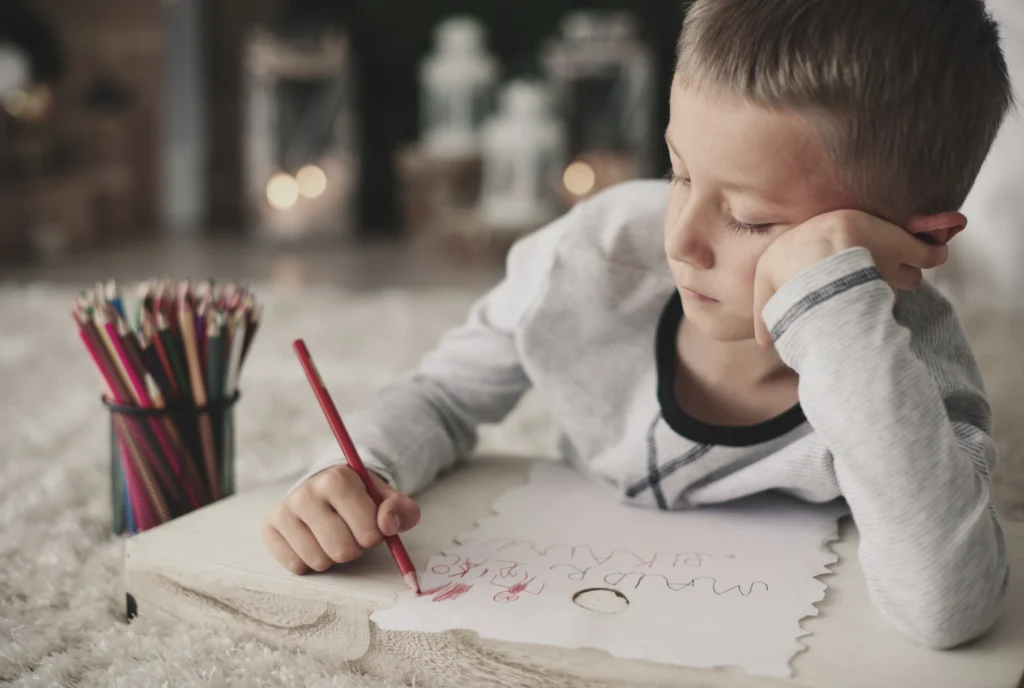
A child who frequently leans on the table, changes sitting positions, rests their head on one hand or struggles to keep the paper steady may find drawing more demanding.
Postural difficulties are only one possible explanation and should be considered alongside the child’s other movement and daily living skills.
6. Sensory Sensitivities
Some children are sensitive to the sensory experiences associated with drawing and coloring.
For example, they may dislike:
- The texture of crayons, chalk or paint.
- The feeling of pencil pressure on paper.
- Sticky paint or messy materials on their fingers.
- The sound of crayons or markers moving across a surface.
Other children may prefer activities that provide more movement or stronger sensory feedback.
Sensory preferences vary between children. Avoiding a particular material does not automatically mean that a child has a sensory processing disorder.
7. Difficulty Concentrating or Following Instructions
Drawing activities often involve sitting, listening, planning and completing a task.
Children who find it difficult to maintain attention may quickly lose interest, move away from the table or become distracted.
Some children may also struggle when instructions involve several steps, such as choosing colors, drawing shapes and completing a picture.
Attention-related difficulties can occur for many reasons. Avoiding drawing alone is not enough to identify ADHD or another developmental condition.
8. Fear of Making Mistakes or Low Confidence
Not every child avoids drawing because of a physical difficulty.
Some children become frustrated because their drawings do not match what they imagined.
They may compare their work with siblings or classmates and decide that they are not good at drawing.
You might hear statements such as:
- “I can’t draw.”
- “Mine looks wrong.”
- “You do it for me.”
- “I don’t want to color.”
Repeated correction or pressure to stay within lines can make the activity even less enjoyable.
Children need opportunities to experiment without worrying about producing perfect pictures.
What Signs Should Parents Look For?
Occasional refusal is common, particularly when children are tired or simply prefer another activity.
However, repeated avoidance combined with difficulties in other tasks may deserve closer attention.
Look for patterns such as:
- Consistently refusing crayons, pencils, paintbrushes or coloring activities.
- Difficulty holding or controlling drawing tools.
- Becoming frustrated during simple drawing tasks.
- Avoiding puzzles, blocks, threading beads or age-appropriate crafts.
- Struggling to use a spoon, fork, buttons or zippers.
- Frequently dropping small objects.
- Difficulty using both hands together.
- Complaining of hand discomfort or tiring quickly.
- Finding it difficult to copy simple shapes as they grow older.
One sign alone does not establish a developmental problem.
The child’s age, overall development, opportunities for practice and performance across different activities all matter.
What Drawing Skills Should Children Develop at Different Ages?
Children develop drawing and pencil skills at different rates.
The following examples provide a general guide rather than a strict deadline.
Around 2 Years
Many children begin to:
- Make spontaneous scribbles.
- Hold crayons using a whole-hand grasp.
- Enjoy making marks on paper.
- Explore drawing through large arm movements.
At this stage, the focus should be on exploration rather than neatness.
Around 3 Years
Children may begin to:
- Make more controlled scribbles.
- Copy simple lines or a circle.
- Hold crayons using their fingers and thumb.
- Show increasing interest in drawing and painting.
Some children may still prefer large movements and less structured activities.
Around 4 Years
Many children can:
- Hold a crayon or pencil between their fingers and thumb rather than using a fist.
- Draw a person with three or more body parts.
- Copy some basic shapes.
- Participate in simple coloring and craft activities.
The CDC includes holding a crayon or pencil between the fingers and thumb and drawing a person with three or more body parts among its four-year developmental milestones.
Around 5 Years
Children may increasingly:
- Copy more complex shapes.
- Draw people with additional details.
- Use pencils and crayons with better control.
- Attempt to write some letters.
- Participate in more structured drawing and coloring activities.
These examples should not be used as a diagnostic checklist.
If a child is not progressing or has difficulties across several areas, discuss this with a healthcare professional. (CDC, 2025)
Is Avoiding Drawing a Sign of Developmental Delay?
Not necessarily.
Some children naturally prefer outdoor play, building blocks, music, pretend play or physical activities over drawing.
A lack of interest in coloring does not automatically indicate a developmental condition.
However, persistent avoidance may sometimes be associated with difficulties involving:
- Fine motor development.
- Visual-motor integration.
- Developmental Coordination Disorder (DCD).
- Attention and executive functioning.
- Sensory processing differences.
- Handwriting and written-expression development.
Children with DCD, for example, may find everyday motor tasks such as drawing, using scissors, dressing or handling small objects more difficult.
It is important not to diagnose a condition based only on drawing behavior. A broader developmental assessment is needed to understand the child’s strengths and challenges.
How Can Parents Encourage Drawing and Pencil Activities at Home?
The goal is to make drawing enjoyable and gradually build the skills involved.
Avoid forcing children to sit for long periods or repeatedly correcting their work.
Try these simple activities:
1. Start With Large Drawing Movements
Instead of asking your child to color small pictures, offer a large sheet of paper.
Encourage drawing big circles, lines, waves and simple shapes.
This allows children to use their arms and shoulders before progressing towards smaller finger movements.
2. Try Drawing on a Vertical Surface
Place paper on a wall or use a child-friendly easel.
Drawing on a vertical surface can encourage shoulder movement and help children practice controlling their arms while making marks.
3. Use Different Drawing Materials
Not every child enjoys traditional pencils or crayons.
Try:
- Chunky crayons.
- Thick markers.
- Chalk on a suitable outdoor surface.
- Finger paints.
- Water painting with a brush.
- Drawing in sand or on a sensory tray.
Allow your child to choose the material they enjoy most.
4. Include Play-Based Hand Activities
Drawing skills can be supported through activities that involve using the hands and fingers.
Examples include:
- Playing with soft modelling dough.
- Building with blocks.
- Threading large beads.
- Tearing and pasting paper.
- Using child-safe tongs to pick up objects.
- Opening and closing containers.
- Playing with age-appropriate puzzles.
These activities provide opportunities to practice hand control, coordination and manipulation.
5. Keep Activities Short and Enjoyable
Start with a few minutes of relaxed activity rather than expecting your child to complete an entire coloring page.
Stop if your child becomes uncomfortable or frustrated. Gradually increase the activity as their confidence and interest improve.
6. Praise Effort Instead of Perfect Results
Avoid focusing only on neatness, staying within lines or drawing recognizable pictures.
Instead, acknowledge effort:
- “You made so many different lines.”
- “I like how you tried that shape.”
- “You used both hands to hold the paper.”
Positive experiences can help children become more willing to try again.
When Should You Seek Professional Advice?
Consider discussing your child’s development with a pediatrician if:
- Your child consistently avoids drawing and other hand-based activities.
- They struggle with age-appropriate fine motor tasks.
- They have difficulty using cutlery, fastening clothes or handling small objects.
- Drawing causes frequent frustration, discomfort or fatigue.
- You notice difficulties in several areas of motor development.
- Your child is not progressing despite having regular opportunities to practice.
A healthcare professional can review the child’s developmental history and decide whether further assessment is appropriate.
Seek prompt medical attention if your child suddenly loses previously acquired hand skills or develops new weakness, pain or other neurological symptoms.
These changes should not be assumed to be a normal developmental variation.
Which Therapist Can Help a Child Who Avoids Drawing?
The right professional depends on the difficulties identified during assessment.
Occupational Therapist
Occupational therapists commonly assess and support children who struggle with fine motor skills and everyday activities.
They may evaluate:
- Pencil and crayon control.
- Hand strength and coordination.
- Visual-motor integration.
- Posture during table-based activities.
- Bilateral hand use.
- Participation in drawing, coloring and classroom tasks.
Intervention may include play-based hand activities, graded drawing tasks, adapting materials and helping children participate more comfortably in everyday activities.
Myth vs Fact: Drawing Difficulties in Children
MYTH: Every child who avoids coloring has a developmental delay.
FACT: Children have different interests. Avoidance may reflect personal preference, frustration or a skill-related difficulty. The wider developmental picture matters.
MYTH: A child must use a pencil perfectly at an early age.
FACT: Pencil control develops gradually. Children should have opportunities to practice through age-appropriate play and drawing activities.
MYTH: Forcing a child to color more will solve the problem.
FACT: Pressure can increase frustration. Short, enjoyable and appropriately challenging activities are more helpful.
MYTH: Poor pencil control always means weak hand muscles.
FACT: Drawing involves several skills, including coordination, visual processing, motor planning, posture and attention.
MYTH: Physiotherapy is the main treatment for all drawing difficulties.
FACT: Occupational therapy is generally more directly relevant to fine motor and drawing tasks. Physiotherapy may help when additional postural or gross motor difficulties are identified.
Physiotherapist
Physiotherapy is not usually the primary intervention for isolated drawing or pencil-control difficulties.
However, a paediatric physiotherapist may help when the child also has difficulties with:
- Trunk stability and postural control.
- Shoulder stability during movement.
- Gross motor coordination.
- Balance and body awareness.
- General movement planning and physical participation.
For example, if a child has broader motor difficulties affecting both playground activities and table-based tasks, physiotherapy may form part of a coordinated support plan.
Pediatrician or Developmental Specialist
A pediatrician or developmental specialist can assess broader developmental concerns and coordinate referrals when necessary.
Depending on the child’s presentation, assessment may also involve other professionals, such as an eye-care specialist or speech-language therapist.
Final Thoughts
A child’s reluctance to draw, color or use a pencil is not necessarily a cause for concern. Children develop different interests and skills at different rates.
However, when avoidance is persistent or occurs alongside difficulties with hand coordination, dressing, eating or other everyday activities, it is worth exploring the reason.
A gentle reminder for parents
Every child does not need to become a confident artist. What matters is helping them develop the coordination, confidence and independence needed for everyday life.
Conclusion
When a child avoids drawing, coloring or using a pencil, it is worth looking beyond the activity itself.
The difficulty may relate to fine motor control, hand strength, visual-motor integration, posture, sensory preferences or confidence.
At the same time, not every child enjoys drawing, and differences in interest are a normal part of childhood.
Parents can help by offering enjoyable, age-appropriate activities without pressure and observing how their child manages other everyday tasks.
If avoidance is persistent or occurs alongside difficulties with dressing, eating, playing or other motor activities, a professional assessment can help identify the support needed.
The aim is not to make every child an artist. It is to help children develop the skills and confidence they need to participate comfortably in everyday activities.
Frequently Asked Questions
1. Why does my child refuse to draw or color?
A child may avoid drawing because of limited fine motor control, hand fatigue, visual-motor coordination difficulties, sensory preferences, attention challenges or low confidence. Some children simply prefer other activities.
2. Is avoiding drawing a sign of autism or ADHD?
Not on its own. Some children with autism or ADHD may have differences in sensory preferences, attention or motor coordination, but avoiding drawing alone cannot identify either condition.
3. At what age should a child start holding a pencil?
Children begin exploring crayons and making marks during toddlerhood. Their grasp and control develop gradually. There is no single pencil grip that every child must achieve at exactly the same age.
4. How can I improve my child’s fine motor skills at home?
Try playdough, building blocks, threading large beads, tearing paper, child-safe tongs and drawing with chunky crayons. Choose activities suited to your child’s age and abilities.
5. Can poor hand strength make drawing difficult?
Yes. Limited hand strength or endurance may make it difficult to maintain a comfortable grip or control drawing tools. However, coordination, posture and visual-motor skills can also affect drawing.
6. Should I take my child to an occupational therapist?
An occupational therapy assessment may be helpful if your child persistently struggles with drawing, pencil control, hand coordination or other everyday fine motor activities.
7. Can physiotherapy help children who avoid drawing?
Physiotherapy is not usually the primary treatment for isolated drawing difficulties. It may support children who also have problems with posture, trunk stability, shoulder control, balance or gross motor coordination.
8. Should I force my child to practice coloring every day?
No. Forcing a child can increase frustration. Offer short, enjoyable activities and let your child explore different materials. Seek professional advice if difficulties persist or affect everyday participation.
Stay tuned with us for more health related topics.
Follow us on LinkedIn and Instagram for more.
More Read





Medical Disclaimer
This article is intended for general educational and informational purposes only. It does not replace professional medical advice, developmental assessment or individualized treatment. Avoiding drawing or pencil activities does not automatically indicate a developmental disorder. If you have concerns about your child’s motor skills, development or everyday activities, consult a qualified pediatrician or appropriate healthcare professional. Seek prompt medical attention if your child develops sudden loss of previously acquired skills, new weakness or other concerning neurological symptoms.