


A baby develops a sudden high fever that lasts for several days.
Just when the temperature finally comes down and parents begin to feel relieved, small pink or red spots appear across the chest, tummy or back.
Quick Answer
Roseola is a common viral infection in babies and toddlers, usually caused by human herpesvirus 6 (HHV-6). It typically begins with a sudden high fever lasting around three to five days, followed by a pink or red rash as the temperature settles.
The rash usually starts on the chest, tummy or back and may spread to the neck, face and arms. Most otherwise healthy babies recover without specific treatment.
- Cause: Usually HHV-6, sometimes HHV-7.
- Common age: Six months to two years.
- Fever: Commonly lasts three to five days.
- Rash: Appears as the fever settles and usually fades within a few days.
- Treatment: Supportive care, fluids and appropriate fever relief.
Important: A baby under three months with a temperature of 38°C or higher needs urgent medical assessment. A non-blanching rash, breathing difficulty, unusual drowsiness or seizure also requires urgent attention.
It can be confusing to see a new rash after the fever has disappeared.
This pattern is often associated with roseola, a common viral infection that mainly affects babies and young children.
Also known as roseola infantum or sixth disease, it typically causes several days of fever followed by a short-lived rash as the temperature returns to normal.
Although the rash can look worrying, most otherwise healthy babies recover without specific treatment.
However, understanding the typical symptoms, recognizing warning signs and knowing when to seek medical advice are important parts of caring for a baby with a fever.
Key Takeaways About Roseola in Babies
It is usually caused by HHV-6 and commonly affects babies between six months and two years.
A sudden fever commonly lasts three to five days before the characteristic rash appears.
Small pink or red spots usually begin on the chest, tummy or back and may spread to other areas.
Rest, regular feeds, hydration and appropriate symptom relief are generally sufficient.
They can occur during the fever phase. A first seizure requires urgent medical assessment.
Most babies return to their normal movement and play after recovery. Persistent functional difficulties need medical assessment.
What Is Roseola in Babies?
Roseola is a viral infection that commonly affects children between six months and two years of age. It is usually caused by human herpesvirus 6 (HHV-6), although human herpesvirus 7 (HHV-7) can also cause the illness.
It is sometimes called exanthem subitum, meaning sudden rash, because the skin eruption often appears as the fever settles.
The term sixth disease is another historical name used to distinguish it from other recognised childhood rash illnesses.
Most children experience a mild illness and recover fully.
Some have a high temperature but remain reasonably alert between fever episodes. Others may become irritable, feed less or seem unusually tired.
Roseola is generally self-limiting in healthy children. However, complications such as febrile seizures can occur during the fever phase.
Children with weakened immune systems may also be at greater risk of severe or unusual illness (Mullins, Daley and Krishnamurthy, 2026)
Why Does a Rash Appear After a High Fever?
The sequence of symptoms is one of the most recognizable features of roseola.
After the virus enters the body, it multiplies and triggers an immune response.
This response is associated with the fever and other early symptoms. After a few days, the temperature often falls quite suddenly. Around this time, a pink or red rash may appear.
This explains why a baby may seem more comfortable just as the skin eruption becomes noticeable.
In a typical case, the rash does not mean the infection is getting worse. Instead, it appears as the illness moves towards recovery.
The exact biological process responsible for the rash is not fully understood. However, the timing of the eruption is an important diagnostic clue.
According to the American Academy of Pediatrics, the fever commonly lasts three to five days, followed by a rash that develops as the temperature returns to normal (Hunt and Mahone).
What Are the Symptoms of Roseola in Babies?
Roseola usually develops in two main stages: a fever phase and a rash phase. Some babies also experience symptoms resembling an ordinary viral infection.
1. Sudden High Fever
A sudden temperature rise is often the first noticeable sign.
The fever may reach approximately 39°C to 40.5°C and commonly lasts three to five days. In some children, it may continue for longer.
Parents may notice:
- Warm skin and flushed cheeks
- Irritability or increased crying
- Reduced appetite or feeding
- Restlessness and disturbed sleep
- Mild tiredness or reduced activity
- Swollen glands around the neck
- Occasionally, swollen eyelids
A high temperature can be alarming, particularly in a young baby.
However, the temperature reading alone does not establish how serious an illness is. Age, alertness, breathing, feeding and hydration also matter.
2. Rash Appears as the Fever Settles
The characteristic roseola rash usually appears when the fever resolves or shortly afterwards.
It commonly consists of:
- Small pink or red spots
- Flat patches or slightly raised bumps
- A rash beginning on the chest, tummy or back
- Spots that may spread towards the neck, face and arms
- Areas that are usually not itchy or painful
The rash may be harder to recognize on darker skin. It can appear as subtle changes in color or texture rather than obvious bright pink spots.
In many babies, the rash fades within one to four days.
Some children may have a shorter-lasting eruption, while others may have a rash that remains visible for a little longer (NHS).
3. Other Possible Symptoms
Not every baby experiences the same symptoms. Some may also develop a runny nose, mild cough, loose stools, reduced appetite or temporary swelling around the eyelids.
Small reddish spots inside the mouth, particularly around the soft palate, can occasionally occur. These are sometimes called Nagayama spots.
Some children have a roseola infection without developing the typical rash, which can make the illness harder to recognize.
What Does a Roseola Rash Look Like?
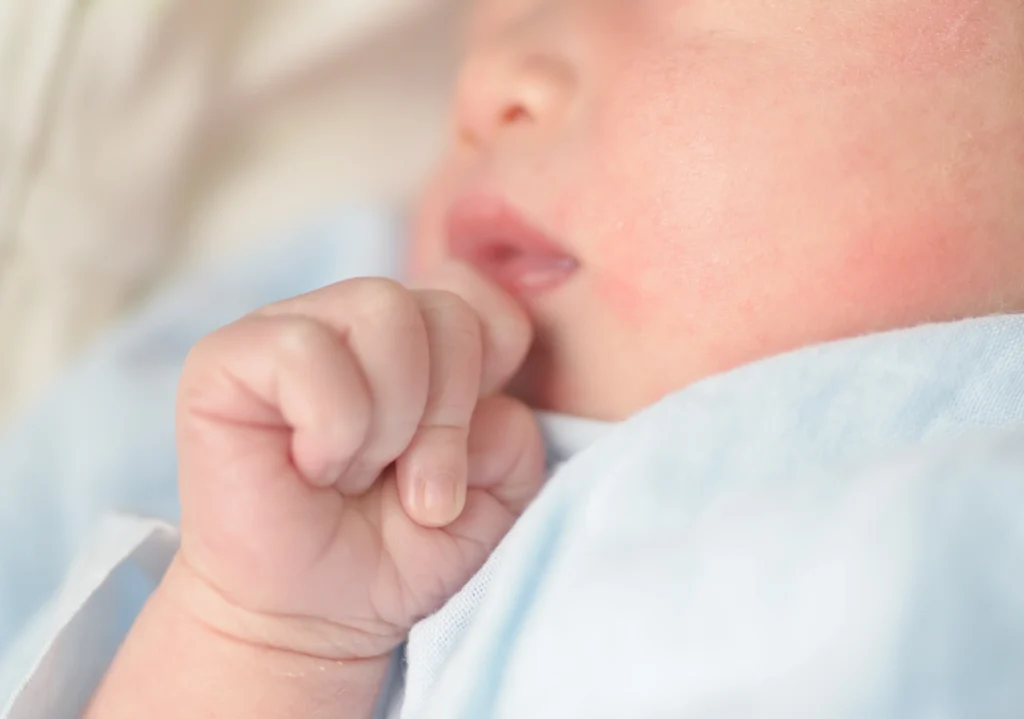
The rash usually appears as multiple small pink or reddish spots scattered across the skin. Unlike some childhood rashes, it generally begins on the trunk rather than the face.
The spots may be flat or slightly raised and often turn lighter when gentle pressure is applied. This is known as a blanching rash.
Roseola is usually not particularly itchy, painful or uncomfortable. Many babies become more active and appear happier once the fever has settled.
The rash can look different from one child to another. Its appearance also varies with skin tone, so parents should not rely on color alone to identify the infection.
Important: A rash that does not fade when pressed with a clear glass can be a warning sign of a serious infection, including meningococcal disease. Do not assume that such a rash is roseola. Seek emergency medical care.
How Long Does Roseola Last?
Most uncomplicated cases of roseola resolve within approximately a week.
The typical pattern is:
| Stage | What parents may notice |
|---|---|
| Early infection | The virus is present before obvious symptoms develop |
| Days 1-3 | Sudden high fever, irritability and reduced appetite |
| Days 3-5 | Fever begins to settle, sometimes quite rapidly |
| Following days | Pink or red rash appears, usually starting on the trunk |
| Recovery | Rash fades and the baby gradually returns to normal activities |
The timeline is not identical for every child. Some babies have a shorter fever, while others may have fever for up to seven days.
If the fever lasts five days or longer, returns after settling or is accompanied by worsening symptoms, the baby should be assessed by a healthcare professional.
A prolonged fever may have another cause and should not automatically be attributed to roseola.
At What Age Do Babies Usually Get Roseola?
Roseola is most common between six months and two years of age. It can occur in younger or older children, but it is less typical outside this age range.
Babies receive some protection from maternal antibodies during early infancy, although this protection gradually decreases.
As a result, infections become more common during the later months of the first year.
A fever in a baby younger than three months should never be assumed to be roseola. Such infants require prompt medical assessment, even if they appear relatively comfortable.
Can a Baby Have Roseola Without a Rash?
Yes. Not every child infected with HHV-6 or HHV-7 develops the classic roseola rash.
Some babies experience only fever and mild symptoms, while others may have an infection with very few noticeable signs.
Without the characteristic rash, identifying roseola can be difficult because many childhood infections cause similar fever symptoms. A doctor may need to consider other causes, particularly in young infants.
How Does Roseola Spread?
Roseola viruses can spread through saliva and respiratory secretions, including during close contact with an infected person. Transmission can occur even when someone does not have obvious symptoms.
Because HHV-6 and HHV-7 are common, exposure during early childhood is not unusual. Parents may not know where or when their baby encountered the virus.
Good hygiene can help reduce exposure to infectious secretions. Wash hands regularly, avoid sharing feeding utensils and clean frequently touched household surfaces.
Keep a baby who has a fever and feels unwell away from group childcare until they are well enough to participate and meet the childcare setting’s illness policy.
How Is Roseola Diagnosed?
A doctor can often identify roseola by reviewing the baby’s symptoms and examining the skin.
The timing is particularly helpful: a sudden high fever lasting several days, followed by a rash as the fever settles, supports the diagnosis.
The doctor may also assess:
- The baby’s age and medical history
- Temperature and duration of fever
- Feeding and fluid intake
- Wet nappies and signs of dehydration
- Alertness and responsiveness
- Breathing and general appearance
- Rash location and whether it fades with pressure
Routine blood tests are generally unnecessary when a healthy child has a typical presentation.
Laboratory testing may be considered if symptoms are unusual, the child has a weakened immune system or another diagnosis needs investigation (Mullins, Daley and Krishnamurthy, 2026)
Importantly, roseola should not be assumed during the early fever stage, especially in very young infants. A serious bacterial infection can initially present as fever alone.
The appearance of a rash later does not replace appropriate assessment of an earlier fever.
Roseola in Babies: Myth vs Fact
Myth: The rash appears before the fever.
Fact: Roseola usually begins with a sudden high fever. The characteristic rash appears as the temperature settles.
Myth: A rash after fever always means the infection is getting worse.
Fact: In typical roseola, the rash appears as the illness moves towards recovery. However, other causes of fever and rash must be considered.
Myth: Every baby with roseola develops a rash.
Fact: Some babies develop fever without the typical skin eruption.
Myth: Roseola always requires antibiotics.
Fact: Roseola is caused by a virus. Antibiotics do not treat the infection, and most healthy babies need only supportive care.
Myth: Fever medicines prevent febrile seizures.
Fact: Fever medicines may improve comfort, but they do not reliably prevent febrile seizures.
Myth: Physiotherapy is needed after every case of roseola.
Fact: Most babies recover their usual movement naturally. Physiotherapy is considered only when an ongoing functional concern has been medically assessed.
Which Conditions Can Look Like Roseola?
Several childhood illnesses can cause fever and skin eruptions. Their symptoms may overlap, particularly before the rash pattern becomes clear.
- Measles: Often causes fever, cough, runny nose, red eyes and a rash that usually begins on the face.
- Rubella: Can cause mild fever, swollen lymph nodes and a pink rash that spreads across the body.
- Fifth disease: Often begins with a bright red cheek rash, followed by a lacy rash on the body.
- Hand, foot and mouth disease: May cause mouth sores and spots or blisters on the hands and feet.
- Scarlet fever: Can cause fever, sore throat and a fine, rough-feeling rash.
- Kawasaki disease: Can cause prolonged fever, rash, red eyes, changes to the lips and mouth, and swollen hands or feet.
Kawasaki disease is particularly important when a child has a fever lasting five days or longer. It needs prompt medical assessment because early treatment can reduce the risk of heart complications.
The appearance of a rash alone is not enough to confirm roseola. A healthcare professional should assess symptoms that are unusual, persistent or concerning.
How Is Roseola Treated in Babies?
There is no specific antiviral medicine routinely recommended for uncomplicated roseola. Most otherwise healthy babies recover as their immune system clears the infection.
Treatment focuses on keeping the baby comfortable, supporting hydration and monitoring for warning signs.
1. Manage Fever Safely
Fever-reducing medicines may help if the baby is uncomfortable. Paracetamol or ibuprofen may be appropriate depending on the child’s age, weight and medical history.
Always follow the product instructions and seek advice from a healthcare professional if you are unsure about the correct medicine or dose.
Paracetamol should not be given to babies under two months unless specifically directed by a clinician.
Ibuprofen is generally unsuitable for babies under three months or weighing less than 5 kg, and should be avoided if the baby is dehydrated.
Do not give aspirin to children.
Do not routinely alternate paracetamol and ibuprofen unless a healthcare professional advises you to do so (NHS)
2. Maintain Breastfeeding and Fluid Intake
Babies may feed less when they have a fever. Offer breast milk or formula regularly and monitor wet nappies.
Older babies who have started complementary feeding can continue their usual age-appropriate foods if they are interested.
Fluids and regular feeds are more important than forcing food during recovery.
3. Allow Adequate Rest
A baby may be more unsettled or sleepy than usual during the fever phase. Provide a comfortable environment and allow extra rest.
Avoid overdressing or covering the baby with heavy blankets. Keep the room comfortably cool without making the baby cold.
4. Monitor the Rash
The roseola rash usually disappears without creams or special skin treatment. Avoid applying medicated products unless a healthcare professional recommends them.
If the rash becomes painful, blistered, swollen or unusually widespread, arrange a medical assessment.
Can Roseola Cause Febrile Seizures?
Yes. Febrile seizures are a recognized complication of roseola and can occur during the fever phase.
During a seizure, a child may become stiff, lose awareness, shake or experience jerking movements.
Although frightening to witness, most simple febrile seizures are brief and do not cause long-term neurological problems.
If your baby has a seizure:
- Place them on a safe, flat surface.
- Remove nearby objects that could cause injury.
- Turn them onto their side when possible.
- Do not restrain the movements.
- Do not put anything inside their mouth.
- Note how long the seizure lasts.
A first seizure requires urgent medical assessment.
Call emergency services if it lasts five minutes or longer, breathing is difficult, repeated seizures occur or the baby does not recover normally.
Fever-reducing medicines may improve comfort, but they do not reliably prevent febrile seizures.
The American Academy of Pediatrics provides further guidance on recognizing and responding to febrile seizures (Hunt and Mahoney)
When Should Parents Seek Medical Attention?
Most babies with roseola recover without complications. However, fever in young infants and certain warning signs should never be ignored.
Seek urgent medical assessment if:
- Your baby is under three months old and has a temperature of 38°C or higher.
- Your baby is between three and six months old and has a temperature of 39°C or higher.
- Fever lasts five days or longer.
- Your baby is feeding poorly or has noticeably fewer wet nappies.
- Your child is unusually irritable, weak or difficult to comfort.
- The fever returns after it has settled.
Seek emergency medical help if your baby:
- Has a rash that does not fade when pressed.
- Is difficult to wake or does not respond normally.
- Has difficulty breathing or is breathing unusually fast.
- Develops blue, grey, very pale or blotchy skin.
- Has a seizure.
- Shows signs of severe dehydration or becomes unusually floppy.
These symptoms can indicate conditions that need immediate assessment and should not be attributed to roseola without medical evaluation (NHS).
Can Roseola Be Serious in Babies With Weakened Immunity?
Roseola is usually mild in healthy children, but it deserves additional attention in babies and children with weakened immune systems.
HHV-6 can remain inactive in the body after the initial infection. In people with significant immune suppression, the virus may reactivate and cause more serious or unusual illness.
Parents of children who have undergone organ or stem cell transplantation, receive immune-suppressing medicines or have certain immune disorders should contact their medical team if the child develops a fever, unusual rash or possible exposure.
These children may need a different assessment and monitoring approach from otherwise healthy babies.
Does Roseola Affect a Baby’s Development or Movement?
Roseola is an acute viral infection, not a developmental or musculoskeletal condition. Most babies return to their usual feeding, play and movement patterns once the fever and rash resolve.
During the illness, a baby may temporarily:
- Move around less because of fever and tiredness.
- Become less interested in crawling, sitting or playing.
- Need more rest and comfort from caregivers.
- Show reduced activity because of poor sleep or appetite.
These temporary changes do not usually indicate a developmental problem.
Is Physiotherapy Needed After Roseola?
Physiotherapy is not routinely required for roseola. It does not treat the virus, reduce the rash or prevent febrile seizures.
If a baby continues to show reduced movement, unusual weakness, poor balance or difficulty returning to previously achieved activities after recovering, parents should first consult a pediatrician.
A medical assessment can help identify whether another condition needs attention.
If an ongoing functional or developmental concern is identified, a pediatric physiotherapist may assess age-appropriate movement, posture, muscle function and motor skills.
A baby who stops using an arm or leg, develops a swollen joint or refuses to bear weight needs medical assessment rather than being assumed to be tired after an infection.
Can Roseola Be Prevented?
There is currently no routinely available vaccine specifically for roseola.
Because the viruses can spread through close contact and saliva, complete prevention can be difficult. However, basic hygiene measures may help reduce exposure to infectious secretions.
Parents can:
- Wash their hands before feeding or handling the baby.
- Avoid sharing cups, spoons and feeding utensils.
- Clean frequently touched household surfaces.
- Avoid close contact with people who are visibly unwell.
- Follow childcare guidance when the baby has a fever.
Remember that exposure can occur even when an infected person has no obvious symptoms.
Final Thoughts
Roseola can be confusing for parents because the characteristic rash often appears just as a baby’s high fever disappears. This fever-to-rash pattern is typical of the infection and usually signals that the illness is moving towards recovery.
Most babies recover with regular feeding, adequate fluids, rest and appropriate symptom relief. However, fever in very young infants, unusual drowsiness, breathing difficulties, seizures or a rash that does not fade with pressure should never be ignored.
Remember: Most babies do not need physiotherapy after roseola. If reduced movement, weakness or developmental concerns continue after recovery, seek a pediatric assessment to understand the underlying cause.
Conclusion
Roseola is a common viral infection in babies and toddlers, recognized by its characteristic pattern of several days of high fever followed by a pink or red rash as the temperature settles.
Although the sudden appearance of spots can worry parents, most otherwise healthy babies recover within about a week without specific treatment.
The main priorities are to support feeding and hydration, keep the baby comfortable and monitor their overall condition.
Parents should pay particular attention to fever in very young infants, signs of dehydration, unusual drowsiness, breathing difficulties and seizures.
Physiotherapy is not normally needed after roseola. Most babies return to their usual movement and play as they recover.
If weakness, reduced movement or developmental concerns persist, seek pediatric assessment rather than assuming they are part of the infection.
Understanding the typical fever-to-rash pattern can help parents feel more prepared, but a new rash should never be used on its own to rule out a more serious illness.
Frequently Asked Questions
1. What is the first sign of roseola in babies?
The first noticeable sign is usually a sudden high fever, which may last three to five days. Some babies may also become irritable, feed less or seem unusually tired.
2. Why does a rash appear after a baby’s fever?
In roseola, the rash typically appears as the fever settles. It is associated with the body’s immune response to the viral infection and usually does not mean the illness is getting worse.
3. How long does a roseola rash last?
The rash usually fades within one to four days. It commonly begins on the chest, tummy or back and may spread towards the neck, face and arms.
4. Can a baby have roseola without a rash?
Yes. Some babies develop a fever and mild viral symptoms without the typical roseola rash. A healthcare professional may need to assess other possible causes of fever.
5. Is roseola contagious?
Yes. The viruses that cause roseola can spread through saliva and respiratory secretions, including during close contact. Transmission may occur even when an infected person has no obvious symptoms.
6. Can roseola cause febrile seizures?
Yes. Febrile seizures can occur during the fever phase of roseola. Most simple febrile seizures do not cause long-term problems, but a first seizure requires urgent medical assessment.
7. Can roseola happen more than once?
Roseola is usually a one-time recognised illness, although HHV-6 and HHV-7 are different viruses and can cause separate infections. Repeated fever or rash should be assessed rather than automatically attributed to roseola.
8. When should I take my baby to the doctor for a fever?
A baby under three months with a temperature of 38°C or higher needs urgent medical assessment. Babies aged three to six months with a temperature of 39°C or higher also need urgent assessment. Seek emergency help for breathing difficulty, unusual drowsiness, seizures or a non-blanching rash.
9. Does a baby need physiotherapy after roseola?
No. Most babies return to their usual movement and play after recovery without physiotherapy. Persistent weakness, reduced movement or developmental concerns should first be assessed by a pediatrician.
Stay tuned with us for more health related topics.
Follow us on LinkedIn and Instagram for more.
More Read


Medical Disclaimer
The information in this article is intended for general educational purposes only. It should not replace professional medical advice, diagnosis or treatment.
Every baby may experience roseola differently. Parents and caregivers should consult a qualified healthcare professional if they are concerned about fever, rash, feeding, hydration or recovery.
A baby under three months with a temperature of 38°C or higher requires urgent medical assessment. Seek emergency medical help for a non-blanching rash, breathing difficulty, unusual drowsiness or seizures.


