


Tight pelvic floor vs weak pelvic floor?
This is a common source of confusion, as both conditions can cause similar symptoms but often require very different treatment approaches.
If you’ve been searching online for answers about pelvic floor problems, you’ve probably come across the same advice repeatedly:
“Your pelvic floor is weak. Do more Kegels.”
As a physiotherapist, I can tell you that pelvic floor health is rarely that simple.
One of the biggest misconceptions in pelvic health is that every pelvic floor symptom is caused by weakness.
Yes, you read that correctly.
A pelvic floor can be tight and weak at the same time.
This is one reason why generic exercise advice often fails.
When the wrong treatment is applied to the wrong problem, symptoms can linger for months or even years.
The challenge is that tight and weak pelvic floors can sometimes produce surprisingly similar symptoms.
Many people assume they know which category they fall into.
After an assessment, they are often surprised to discover the opposite is true.
Let’s explore the differences, the similarities, and why understanding them can help you choose the right path to recovery.
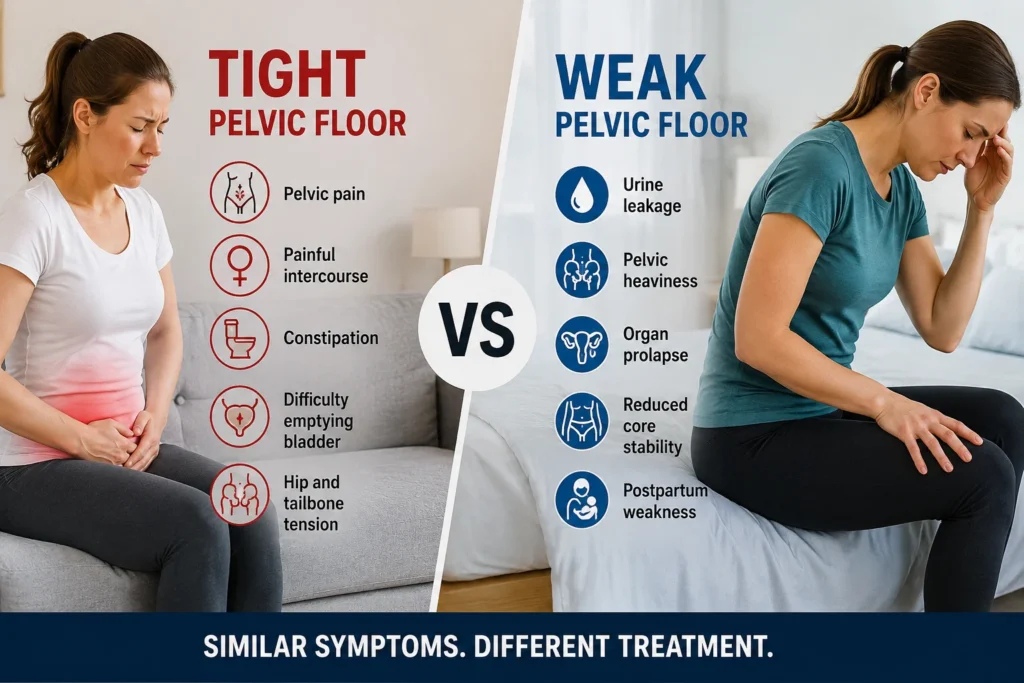
A tight pelvic floor and a weak pelvic floor are not the same thing, although their symptoms can sometimes overlap. A tight pelvic floor struggles to relax and may contribute to pelvic pain, urinary urgency, constipation, or discomfort during intercourse. A weak pelvic floor has difficulty generating enough support and is more commonly associated with urinary leakage, reduced pelvic support, and decreased muscle endurance. Surprisingly, some people can have a pelvic floor that is both tight and weak at the same time. The best way to determine the underlying issue is through a pelvic health physiotherapy assessment.
Understanding the Pelvic Floor
Before comparing a tight pelvic floor vs weak pelvic floor, it helps to understand what the pelvic floor actually does.
The pelvic floor is a group of muscles and connective tissues that sit at the base of the pelvis.
These muscles support:
- The bladder
- The bowel
- The uterus in women
- Pelvic organs
They also play an important role in:
- Bladder control
- Bowel control
- Sexual function
- Core stability
- Breathing mechanics
- Pressure management within the abdomen
Most people only think about the pelvic floor when symptoms appear.
In reality, these muscles are working all day, every day.
They contract when needed.
They relax when needed.
They coordinate with breathing.
They respond to movement.
A healthy pelvic floor is not simply strong.
A healthy pelvic floor is flexible, coordinated, and adaptable.
That distinction is important.
Tight Does Not Mean Strong
One of the most common misunderstandings I hear in clinic is:
“My pelvic floor feels tight, so it must be strong.”
Unfortunately, that is not necessarily true.
Think about your jaw.
If you clench your teeth all day, your jaw muscles become tight.
That does not make them stronger.
It often makes them more fatigued and less efficient.
The same concept applies to the pelvic floor.
A muscle that stays partially contracted for long periods may struggle to generate an effective contraction when needed.
In other words, excessive tension does not automatically translate into good function.
This is why some people with very tight pelvic floors still experience symptoms commonly associated with weakness.
Weak Does Not Always Mean Loose
On the other hand, many people imagine a weak pelvic floor as a muscle that is completely relaxed and inactive.
The reality is more complex.
Weak muscles can sometimes develop protective tension.
The body often compensates when something is not functioning efficiently.
This can create confusing symptom patterns that make self-diagnosis difficult.
That is why a proper assessment is often more valuable than guessing.
What Is a Tight Pelvic Floor?
A tight pelvic floor is sometimes called an overactive pelvic floor or a hypertonic pelvic floor.
In this situation, the muscles have difficulty relaxing fully.
Instead of moving through a healthy cycle of contraction and relaxation, the muscles remain in a more guarded state.
Imagine holding a light dumbbell with your arm slightly bent all day.
Eventually, the muscles become tired and uncomfortable.
The pelvic floor can behave in a similar way.
The person may not even realize they are holding tension.
For many individuals, the pattern develops gradually over time.
Common Signs of a Tight Pelvic Floor
A tight pelvic floor often presents differently from what people expect.
Pelvic Pain
Pain is one of the most common symptoms.
This may include:
- Pelvic aching
- Deep pelvic discomfort
- Pain around the hips
- Pressure sensations
- Tailbone pain
Pain During Intercourse
Many women with an overactive pelvic floor experience discomfort during penetration.
This symptom is frequently misunderstood or misdiagnosed.
Difficulty Fully Emptying the Bladder
Some individuals feel as though they have to strain to urinate.
Others feel they have not completely emptied their bladder after using the bathroom.
Constipation
Pelvic floor muscles must relax appropriately for bowel movements to occur comfortably.
When relaxation is impaired, bowel symptoms like constipation can develop.
Feeling Constantly Tight
Many people describe a sensation of gripping or tension in the pelvic region.
Some struggle to identify exactly where the feeling is coming from.
They simply know something feels “tight.”
What Causes a Tight Pelvic Floor?
There is rarely a single cause.
Instead, multiple factors often contribute.
Chronic Stress
Stress can influence muscle activity throughout the body.
Most people recognize tension in their neck and shoulders.
The pelvic floor can respond similarly.
Long-term stress may encourage the body to remain in a protective state.
Habitual Muscle Clenching
Some people unknowingly hold tension in their pelvic floor throughout the day.
This may happen while:
- Working at a desk
- Driving
- Exercising
- Managing anxiety
Pain Conditions
When pain develops, muscles often tighten to protect the area.
Unfortunately, this protective response can sometimes continue long after the original issue has improved.
High-Intensity Training
Athletes occasionally develop pelvic floor tension due to repeated loading and bracing strategies.
This does not mean exercise is harmful.
It simply highlights the importance of balance.
What Is a Weak Pelvic Floor?
A weak pelvic floor occurs when the muscles cannot generate sufficient force or endurance to perform their job effectively.
This may happen because of:
- Pregnancy
- Childbirth
- Aging
- Surgery
- Chronic pressure on the pelvic floor
- Reduced physical activity
Weakness can affect support, stability, and continence.
Unlike a tight pelvic floor, pain is not always the primary symptom.
Instead, people often notice functional issues.
Common Signs of a Weak Pelvic Floor
Urinary Leakage
This is one of the most recognized symptoms.
Urinary Leakage may occur during:
- Coughing
- Sneezing
- Running
- Jumping
- Lifting
Recent evidence continues to support pelvic floor muscle training as an effective strategy for preventing and managing urinary incontinence in women. (Woodley et al. 2024)
Reduced Support
Some individuals notice a sensation of heaviness or dragging within the pelvis.
This symptom should always be professionally assessed.
Difficulty Maintaining Continence
The pelvic floor contributes to bladder and bowel control.
Weakness may make it harder to maintain continence under increased pressure.
Reduced Endurance
The muscles may initially contract but struggle to sustain the effort.
This often becomes noticeable during exercise or physically demanding activities.
The Surprising Symptom Overlap
This is where things become interesting.
Many symptoms overlap between tight and weak pelvic floors.
For example:
- Urinary urgency can occur in both.
- Pelvic pressure can occur in both.
- Sexual dysfunction can occur in both.
- Bladder symptoms can occur in both.
This overlap is one reason self-diagnosis can be misleading.
The symptom alone does not always reveal the underlying cause.
Can a Pelvic Floor Be Tight and Weak at the Same Time?
Absolutely.
In fact, this combination is more common than many people realize.
Imagine trying to perform a maximum bicep curl after holding a grocery bag for six hours.
The muscle may be tight and fatigued.
It may also be unable to produce an effective contraction.
The pelvic floor can behave similarly.
An overactive muscle is not necessarily a strong muscle.
A chronically tense pelvic floor may actually demonstrate poor strength, endurance, and coordination during assessment.
This is why treatment often focuses on restoring relaxation before progressing to strengthening exercises.
Tight Pelvic Floor vs Weak Pelvic Floor
| Tight Pelvic Floor | Weak Pelvic Floor |
|---|---|
| Difficulty relaxing muscles | Difficulty generating force |
| Pelvic pain is common | Leakage is more common |
| Pain during intercourse may occur | Reduced pelvic support may occur |
| May be linked to stress and muscle guarding | May be linked to pregnancy, childbirth, or aging |
| Treatment often focuses on relaxation | Treatment often focuses on strengthening |
Why Kegels Sometimes Make Symptoms Worse
Kegels are not bad.
They are simply not appropriate for every situation.
If someone already has an overactive pelvic floor, repeatedly performing strengthening exercises may increase tension and aggravate symptoms.
I have seen patients spend months performing hundreds of Kegels each week only to experience worsening pelvic pain and increased tightness.
Once relaxation strategies were introduced, symptoms began improving.
The lesson is simple.
The correct exercise depends on the correct diagnosis.
What I Often See in Clinic
Many people arrive expecting to hear they have a weak pelvic floor.
They are surprised when the assessment reveals excessive tension instead.
Others assume they have a tight pelvic floor because they feel discomfort.
Assessment then reveals significant weakness contributing to their symptoms.
This is why a personalized evaluation is so valuable.
Pelvic floor dysfunction is not a one-size-fits-all condition.
Every person brings a unique combination of symptoms, lifestyle factors, movement habits, breathing patterns, and physical findings.
How Physiotherapists Tell the Difference
One of the most common questions I hear is:
“How do you know whether a pelvic floor is tight or weak?”
The answer is surprisingly simple.
We do not guess.
A pelvic health physiotherapist looks at several factors before making recommendations.
Symptom History
The story often provides valuable clues.
For example:
- Does leakage occur when coughing or exercising?
- Is there pain during intercourse?
- Is there difficulty emptying the bladder?
- Are symptoms worse during stressful periods?
- Is there a feeling of heaviness or pressure?
Patterns often emerge during conversation.
Breathing Assessment
Many people are surprised when I ask them to breathe.
Yet breathing can reveal a great deal about pelvic floor function.
The pelvic floor and diaphragm work as a team.
If breathing is shallow, restricted, or dominated by the upper chest, pelvic floor mechanics may also be affected.
Recent research continues to highlight the close relationship between diaphragm movement and pelvic floor function. (Baryla-Matejczuk et al. 2025)
Movement Assessment
How you squat, bend, lift, walk, and transition between positions can provide useful information.
Movement patterns often influence how pressure is distributed throughout the body.
Muscle Function Assessment
A proper pelvic floor assessment evaluates:
- Strength
- Endurance
- Relaxation
- Coordination
- Timing
These factors are equally important.
Strong muscles that cannot relax are not functioning optimally.
Relaxed muscles that cannot generate sufficient support are also problematic.
The Breathing Connection Most People Miss
If there is one topic I wish more people understood, it is the relationship between breathing and the pelvic floor.
Many online articles focus exclusively on exercises.
Few explain how breathing affects pelvic health.
Every breath creates movement within the body.
As you inhale:
- The diaphragm descends.
- The ribcage expands.
- The pelvic floor gently lengthens.
As you exhale:
- The diaphragm rises.
- The pelvic floor naturally recoils.
This coordinated rhythm helps regulate pressure and movement.
When breathing becomes shallow or rushed, this system may become less efficient.
Many people with overactive pelvic floors unknowingly spend years breathing primarily into their upper chest.
Once breathing mechanics improve, pelvic floor symptoms often become easier to manage.
Tight Pelvic Floor vs Weak Pelvic Floor During Pregnancy
Pregnancy creates unique demands on the pelvic floor.
As the baby grows, the pelvic floor must support increasing weight while adapting to hormonal and postural changes.
This can lead to both tightness and weakness.
Why Tightness Can Develop During Pregnancy
Many pregnant women experience:
- Increased stress
- Reduced sleep
- Physical discomfort
- Anxiety about labor and delivery
These factors may encourage muscle guarding.
Some women unconsciously tighten their abdominal and pelvic muscles throughout the day.
This tension may contribute to:
- Pelvic pain
- Tailbone discomfort
- Pressure sensations
- Difficulty relaxing
Why Weakness Can Develop During Pregnancy
The growing uterus increases demand on pelvic floor structures.
Over time, muscles may become less efficient at providing support.
Research continues to show that pelvic floor symptoms are common during pregnancy and after childbirth, highlighting the importance of early assessment and education. (Wang et al. 2025)
What Happens After Childbirth?
Many people assume every postpartum pelvic floor is weak.
While weakness is common, postpartum recovery is rarely identical from one woman to another.
Some women primarily experience:
- Reduced strength
- Reduced endurance
- Leakage
Others experience:
- Pain
- Tightness
- Pelvic tension
- Difficulty relaxing
Some experience both.
This is why individualized care remains so important.
Treatment for a Tight Pelvic Floor
Treatment focuses on helping the muscles learn to relax and move more effectively.
Breathing Retraining
Improving diaphragm function often becomes an important starting point.
The goal is not deep breathing for the sake of relaxation alone.
The goal is restoring healthy coordination.
Relaxation Strategies
Depending on the individual, this may include:
- Gentle mobility work
- Stretching
- Mindfulness techniques
- Position changes
- Manual therapy
Reducing Protective Tension
Many individuals are unaware they are constantly gripping their pelvic floor.
Learning how to release unnecessary tension can be transformative.
Stress Management
The nervous system plays an important role in muscle activity.
Addressing chronic stress may improve overall symptom management.
Treatment for a Weak Pelvic Floor
When weakness is identified, strengthening strategies often become appropriate.
Pelvic Floor Muscle Training
Targeted pelvic floor exercises can improve:
- Strength
- Endurance
- Coordination
Research supports pelvic floor muscle training for preventing and treating urinary incontinence in women. (Mantilla et al. (2024)
Functional Strength Training
The pelvic floor does not work alone.
Exercises often include:
- Core training
- Glute strengthening
- Functional movement patterns
Pressure Management
Learning how to manage pressure during lifting, exercise, and daily activities can improve outcomes.
Common Mistakes People Make
Many pelvic floor issues persist because people unknowingly follow advice that is not suited to their situation.
Assuming Every Problem Is Weakness
This is perhaps the most common mistake.
Many people immediately begin strengthening exercises without understanding the nature of their symptoms.
Ignoring Pain
Pain is information.
It does not automatically mean something serious is wrong.
However, it deserves attention rather than dismissal.
Chasing Symptoms Online
The internet can be helpful.
It can also be overwhelming.
Symptoms that look identical online may have completely different causes.
Overdoing Exercises
More is not always better.
The pelvic floor responds best to appropriate loading rather than endless repetitions.
Myth vs Fact
Myth: Every pelvic floor problem is caused by weakness.
Fact: Many people have symptoms because their pelvic floor is too tight, not too weak.
Myth: Kegel exercises are the solution for everyone.
Fact: Kegels may help some people but can aggravate symptoms in those with an overactive pelvic floor.
Myth: Tight muscles are always strong muscles.
Fact: A muscle can be tight, fatigued, and functionally weak at the same time.
Myth: Leakage always means weakness.
Fact: Leakage can occur in both weak and overactive pelvic floors.
Lesser-Known Signs You May Need an Assessment
Many people wait until symptoms become severe.
Some earlier warning signs include:
- Needing to urinate frequently despite normal medical tests
- Pelvic discomfort after sitting for long periods
- Tailbone pain
- Pain during intercourse
- Difficulty starting urination
- A sensation of incomplete emptying
- Persistent pelvic heaviness
- Discomfort during exercise
These symptoms do not automatically indicate a serious problem.
They do suggest it may be worth seeking professional guidance.
- Persistent urinary leakage
- Pelvic heaviness or pressure
- Pain during intercourse
- Tailbone pain
- Difficulty emptying the bladder
- Chronic constipation
- Urinary urgency without infection
- Pelvic discomfort during exercise
- Ongoing pelvic pain that affects daily activities
- Symptoms that continue despite doing pelvic floor exercises
What I Tell Patients Who Feel Confused
One of the most reassuring conversations I have with patients is explaining that pelvic floor dysfunction is not always about strength.
Many arrive convinced they have been doing something wrong.
Often, they have simply been following advice that was not designed for their specific needs.
A tight pelvic floor requires a different approach than a weak pelvic floor.
Understanding that distinction often brings tremendous relief.
It shifts the focus away from blame and toward finding the right solution.
The Goal Is Function, Not Constant Tightness
Social media has popularized the idea that muscles should always be activated.
The pelvic floor does not work that way.
Healthy muscles need to:
- Contract when necessary
- Relax when necessary
- Respond to changing demands
A constantly tightened pelvic floor is not the goal.
Neither is a pelvic floor that lacks support.
The ideal pelvic floor is adaptable.
It responds appropriately to movement, breathing, exercise, and daily life.
- A tight pelvic floor is not necessarily a strong pelvic floor.
- A weak pelvic floor is not always completely relaxed or loose.
- Pelvic pain is more commonly associated with overactive or tight pelvic floor muscles.
- Urinary leakage is often linked to pelvic floor weakness but can sometimes occur with excessive muscle tension.
- A pelvic floor can be both tight and weak at the same time.
- Kegel exercises are not appropriate for everyone and may worsen symptoms in some individuals.
- The diaphragm and pelvic floor work together during breathing.
- Stress, anxiety, and muscle guarding can contribute to pelvic floor tightness.
- Pregnancy and childbirth can contribute to both pelvic floor weakness and pelvic floor tension.
- A pelvic health physiotherapist can determine whether relaxation, strengthening, or coordination training is most appropriate.
Final Thoughts
The debate between a tight pelvic floor vs weak pelvic floor is often presented as if the two conditions are complete opposites.
In reality, pelvic floor function exists on a spectrum.
Some people are predominantly tight.
Some are predominantly weak.
Many experience elements of both.
This is why symptom-based guessing can be misleading.
Pain does not automatically mean tightness.
Leakage does not automatically mean weakness.
The most effective treatment begins with understanding what your body actually needs.
If there is one lesson to take away from this article, it is this:
A healthy pelvic floor is not simply strong.
A healthy pelvic floor is coordinated, adaptable, and capable of both contraction and relaxation.
That balance is what allows the pelvic floor to support you through exercise, pregnancy, recovery, aging, and everyday life.
When symptoms appear, focus less on whether your pelvic floor is “good” or “bad.”
Instead, focus on discovering how it is functioning.
That answer is often far more useful than any label.
Frequently Asked Questions
Can a pelvic floor be both tight and weak at the same time?
Yes. A pelvic floor muscle can become chronically tense and fatigued, making it less effective at generating strength when needed. This is why some people experience symptoms of both tightness and weakness simultaneously.
How do I know if my pelvic floor is tight or weak?
Symptoms alone are not always enough to tell the difference. A pelvic health physiotherapist can assess muscle strength, relaxation, coordination, breathing patterns, and pelvic floor function to determine the underlying issue.
Can Kegel exercises make a tight pelvic floor worse?
In some cases, yes. If the pelvic floor is already overactive or unable to relax properly, excessive strengthening exercises may increase tension and worsen symptoms. An individualized assessment is recommended before starting pelvic floor exercises.
What are the most common symptoms of a tight pelvic floor?
Common symptoms include pelvic pain, urinary urgency, constipation, tailbone discomfort, difficulty emptying the bladder, and pain during intercourse.
What are the most common symptoms of a weak pelvic floor?
A weak pelvic floor is often associated with urinary leakage, reduced pelvic support, feelings of heaviness, and difficulty maintaining bladder or bowel control during activities that increase abdominal pressure.
Can stress contribute to a tight pelvic floor?
Yes. Chronic stress may increase muscle tension throughout the body, including the pelvic floor. Some individuals unknowingly clench or guard their pelvic floor muscles during stressful periods.
Does pregnancy increase the risk of pelvic floor dysfunction?
Yes. Pregnancy places additional pressure on the pelvic floor and can contribute to both muscle weakness and increased muscle tension, depending on individual circumstances.
When should I see a pelvic floor physiotherapist?
Consider seeking professional help if you experience persistent urinary leakage, pelvic pain, pelvic pressure, pain during intercourse, constipation, or symptoms that interfere with daily activities and quality of life.
Stay tuned with us for more health related topics.
Follow us on LinkedIn and Instagram for more.
More Read


Medical Disclaimer!
This article has been reviewed and written under the guidance of our Head Physiotherapist, Dr. Kruti Raj (PT, MUHS,CPT,CMPT). The information shared is intended for educational purposes only and should not be considered a substitute for personalized medical advice, diagnosis, or treatment.
Please consult us or any other qualified healthcare professional before beginning any exercise program, especially if you are experiencing pain, recovering from injury, or managing a medical condition.


