


Headaches are something most people don’t take seriously until they start coming back again and again, which is when options like dry needling for headaches are often considered.
A tablet helps for a few hours. Rest helps sometimes. Then it returns.
In clinic, I hear this almost every day.
“Doctor, I feel like the pain starts from my neck and comes to my head.”
And many times, that’s exactly what’s happening.
Not every headache starts in the brain. A large number actually begin in the muscles of your neck and shoulders.
This is where dry needling becomes relevant.
But before you assume it is a miracle solution, let’s slow down and understand it properly.
Dry needling can help reduce headaches that are caused by muscle tightness and trigger points, especially tension-type and cervicogenic headaches. It works by releasing tight muscles in the neck and shoulders and improving blood flow. However, it is not a standalone solution and works best when combined with exercises, posture correction, and lifestyle changes.
- Dry needling targets trigger points, not just headache symptoms
- Most effective for tension and neck-related headaches
- Results improve gradually over multiple sessions
- Not all headaches respond to dry needling
- Exercises and posture correction are essential for lasting relief
- Mild soreness after treatment is normal and temporary
- Should only be performed by a trained physiotherapist
- Best results come from combining treatment with lifestyle changes
First, understand this simple truth about headaches
If your headache is linked with:
- Long sitting
- Laptop or mobile use
- Neck stiffness
- Stress
- Poor posture
Then there is a strong chance your muscles are involved. In physiotherapy, we often see:
Tension-type headaches
A tight band feeling around the head
Cervicogenic headaches
Pain that starts in the neck and travels upward.
Research supports this connection between neck muscles and headaches. Fernández-de-Las-Peñas et al. (2006)
Found that trigger points in neck muscles can reproduce headache symptoms.
So instead of asking
“Which medicine should I take?”
The better question is
“Which muscle is causing this?”
How to know if your headache is coming from muscles
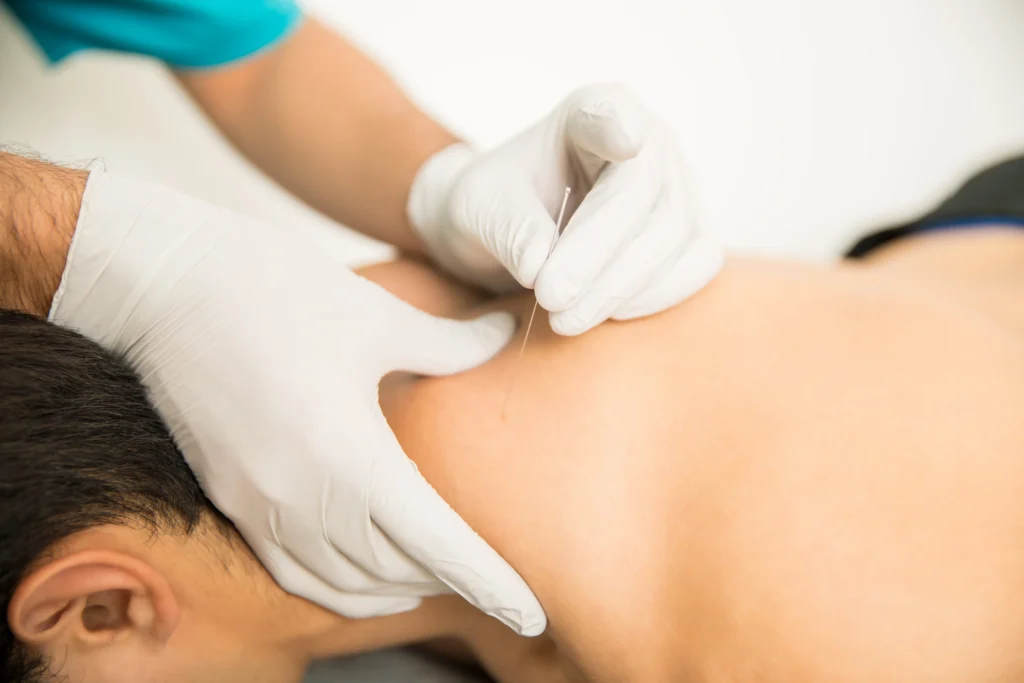
Look for these signs:
- Pain starts after long sitting
- Neck feels stiff
- Pressing neck muscles reproduces headache
- Pain reduces with stretching
- One-sided pain linked with posture
If you relate to these:
Dry needling may help you
What exactly is dry needling
Dry needling is a technique where a very thin needle is inserted into tight muscle knots, also called trigger points.
These knots are not always painful when touched, but they can refer pain elsewhere.
For example:
- Upper trapezius can refer pain to the temples
- SCM muscle can refer pain around the eyes
- Suboccipital muscles can cause pain at the back of the head
The needle helps to:
- Release the tight band
- Improve blood flow
- Reduce pain sensitivity
Explained that dry needling reduces muscle tension and improves local circulation. Cagnie et al. (2015)
Let’s talk honestly. Does it really work
This is where most articles oversimplify things.
In real clinical practice, results are not identical for everyone.
I usually see three types of responses:
- Immediate relief
- Relief after a few sessions
- Minimal change
All of these are normal.
Because dry needling works best when the headache is muscle-driven.
How many sessions do you actually need
This varies, but a general pattern looks like this:
- Mild headaches: 2 to 3 sessions
- Moderate: 4 to 6 sessions
- Chronic cases: 6 to 10 sessions
But here is what matters more:
Frequency reduces first. Intensity reduces later. So don’t judge results too early.
When dry needling works well
It tends to help in:
- Tension headaches
- Cervicogenic headaches
- Desk job related headaches
- Neck stiffness with headache
A recent study showed meaningful improvements. Kandeel et al. (2024)
Reported reduction in headache intensity and frequency after dry needling.
Another review supports its role in improving function.
Found improvements in disability and daily activity levels. Vázquez-Justes et al. (2022)
But there is one important detail most people miss.
Results are better over weeks, not instantly.
When it may not work much
This part is often ignored, but it matters.
Dry needling may not give strong results if:
- Headache is hormonal
- Migraine is purely neurological
- Sleep is poor
- Stress levels are high
- No trigger points are present
Some research also shows that it is not always superior to other treatments. Systematic Review (2020)
Found dry needling effective, but best when combined with other therapies.
So if someone says, “This alone will cure your headaches”, Be cautious.
How I decide if a patient needs dry needling
Not every patient gets it.
I usually check:
- Does pressing on a muscle reproduce the headache
- Is neck movement restricted
- Are trigger points present
- Is posture contributing
If yes, then dry needling makes sense. If not, I choose other approaches.
This step is important and often skipped in generic advice online.
What happens during the session
Let me walk you through it in simple terms.
Before treatment
- Assessment of posture and movement
- Identification of painful or tight areas
During treatment
- Thin needle inserted into trigger point
- You may feel a twitch or deep ache
After treatment
- Muscle soreness
- Lightness in movement
- Sometimes temporary heaviness
Kietrys et al. (2013) Reported reduction in musculoskeletal pain with trigger point dry needling.
What is the cost of dry needling
In India, the cost usually depends on:
- City
- Clinic setup
- Experience of therapist
Approximate range:
- Per session: ₹800 to ₹2500
- Package (3 to 5 sessions): ₹2500 to ₹8000
In bigger cities, it may be slightly higher.
Important point
Cheapest is not always safest. Skill matters more than price here.
Is it painful
Most people tolerate it well.
What patients usually say:
- It feels like a quick prick
- A twitch sensation
- Deep pressure for a few seconds
It is uncomfortable, but short lasting.
What patients expect vs what actually happens
Expectation:
“I will be pain free after one session”
Reality:
- Relief is gradual
- Some soreness is normal
- Requires follow up sessions
Expectation:
“This will fix my problem permanently”
Reality:
- Habits need to change
- Exercises are essential
What you may feel after the session
This surprises many people.
You might feel:
- Soreness
- Mild headache
- Heaviness
Sometimes patients say
“I feel worse today”
This is temporary and usually settles within 24 to 48 hours.
What to do after a dry needling session
- Drink enough water
- Avoid heavy workouts for 24 hours
- Do gentle stretching
- Apply heat if sore
- Stay active but don’t overstrain
These small steps improve recovery.
The biggest mistake people make
They take dry needling as the full treatment.
It is not.
It only releases the muscle.
It does not fix:
- Weak muscles
- Poor posture
- Bad sitting habits
So the pain comes back.
Dry needling vs exercises. What matters more
Honestly, exercises matter more.
Dry needling:
- Releases tight muscle
- Gives short term relief
Exercises:
- Build strength
- Improve posture
- Prevent recurrence
Best approach is both together. If you had to choose only one:
Choose exercises
What actually gives long term relief
This is what works in real life.
Step 1 Release
Dry needling or manual therapy
Step 2 Retrain
- Deep neck flexor exercises
- Scapular strengthening
Step 3 Correct habits
- Screen at eye level
- Back supported
- Regular breaks
Without step 2 and 3, results do not last.
A small but important detail
Trigger points refer pain.
So the pain you feel in the head may actually start in the neck.
This is why treating only the head often fails.
Risks and side effects
Dry needling is generally safe when done by trained professionals.
Common effects:
- Soreness
- Bruising
- Fatigue
Less common:
- Bleeding
- Dizziness
Rare but serious:
- Lung injury if done incorrectly in certain areas
This is why proper training matters.
Who should be careful
Avoid or consult before treatment if:
- You have bleeding disorders
- You are on blood thinners
- You have severe needle fear
- You have skin infections
- You are pregnant
Lesser known facts that help patients
These are things people usually realise late.
- Hydration affects muscle tightness
- Stress directly increases neck tension
- Sleep quality affects headache frequency
- One session is rarely enough
- Exercises matter more than needles
Simple daily routine that actually helps
Morning
- Neck stretches
- Shoulder rolls
During work
- Break every 30 to 40 minutes
- Chin tuck exercise
Evening
- Light stretching
- Heat if needed
When not to ignore your headache
Do not rely only on physiotherapy if you notice:
- Sudden severe headache
- Vision changes
- Vomiting with headache
- Loss of balance
- Headache after injury
These need medical evaluation first.
A small real life example
A patient came with daily headaches for 6 months.
Desk job. Long hours. Minimal movement.
We did:
- 4 sessions of dry needling
- Posture correction
- Simple neck exercises
Result:
- Headache frequency reduced in 2 weeks
- Almost gone in 1 month
But only because:
Exercises were followed regularly
Final thoughts from a physiotherapy perspective
Dry needling is useful. It is backed by research.
It helps many patients. But it is not magic.
If your headache is coming from:
- Muscles
- Posture
- Repetitive strain
Then it can make a big difference.
But only when combined with the right exercises and habits.
Think of it as:
A tool that opens the door. Not the full solution
Frequently Asked Questions
1. Is dry needling safe for headaches?
Yes, when performed by a trained physiotherapist, it is generally safe and effective for muscle-related headaches.
2. How many sessions of dry needling are needed?
Most people require 3 to 6 sessions, depending on the severity and duration of their headache condition.
3. Does dry needling give permanent relief?
It can provide long-term relief when combined with exercises, posture correction, and lifestyle changes.
4. Can dry needling make headaches worse?
Some people may feel temporary soreness or heaviness after treatment, but this usually settles within 24 to 48 hours.
5. Is dry needling painful?
It may feel uncomfortable for a few seconds with a twitch or deep ache, but most people tolerate it well.
6. Can dry needling help migraines?
It may help reduce frequency and intensity if muscle tension is a contributing factor, but it is not effective for all migraine types.
7. Is dry needling better than medication?
Dry needling addresses the root cause of muscle-related headaches, while medication usually provides temporary relief.
Stay tuned with us for more health related topics.
Follow us on LinkedIn and Instagram for more.
More Read


Medical Disclaimer!
This article has been reviewed and written under the guidance of our Head Physiotherapist, Dr. Kruti Raj (PT, MUHS,CPT,CMPT). The information shared is intended for educational purposes only and should not be considered a substitute for personalized medical advice, diagnosis, or treatment.
Please consult us or any other qualified healthcare professional before beginning any exercise program, especially if you are experiencing pain, recovering from injury, or managing a medical condition.


