


Hip pain and stiffness can make simple activities, such as walking, getting into a car or putting on socks, unexpectedly difficult.
Hip Capsulitis: Quick Answer
Hip capsulitis refers to irritation or inflammation involving the capsule surrounding the hip joint. It may contribute to hip pain, stiffness and restricted movement, although similar symptoms can occur with arthritis, labral injuries and other hip conditions.
Treatment depends on the underlying cause. When appropriate, physiotherapy may include gentle mobility exercises, progressive strengthening, activity modification and functional rehabilitation. Persistent or worsening symptoms require professional assessment.
While muscle strains and arthritis are common explanations, problems involving the hip joint capsule may also contribute to discomfort and restricted movement.
Hip capsulitis generally describes inflammation or irritation affecting the joint capsule.
A related but distinct condition, adhesive capsulitis of the hip, involves painful restriction of movement and capsular adhesions or fibrosis.
Understanding this difference matters because treatment depends on the underlying cause, and physiotherapy must be tailored to the individual’s symptoms and assessment findings.
Key Takeaways
- Hip capsulitis refers to irritation or inflammation involving the hip joint capsule.
- Adhesive capsulitis of the hip is a distinct, relatively uncommon condition associated with painful restriction of movement.
- Hip pain and stiffness can also result from osteoarthritis, labral problems, muscle-related conditions or referred pain.
- Diagnosis may involve a clinical examination and, when indicated, imaging or other medical tests.
- Physiotherapy may help improve mobility, strength and daily function when it is appropriate for the underlying condition.
- Sudden severe pain, inability to bear weight, or hip pain accompanied by fever requires urgent medical assessment.
What Is Hip Capsulitis?
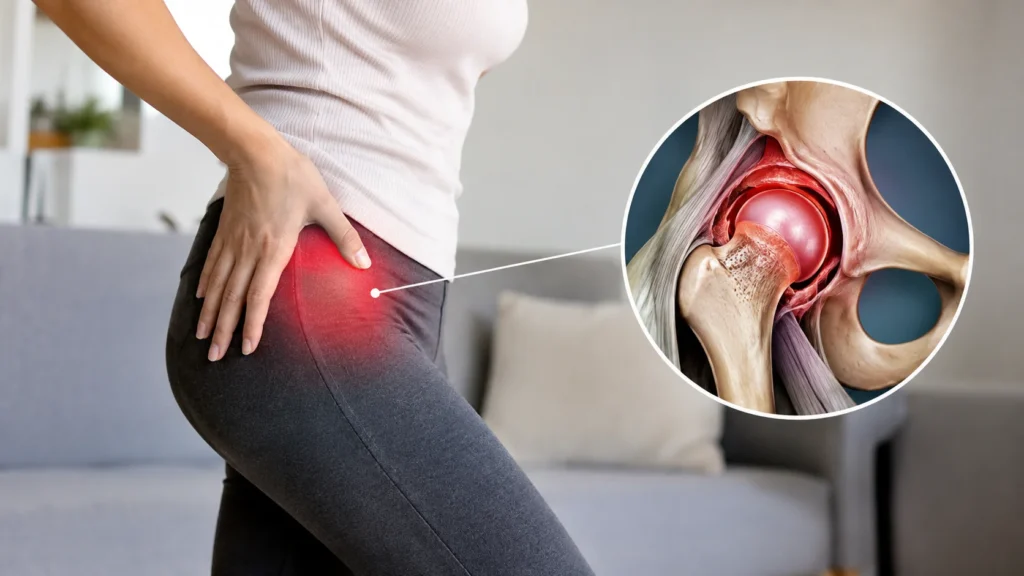
The hip is a ball-and-socket joint surrounded by a strong connective tissue structure called the joint capsule.
This capsule helps support joint stability while allowing the hip to move through a wide range of positions.
The capsule also contains sensory nerves that contribute to pain perception.
Research has identified a complex nerve supply around the hip capsule, helping explain why problems involving the joint and its surrounding tissues can be painful. (Tomlinson et al., 2021)
Capsular irritation may occur alongside other hip conditions.
However, the term hip joint capsulitis does not always identify one specific diagnosis.
Adhesive capsulitis of the hip is a more clearly described, relatively uncommon condition associated with progressive pain and restriction of both active and passive hip movement. T
he available research remains limited, so it is important not to assume that every stiff or painful hip has this condition. (Chellamuthu et al., 2023)
What Causes Hip Capsulitis?
Capsular irritation or stiffness can develop in several circumstances.
The underlying cause may not always be obvious.
Repetitive activity or injury
Repeated deep squats, sudden increases in training intensity, twisting movements or an injury may aggravate the hip joint and surrounding tissues.
Pain after exercise does not automatically mean the capsule is inflamed, however.
Hip osteoarthritis
Hip Osteoarthritis affects the cartilage and other structures within the joint.
It may also be associated with synovial inflammation, stiffness and changes in the surrounding capsule.
Adhesive capsulitis
In adhesive capsulitis, painful movement restriction develops as the capsule becomes less compliant and may develop adhesions or fibrosis.
It can resemble other hip disorders, making careful clinical assessment essential. (de Sa et al., 2016)
Inflammatory conditions
Some inflammatory joint disorders can affect the hip and produce pain or stiffness.
Persistent morning stiffness, symptoms affecting multiple joints or unexplained systemic symptoms may warrant further medical investigation.
Reduced movement after surgery or injury
A period of reduced activity can contribute to stiffness and muscle weakness.
These changes may occur alongside capsular problems, but reduced movement alone does not confirm capsulitis.
What Are the Symptoms of Hip Capsulitis?
Symptoms vary depending on the underlying condition.
Possible features include:
- Deep hip or groin pain: Discomfort may feel as though it comes from inside the joint.
- Stiffness after rest: The hip may feel difficult to move after sitting or sleeping.
- Restricted movement: Bending the hip, rotating the thigh or spreading the leg may become uncomfortable.
- Pain during walking: Weight-bearing activities may aggravate symptoms.
- Difficulty with daily tasks: Putting on footwear, climbing stairs or getting into a car may become harder.
- Progressive loss of mobility: Some people experience increasing restriction over time, particularly with adhesive capsulitis.
These symptoms overlap with several other conditions.
Pain location and movement restriction can guide an assessment, but neither confirms capsulitis on its own.
Who Is More at Risk?
The risk depends on the specific condition affecting the hip.
Factors that may be relevant include:
- Previous hip injury or surgery.
- Existing osteoarthritis or other joint disease.
- Prolonged reduction in movement.
- Repeated activities that aggravate the hip.
- An inflammatory condition affecting the joints.
These are possible contributing factors rather than proof of capsular inflammation.
Adhesive capsulitis of the hip is uncommon, and the evidence is not strong enough to establish a single set of risk factors that applies to everyone.
How Is Hip Capsulitis Diagnosed?
Diagnosis involves identifying the source of the pain and determining whether the capsule is likely to be involved.
Clinical assessment
A doctor or physiotherapist may ask about the onset of symptoms, previous injuries, activity levels, morning stiffness and movements that worsen the pain.
The examination may include:
- Active and passive hip range of motion.
- Hip strength and muscle control.
- Walking pattern and tolerance for weight-bearing.
- Functional tasks such as sitting, standing and climbing steps.
- Assessment of the lower back and surrounding joints when referred pain is possible.
A pattern of progressively restricted hip movement may raise suspicion of adhesive capsulitis, but other causes must be considered.
Imaging and medical tests
An X-ray may help identify osteoarthritis or certain bony abnormalities.
MRI may be considered when further information about the joint, capsule or surrounding soft tissues is needed.
Blood tests may be appropriate if an inflammatory condition or infection is suspected.
No single scan or physical test should be interpreted in isolation.
Can Physiotherapy Help Hip Capsulitis?
Physiotherapy may help improve mobility, strength and daily function, particularly when a clinician has assessed the cause and determined that conservative rehabilitation is appropriate.
Evidence specific to adhesive capsulitis of the hip is limited.
Broader hip rehabilitation guidance supports individualized treatment based on clinical findings, functional limitations and response to exercise. (Enseki et al., 2023)
1. Gentle hip mobility exercises
Controlled movements may help maintain available range of motion.
Depending on the assessment, a physiotherapist may prescribe comfortable hip flexion, gentle rotation or supported movement exercises.
The aim is to improve movement without repeatedly provoking pain.
Forcing the hip into a restricted position is not a suitable starting point.
2. Progressive strengthening
Exercises for the gluteal muscles and other hip muscles may help improve control during walking, standing and stair climbing.
Rehabilitation may progress from low-load exercises to standing and functional movements as tolerated.
Strengthening supports function, but it does not directly reverse every form of capsular fibrosis or structural joint disease.
3. Activity modification
Temporarily reducing activities that consistently worsen symptoms may help manage discomfort.
This might include modifying deep squats, high-impact exercise or repeated twisting movements.
Complete rest is not usually necessary unless a healthcare professional recommends it.
The goal is to maintain comfortable activity while avoiding excessive loading.
4. Gait and functional training
If hip pain changes the way a person walks, physiotherapy may include gait retraining, balance work and practice with everyday tasks.
A walking aid may be appropriate for some people if weight-bearing is painful.
5. Hands-on treatment when appropriate
A physiotherapist may use selected manual techniques to support mobility and symptom management.
These should be adapted to the diagnosis and tolerance of the person receiving treatment, and should complement an active rehabilitation plan.
Important: Suspected infection, fracture or significant structural injury needs medical evaluation rather than exercise-based treatment alone.
Which Exercises Should You Avoid?
There is no single list of exercises that everyone with hip capsulitis must avoid.
The right choice depends on the diagnosis, pain severity and movement restriction.
Initially, consider modifying:
- Deep squats or lunges that cause sharp groin pain.
- Forceful hip rotation or aggressive stretching.
- Running or jumping that noticeably worsens symptoms.
- Heavy resistance exercises through a painful range.
- Repeatedly pushing the hip into its restricted movement.
Stop an exercise if it causes sharp or escalating pain, increases limping or produces a sustained worsening of symptoms.
A physiotherapist can help adjust the range, resistance and progression.
Hip Capsulitis: Myth vs Fact
Myth: Every stiff hip has capsulitis.
Fact: Hip stiffness can result from osteoarthritis, muscle guarding, labral problems and other conditions. An assessment is needed to identify the likely cause.
Myth: Stretching harder will release the capsule faster.
Fact: Forceful stretching may aggravate pain. Mobility exercises should be gentle, controlled and suited to the diagnosis.
Myth: Physiotherapy is only about stretching.
Fact: Rehabilitation may also include strengthening, activity modification, balance training and functional movement practice.
Myth: Hip capsulitis always heals with exercises alone.
Fact: Treatment depends on the underlying cause. Some conditions require medical treatment or further investigation in addition to physiotherapy.
How Long Does Hip Capsulitis Take to Improve?
Recovery depends on the underlying condition, severity of stiffness, overall health and response to treatment.
In the published literature on adhesive capsulitis of the hip, improvement may occur over an extended period, and some cases have required additional medical or surgical management.
However, the evidence is limited, and a fixed recovery timeline cannot be applied to everyone.
If mobility continues to decline, pain remains persistent or rehabilitation is not helping, the diagnosis and treatment plan should be reviewed.
When Should You Seek Medical Attention?
Seek urgent medical assessment if you develop:
- Sudden, severe hip pain.
- Inability to bear weight, particularly after an injury.
- Hip pain accompanied by fever, chills or feeling seriously unwell.
- A hot or swollen joint with significant pain.
These symptoms may indicate a serious problem, including infection or fracture, and should not be managed with stretching alone.
Arrange a clinical assessment if pain repeatedly disrupts sleep, stiffness is progressively worsening or walking and daily activities are becoming increasingly difficult.
A Lesser-Known Fact About the Hip Capsule
The hip capsule contributes to joint stability and contains sensory nerve fibres involved in pain perception.
However, its precise role in proprioception, or the body’s awareness of joint position, is not fully established.
This matters because a sensation of tightness or restricted movement does not necessarily mean the capsule itself is inflamed.
Muscle guarding, osteoarthritis and other joint problems can create similar symptoms.
Final Thoughts
Hip pain and stiffness can have several causes, and capsular irritation is only one possibility. Identifying the underlying condition helps determine whether mobility exercises, strengthening, medical treatment or a combination of approaches is appropriate.
With an accurate assessment and a suitable rehabilitation plan, many people can work towards more comfortable movement and better daily function. Avoid forcing painful movements and seek professional advice if symptoms persist or worsen.
Conclusion
Hip capsulitis may contribute to hip pain, stiffness, and restricted movement, but these symptoms can also occur with osteoarthritis, labral injuries, and other joint conditions.
Accurate assessment is essential to identify the underlying cause and determine the most appropriate treatment.
Physiotherapy may help improve hip mobility, muscle strength, movement control, and daily function through gentle exercises, progressive strengthening, and activity modification.
However, treatment should be tailored to the diagnosis and the individual’s symptoms rather than relying on a standard exercise routine.
If hip pain persists, stiffness progressively worsens, or walking becomes difficult, seek professional assessment.
Early identification of the underlying condition can help guide appropriate treatment and support a safer return to everyday activities.
Frequently Asked Questions About Hip Capsulitis
1. What is hip capsulitis?
Hip capsulitis generally refers to inflammation or irritation involving the capsule surrounding the hip joint. The term can be used broadly, so clinical assessment is important to identify the specific condition.
2. Can hip capsulitis cause groin pain?
Yes, problems involving the hip joint may cause deep groin pain. However, groin pain can also result from arthritis, labral injuries, muscle problems and other conditions.
3. Can physiotherapy help hip capsulitis?
Physiotherapy may help improve mobility, strength and daily function when appropriate. Treatment may include gentle exercises, progressive strengthening and activity modification based on the underlying diagnosis.
4. Which exercises should I avoid with hip capsulitis?
Avoid or modify exercises that cause sharp pain or worsen your symptoms, which may include deep squats, forceful rotations or aggressive stretching. A physiotherapist can recommend suitable alternatives.
5. How long does hip capsulitis take to heal?
Recovery varies with the underlying condition, severity of symptoms and response to treatment. There is no single recovery timeline that applies to every person with hip capsulitis.
6. When should I see a doctor for hip capsulitis?
Seek urgent assessment for sudden severe pain, inability to bear weight, or hip pain accompanied by fever or chills. Arrange a clinical review if pain persists or mobility continues to worsen.
Stay tuned with us for more health related topics.
Follow us on LinkedIn and Instagram for more.
More Read


Medical Disclaimer
This article is intended for general educational purposes only and does not replace professional medical advice, diagnosis or treatment. Hip pain and stiffness may have several underlying causes, and the exercises or rehabilitation approaches discussed may not be suitable for everyone. Consult a qualified healthcare professional for an individual assessment before starting a new exercise program. Seek urgent medical care for severe or sudden hip pain, inability to bear weight, or symptoms accompanied by fever or chills.


