


A burning sensation when you urinate can be surprisingly uncomfortable, but it is also a symptom that deserves attention rather than guesswork.
Burning urination in men, medically called dysuria, can come from an infection, inflammation, a prostate problem, a urinary stone, irritation around the penis, or even tension in the pelvic floor muscles.
One important point I tell my patients is this: burning does not automatically mean you have a urinary tract infection.
Quick Answer
Burning urination in men can be caused by a UTI, STI-related urethritis, prostatitis, urinary stones, urethral stricture, prostate enlargement, genital irritation, bladder pain syndrome or, less commonly, a urinary tract cancer.
Important: Burning with fever, chills, severe back/flank pain, blood in the urine, discharge or inability to urinate should be medically assessed promptly.
A recent clinical review found that dysuria can also result from sexually transmitted infections, bladder irritants, skin conditions and chronic pelvic pain disorders.
Most people with dysuria need at least a urinalysis, while recurrent or complicated cases may require urine culture and additional testing. (AFP)
As a physiotherapist, I also pay attention to something that is often overlooked: what the pelvic floor is doing while you are experiencing urinary symptoms.
A painful urinary episode can cause a man to unconsciously tighten the muscles around the pelvis.
If that tension persists after the original problem has settled, urinary urgency, discomfort, difficulty relaxing during urination and pelvic pain can sometimes continue.
So, rather than treating every burning sensation as “just a UTI,” let’s look at the nine possibilities and how you can recognize when medical assessment is necessary.
Key Takeaways
- Burning urination is a symptom, not a diagnosis.
- UTIs are important, but STIs, prostatitis, stones and irritation can cause similar symptoms.
- Burning plus a weak urine stream should not be ignored.
- Persistent pelvic symptoms may involve an overactive or poorly relaxing pelvic floor.
- Do not repeatedly self-treat with leftover antibiotics.
- Avoid excessive genital washing and irritating personal-care products.
- Fever, chills, severe pain, blood in urine or urinary retention require prompt medical assessment.
Common Causes
Burning urination in men may be caused by:
- Urinary tract infection
- Urethritis from an STI or another infection
- Prostatitis
- Kidney or bladder stones
- Urethral stricture
- Prostate enlargement and urinary obstruction
- Irritation, balanitis or chemical exposure
- Bladder pain syndrome/interstitial cystitis
- Less commonly, bladder cancer or another urinary tract condition
The pattern of your symptoms matters.
Burning plus discharge suggests a different pathway from burning plus fever, flank pain, a weak stream or visible blood in the urine.
1. Urinary Tract Infection
A urinary tract infection is one of the first causes doctors consider when a man reports burning while urinating.
A UTI can affect different parts of the urinary system.
When the bladder is involved, burning may occur together with increased urinary frequency, urgency, lower abdominal discomfort, cloudy urine, strong-smelling urine or blood in the urine. (NIDDK)
But there is an important distinction for men: urinary symptoms should not simply be self-diagnosed and treated repeatedly with leftover antibiotics.
The urinary tract and prostate are anatomically connected.
Bacteria associated with a urinary infection can involve the prostate, which may influence treatment decisions.
NIDDK notes that men may require longer antibiotic treatment for bladder infections because bacteria can move into the prostate. (NIDDK: Treatment)
A lesser-known clue
If burning is accompanied by fever, chills, nausea, vomiting or pain in the back, side or groin, think beyond a simple bladder infection. These can indicate kidney involvement and need prompt medical attention. (NIDDK: Kidney Infection)
From a physiotherapy perspective, I would not use pelvic-floor exercises to “treat” an active infection.
The priority is proper medical diagnosis and treatment.
Once the infection is appropriately managed, persistent pelvic tension can be assessed separately if symptoms remain.
2. Urethritis, Including Sexually Transmitted Infections
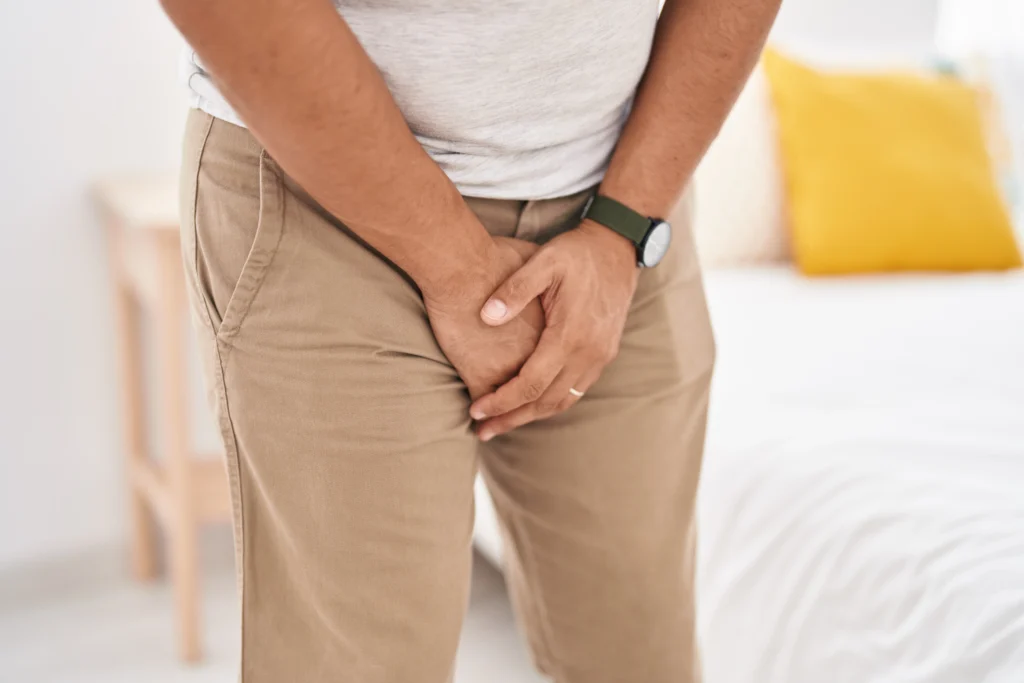
The urethra is the tube through which urine leaves the body.
When its lining becomes inflamed, urination can sting or burn.
Urethritis can be caused by infections such as chlamydia, gonorrhea and Mycoplasma genitalium, among others.
Symptoms may include burning, urethral irritation, itching and discharge. (CDC,2021)
This is one of the most important causes not to overlook because a routine urine test for a bladder infection may not answer the entire question.
The CDC recommends nucleic acid amplification testing, or NAAT, for chlamydia and gonorrhea in men with suspected urethritis.
Persistent or recurrent cases may warrant testing for organisms such as M. genitalium, depending on the clinical situation.
What if there is no discharge?
You can still have urethritis without obvious discharge.
This is a useful point because many men assume, “There is no discharge, so it can’t be an STI.”
That assumption is unreliable. Burning, irritation or urinary discomfort may occur without dramatic visible symptoms.
If there has been a new sexual partner, unprotected sex or another potential exposure, tell the healthcare professional.
This information changes which tests are appropriate.
What to avoid
Do not repeatedly take antibiotics without testing simply because burning returned.
The CDC specifically emphasizes identifying the underlying cause when possible because accurate diagnosis helps reduce complications, reinfection and transmission.
3. Prostatitis
The prostate sits just below the bladder and surrounds part of the urethra.
When the prostate becomes inflamed or infected, urination can become painful.
Prostatitis may cause burning urination along with urinary frequency, urgency, difficulty starting the stream, weak or interrupted flow, pelvic discomfort, pain around the penis or scrotum, lower abdominal pain or painful ejaculation. (NIDDK: Prostatitis)
Acute bacterial prostatitis is different from chronic prostatitis/chronic pelvic pain syndrome.
Acute bacterial prostatitis can develop rapidly and may produce fever, chills, body aches and significant urinary difficulty.
That requires prompt medical care.
Chronic prostatitis/chronic pelvic pain syndrome is more complicated.
Some men have persistent urinary symptoms and pelvic discomfort without a demonstrable bacterial infection.
This is where the pelvic floor becomes particularly interesting.
4. Pelvic Floor Tension Can Amplify Urinary Symptoms
This is one of the lesser-known connections I want men to understand.
Your pelvic floor muscles help support the bladder and bowel and contribute to urinary control.
They also need to relax during normal urination.
If these muscles remain excessively active, a man may experience pelvic discomfort, urinary symptoms and difficulty relaxing the muscles appropriately.
A 2022 study published in Physical Therapy compared men with chronic prostatitis/chronic pelvic pain syndrome with controls and found evidence of impaired pelvic-floor relaxation in affected men. (Oxford Academic)
This does not mean that pelvic-floor tension is the original cause of every case of burning urination.
Instead, think of it as a possible symptom amplifier or contributor, particularly when infection and other urological causes have been investigated.
This is where physiotherapy can help
For an appropriately assessed patient with chronic pelvic pain, treatment may include:
- pelvic-floor relaxation rather than strengthening
- diaphragmatic breathing
- gentle mobility exercises
- graded aerobic activity
- education about pelvic-floor coordination
- manual therapy when clinically appropriate
- reducing habitual pelvic bracing
A systematic review found that pelvic-floor physical therapy may benefit men with chronic prostatitis/chronic pelvic pain syndrome and pelvic-floor hypertonicity, although the authors also emphasized limitations in the quality and size of available studies. (PMC)
So please don’t assume that more Kegel exercises are always better.
A tight pelvic floor may need to learn how to relax, not contract harder.
5. Kidney or Bladder Stones
A urinary stone can irritate the urinary tract and cause painful urination.
Kidney stones are particularly memorable because of their classic severe, cramping pain, but their presentation can vary.
Symptoms may include sharp pain in the back, side, lower abdomen or groin, blood in the urine, frequent urination and pain during urination. (NIDDK: Kidney Stone)
A small stone moving toward the bladder or through the urethra may create irritation that feels like burning.
A useful prevention tip
Hydration is important, but “drink as much water as possible” is not an appropriate universal prescription.
Fluid needs depend on your health, environment, medications and other medical factors.
For people prone to stones, the specific type of stone also matters.
Calcium, oxalate, uric acid and other stone types have different prevention considerations.
NIDDK notes that inadequate fluid intake increases kidney-stone risk, while stone prevention can also depend on dietary and metabolic factors.
Seek urgent medical attention for severe pain, vomiting, fever, inability to urinate or significant blood in the urine.
6. Urethral Stricture
A urethral stricture is a narrowing of the urethra caused by scar tissue or other structural changes.
This can be easy to overlook because men may initially describe the problem as “burning urine” when the bigger issue is actually restricted urine flow.
Watch for:
- weak urine stream
- spraying or altered stream direction
- prolonged urination
- straining to urinate
- incomplete emptying
- dribbling
- recurrent urinary infections
- burning or discomfort
A previous catheter, urethral procedure, trauma or infection can increase the likelihood of urethral narrowing.
This is an important reason not to rely on home remedies if burning keeps returning alongside a progressively weaker stream. Urethral obstruction can require urological assessment rather than exercises.
7. Prostate Enlargement and Urinary Obstruction
Benign prostatic hyperplasia, or BPH, becomes increasingly common with age.
An enlarged prostate can narrow the urethral passage and contribute to difficulty starting urination, weak flow, incomplete emptying, frequency and nighttime urination.
BPH itself is not the same thing as an infection.
However, urinary obstruction and incomplete emptying can change the urinary environment and may coexist with infection or inflammation.
That is why a man with burning plus significant lower urinary tract symptoms should be assessed rather than assuming the prostate is simply “getting old.”
The European Association of Urology recommends urinalysis as part of the assessment of men with lower urinary tract symptoms because it can identify findings such as infection, blood, protein or glucose that may require further investigation. (EAU)
8. Irritation, Balanitis or Chemical Exposure
Not every burning sensation originates deep inside the urinary tract.
The skin around the glans and urethral opening can become irritated by soaps, fragrances, antiseptics, lubricants, condoms, topical products, excessive washing or other substances.
This is particularly relevant when burning started after changing a personal-care product or after vigorous sexual activity.
Research in dermatology has documented irritant and allergic reactions associated with products such as soaps, lubricants, wipes and other personal-care products in the genital region. (Elsevier)
Try this simple elimination strategy
If your clinician has ruled out infection and you notice external irritation:
- stop fragranced genital washes
- avoid aggressive scrubbing
- rinse gently with lukewarm water
- avoid repeatedly applying antiseptic products
- consider whether a new lubricant or condom coincided with symptoms
- allow irritated skin time to recover
The goal is not to “sterilize” the penis.
Over-cleaning can actually irritate sensitive skin.
If there is redness, swelling, sores, persistent itching, discharge or recurrent inflammation, see a doctor rather than repeatedly changing products yourself.
9. Bladder Pain Syndrome or, Less Commonly, Bladder Cancer
Two very different conditions belong on the “don’t overlook persistent symptoms” list.
Bladder pain syndrome
Interstitial cystitis/bladder pain syndrome can cause urinary urgency, frequency and bladder or pelvic discomfort even when routine testing does not reveal a conventional infection.
NIDDK describes symptoms that may worsen as the bladder fills and temporarily improve after urination.
Diagnosis generally involves ruling out other causes. Physical assessment, including evaluation of pelvic-floor muscles in men, may form part of the assessment. (NIDDK: Interstitial Cystitis)
This condition is less straightforward than a UTI and should not be diagnosed simply because a urine test is negative once.
Bladder cancer
Burning urination is not automatically a sign of cancer. In fact, infections and stones are much more common explanations for many urinary symptoms.
However, persistent urinary symptoms accompanied by blood in the urine deserve proper evaluation.
The National Cancer Institute identifies blood in the urine as the most common symptom of bladder cancer, while other symptoms can include frequent urination and burning or pain during urination. (NCI)
Visible blood should never simply be dismissed as “probably a UTI,” particularly if it recurs.
How Doctors Find the Cause of Burning Urination in Men
The most useful first step is often a good history.
I would want to know:
When did the burning begin?
Sudden symptoms may suggest an acute infection, irritation or stone, while persistent or recurrent symptoms broaden the differential.
Where exactly do you feel it?
Burning at the urethral opening is different from deep pelvic discomfort or pain in the bladder region.
Do you have discharge?
This increases suspicion for urethritis and changes the testing pathway.
Is your urine stream weak?
A weak or interrupted stream raises questions about prostate enlargement, urethral narrowing or other forms of obstruction.
Are you urinating more frequently?
Frequency and urgency can occur with infection, bladder irritation, prostatitis and bladder pain syndrome.
Is there blood?
Blood in the urine warrants appropriate medical evaluation.
Do you have fever or chills?
These symptoms make a more significant infection much more concerning.
A typical evaluation may include urinalysis, urine culture when appropriate, STI testing, physical examination and additional testing based on the symptoms.
A recent review of dysuria emphasizes urinalysis for most patients and urine culture particularly when infection is suspected to be recurrent or complicated.
When Burning Urination Needs Urgent Medical Attention
Please don’t wait for a home remedy to work if you have:
- fever or chills
- vomiting
- severe back, side or flank pain
- inability to urinate
- severe pelvic or genital pain
- significant blood in the urine
- rapidly worsening symptoms
- confusion, marked weakness or feeling seriously unwell
A combination of urinary symptoms with fever, chills, flank pain or pelvic/perineal pain can indicate a systemic urinary infection.
The 2026 EAU guidance specifically highlights these combinations as warning signs.
What You Can Do While Waiting for Assessment
There are a few sensible measures that can reduce irritation without pretending to treat the underlying cause.
Drink fluids sensibly
Unless you have been told to restrict fluids because of a medical condition, maintain normal hydration.
Extremely concentrated urine can feel irritating, but forcing excessive quantities of water is not necessary.
Temporarily reduce obvious bladder irritants
If symptoms are particularly noticeable, some people find it useful to temporarily reduce caffeine, alcohol and very spicy foods while the cause is being investigated.
Don’t hold urine for prolonged periods
Regularly ignoring the urge to urinate is not a useful strategy when your urinary tract is already irritated.
Don’t repeatedly self-medicate with antibiotics
Antibiotics should be selected according to the suspected infection and clinical findings.
Unnecessary or inappropriate antibiotic use can contribute to resistance and may delay the correct diagnosis.
Don’t aggressively exercise the pelvic floor
This is particularly important from my physiotherapy perspective.
If your urinary burning is accompanied by pelvic pain, urinary hesitancy, pain after ejaculation or a feeling of pelvic tightness, automatically performing hundreds of Kegels may not be appropriate.
The pelvic floor is a coordination system, not simply a muscle group that needs strengthening.
A Physiotherapist’s Perspective: When Should Pelvic Floor Physiotherapy Be Considered?
Physiotherapy is not a replacement for medical testing when burning urination is caused by infection, stones, obstruction or another urological condition.
But physiotherapy can become valuable when persistent symptoms are associated with chronic pelvic pain or pelvic-floor overactivity after serious causes have been evaluated.
A particularly interesting research finding is that pelvic myofascial trigger points can reproduce pain in different areas in men with chronic prostatitis/chronic pelvic pain syndrome.
A study involving 72 men found relationships between pelvic and abdominal trigger points and reported penile, perineal, rectal, testicular and groin pain. (Wolters Kluwer)
That helps explain why a man can sometimes feel urinary or genital discomfort even when the original infection has been treated.
A pelvic-health physiotherapist may assess breathing mechanics, abdominal and pelvic-floor muscle tone, movement patterns, hip mobility and the ability to contract and relax the pelvic floor.
Treatment should be individualized. Some men need strengthening. Others need relaxation and coordination.
The goal is not simply a stronger pelvic floor.
The goal is a pelvic floor that knows when to switch on and when to let go.
7 Mistakes Men Should Avoid When They Have Burning Urination
Mistake 1: Assuming every burning sensation is a UTI
Dysuria has a broad differential. Infection is important, but it is not the only possibility.
Mistake 2: Ignoring sexual-health testing
Urethritis can occur without dramatic discharge. Appropriate STI testing may be essential when exposure is possible.
Mistake 3: Taking leftover antibiotics
This may partially suppress symptoms without eliminating the underlying problem and can complicate later diagnosis.
Mistake 4: Washing the genital area repeatedly
More washing is not necessarily better. Irritant dermatitis can itself contribute to burning.
Mistake 5: Doing excessive Kegels
If pelvic-floor overactivity is contributing to chronic pelvic symptoms, repeated contractions may be counterproductive.
Mistake 6: Ignoring a progressively weaker urine stream
Burning plus declining flow can point toward obstruction, prostate-related symptoms or urethral narrowing.
Mistake 7: Ignoring blood in the urine
Even if the burning seems mild, blood warrants appropriate evaluation.
Final Word
If you are experiencing burning urination in men, don’t focus only on stopping the burning.
Focus on finding out why it is happening.
A urine test may reveal an infection. STI testing may identify urethritis.
A prostate assessment may explain urinary difficulty.
Imaging may be necessary for stones. And when medical causes have been appropriately investigated but pelvic symptoms persist, the pelvic floor may deserve attention too.
As a physiotherapist, my biggest advice is not to self-diagnose from one symptom.
The urinary system, prostate, nerves, bladder and pelvic-floor muscles work together.
Sometimes the original problem is an infection; sometimes it is irritation; and sometimes the muscles continue guarding long after the original trigger has disappeared.
Getting the cause right is what makes treatment effective.
If burning urination is new, persistent, recurrent or accompanied by discharge, blood, fever, pelvic pain or changes in your urine stream, arrange an appropriate medical evaluation rather than waiting indefinitely for it to disappear.
Frequently Asked Questions
What is the most common cause of burning urination in men?
A urinary tract infection is an important cause, but burning can also result from urethritis, sexually transmitted infections, prostatitis, urinary stones, irritation and other urinary conditions.
Can an STI cause burning urination without discharge?
Yes. Urethritis caused by sexually transmitted infections can cause dysuria or irritation even when obvious discharge is absent. Appropriate STI testing may be necessary.
Can prostatitis cause burning when urinating?
Yes. Prostatitis can cause burning or painful urination along with urinary frequency, urgency, pelvic discomfort, difficulty starting the stream or painful ejaculation.
Can dehydration cause burning urination in men?
Highly concentrated urine can sometimes feel irritating, but persistent burning should not automatically be blamed on dehydration. Infection, inflammation and other causes should be considered.
Can kidney stones cause burning urination?
Yes. A stone moving through the urinary tract can cause painful urination and may also cause severe flank, abdominal or groin pain and blood in the urine.
Can pelvic floor dysfunction cause urinary burning?
Pelvic-floor overactivity can contribute to chronic pelvic pain and urinary symptoms in some men. However, infection, stones and other medical causes should be ruled out before attributing burning to pelvic-floor dysfunction.
Should men do Kegel exercises for urinary burning?
Not automatically. Some men with pelvic-floor overactivity need relaxation and coordination rather than more strengthening. Assessment by a pelvic-health physiotherapist can help determine the appropriate approach.
When should burning urination be treated as an emergency?
Seek prompt medical care if burning occurs with fever, chills, vomiting, severe back or flank pain, significant blood in the urine, severe pelvic pain or inability to urinate.
Can soap cause burning around the penis?
Yes. Fragranced soaps, antiseptics, wipes, lubricants and other products can irritate sensitive genital skin and cause burning or discomfort.
How is burning urination diagnosed in men?
Evaluation may include a medical history, physical examination, urinalysis, urine culture, STI testing and additional investigations such as imaging or urological assessment depending on the symptoms.
Stay tuned with us for more health related topics.
Follow us on LinkedIn and Instagram for more.
More Read


Medical Disclaimer!
This article has been reviewed and written under the guidance of our Head Physiotherapist, Dr. Kruti Raj (PT, MUHS,CPT,CMPT). The information shared is intended for educational purposes only and should not be considered a substitute for personalized medical advice, diagnosis, or treatment.
Please consult us or any other qualified healthcare professional before beginning any exercise program, especially if you are experiencing pain, recovering from injury, or managing a medical condition.


