Exercises with a breast cancer port can help you stay active during treatment.
A breast cancer port, also called an implanted port or port-a-cath, is a small medical device placed beneath the skin to make cancer treatment easier.
It is commonly used to deliver chemotherapy, fluids, blood products, and certain medications without repeatedly inserting a needle into the veins of the hands or arms.
Can You Exercise With a Breast Cancer Port?
Yes, many people can exercise with a breast cancer port. Gentle walking, mobility exercises, and carefully selected strengthening exercises may be suitable once your healthcare team confirms that movement is safe.
Avoid heavy lifting, vigorous chest exercises, contact sports, swimming, and activities that place pressure on the port until the incision has healed and your oncology team gives clearance.
Many women wonder whether they can continue exercising after getting a port.
The answer is generally yes, exercise is often possible and beneficial, but the type, intensity, and timing of exercise must be adjusted according to the port’s healing stage, treatment schedule, symptoms, and medical advice.
Exercise may help reduce cancer-related fatigue, maintain muscle strength, support mobility, improve mood, and make daily activities easier.
However, exercising too intensely too soon may irritate the incision, place pressure on the port, or increase the risk of complications.
The safest approach is to begin gradually and work with your oncology team or a physiotherapist experienced in cancer rehabilitation.
Key Takeaways
- Exercise is often possible: A breast cancer port does not automatically mean that you must stop all physical activity.
- Start gently: Walking and comfortable mobility exercises are usually easier starting points.
- Respect the healing period: Avoid heavy lifting and vigorous upper-body exercise soon after port placement.
- Modify chest and shoulder exercises: Push-ups, chest presses, overhead presses, and planks may need to be postponed.
- Consider your treatment symptoms: Fatigue, anaemia, low blood counts, neuropathy, and dizziness can change your exercise plan.
- Stop when warning signs appear: Pain, swelling, redness, bleeding, fever, chest pain, or unusual breathlessness require medical advice.
- Get professional guidance: An oncology physiotherapist can create a safe and gradual exercise programme.
What Is a Breast Cancer Port?
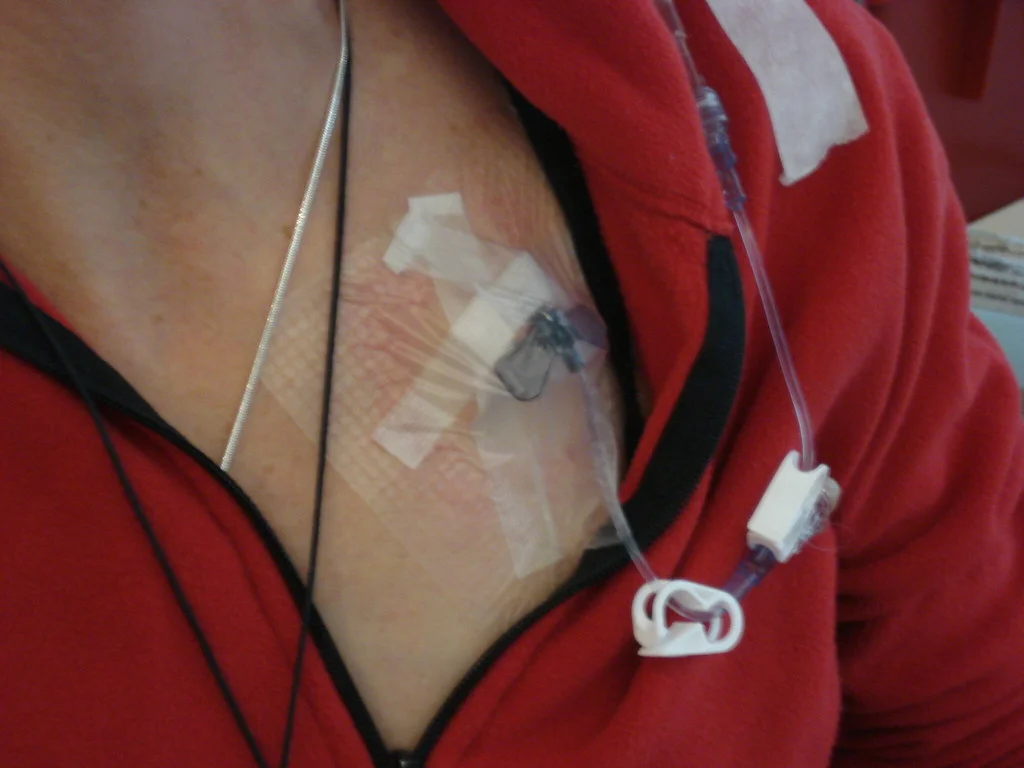
A port is a small reservoir placed under the skin, usually in the upper chest.
It is connected to a thin flexible tube called a catheter, which enters a large vein.
During treatment, a special needle is inserted through the skin into the port.
Medication can then travel through the catheter directly into the bloodstream.
Unlike an external intravenous line, most of the port remains beneath the skin.
This allows many people to move around more comfortably between treatment sessions.
However, the port still needs time to settle after surgery.
The skin, tissues, and catheter area must heal before you return to heavy lifting, vigorous upper-body exercise, or contact sports. (American Cancer Society, 2025).
Is Exercise Safe With a Breast Cancer Port?
For many people, gentle and appropriately modified exercise is safe after port placement.
In fact, staying physically active during cancer treatment may support physical function and emotional wellbeing.
Research-based cancer exercise guidance supports a combination of aerobic activity, such as walking, and resistance exercise when medically appropriate.
Exercise should be adapted to the person’s treatment, symptoms, fitness level, and surgical recovery.
The important point is that having a port does not automatically mean you must stop all physical activity (Ligibel et al., 2022). Instead, you may need to change:
- The intensity of exercise
- The amount of weight lifted
- The position of your arms and shoulders
- The duration of the workout
- The type of movement performed
- The timing of exercise around chemotherapy sessions
When Can You Start Exercising After Port Placement?
The timing depends on how the port was inserted, how the incision is healing, whether complications are present, and your oncology team’s instructions.
During the First Few Days
Immediately after port placement, you may experience:
- Tenderness around the incision
- Mild swelling or bruising
- Tightness across the chest or shoulder
- Discomfort when moving the arm
- Fatigue from the procedure or sedation
During this period, rest is important.
Short, gentle walks around your home may be appropriate if you feel well and your healthcare team permits it.
Avoid activities that pull on the incision or place pressure over the port.
This includes heavy lifting, vigorous arm movements, forceful stretching, push-ups, chest exercises, and strenuous household work.
Your body needs time to heal around the device.
Pain should not be ignored or pushed through.
During the First Week
Many port-care instructions recommend temporarily avoiding heavy lifting and vigorous upper-body activity during the early healing period.
Some guidance also advises limiting movements that pull on the incision, such as repeatedly reaching overhead or stretching the arm strongly behind the back.
This does not necessarily mean complete bed rest.
Gentle walking and comfortable lower-body movement may still be possible, depending on your condition.
A useful rule is:
Move enough to prevent stiffness and maintain circulation, but avoid movements that cause pulling, pressure, pain, or bleeding around the port.
Walking: The Best Starting Exercise
Walking is often the easiest exercise to begin with because it places little direct pressure on the port area.
You can start with short walks and increase the duration slowly.
For example:
Beginner Walking Plan
- Begin with 5-10 minutes at a comfortable pace.
- Walk on level ground.
- Keep your shoulders relaxed.
- Avoid carrying heavy bags.
- Stop if you feel dizzy, unusually breathless, weak, or unwell.
- Increase the duration by a few minutes when your body tolerates it.
On chemotherapy days, your energy may vary considerably.
It is acceptable to walk for only a few minutes or take several short walks instead of one long session.
Walking can also help reduce prolonged sitting, support joint mobility, and maintain confidence during treatment.
Exercise During Chemotherapy
Exercise during chemotherapy should be flexible.
Some days you may feel capable of a normal walk, while on other days you may need rest or very gentle movement.
Your exercise plan should consider:
- Fatigue
- Nausea or vomiting
- Anaemia
- Low white blood cell counts
- Low platelet counts
- Neuropathy
- Dizziness
- Pain
- Fever or signs of infection
- Recent surgery or complications
If your blood counts are low, your oncology team may recommend reducing exercise intensity or avoiding certain environments.
For example, crowded gyms may not be suitable when infection risk is high.
During treatment, the goal is not to achieve personal records.
The goal is to maintain safe movement, preserve strength, and support recovery.
Gentle Exercises That May Be Suitable
Once your healthcare team confirms that movement is safe, several low-impact exercises may be considered.
Ankle Pumps
Ankle pumps are useful when you have been sitting or resting for long periods.
- Sit or lie comfortably.
- Point your toes away from you.
- Pull your toes back toward your body.
- Repeat slowly 10-20 times.
This exercise does not place pressure on the port and can be performed in bed or in a chair.
Seated Marching
- Sit upright in a stable chair.
- Lift one knee slightly.
- Lower it slowly.
- Repeat with the other leg.
- Continue for 30-60 seconds.
Keep your upper body relaxed and avoid holding your breath.
Gentle Shoulder Movement
After the incision has healed sufficiently and your medical team allows it, gentle shoulder movements may help prevent stiffness.
Examples include:
- Slowly rolling the shoulders backward
- Bending and straightening the elbow
- Moving the wrist and fingers
- Sliding the arm forward within a comfortable range
Do not force the shoulder overhead or stretch aggressively across the chest during the early healing period.
Light Lower-Body Strengthening
Depending on your strength and medical clearance, you may be able to perform:
- Sit-to-stand from a chair
- Supported mini-squats
- Gentle heel raises
- Low step-ups
- Seated leg extensions
These exercises help maintain lower-body strength without directly loading the chest or port area.
How Physiotherapy Can Help
A physiotherapist can help you return to movement safely after port placement and during breast cancer treatment.
Your physiotherapy assessment may include:
- Shoulder and neck mobility
- Chest wall tightness
- Posture
- Arm strength
- Fatigue level
- Balance and walking ability
- Pain or movement restrictions
- Risk of lymphoedema
- Functional activities such as dressing, bathing, and reaching
The physiotherapist can create a gradual programme that changes according to your treatment cycle and symptoms.
If you have also had breast surgery or lymph node surgery, rehabilitation may need to address shoulder stiffness, scar tightness, weakness, or lymphatic concerns in addition to port precautions.
The most important principle is to progress slowly, respect your symptoms, and communicate with your oncology team before increasing exercise intensity.
Upper-Body Exercise With a Breast Cancer Port
Upper-body exercise usually requires more caution because the port is commonly placed in the upper chest.
Movements involving the chest, shoulder, neck, and arm may create pulling or pressure around the healing area.
Once your incision has healed and your oncology team gives clearance, gentle upper-body movement can help maintain shoulder mobility and reduce stiffness.
However, the exercise should be introduced gradually.
Gentle movements to begin with
Depending on your recovery stage, you may start with:
- Opening and closing the hands
- Wrist circles
- Gentle elbow bends
- Shoulder rolls
- Slowly bringing the shoulders backward
- Sliding the arm forward along a wall
- Gentle neck movements
- Comfortable arm movements below shoulder height
Perform each movement slowly and stay within a comfortable range.
Mild tightness may occur, especially after breast surgery, but sharp pain, pulling at the port site, swelling, or increased discomfort is a reason to stop.
Exercises that may need modification
Some exercises place greater demand on the chest and shoulder region.
These may need to be avoided temporarily or performed only after medical clearance:
- Push-ups
- Chest press
- Bench press
- Overhead shoulder press
- Heavy rows
- Pull-ups
- Planks
- Heavy resistance-band exercises
- Deep chest stretches
- Repeated lifting of heavy objects
- Contact sports or activities involving impact to the chest
You may eventually return to some of these activities, but the timing should be individualised.
Start with lighter resistance, fewer repetitions, and controlled movement rather than sudden or forceful exercise.
Can You Lift Weights With a Port?
Light resistance exercise may be possible after the port site has healed.
Strength training can help maintain muscle mass and improve function during cancer treatment, but the load must be appropriate for your current condition.
Start with movements that do not place direct pressure over the port.
For example, lower-body exercises may be easier to begin with than chest or shoulder exercises.
When returning to weights:
- Start with very light resistance.
- Use slow, controlled movements.
- Avoid holding your breath.
- Do not lift to exhaustion.
- Keep the port area free from pressure or rubbing.
- Stop if you notice pain, swelling, bleeding, or pulling.
- Increase resistance only after several comfortable sessions.
Your doctor may recommend temporary weight restrictions after port insertion.
Some patient instructions advise avoiding heavy lifting, including loads greater than approximately 10 pounds, during the early healing period.
This is not a universal rule for every patient, so follow the specific instructions provided by your treatment team. (Memorial Sloan Kettering Cancer Center, 2025).
Exercise When the Port Is Accessed
A port is described as accessed when a needle is inserted through the skin into the port, usually during chemotherapy or another treatment.
Exercise restrictions may be greater while the port is accessed because the needle and dressing need to remain secure.
During this time:
- Avoid activities that may dislodge the needle.
- Do not rub, press, or stretch forcefully over the dressing.
- Avoid swimming or soaking the area.
- Avoid contact sports.
- Do not perform heavy chest or shoulder exercises.
- Check that the dressing remains clean, dry, and intact.
- Ask the nurse before exercising during an infusion.
Gentle walking may be acceptable during some infusions, but this depends on the medication, infusion setup, symptoms, and hospital policy.
Never disconnect or adjust the port equipment yourself.
If the port becomes painful, the dressing loosens, fluid leaks, or the needle appears displaced, stop exercising and inform the medical team immediately.
Can You Swim With a Breast Cancer Port?
Swimming is usually avoided until the incision has completely healed and your healthcare team confirms that the port site is safe.
Water exposure may increase the risk of infection when the wound is still healing.
Swimming may also be unsuitable when the port is accessed or when a dressing must remain dry.
Before returning to swimming, confirm that:
- The incision is fully closed.
- There is no redness, drainage, swelling, or tenderness.
- The port is not accessed.
- Your doctor or nurse has approved swimming.
- You do not have another wound or treatment-related restriction.
Some patient guidance suggests waiting several weeks after port placement before swimming, but the correct timeframe varies.
Do not rely on a fixed number of days if your wound is not fully healed.
Exercise Precautions During Chemotherapy
Your ability to exercise may change throughout the chemotherapy cycle.
Some people feel relatively well during the first few days, while others experience increased fatigue, nausea, weakness, or dizziness.
If you have anaemia
Anaemia can cause:
- Unusual tiredness
- Breathlessness
- Fast heartbeat
- Dizziness
- Reduced exercise tolerance
If these symptoms occur, reduce the intensity and speak with your oncology team.
Avoid pushing through significant breathlessness or dizziness.
If your white blood cell count is low
When white blood cell levels are low, your infection risk may increase.
Your care team may advise avoiding crowded gyms, public swimming pools, or exercise environments where exposure to infection is more likely.
Choose a clean, well-ventilated space and avoid exercising around people who are unwell.
If your platelet count is low
Low platelet levels can increase bruising or bleeding risk.
Your medical team may recommend avoiding:
- Heavy resistance training
- Contact sports
- High-impact exercise
- Activities with a fall risk
- Exercises that cause excessive strain
If you have neuropathy
Chemotherapy-related neuropathy may cause numbness, tingling, or reduced sensation in the feet and hands.
This can affect balance and increase the risk of falls.
Choose stable surfaces, supportive footwear, and supervised exercise when needed.
Seated exercises may be safer on days when balance is affected.
How Hard Should You Exercise?
A useful way to judge intensity is the talk test.
During moderate activity, you should generally be able to speak in short sentences without struggling for breath.
You can also use a perceived exertion scale:
- Very easy: You can move comfortably and speak normally.
- Easy: You feel slightly warmer but remain comfortable.
- Moderate: You are breathing faster but can still talk.
- Hard: Talking becomes difficult and fatigue rises quickly.
During active cancer treatment, most exercise should remain easy to moderate unless your healthcare team recommends otherwise.
It is also reasonable to divide exercise into smaller sessions, such as:
- Five minutes of walking in the morning
- Five minutes of mobility later in the day
- A short lower-body strengthening session in the evening
Short sessions still contribute to movement and may be more manageable than one long workout.
When Should You Stop Exercising?
Stop exercising and contact your healthcare team if you experience:
- Fever or chills
- New or worsening pain around the port
- Redness, warmth, swelling, or discharge
- Bleeding from the port area
- Sudden swelling of the neck, chest, shoulder, or arm
- Unusual shortness of breath
- Chest pain
- Severe dizziness
- Fainting
- Sudden weakness
- A feeling that the port has shifted
- Pain or swelling that continues after exercise
A port-related infection or blood clot requires prompt medical assessment.
Do not attempt to manage these symptoms by simply reducing exercise intensity.
The Role of a Cancer Rehabilitation Physiotherapist
A physiotherapist can help you understand which movements are safe at each stage of recovery.
This is especially helpful if you have also undergone breast surgery, lymph node removal, radiation therapy, or reconstruction.
Your programme may include:
- Gentle shoulder mobility
- Posture correction
- Breathing exercises
- Gradual strengthening
- Walking progression
- Fatigue management
- Balance training
- Scar and chest-wall mobility when appropriate
- Strategies to reduce fear of movement
- Monitoring for possible lymphoedema
Exercise should be progressed according to healing, symptoms, blood counts, treatment schedule, and functional goals. (Harris et al., 2001)
The key is to remain active without placing unnecessary stress on the port or the healing tissues.
A safe exercise plan should feel gradual, controlled, and adaptable rather than exhausting.
Practical Tips for Exercising Safely With a Breast Cancer Port
Exercising with a breast cancer port becomes easier when you plan your activity around your treatment schedule, energy levels, and recovery.
The aim is to stay mobile and maintain strength without irritating the port or placing unnecessary stress on the healing tissues.
Plan exercise around chemotherapy
Your energy may change throughout the treatment cycle.
Try to exercise when you usually feel strongest rather than forcing yourself to follow a fixed routine.
For example:
- Choose gentle walking on low-energy days.
- Perform strengthening exercises on days when you feel more stable.
- Keep sessions shorter during periods of nausea or fatigue.
- Rest when symptoms are significant.
- Drink enough fluids, unless your doctor has advised fluid restriction.
- Avoid exercising immediately after a difficult infusion if you feel weak or dizzy.
A flexible plan is more useful than trying to complete the same workout every day.
Wear comfortable clothing
Choose soft, loose-fitting clothing that does not rub against the port site.
Avoid tight straps, underwired bras, chest bags, or backpacks that place pressure directly over the port.
If you use resistance bands or exercise equipment, check that nothing catches on the port area.
Comfortable clothing can also make it easier to notice changes such as swelling, redness, or irritation.
Protect the port area
The port should not be exposed to unnecessary pressure or impact.
Avoid:
- Sleeping directly on the port if it is painful
- Placing weights over the chest
- Tight massage over the port
- Deep pressure from gym machines
- Contact sports during the healing period
- Exercises that cause repeated rubbing over the incision
Do not massage the port itself.
If you need scar treatment or chest-wall massage after healing, ask your physiotherapist or medical team to guide you.
What About Yoga and Pilates?
Gentle yoga and modified Pilates may be suitable for some people, but the exercises should be selected carefully.
Potentially useful movements include:
- Gentle breathing exercises
- Seated mobility
- Ankle and leg movements
- Supported standing exercises
- Gentle posture work
- Relaxation techniques
- Controlled pelvic and lower-body strengthening
Avoid deep chest opening, strong backbends, forceful arm stretches, intense planks, and positions that place body weight directly over the port.
Inform your instructor about your port and any breast or lymph node surgery.
A cancer rehabilitation physiotherapist can help modify movements safely.
Can Exercise Cause Port Damage?
Normal gentle movement is not usually expected to damage a properly placed port.
However, sudden force, heavy lifting, direct impact, or exercising before the incision has healed may increase the risk of discomfort or complications.
Possible port-related complications include:
- Infection
- Bleeding or bruising
- Catheter movement
- Blood clot formation
- Skin irritation
- Pain around the port
- Difficulty accessing the port
The risk is not the same for everyone.
Your medical team may recommend different restrictions depending on the port location, healing progress, treatment type, and other medical conditions.
If you notice new swelling in the arm, shoulder, neck, or chest on the port side, seek medical advice promptly.
Myth vs Fact: Exercising With a Breast Cancer Port
Myth: You cannot exercise at all after getting a breast cancer port.
Fact: Many people can continue gentle exercise, such as walking, once their healthcare team confirms that it is safe.
Myth: If exercise does not hurt, every exercise is safe.
Fact: Heavy lifting, direct pressure, contact sports, or vigorous chest exercises may still be unsuitable during the healing period.
Myth: You should push through severe fatigue to maintain fitness.
Fact: Cancer treatment can affect energy and blood counts. Rest and medical guidance are important when symptoms are significant.
Myth: A physiotherapist cannot help until cancer treatment is completed.
Fact: Oncology physiotherapists can support safe movement, fatigue management, shoulder mobility, strength, balance, and recovery during treatment.
Lesser-Known Fact: Exercise May Help You Feel More in Control
A breast cancer port can make some people feel anxious about moving, stretching, or using the affected arm.
This fear may lead to prolonged inactivity, which can contribute to stiffness, weakness, and reduced confidence.
A gradual exercise programme can help rebuild trust in your body.
Even a few minutes of safe movement may support independence and make everyday tasks feel easier.
However, exercise should never be used to ignore symptoms.
The goal is not to prove that you can tolerate pain.
The goal is to improve comfort, function, and confidence while respecting your treatment and recovery needs.
When to Ask for Individual Physiotherapy Support
You should consider an oncology physiotherapy assessment if you experience:
- Persistent shoulder stiffness
- Difficulty reaching overhead
- Chest tightness
- Pain around the breast or port
- Arm swelling or heaviness
- Reduced arm strength
- Fear of moving the affected side
- Difficulty returning to work or household activities
- Fatigue that interferes with daily life
- Balance problems or chemotherapy-related neuropathy
A physiotherapist can coordinate exercise with your oncology treatment and help you progress from gentle movement to strengthening when appropriate.
Final Thoughts
A breast cancer port does not have to prevent you from staying active. With the right precautions, gentle exercise can support mobility, strength, confidence, and recovery during treatment.
Start slowly, respect your body’s signals, protect the port site, and follow the advice of your oncology team. An oncology physiotherapist can help you choose safe exercises and progress at a pace that suits your recovery.
Conclusion
Yes, many people can exercise with a breast cancer port, but the activity must be adjusted to the stage of healing and the effects of cancer treatment.
Walking, gentle mobility, and carefully selected lower-body exercises are often useful starting points.
Heavy lifting, vigorous chest exercises, contact sports, swimming, and intense upper-body movements may need to be postponed until the port site has healed and your healthcare team gives clearance.
Always follow the instructions provided by your oncologist, surgeon, or oncology nurse.
Stop exercising if you experience pain, swelling, bleeding, fever, dizziness, chest pain, or changes around the port.
With gradual progression and support from a cancer rehabilitation physiotherapist, exercise can remain a safe and valuable part of breast cancer recovery.
Frequently Asked Questions
1. Can I walk after getting a breast cancer port?
Gentle walking may be possible after port placement if your healthcare team permits it. Begin with short walks and stop if you experience pain, dizziness, unusual breathlessness, or discomfort around the port.
2. Can I lift weights with a breast cancer port?
Light resistance exercise may be possible after the port site has healed and your doctor gives clearance. Heavy lifting and chest-focused exercises may need to be postponed.
3. Can I do yoga with a breast cancer port?
Gentle, modified yoga may be suitable. Avoid deep chest stretches, strong arm loading, forceful backbends, and positions that place pressure directly on the port.
4. How long after port placement can I swim?
Swimming should usually wait until the incision is completely healed and your healthcare team approves it. Do not swim while the port is accessed or while the wound is still healing.
5. What exercises should I avoid with a breast cancer port?
Depending on your recovery stage, you may need to avoid heavy lifting, push-ups, chest presses, overhead presses, contact sports, intense planks, and movements that pull or press against the port.
6. When should I stop exercising and call my doctor?
Stop and seek medical advice if you develop fever, redness, swelling, bleeding, worsening port-site pain, chest pain, sudden breathlessness, or swelling in the arm, neck, shoulder, or chest.
Stay tuned with us for more health related topics.
Follow us on LinkedIn and Instagram for more.
More Read





Medical Disclaimer
This article is intended for general educational purposes only and should not replace personalised medical advice. Exercise recommendations may vary depending on your port placement, surgery, chemotherapy, radiation therapy, blood counts, symptoms, and overall health. Always consult your oncologist, surgeon, oncology nurse, or qualified oncology physiotherapist before starting or changing an exercise programme.