If the pain is deep at the back of your ankle and becomes sharp when you point your toes downward, squat deeply, dance, kick a ball, climb stairs, or repeatedly push off during sport, there may be more going on than a simple ankle strain.
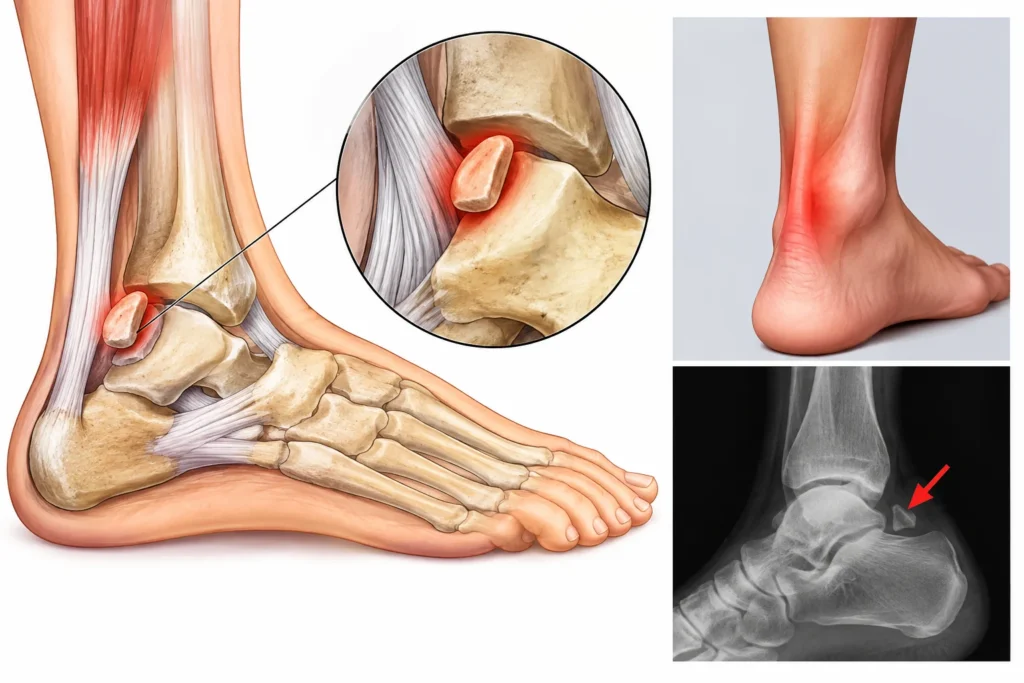
One possible explanation is os trigonum syndrome, a form of posterior ankle impingement in which an accessory bone behind the talus becomes irritated or repeatedly compressed.
The interesting part is that the os trigonum itself is not necessarily abnormal.
Quick Answer
Os trigonum syndrome is a type of posterior ankle impingement that can cause deep pain at the back of the ankle, especially when the foot is repeatedly pointed downward. An os trigonum is an accessory bone that many people have without symptoms. Pain usually develops when the bone and surrounding tissues become irritated or compressed. Treatment often begins with activity modification, physiotherapy and progressive strengthening. Persistent symptoms may require specialist assessment, imaging and, in selected cases, surgical removal of the symptomatic os trigonum.
Many people have one and never experience pain.
Recent evidence suggests that an os trigonum is present in roughly 1 in 10 feet, although prevalence varies considerably depending on the imaging method and population studied. (Springer Link)
So why does one person have an os trigonum without symptoms while another develops significant posterior ankle pain?
That distinction is at the heart of this condition.
As a physiotherapist, I would not look at an X-ray and automatically conclude,
“This bone is causing your pain.” I would first ask when the pain occurs, what ankle position reproduces it, whether your big toe movement is painful, how your ankle moves, and what changed in your activity before the symptoms started.
That clinical story often tells us much more than the presence of the accessory bone alone.
Key Takeaways
- An os trigonum is an accessory bone behind the talus and is often completely painless.
- Symptoms are typically linked to repeated or forceful ankle plantarflexion.
- Deep posterior ankle pain during toe-pointing is an important clinical clue.
- The flexor hallucis longus tendon can also become involved.
- An os trigonum seen on an X-ray does not automatically mean it is causing your pain.
- MRI can help identify bone marrow and soft-tissue changes when clinically appropriate.
- Physiotherapy usually focuses on load modification, restoring capacity and progressive strengthening.
- Avoid repeatedly forcing painful plantarflexion during the irritable stage.
- Surgery is generally considered when appropriate conservative management fails and the diagnosis is well supported.
- Endoscopic techniques can offer good outcomes and may allow faster recovery in appropriately selected patients.
What exactly is an os trigonum?
The os trigonum is a small accessory bone located behind the talus, one of the major bones forming the ankle joint.
During childhood, part of the posterior talus develops as a separate ossification centre.
In many people it eventually fuses with the talus. In others, it remains separate and becomes an os trigonum.
It is therefore generally a developmental anatomical variant rather than a disease. (Radiopaedia)
A 2024 meta-analysis involving more than 17,000 ankles estimated the pooled prevalence at approximately 10.3%.
Another recent meta-analysis found a prevalence of about 9%, demonstrating why the exact number differs between studies. (PubMed)
This is one of the most important facts patients should know:
Having an os trigonum does not automatically mean you have os trigonum syndrome.
The syndrome develops when the posterior ankle structures become painful, irritated or mechanically compressed, particularly during repeated or forceful plantarflexion.
Why can a harmless accessory bone suddenly start hurting?
Think about what happens when you point your foot downward.
The posterior part of the ankle becomes more crowded as the talus moves relative to the tibia.
If an os trigonum is present, that additional bony structure can become involved in this compression.
Repeated plantarflexion can irritate:
- the os trigonum itself
- the surrounding joint capsule
- synovial tissue
- the posterior talus
- the flexor hallucis longus tendon
- nearby ligaments and soft tissues
This is why dancers, footballers, gymnasts and athletes involved in repeated plantarflexion have traditionally been associated with posterior ankle impingement.
However, you absolutely do not need to be a dancer or elite athlete to develop symptoms. (Elsevier)
A sudden increase in running, repeated hill training, jumping, kicking, dance practice or exercises that repeatedly force the ankle downward can be enough to expose a previously silent problem.
The “activity change” clue many people miss
A patient may say:
“I never had ankle pain before. My scan says I have an os trigonum. So why did it suddenly appear?”
The bone probably did not suddenly appear.
More often, the mechanical environment around it changed.
For example, you may have:
- doubled your running volume
- started playing football after months away
- increased dance practice
- introduced calf raises or plyometrics
- begun training on hills
- changed footwear
- returned to sport after an ankle injury
- repeatedly practised deep plantarflexion positions
The accessory bone may have been there for years without causing trouble.
The new loading pattern may simply have exceeded the tolerance of the tissues around it.
The signature symptom: pain when pointing your toes down
One of the most useful clues is pain during plantarflexion, meaning moving the foot downward.
You may notice pain when:
- standing on your toes
- pushing off while running
- kicking a football
- dancing en pointe
- jumping
- performing calf raises
- descending into certain deep ankle positions
- wearing footwear that forces repeated ankle plantarflexion
- actively pointing your toes
The pain may feel deep rather than superficial.
Some people describe it as:
- a pinch
- catching
- sharp pain
- deep ache
- pressure
- a blocked sensation
- pain that feels “inside” the back of the ankle
Posterior ankle impingement can occur after an acute hyper-plantarflexion injury or develop gradually from repetitive loading. (PMC)
Why walking may not hurt as much as sport
This can be confusing.
A person may walk relatively comfortably but experience considerable pain during running, jumping or kicking.
That does not necessarily mean the problem is minor.
Normal walking may not place the ankle into the same degree or speed of plantarflexion as sport.
A footballer kicking a ball, for example, can generate a much more provocative position than ordinary walking.
This difference between daily activity tolerance and end-range activity tolerance is something I specifically assess during physiotherapy.
An overlooked culprit: your big toe tendon
One of the most interesting aspects of os trigonum syndrome is its relationship with the flexor hallucis longus (FHL)tendon.
The FHL is the tendon responsible for flexing the big toe. It travels behind the ankle through a relatively confined anatomical region.
Because of its location, irritation around the posterior ankle can involve the FHL tendon as well.
That means a patient may experience posterior ankle pain not only when moving the ankle, but also when repeatedly moving the big toe.
Research has found an association between os trigonum and FHL abnormalities, including tenosynovitis, degeneration and partial tearing.
One study also reported that larger os trigona were associated with a greater frequency of FHL degeneration and partial tears. (Elsevier)
This is a valuable diagnostic clue.
A simple question I would ask
“Does moving your big toe reproduce the pain at the back of your ankle?”
If the answer is yes, I would not assess the ankle in isolation.
The big toe, FHL tendon, calf complex, subtalar joint and posterior ankle all deserve attention.
This is one reason a generic “ankle strengthening” programme may fail if the actual problem involves the FHL or posterior impingement mechanism.
Is os trigonum syndrome the same as a posterior ankle impingement?
They are closely related, but the terms are not completely interchangeable.
Posterior ankle impingement syndrome describes the clinical problem of painful compression at the back of the ankle.
An os trigonum can be one of the structural contributors.
But posterior ankle impingement can also arise from other causes, including:
- an enlarged posterior talar process
- soft-tissue impingement
- scar tissue
- synovitis
- posterior talar abnormalities
- fractures or non-union fragments
- other bony structures
This distinction matters because removing an os trigonum is unlikely to solve pain if the real source is somewhere else.
A systematic review of posterior ankle impingement emphasizes that both bony and soft-tissue structures can contribute to the condition. (PubMed)
Who is most likely to develop symptoms?
You may hear that os trigonum syndrome is a “dancer’s injury.”
That description is too narrow.
People involved in activities requiring frequent or forceful plantarflexion may be at greater risk.
Examples include:
- ballet dancers
- football players
- gymnasts
- runners
- jumping athletes
- martial artists
- swimmers using forceful ankle movements
- recreational athletes returning suddenly to sport
But ordinary people can develop symptoms too.
A sudden increase in exercise is often more relevant than the sport itself.
For example, someone who starts doing hundreds of calf raises after being sedentary may provoke posterior ankle symptoms even without competitive training.
Can an ankle sprain cause os trigonum syndrome?
It can contribute to symptoms.
A forceful plantarflexion injury can irritate the tissues surrounding the posterior talus or aggravate a previously asymptomatic os trigonum.
However, not every case follows an obvious injury.
Some patients remember no particular incident at all.
This is why I would be cautious about assuming that all posterior ankle pain after a “sprain” is simply a routine ligament injury.
If swelling has settled but deep pain at the back of the ankle persists, particularly during plantarflexion, the diagnosis may need to be reconsidered.
How is os trigonum syndrome diagnosed?
Diagnosis is usually based on a combination of:
- your symptom pattern
- physical examination
- activity history
- imaging when appropriate
An X-ray can demonstrate an os trigonum or another posterior bony structure.
However, an X-ray cannot always tell us whether that bone is actually responsible for the pain.
This is a crucial distinction.
A person may have an os trigonum on an X-ray and have completely normal ankles.
Recent research reinforces how common these accessory bones can be in people without symptoms.
One study of healthy, asymptomatic adults found an os trigonum in 5.8% of feet, while other imaging studies have reported substantially higher rates depending on the population and modality. (CIOS)
When MRI becomes useful
MRI can provide considerably more information about the surrounding tissues.
It may help identify:
- bone marrow oedema
- inflammation
- soft-tissue irritation
- FHL tenosynovitis
- tendon abnormalities
- joint pathology
- associated osteochondral lesions
For example, imaging findings such as altered marrow signal within the os trigonum and adjacent posterior talus can support an active inflammatory or stress-related process rather than simply demonstrating an incidental bone. (Radiopaedia)
CT has a different advantage
CT is particularly useful when the clinician needs a detailed assessment of bony anatomy.
This can help distinguish an os trigonum from other posterior talar abnormalities.
Interestingly, a CT study found that enlarged lateral posterior talar processes can exist even when no separate os trigonum is present. That means “no os trigonum” does not necessarily exclude posterior bony impingement. (NCBI)
What I look for during a physiotherapy assessment
I would not start by giving you a generic ankle exercise sheet.
First, I want to reproduce your symptoms carefully.
1. Plantarflexion test
I assess whether active and passive plantarflexion reproduces the familiar pain.
The quality of the pain matters.
A general stretch sensation is very different from the patient’s recognisable deep posterior pinch.
2. Big toe movement
I assess the FHL because it can become involved with posterior ankle pathology.
Pain during big-toe flexion or movement under load can provide another important clue.
3. Calf capacity
Weakness or poor endurance of the calf does not automatically cause os trigonum syndrome, but it can alter how the ankle handles repeated loading.
I may assess:
- single-leg heel raises
- heel-raise endurance
- calf strength
- ankle range
- balance
- hopping tolerance
4. Subtalar and foot mechanics
The ankle does not function independently.
I also consider:
- foot control
- rearfoot motion
- subtalar mobility
- big-toe mobility
- single-leg stability
- running mechanics
The goal is not to “correct” every variation in foot posture.
The goal is to identify whether a modifiable movement or loading factor is increasing symptoms.
Can physiotherapy treat os trigonum syndrome?
Yes, particularly when symptoms are mild to moderate and there is no major structural problem requiring surgery.
But physiotherapy cannot make the accessory bone disappear.
The purpose is different.
We aim to reduce irritation, improve load tolerance and modify the activities that repeatedly provoke compression.
Conservative management is generally recommended as the initial approach before considering surgery. (Elsevier)
The first step is usually load modification
This does not mean complete rest for weeks.
Instead, temporarily reduce the activities that repeatedly provoke deep posterior ankle pain.
For example, you may need to reduce:
- repeated jumping
- sprinting
- aggressive calf raises
- deep plantarflexion
- dancing en pointe
- kicking drills
- hill running
The exact modification depends on what triggers your symptoms.
Strengthening should be progressive
Once irritability settles, rehabilitation can gradually address:
- calf strength
- soleus capacity
- ankle control
- foot and intrinsic muscle strength
- hip strength
- balance
- sport-specific loading
The important word is progressive.
If an exercise repeatedly produces sharp posterior ankle pain, doing more repetitions is not necessarily making the ankle stronger.
Do not aggressively stretch into pain
This is an especially important point.
A patient may think:
“My ankle feels tight, so I should stretch it harder.”
But if deep plantarflexion is the painful position, repeatedly forcing the ankle into that position may aggravate the very tissue we are trying to calm.
A better approach is to restore useful mobility without repeatedly forcing painful end-range compression.
Things to do if you suspect os trigonum syndrome
Do
- Track which movements reproduce your pain.
- Temporarily reduce painful end-range plantarflexion.
- Maintain pain-free cardiovascular exercise where possible.
- Progress calf strength gradually.
- Address big-toe and FHL function when clinically indicated.
- Rebuild running and jumping capacity progressively.
- Seek assessment if posterior ankle pain persists despite sensible load modification.
- Consider imaging when the clinical picture remains unclear or symptoms fail to improve.
Avoid
- Continuing painful training simply because walking is comfortable.
- Repeatedly forcing the ankle into plantarflexion to “loosen it.”
- Assuming every posterior ankle pain is Achilles tendinopathy.
- Assuming an os trigonum on an X-ray automatically requires surgery.
- Returning directly from rest to full-intensity sport.
- Ignoring persistent big-toe-associated posterior ankle pain.
- Choosing surgery solely because an MRI shows an os trigonum.
That last point is particularly important.
The scan must match the symptoms.
When does surgery become an option?
Surgery may be considered when symptoms remain significant despite appropriate conservative treatment and the clinical and imaging findings support a symptomatic os trigonum.
The procedure generally involves removal of the symptomatic ossicle, sometimes with treatment of associated soft-tissue pathology such as FHL problems.
Both open and minimally invasive/endoscopic techniques are used.
A systematic review of minimally invasive treatment involving 435 patients reported substantial improvements in pain and function, with an overall complication rate of about 5%, although the authors emphasized that higher-quality evidence is still needed. (Sage Journals)
A meta-analysis comparing open and endoscopic treatment found similar postoperative functional outcomes but generally fewer complications with endoscopic approaches, particularly when lower-quality studies were excluded. (NCBI)
A randomized study with five-year follow-up also reported acceptable outcomes for both techniques, with faster return to training and fewer complications in the endoscopic group. (NIH)
What about recovery after surgery?
Recovery depends on the procedure, associated pathology, surgeon protocol and the patient’s sport.
Research in athletes has reported return-to-sport timelines commonly in the range of several weeks, although high-level sporting return can take considerably longer than simply walking comfortably.
A recent study of athletes undergoing os trigonum excision after failed conservative care reported that 25 of 26 athletes ultimately returned to their sport, with long-term follow-up averaging more than seven years. (PMC)
Older studies in elite footballers have reported particularly rapid return to training after posterior ankle arthroscopy, but those results should not be interpreted as a universal recovery timetable. (PubMed)
Can you prevent os trigonum syndrome?
You cannot necessarily prevent the anatomical formation of an os trigonum.
If you have the accessory bone, it may simply be part of your anatomy.
What you can influence is how much stress you repeatedly place on the posterior ankle.
This is where prevention becomes practical.
The 10% rule is not enough for every athlete
Rather than obsessing over a specific percentage increase in training, pay attention to sudden changes in:
- running distance
- sprinting
- jumping
- hill work
- dance volume
- football practice
- calf-loading exercises
- training frequency
A gradual progression gives tissues time to adapt.
Give your ankle a “movement menu”
One lesser-known strategy is to avoid doing huge amounts of the same ankle movement repeatedly.
If your training contains hundreds of repetitions of plantarflexion, vary your loading when possible.
For example:
running + cycling + strength training + mobility + recovery
may be more tolerable than repeatedly performing high-volume plantarflexion-based drills every day.
This is not because plantarflexion is harmful.
It is because repetitive loading without sufficient adaptation can turn a normal anatomical structure into a painful one.
When should you see a doctor or physiotherapist?
Seek professional assessment if you have persistent deep posterior ankle pain, particularly when it:
- repeatedly occurs with plantarflexion
- prevents running or sport
- persists after an ankle injury
- causes catching or locking
- is associated with swelling
- accompanies significant loss of ankle movement
- is associated with pain around the big-toe tendon
- continues despite sensible activity modification
Urgent evaluation is appropriate after significant trauma, inability to bear weight, marked swelling, deformity, fever or other symptoms suggesting a more serious condition.
The most important thing I want you to remember
An os trigonum is not automatically the villain.
It is an anatomical variant that many people carry without symptoms.
The real question is:
“Is this os trigonum clinically interacting with the tissues around my ankle and reproducing my pain?”
That requires more than looking at an X-ray.
It requires connecting the imaging with your movement pattern, activity history, plantarflexion symptoms, big-toe function and physical examination.
From a physiotherapy perspective, I would therefore focus less on the name of the bone and more on why your ankle has become intolerant to a particular load.
For some people, modifying training and progressively rebuilding strength is enough.
For others with persistent mechanical impingement, associated FHL pathology or failure of appropriate conservative treatment, specialist assessment and surgery may eventually be appropriate.
The good news is that symptomatic os trigonum syndrome is a treatable problem, and modern evidence suggests that carefully selected patients can achieve very good functional outcomes. (NLM)
Frequently Asked Questions
Can an os trigonum cause ankle pain?
Yes. An os trigonum can contribute to posterior ankle impingement and cause deep pain at the back of the ankle, particularly during repeated or forceful plantarflexion.
Is an os trigonum a fracture?
Usually, no. An os trigonum is generally a developmental accessory bone. However, imaging may need to distinguish it from certain posterior talar fractures or other bony abnormalities.
What does os trigonum syndrome pain feel like?
People often describe deep pain, pinching, catching or aching at the back of the ankle. It may become worse when pointing the toes downward, running, jumping, dancing or kicking.
Can walking cause os trigonum pain?
It can, particularly if symptoms are more irritable, but some people experience little pain during normal walking and much more discomfort during running, jumping or deep plantarflexion.
Can physiotherapy help os trigonum syndrome?
Physiotherapy can help many people by reducing aggravating loads, improving ankle and calf capacity and progressively returning the person to normal activity. Persistent mechanical symptoms may require specialist assessment.
Should I stretch my ankle if I have os trigonum syndrome?
Aggressive stretching into painful plantarflexion is generally not advisable during an irritable phase. Exercise selection should depend on the person’s symptoms and clinical assessment.
Can an os trigonum affect the big toe?
It can be associated with problems involving the flexor hallucis longus tendon, which runs behind the ankle and controls big-toe flexion. Big-toe movement may therefore reproduce posterior ankle symptoms in some patients.
Does every os trigonum need surgery?
No. Many people have an asymptomatic os trigonum. Surgery is generally reserved for appropriately diagnosed symptomatic cases that continue to cause significant problems despite suitable conservative management.
How long does os trigonum surgery recovery take?
Recovery varies according to the surgical technique, associated conditions and the individual’s goals. Studies of athletes commonly report return to sport over several weeks, but competitive return can take longer.
Can you prevent os trigonum syndrome?
You cannot necessarily prevent having the accessory bone, but you can reduce the risk of irritation by progressing training gradually, avoiding sudden increases in repetitive plantarflexion and addressing persistent ankle symptoms early.
Stay tuned with us for more health related topics.
Follow us on LinkedIn and Instagram for more.
More Read




Medical Disclaimer!
This article has been reviewed and written under the guidance of our Head Physiotherapist, Dr. Kruti Raj (PT, MUHS,CPT,CMPT). The information shared is intended for educational purposes only and should not be considered a substitute for personalized medical advice, diagnosis, or treatment.
Please consult us or any other qualified healthcare professional before beginning any exercise program, especially if you are experiencing pain, recovering from injury, or managing a medical condition.