Haglund’s syndrome treatment focuses on reducing irritation around the bony prominence, improving how the Achilles tendon and ankle handle load, and modifying activities or footwear that continue to aggravate the back of the heel.
A painful bump at the back of your heel can look like a small cosmetic problem.
But if that bump becomes irritated every time your shoe presses against it, or your Achilles tendon repeatedly rubs around the area, the result can be surprisingly stubborn heel and ankle pain.
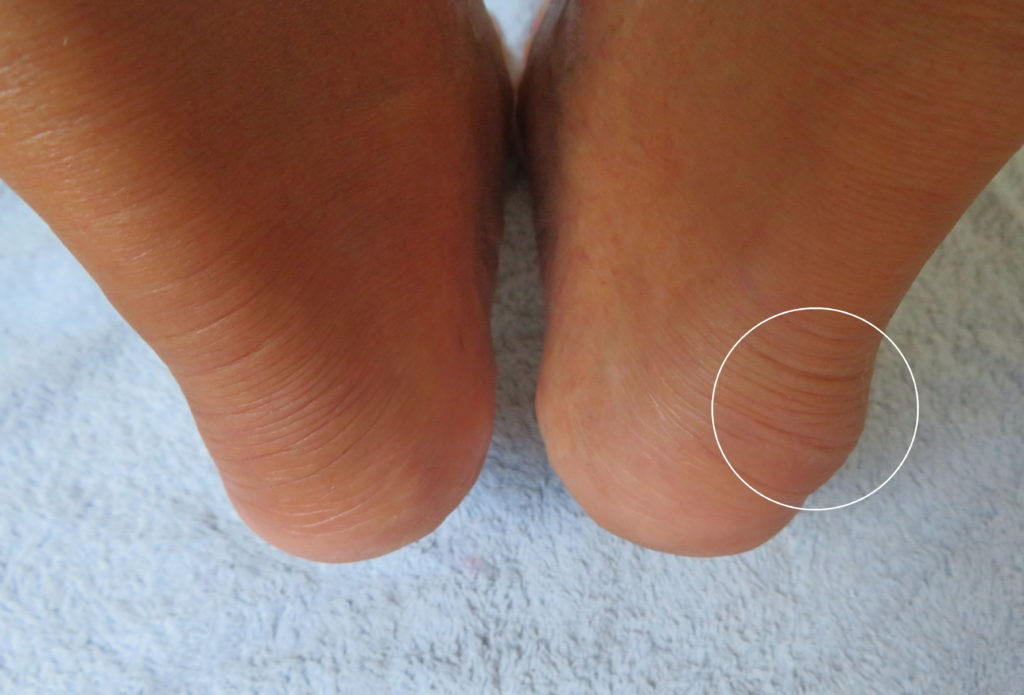
This condition is commonly called Haglund’s syndrome, while the underlying bony prominence is often called Haglund’s deformity or a “pump bump.”
Quick Answer
Haglund’s syndrome is painful irritation around a bony prominence at the back of the heel. It can involve the Achilles tendon and retrocalcaneal bursa and is often aggravated by rigid heel counters, running, excessive loading and certain ankle positions. Haglund’s syndrome treatment usually begins with footwear modification, activity and load management, and progressive physiotherapy. A visible Haglund’s deformity does not automatically mean that surgery is required.
The distinction matters.
You can have a prominent heel bone without having symptoms.
In fact, imaging alone cannot tell us whether the bump is actually responsible for your pain.
Haglund-related symptoms usually develop when the bony prominence interacts with the Achilles tendon and nearby soft tissues, particularly the retrocalcaneal bursa.
Recent imaging research has also questioned several traditional X-ray measurements used to label Haglund’s deformity.
Newer measurements based on the actual size of the bony bump may correlate better with insertional Achilles tendon changes. (MDPI)
As a physiotherapist, this is one of the first things I would explain to someone sitting in front of me with posterior heel pain:
Do not treat the X-ray. Treat the painful system around the heel.
That system may include the Achilles tendon, bursa, calf muscles, ankle mobility, footwear and the way your foot handles load.
Key Takeaways
- Haglund’s deformity is a bony prominence; Haglund’s syndrome refers to the painful clinical problem.
- A large heel bump does not automatically mean that it is the cause of pain.
- Achilles tendon irritation and retrocalcaneal bursitis can occur alongside the bony prominence.
- Rigid shoes and direct pressure from a heel counter can aggravate symptoms.
- Aggressive calf stretching may worsen symptoms in some people with insertional Achilles problems.
- Progressive calf strengthening is an important part of rehabilitation.
- Heel lifts may reduce Achilles compression in selected patients.
- Running should usually be modified rather than abandoned permanently.
- Surgery is generally considered after an appropriate conservative programme has failed.
- Diagnosis should combine symptoms, physical examination and imaging rather than relying on an X-ray alone.
What exactly is Haglund’s syndrome?
Haglund’s syndrome occurs when a prominent area of bone develops at the posterosuperior part of the calcaneus, the heel bone.
This prominence sits close to the Achilles tendon insertion.
When the surrounding tissues become irritated, several problems can occur together:
- irritation of the Achilles tendon insertion
- retrocalcaneal bursitis
- swelling around the back of the heel
- tenderness when wearing rigid-backed shoes
- pain during walking or running
- stiffness after rest
- difficulty climbing stairs
- reduced tolerance for calf raises and jumping
The term Haglund’s deformity generally describes the bony morphology.
Haglund’s syndrome refers more specifically to the painful clinical presentation associated with that morphology.
That difference is important because not every person with a prominent calcaneus Haglund’s syndrome needs treatment.
A 2022 radiographic study found that traditional measurements such as the Fowler-Phillip angle and parallel pitch lines did not necessarily distinguish symptomatic patients from controls.
The investigators found that newer measures of bump height and the bump-to-calcaneus ratio were more useful in identifying surgically treated symptomatic Haglund’s deformity. (PMC)
This is one of the lesser-known facts about the condition: the size or appearance of a heel bump is not the same thing as its pain-producing behaviour.
Why does the heel bump become painful?
Think about what happens at the back of your heel when you walk.
Your Achilles tendon transfers force from the calf muscles to the heel bone.
During activities such as running, jumping, stair climbing and fast walking, the tendon experiences substantial mechanical loading.
If a prominent section of the calcaneus sits directly beneath or beside the tendon and surrounding tissues, repeated loading can increase local irritation.
But there is another piece of the puzzle that is often missed.
Compression may matter as much as stretching
The Achilles tendon does not only experience tensile load.
At its insertion, it can also experience compression, particularly when the ankle moves into dorsiflexion.
That means repeatedly forcing the ankle deeply forward may aggravate some people with insertional Achilles problems.
This has major implications for physiotherapy.
A recent randomised clinical trial involving people with chronic insertional Achilles tendinopathy compared rehabilitation designed to reduce tendon compression with a higher-compression programme.
The lower-compression approach limited dorsiflexion, avoided calf stretching and incorporated heel lifts. Participants had significantly greater improvements in VISA-A scores at 12 and 24 weeks. (Research Gate)
This does not mean everyone with Haglund’s syndrome should permanently avoid ankle dorsiflexion.
It means rehabilitation should be dose-controlled and individualised, particularly when compression is clearly provoking symptoms.
Haglund’s syndrome vs Achilles tendinopathy: are they the same?
No.
They can occur together, but they are not identical.
Haglund’s syndrome involves a symptomatic posterosuperior calcaneal prominence and irritation of nearby tissues.
Insertional Achilles tendinopathy involves pathological changes in the Achilles tendon close to its attachment to the heel.
Retrocalcaneal bursitis involves irritation of the fluid-filled bursa located between the Achilles tendon and calcaneus.
One person can have one, two or all three.
This is why simply searching for “Haglund’s bump or syndrome treatment” and immediately choosing surgery is not an ideal approach.
Recent MRI research found that larger bump height and a higher bump-to-calcaneus ratio were positively associated with Achilles tendon thickness and intratendinous degeneration in people with insertional Achilles tendinopathy. (PubMed)
However, the relationship between Haglund’s morphology and Achilles disease remains an area of ongoing research.
What does Haglund’s syndrome pain actually feel like?
The location of pain can provide useful clues.
People commonly describe:
- pain directly at the back of the heel
- pain where the Achilles tendon meets the heel bone
- soreness underneath a shoe heel counter
- swelling or a visible bump
- stiffness when getting out of bed
- pain after sitting for a long time
- discomfort during uphill walking
- pain during running
- tenderness after wearing stiff shoes
- aching after prolonged standing
Some people notice something particularly revealing:
Their heel hurts more in one pair of shoes than when they walk barefoot.
That is an important clinical clue because external shoe pressure may be contributing to the symptoms.
The original clinical descriptions and later reports have consistently recognised footwear modification as part of conservative management for symptomatic Haglund’s syndrome.
The “shoe test” you can pay attention to
This is not a diagnostic test, but it can provide useful information.
Think about your symptoms over several days.
Does the pain increase when wearing:
- rigid formal shoes?
- stiff sports shoes?
- shoes with a hard heel counter?
- narrow footwear?
- shoes that directly press against the bump?
And does it decrease with:
- softer-backed shoes?
- open-backed footwear?
- footwear with more space around the heel?
- a modest heel lift?
If the answer is consistently yes, external compression may be playing an important role.
However, do not simply switch permanently to completely flat or unsupportive footwear.
The objective is to reduce irritation while maintaining comfortable function.
Why runners can struggle with Haglund’s syndrome
Running creates a very different mechanical environment from ordinary walking.
The Achilles tendon must repeatedly store and release energy.
If training volume increases rapidly, recovery is inadequate or footwear changes suddenly, the tendon may struggle to adapt to the new load.
This does not mean running itself “causes” Haglund’s syndrome.
Instead, running can expose a problem that was previously tolerable.
A runner might have had the same bony morphology for years without symptoms.
Then they suddenly increase mileage, introduce hill sessions, change shoes and begin experiencing posterior heel pain.
The bump may not have suddenly appeared.
The load environment changed.
That is an important distinction when deciding how to rehabilitate the problem.
Can Haglund’s syndrome occur without running?
Absolutely.
You do not need to be an athlete.
People who spend much of the day standing, walk extensively for work, wear rigid footwear or repeatedly climb stairs may develop symptoms.
Reduced calf capacity can also become relevant.
If the calf-Achilles unit is poorly conditioned and suddenly exposed to greater demand, the tendon may become painful even without a dramatic sporting event.
Body weight, activity level, age, previous tendon problems and changes in training can all influence tendon loading.
However, I would avoid blaming the patient for having “weak ankles” or “bad feet.”
Haglund-related pain is usually multifactorial.
Common symptoms that should not be ignored
A visible hard bump
A hard prominence at the back of the heel is one of the classic clues.
Unlike simple soft-tissue swelling, bone does not disappear when you press on it.
Tenderness around the Achilles insertion
Pain may be felt directly where the Achilles attaches to the heel.
Shoe irritation
A heel counter rubbing against the prominence can create considerable discomfort.
Swelling
Inflammation around the bursa or Achilles insertion may produce visible swelling.
Morning stiffness
Pain and stiffness after rest are common in Achilles disorders.
Pain during calf raises
A person may tolerate normal walking but struggle with single-leg heel raises.
Activity-related pain
Running, jumping, uphill walking and repeated stair climbing may provoke symptoms.
A surprising clue: your pain may not be proportional to the size of the bump
This is something I regularly want patients to understand.
A relatively modest-looking bump can hurt significantly, while a much more obvious bump may remain completely painless.
Why?
Because pain is influenced by tissue sensitivity, load, compression, tendon health, footwear and individual biomechanics.
Modern research reinforces the limitations of relying on a single radiographic measurement.
A 2023 study examining the biomechanics of Haglund’s deformity found that newer radiographic measures incorporating ankle motion were more predictive than several traditional criteria. (Elsevier)
So if someone tells you, “Your bump is large, therefore you need surgery,” that conclusion is too simplistic.
How is Haglund’s syndrome diagnosed?
Diagnosis usually begins with your history and physical examination.
A clinician may assess:
- exact location of tenderness
- Achilles tendon thickness
- ankle dorsiflexion
- calf strength
- single-leg heel raise ability
- walking pattern
- footwear
- running mechanics
- swelling
- bursal tenderness
- response to compression
- symptoms during calf loading
X-ray
A lateral X-ray can demonstrate the shape of the calcaneus and help identify a posterosuperior prominence.
But there is no universally accepted single X-ray measurement that perfectly defines symptomatic Haglund’s syndrome.
That is why imaging should support the clinical examination rather than replace it.
Ultrasound
Ultrasound can be useful for examining the Achilles tendon and surrounding soft tissues and can provide a dynamic assessment in experienced hands.
MRI
MRI may be considered when symptoms are persistent, the diagnosis is uncertain, surgery is being considered or there is concern about substantial tendon pathology.
Recent research has investigated MRI tendon thickness and intratendinous degeneration alongside Haglund morphology, highlighting how the bony prominence and tendon changes can interact.
Do you need surgery for Haglund’s syndrome?
Usually, surgery is not the first step.
A sensible treatment programme for Haglund’s syndrome normally begins with conservative management unless there is a specific reason to consider earlier surgical assessment.
A systematic review of surgical treatment for Haglund’s syndrome found that both open and endoscopic procedures can improve outcomes in appropriately selected patients,
but surgery is generally considered after conservative treatment involving activity modification, physiotherapy and footwear changes has failed for Haglund’s syndrome.
That distinction is important.
Having Haglund’s deformity does not automatically mean:
“The bone must be removed.”
The more useful question is:
“Have we adequately changed the mechanical environment around the heel and progressively rebuilt the tendon’s capacity?”
Physiotherapy treatment for Haglund’s syndrome
Step 1: Reduce the irritating load, not all activity
Complete rest is rarely the long-term solution.
Instead, I would look for the activities that are disproportionately aggravating the heel.
For example:
If running hurts but cycling is comfortable, temporarily reducing running while maintaining cycling may be more sensible than stopping all exercise.
If stair climbing is painful, reducing unnecessary repeated stair exposure may help.
If one particular shoe causes pain, changing footwear may be more valuable than adding another passive treatment for Haglund’s syndrome.
The goal is to create a temporary window of lower irritation while maintaining as much healthy movement as possible.
Step 2: Modify footwear intelligently
This can make a surprisingly large difference.
Consider shoes with:
- a softer heel counter
- adequate rearfoot space
- cushioning around the heel
- a modest heel elevation when appropriate
- less direct pressure over the bony prominence
Avoid footwear that repeatedly rubs directly over the bump.
A small heel lift may reduce Achilles compression in some people.
Importantly, heel lifts should not be treated as a miracle cure.
A 2024 feasibility randomised trial specifically investigated heel lifts for insertional Achilles tendinopathy, demonstrating that this intervention is practical to study and potentially useful, although larger definitive trials are still needed. (WILEY)
Step 3: Be careful with aggressive calf stretching
This is one of the most important practical points.
People often receive the advice:
“Your Achilles is tight. Stretch it more.”
That may not be appropriate when pain is coming from the Achilles insertion.
Deep ankle dorsiflexion can increase compression at the insertion.
The recent randomised trial on insertional Achilles tendinopathy provides particularly interesting evidence here:
the rehabilitation programme that controlled compression by limiting dorsiflexion and avoiding calf stretching produced better outcomes than the higher-compression approach. (BMJ)
So if a traditional wall calf stretch makes your heel pain worse, do not force your heel deeper into the stretch simply because it is labelled a rehabilitation exercise.
Step 4: Strengthen the calf progressively
This is where physiotherapy becomes much more than massage or ultrasound.
Your Achilles tendon needs capacity.
A typical progression may include:
Stage 1: comfortable isometric calf loading
Stage 2: double-leg heel raises
Stage 3: controlled single-leg heel raises
Stage 4: heavier resistance
Stage 5: faster calf contractions
Stage 6: hopping and energy-storage exercises for athletes
The exact progression should depend on symptoms, strength and functional goals.
A 2025 international Delphi study involving Achilles rehabilitation experts identified ankle dorsiflexion range as particularly important for exercise prescription in insertional Achilles tendinopathy, reinforcing the importance of not treating every Achilles problem with exactly the same heel-raise technique. (NCBI)
Step 5: Don’t automatically perform heel drops off a step
This deserves its own warning.
The famous Achilles exercise of standing on a step and allowing the heel to drop deeply below the level of the step can be useful for some Achilles conditions.
But insertional Achilles pain is different.
If deep dorsiflexion increases compression at the painful insertion, aggressive heel drops may irritate rather than calm the condition.
This is a perfect example of why “one exercise for Achilles pain” is not good physiotherapy.
Step 6: Gradually restore activity
Once daily activities become easier, rehabilitation should progress toward the activity that actually matters to you.
For a walker, that may mean longer walks.
For a runner, it may mean:
- brisk walking
- short jogging intervals
- longer running intervals
- faster running
- hills
- speed work
For an athlete, jumping and rapid force production eventually need to return.
The tendon should not merely become pain-free on the treatment table.
It should become capable of handling the demands of real life.
What about shockwave therapy?
Extracorporeal shockwave therapy, or ESWT, is sometimes considered for persistent insertional Achilles tendinopathy.
Evidence suggests that ESWT may help some patients, particularly in non-calcified insertional Achilles tendinopathy, although the quality and consistency of evidence varies.
A 2023 network meta-analysis concluded that evidence for non-surgical treatment of Haglund’s syndrome remains limited and did not support one universally superior intervention. (Journal of Chiropractic Medicine)
I therefore see ESWT as a possible component of Haglund’s syndrome treatment rather than something that should replace progressive rehabilitation.
What about massage?
Soft-tissue treatment may help reduce symptoms and improve tolerance to movement in some people.
But I would not repeatedly attack the painful Achilles insertion with aggressive massage.
The objective is not to “break scar tissue.”
The objective is to improve your ability to load the tendon progressively.
Interestingly, a 2023 network meta-analysis found that combining eccentric exercise with soft-tissue treatment ranked highly for short-term pain outcomes, although the authors emphasised that overall certainty was very low. (Sports Health)
That is an important distinction between promising evidence and definitive evidence.
Things I would ask you to avoid
Do not keep wearing the shoe that causes the problem
If a hard heel counter repeatedly presses directly against the bump, changing footwear is a simple first intervention.
Do not stretch aggressively through pain
Particularly avoid forcing deep dorsiflexion if it consistently aggravates your posterior heel.
Do not completely stop loading the Achilles for months
Tendons need progressive loading to regain capacity.
Do not judge recovery by pain alone
Strength, walking tolerance, heel-raise capacity and activity tolerance matter too.
Do not increase running mileage suddenly
A sudden change in training can expose an already overloaded tendon.
Do not assume every heel bump needs surgery
The presence of a bony prominence is not itself an indication for an operation.
Can Haglund’s syndrome be prevented?
You cannot necessarily prevent the underlying shape of your calcaneus.
But you can potentially reduce the likelihood of developing symptomatic irritation.
Some practical strategies include:
- increase running volume gradually
- avoid sudden increases in hill running
- rotate footwear if appropriate
- avoid consistently wearing shoes that rub the heel
- maintain calf strength
- build running capacity progressively
- respond early to persistent Achilles pain
- avoid repeatedly training through escalating symptoms
- address large changes in activity after periods of inactivity
One particularly useful principle is:
Do not wait until the heel hurts every day before modifying the load.
Early load management is usually easier than rehabilitating a highly irritable tendon.
When should you see a physiotherapist or doctor?
Seek professional assessment if:
- pain persists for several weeks
- the bump is becoming increasingly swollen
- walking becomes difficult
- you cannot perform a comfortable heel raise
- symptoms are worsening despite reducing aggravating activities
- pain is interfering with sleep
- you have significant redness or warmth
- there was a sudden “pop”
- you suddenly lose the ability to push off
- you suspect an Achilles tendon rupture
A sudden pop followed by weakness or inability to push off is not typical Haglund’s syndrome and requires prompt medical assessment.
When might surgery become reasonable?
Surgery may be considered when significant symptoms persist despite a well-designed conservative programme.
Procedures can involve removing the bony prominence, addressing the retrocalcaneal bursa and treating damaged portions of the Achilles tendon.
In some cases, additional reconstruction or tendon transfer may be required depending on the amount of tendon disease.
A systematic review and meta-analysis found that both open and endoscopic approaches can improve function.
Earlier evidence suggested potential advantages for endoscopic surgery regarding complications and cosmetic outcomes. (JNS)
However, newer comparative evidence is more cautious.
A 2026 systematic review and meta-analysis of five comparative cohort studies involving 226 patients found no statistically significant difference in postoperative ankle function between open and endoscopic procedures, and the authors highlighted the serious risk of bias in the available studies. (Sage Journals)
That is exactly why I would not describe one surgical technique as universally “best.”
A newer surgical option: Zadek osteotomy
Zadek osteotomy is another procedure being investigated for insertional Achilles tendinopathy associated with Haglund’s deformity.
A 2024 systematic review included 17 studies and 611 subjects, reporting postoperative improvements in pain and function with both open and percutaneous approaches.
However, the percutaneous evidence involved substantially fewer patients, so the apparently lower complication rate should not be interpreted as definitive proof of superiority. (Foot and Ankle Orthopaedics)
This is an area worth watching as the evidence develops.
One lesser-known surgical consideration
The Achilles tendon insertion is mechanically important.
Removing a large amount of diseased tendon or bone is not simply a matter of “shaving off the bump.”
The surgeon has to balance adequate decompression with preservation or restoration of tendon attachment.
Biomechanical research has historically examined how much Achilles insertion can be released before structural stability becomes a concern, which illustrates why surgery around this region requires careful planning.
This is another reason why surgery should be based on the complete clinical picture rather than an X-ray photograph alone.
A practical physiotherapy roadmap
If you came to my clinic with suspected Haglund’s syndrome, I would not begin by asking, “How big is the bump?”
I would first ask:
What activities hurt?
Then:
What specifically compresses the area?
Then:
How strong is your calf?
Then:
How much dorsiflexion can you tolerate?
And finally:
What does your tendon need to be able to do again?
Your rehabilitation might then look something like this:
Phase 1: Calm the irritation
Modify painful footwear.
Reduce highly provocative activities.
Use relative rest rather than complete inactivity.
Introduce comfortable low-load calf exercises.
Phase 2: Rebuild capacity
Progress calf strengthening.
Control ankle range.
Increase resistance gradually.
Monitor next-day symptoms.
Phase 3: Restore function
Increase walking distance.
Progress single-leg strength.
Introduce faster contractions.
Return gradually to running or sport.
Phase 4: Prevent recurrence
Continue strength work.
Manage training volume.
Use appropriate footwear.
Maintain adequate recovery between high-load sessions.
This approach treats the person and the mechanical environment, not simply the X-ray finding.
The bottom line: is Haglund’s syndrome curable?
Many people can substantially improve without surgery.
But recovery is rarely about making the bony prominence disappear.
The bone may remain.
What needs to change is the relationship between the bump, Achilles tendon, surrounding tissues and the loads you place through the heel.
That is why two people with almost identical X-rays can have completely different experiences.
One may run without pain.
Another may struggle to wear formal shoes.
The goal of physiotherapy is therefore not necessarily to remove the bump.
It is to reduce unnecessary irritation, improve tendon capacity, modify compression when necessary and gradually return the heel to the demands of everyday life or sport.
And if conservative treatment genuinely fails after an appropriate period, surgical options for Haglund’s syndrome can be discussed with an orthopaedic foot-and-ankle specialist.
My biggest advice is simple: don’t panic when an X-ray says “Haglund’s deformity.”
A bony shape is not a diagnosis of disability. Your symptoms, examination and functional capacity matter just as much.
Frequently Asked Questions
What is Haglund’s syndrome?
Haglund’s syndrome is painful irritation around a bony prominence at the back of the heel. It can involve the Achilles tendon and retrocalcaneal bursa and is often aggravated by footwear and repeated mechanical loading.
What causes Haglund’s syndrome?
Haglund’s syndrome is associated with the shape of the back of the heel bone, but symptoms are influenced by footwear pressure, Achilles tendon loading, ankle mechanics, activity changes and irritation of surrounding tissues.
What does Haglund’s syndrome pain feel like?
Typical symptoms include pain at the back of the heel, tenderness around the Achilles insertion, swelling, stiffness after rest and discomfort when wearing shoes that press against the heel.
Can Haglund’s syndrome go away without surgery?
Many people improve with conservative treatment. Management can include footwear modification, activity adjustment, progressive calf strengthening and physiotherapy. Surgery may be considered when significant symptoms persist despite appropriate conservative treatment.
Can shoes make Haglund’s syndrome worse?
Yes. Shoes with rigid or poorly positioned heel counters can repeatedly press against the bony prominence and aggravate the surrounding tissues.
Should I stretch my calf if I have Haglund’s syndrome?
Not necessarily. Deep calf stretching increases ankle dorsiflexion and may increase compression around the Achilles insertion. Exercise selection should be based on your symptoms and clinical assessment.
Can running cause Haglund’s syndrome?
Running does not necessarily create the bony prominence, but sudden increases in running volume, hills, speed work or other loading changes can aggravate the Achilles tendon and make a previously painless heel prominence symptomatic.
Is Haglund’s deformity visible on an X-ray?
Yes. X-rays can show a posterosuperior calcaneal prominence, but imaging alone cannot establish whether the prominence is responsible for a person’s pain.
When is surgery needed for Haglund’s syndrome?
Surgery may be considered when persistent symptoms significantly affect function despite appropriate conservative treatment. Procedures can involve removing the bony prominence and treating associated Achilles or bursal pathology.
Can physiotherapy help Haglund’s syndrome?
Yes. Physiotherapy can address footwear and load modification, calf strength, ankle mechanics, progressive tendon loading and gradual return to walking, running or sport.
Stay tuned with us for more health related topics.
Follow us on LinkedIn and Instagram for more.
More Read



Medical Disclaimer!
This article has been reviewed and written under the guidance of our Head Physiotherapist, Dr. Kruti Raj (PT, MUHS,CPT,CMPT). The information shared is intended for educational purposes only and should not be considered a substitute for personalized medical advice, diagnosis, or treatment.
Please consult us or any other qualified healthcare professional before beginning any exercise program, especially if you are experiencing pain, recovering from injury, or managing a medical condition.