The best shoes for ankle pain are not necessarily the most expensive or most cushioned; the right choice depends on why your ankle hurts, how you walk and how well the shoe supports your individual needs.
Choosing the right shoes can make walking, exercising and standing more comfortable, especially when your ankles are sensitive or have been injured before.
But footwear is only one part of ankle health.
Quick Answer: What Are the Best Shoes for Ankle Pain?
The best shoes for ankle pain are not necessarily the most expensive, most cushioned or most rigid. Look for footwear that fits properly, keeps the heel secure, provides appropriate stability and traction, and feels comfortable during the activity you are performing.
If you have recurrent ankle pain or instability, footwear alone may not be enough. Physiotherapy can address contributing factors such as reduced ankle mobility, muscle weakness, poor balance and impaired proprioception.
There is no single shoe that can prevent ankle pain for everyone.
The ideal footwear depends on your foot shape, activity, walking surface, ankle strength, previous injuries and the symptoms you are experiencing.
From a physiotherapy perspective, good footwear should provide an appropriate combination of comfort, stability, fit and traction without unnecessarily restricting normal movement.
The goal is not to find the most rigid or heavily cushioned shoe.
It is to find footwear that suits your body and the activity you are asking your ankle to perform.
Key Takeaways
- There is no single shoe that can prevent ankle pain for everyone.
- Proper fit is more important than simply choosing the most heavily cushioned or rigid shoe.
- A secure heel, adequate toe space, appropriate traction and activity-specific stability are useful footwear features.
- High-top shoes may provide a feeling of additional support, but they should not be considered a guaranteed way to prevent ankle sprains.
- Running, hiking, gym training and everyday walking may require different footwear characteristics.
- People with recurrent ankle sprains may need rehabilitation in addition to footwear changes.
- Strength, balance, proprioception and ankle mobility are important components of long-term ankle health.
What Makes a Shoe Suitable for Ankle Health?
A shoe can influence how the foot interacts with the ground, but its effect depends on the person wearing it.
A suitable everyday shoe should generally feel secure without squeezing the foot.
The heel should not move excessively inside the shoe, the toes should have adequate room, and the sole should provide appropriate traction for the surface.
Comfort also matters.
A systematic review of footwear comfort found that well-fitted, lightweight shoes with soft midsoles and curved rocker soles were generally perceived as comfortable, although the researchers emphasized that footwear response varies according to the individual, task and shoe design (Menz et al., 2021)
This is why the most expensive or heavily advertised shoe is not necessarily the best option for your ankle.
Why Proper Shoe Fit Matters
A shoe can have excellent cushioning and still be unsuitable if it does not fit correctly.
Shoes that are too short or narrow can place unnecessary pressure on the foot.
Shoes that are too large may allow excessive movement inside the footwear.
A systematic review found that between 63% and 72% of participants in the included studies were wearing shoes that did not properly accommodate the length or width of their feet.
Incorrectly fitted footwear was also associated with foot pain and several foot disorders (Buldt et al., 2018)
For someone with ankle pain, a secure but comfortable fit is therefore more important than simply choosing a shoe labelled “supportive.”
Best Shoe Features for Ankle Pain
When comparing everyday footwear, consider these features.
A Secure Heel
The heel should remain reasonably stable inside the shoe when you walk.
Excessive heel movement can make the shoe feel unstable and may cause you to alter your walking pattern.
A secure heel counter can be useful, particularly for people who feel that their foot moves around inside softer footwear.
Adequate Toe Room
Your toes should not be compressed against one another or pushed against the front of the shoe.
The front of the shoe should accommodate the natural shape of your foot rather than forcing it into a narrow position.
Appropriate Sole Stability
A shoe should provide enough stability for the activity you are performing.
However, stability does not mean that the sole needs to be completely rigid.
An excessively stiff shoe can feel uncomfortable or change the way the foot moves, while an excessively soft or unstable shoe may not provide the sense of control some people need.
Appropriate Traction
The sole should provide enough grip for the environment.
A walking shoe used indoors has different requirements from a hiking shoe used on wet or uneven ground.
Poor traction can increase the likelihood of slipping, while a shoe designed for an inappropriate surface may not provide enough control.
Comfortable Cushioning
Cushioning can reduce the sensation of impact and fatigue during prolonged activity, but more cushioning is not automatically better.
A 2026 systematic review of footwear for people who stand for prolonged periods found that softer soles may reduce impact and fatigue but can provide less stability, while harder soles may improve stability but create localized pressure.
The authors emphasized that footwear characteristics should be matched to the activity rather than assuming one sole type is best for everyone (Kang et al., 2026)
Are Walking Shoes Good for Ankle Pain?
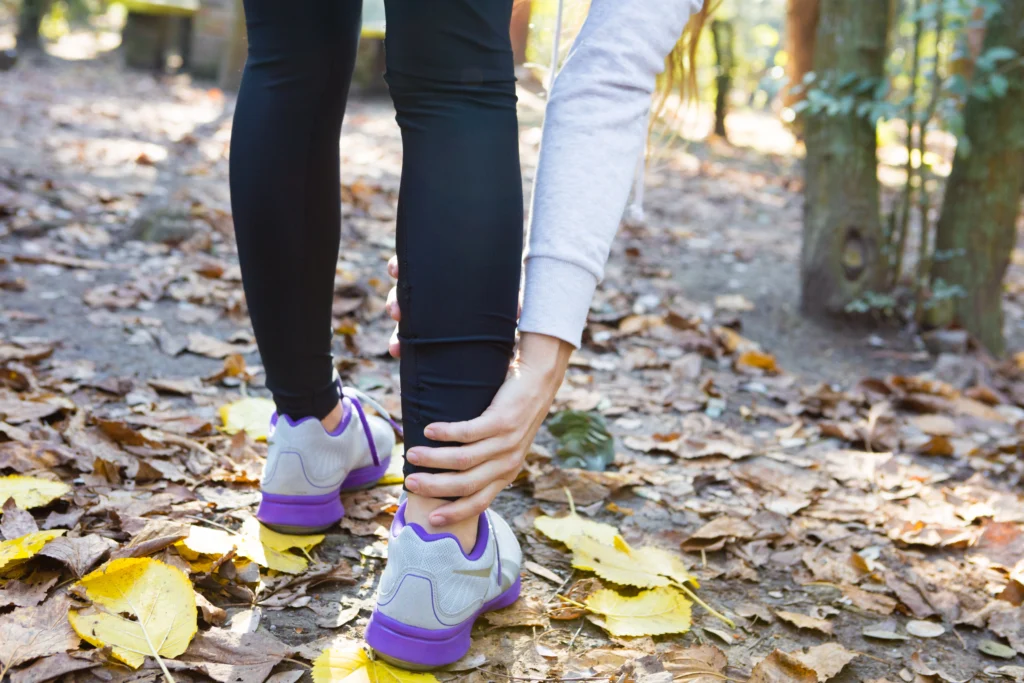
For everyday walking, a comfortable walking shoe is often a sensible starting point.
Look for:
- A secure heel fit
- Adequate toe space
- Comfortable cushioning
- A stable sole
- Appropriate traction
- A fastening system that keeps the foot secure
- No painful pressure points
The shoe should feel comfortable when you walk at your normal speed.
It should also allow you to turn, stop and climb stairs without making you feel as though the foot is moving excessively inside the shoe.
If your ankle feels more stable in one pair than another, that subjective response is useful information.
Are Running Shoes Suitable for Ankle Pain?
Running shoes can be appropriate for people who run, but they should not automatically be recommended simply because they are highly cushioned.
Running creates repetitive loading, and ankle pain during running can have many causes.
Training volume, running surface, recovery, muscle strength, previous injury and movement control can all influence symptoms.
Research on running injuries has not established that one particular shoe design consistently prevents injuries for all runners.
If ankle pain repeatedly appears during running, changing shoes several times without investigating the underlying problem may simply delay appropriate rehabilitation.
A physiotherapist can assess your running mechanics, calf strength, ankle mobility, balance and training load before deciding whether footwear is contributing to the problem.
What About High-Top Shoes?
High-top shoes are often marketed as providing greater ankle support.
There is some biomechanical evidence that high-top designs can reduce the amount and speed of ankle inversion during a sudden inversion event.
A laboratory study found that high-top shoes reduced inversion compared with low-top shoes under a controlled inversion test (Ricard et al., 2000)
However, this does not mean that every person with ankle pain needs a high-top shoe.
Clinical evidence has been less convincing.
A prospective randomized study involving 622 basketball players found no significant difference in ankle injury rates between high-top and low-top footwear groups (Barrett et al., 1993)
So, high-top footwear may provide a useful feeling of external support for some people, but it should not be presented as a guaranteed method of preventing ankle injuries.
What Shoes Are Best After an Ankle Sprain?
The answer depends on the stage of recovery.
Immediately after an injury, the ankle may require protection and controlled loading rather than simply changing everyday shoes.
As recovery progresses, the focus should shift towards restoring movement, strength, balance and confidence.
For someone returning to normal activities after an ankle sprain, a secure shoe may provide a comfortable environment for movement.
On uneven surfaces or during sport, additional external support such as an ankle brace may sometimes be considered.
Importantly, footwear should not replace rehabilitation.
This distinction is particularly important for people who experience repeated ankle sprains or a sensation that the ankle keeps giving way.
Shoes Cannot Replace Ankle Rehabilitation
If your ankle repeatedly rolls, feels unstable or remains painful despite changing footwear, the problem may not be your shoes.
Chronic ankle instability can involve deficits in strength, balance, proprioception and movement control.
Evidence strongly supports exercise-based rehabilitation for this type of problem.
A 2025 network meta-analysis of 44 randomized trials found that physical therapy approaches emphasizing strengthening and balance exercises were among the most effective strategies for improving function and reducing pain in people with chronic ankle instability (Yang et al., 2025)
A separate 2026 systematic review found fair-to-good evidence supporting balance exercise program for chronic ankle instability, particularly program that use a greater variety of balance tasks and sufficient training volume (Milton et al., 2026)
This is an important physiotherapy principle:
A supportive shoe can help the environment around your ankle, but stronger and better-controlled ankles provide the long-term foundation for stability.
Best Shoes for People With Previous Ankle Sprains
If you have a history of ankle sprains, look for footwear that gives you confidence while walking.
A secure heel, appropriate traction and a stable platform may be useful.
For higher-risk activities such as court sports, hiking or walking on uneven surfaces, additional ankle support may be considered based on your injury history and physiotherapist’s assessment.
However, research on footwear alone for ankle-sprain prevention is mixed.
An older systematic review found that the clinical benefit of shoe design alone was unclear, while external supports and proprioceptive training showed more consistent preventive effects in athletes with recurrent sprains (Quinn et al., 2000)
This is why a person with repeated ankle sprains should not rely entirely on footwear.
What About Flat Shoes?
Flat shoes are not automatically better for ankle health.
Some people tolerate flat shoes extremely well, while others may experience increased calf or Achilles discomfort when they suddenly switch from shoes with a heel-to-toe drop to completely flat footwear.
The important question is whether the shoe allows you to walk comfortably and whether your ankle can tolerate the demands of that footwear.
If a particular pair consistently causes pain, it may not be appropriate for you even if it is marketed as a “natural” or minimalist shoe.
Footwear should be introduced gradually when it represents a substantial change from what you normally wear.
Does More Cushioning Mean More Protection?
Not necessarily.
Cushioning mainly affects how forces and pressure are experienced by the foot.
It does not automatically correct ankle instability.
Some people prefer a softer shoe because it feels more comfortable during long walks. Others feel more stable in a firmer platform.
There is no universal cushioning level that prevents ankle pain.
A useful rule is to prioritize comfort, stability and suitability for the activity rather than choosing a shoe solely because it has the thickest midsole.
Myth vs Fact: Choosing Shoes for Ankle Pain
Should You Choose a Flexible or Rigid Sole?
Again, there is no universal answer.
A very flexible shoe may allow more natural movement but may not provide the sense of stability that someone with ankle instability prefers.
A very rigid shoe may feel protective but can also alter how the foot moves.
The ideal amount of flexibility depends on the person’s symptoms, activity and individual mechanics.
This is one reason why physiotherapy assessment can be more useful than simply following general footwear rules.
Shoes for Walking, Running and Hiking Are Different
Everyday Walking
Prioritize comfort, secure fit, appropriate cushioning and adequate traction.
Running
Choose a shoe that is comfortable and appropriate for your running demands.
Persistent ankle pain should prompt assessment of training load, strength and movement rather than repeated shoe changes.
Hiking
Prioritize traction, secure heel fit and appropriate protection for uneven terrain.
A higher-cut hiking shoe or boot may be useful for some people, but it is not automatically necessary for everyone.
Gym Training
The best footwear depends on the exercise.
A running shoe may be comfortable for treadmill walking but less suitable for heavy strength training where a stable platform is preferred.
Long Periods of Standing
Prioritize comfort, pressure distribution and a sole that provides an appropriate balance between cushioning and stability.
How to Know if Your Shoes Are Wearing Out
Shoes gradually change with use.
Look for:
- Uneven outsole wear
- A compressed or flattened midsole
- Heel deformation
- Cracks or damage
- Reduced traction
- A feeling that the shoe has become less stable
- New discomfort when wearing an older pair
There is no universal replacement date that applies to every shoe.
The amount of use, body weight, activity and construction of the shoe all affect how quickly it deteriorates.
If your ankle begins hurting after months of comfortable use, inspect the footwear before assuming that the problem is entirely within the ankle.
A Simple Physiotherapy-Informed Shoe Test
Before buying a pair, do not judge it only by how soft it feels.
Try the following:
Stand
Does your foot feel balanced and stable?
Walk
Does your heel remain secure?
Turn
Can you change direction without the foot sliding inside the shoe?
Step Up and Down
If possible, try stairs or a small step.
Does the ankle feel controlled?
Check the Toes
Can your toes move comfortably without being squeezed?
Check the Heel
Does the heel remain secure without excessive pressure?
If the shoe feels uncomfortable in the store, it is unlikely to become magically comfortable after several hours of walking.
When Should a Physiotherapist Assess Your Ankle?
Changing footwear may be reasonable for occasional mild discomfort.
However, consider physiotherapy assessment if:
- Your ankle repeatedly gives way
- You frequently roll the same ankle
- Pain continues despite changing footwear
- You have persistent swelling
- You have difficulty walking or exercising
- You have reduced ankle movement
- You feel unstable on stairs or uneven ground
- An old ankle injury continues to affect your activities
- You are repeatedly changing shoes without improving your symptoms
A physiotherapist can assess ankle range of motion, calf and foot strength, balance, proprioception, walking mechanics and functional movement.
The assessment can then determine whether footwear modification is appropriate or whether rehabilitation should be the main focus.
A Better Way to Think About “Supportive” Shoes
The word “supportive” can be misleading.
A shoe that feels supportive to one person may feel restrictive or uncomfortable to another.
Good footwear should provide enough external support for the activity without becoming a substitute for normal ankle function.
If you have chronic ankle instability, your long-term goal should be to improve the ankle’s capacity through progressive rehabilitation.
Research continues to support balance and strengthening exercises as important components of chronic ankle instability management.
Recent evidence shows that balance training can improve dynamic postural control, while combined strengthening and balance program can improve functional outcomes (Guo et al., 2024)
The shoe should support that process, not replace it.
Final Thoughts
The best shoes for ankle health are not necessarily the most expensive, most cushioned or most rigid. Good footwear should fit properly, feel comfortable, provide appropriate stability and traction, and match the activity you are performing.
If you have a history of ankle sprains or instability, a secure and comfortable shoe may help you feel more confident, but footwear should work alongside rehabilitation rather than replace it.
If ankle pain continues despite changing footwear, a physiotherapist can assess your ankle mobility, strength, balance, proprioception and movement control to identify the underlying problem.
Final Thoughts
The best shoes for preventing ankle pain are not necessarily the most expensive, most cushioned or most rigid.
For most people, the better starting point is footwear that fits properly, feels comfortable, provides appropriate stability and traction, and matches the activity being performed.
If you have a previous ankle injury, a secure shoe may help you feel more confident, but persistent instability requires more than footwear.
Strength, balance, proprioception and movement control all contribute to how well the ankle handles everyday demands.
If ankle pain continues despite changing shoes, do not keep buying different pairs and hoping one will solve the problem.
A physiotherapist can identify whether the underlying issue is restricted mobility, muscle weakness, poor balance, chronic instability, altered movement or another condition.
The best shoe is the one that works with your body and your activity.
The best long-term protection for your ankle is an ankle that is strong, mobile and well controlled.
Frequently Asked Questions
1. What are the best shoes for ankle pain?
The best shoe depends on your foot, symptoms and activity. In general, look for a secure heel, adequate toe space, appropriate stability, comfortable cushioning and suitable traction.
2. Are high-top shoes better for ankle support?
High-top shoes can influence ankle movement and may provide a greater feeling of support, but they do not guarantee protection from ankle sprains. Individual needs and activity should be considered.
3. Are cushioned shoes good for ankle pain?
Cushioning may improve comfort, particularly during prolonged walking or standing, but more cushioning is not automatically better. Stability and individual comfort also matter.
4. Can the right shoes prevent ankle sprains?
Appropriate footwear may provide a stable and comfortable environment for movement, but shoes alone cannot guarantee prevention of ankle sprains. Strength, balance and proprioception are also important.
5. Can physiotherapy help with ankle pain caused by footwear?
Yes. A physiotherapist can assess ankle mobility, strength, balance, proprioception and movement patterns to determine whether footwear is contributing to the problem and develop an appropriate rehabilitation programme.
6. When should I see a physiotherapist for ankle pain?
Consider an assessment if pain keeps returning, your ankle repeatedly gives way, you frequently roll the same ankle, symptoms persist despite changing footwear, or ankle problems interfere with walking, exercise or daily activities.
Stay tuned with us for more health related topics.
Follow us on LinkedIn and Instagram for more.
More Read


Medical Disclaimer
This article is intended for general educational and informational purposes only. It does not replace an individual assessment, diagnosis or treatment plan from a qualified physiotherapist, doctor or other healthcare professional. Ankle pain can have several causes, and the appropriate treatment depends on the individual’s symptoms, medical history and physical examination. If you have severe pain, significant swelling, difficulty bearing weight, visible deformity or symptoms following an acute injury, seek appropriate medical assessment promptly.