Autism spectrum disorder (ASD) can affect how children communicate, interact with others and experience their surroundings.
Some autistic children also experience difficulties with movement, coordination, balance and everyday physical activities.
Quick Answer
Some autistic children experience difficulties with balance, coordination, motor planning, walking and fine motor skills. These challenges can affect play, school activities and everyday independence. Physiotherapy can help develop gross motor skills, balance, strength and mobility, while occupational therapy can support fine motor skills, self-care and participation in daily activities. Therapy should be tailored to each child’s abilities, preferences and functional needs.
These motor challenges may affect activities such as running, jumping, climbing stairs, catching a ball, handwriting or getting dressed.
However, not every autistic child has motor difficulties, and the type and level of support needed can vary considerably.
Occupational therapy (OT) and physiotherapy (physical therapy) can help children develop functional skills, participate more comfortably in daily activities and build confidence through individualized support.
Key Takeaways
- Some autistic children experience challenges with balance, coordination, motor planning and everyday movement.
- Motor difficulties vary from child to child and are not present in every autistic child.
- Physiotherapy can support gross motor skills, gait, balance, strength and physical activity.
- Occupational therapy can help with fine motor skills, handwriting, dressing, feeding and daily routines.
- Some children benefit from a coordinated approach involving both physiotherapy and occupational therapy.
- Early assessment can help identify functional difficulties and appropriate support needs.
- Home activities should be enjoyable, safe and adapted to the child’s individual abilities.
Understanding Motor Difficulties in Autistic Children
Motor skills involve the movements needed to perform everyday activities. They are generally divided into two categories:
- Gross motor skills: Larger movements involving the arms, legs and whole body, such as walking, running, jumping, balancing and climbing.
- Fine motor skills: Smaller, controlled movements involving the hands and fingers, such as holding a pencil, using scissors, buttoning clothes and handling small objects.
Research suggests that motor difficulties are commonly reported among autistic children, although their presentation and severity vary.
These difficulties are not part of the core diagnostic criteria for autism, but they can influence independence, play and participation in school activities. (Kangarani-Farahani et al. 2024)
Common Motor Difficulties in Autistic Children
Motor challenges may become noticeable during play, school activities or everyday routines. Some commonly reported difficulties include:
1. Poor Balance and Postural Control
Some children may find it difficult to stand on one foot, walk along a narrow path, maintain balance while playing or manage uneven surfaces.
These challenges can affect confidence and participation in playground activities.
2. Difficulty with Coordination
Activities requiring different body parts to work together may be challenging.
Examples include catching or throwing a ball, jumping with both feet, skipping and coordinating movements during sports.
3. Delayed Gross Motor Skills
Some children may take longer to develop certain movement skills, such as running, climbing, hopping or riding a bicycle.
This does not necessarily mean that every developmental milestone will be delayed.
4. Fine Motor Difficulties
A child may struggle with pencil control, handwriting, using cutlery, fastening buttons or manipulating small toys.
These difficulties can affect classroom participation and self-care.
5. Unusual Walking Patterns
Toe walking is sometimes observed in autistic children. However, it should not automatically be attributed to autism.
Persistent toe walking may require assessment of ankle movement, muscle flexibility, gait and possible neurological or musculoskeletal causes.
6. Difficulty with Motor Planning
Some children may find it challenging to plan and perform a sequence of movements.
For example, they may struggle to learn a new playground activity, follow a movement sequence or imitate a physical action.
Why Do Motor Difficulties Occur in Autistic Children?
Motor differences in autism are likely to have multiple contributing factors.
They do not occur in the same way in every child.
Possible factors include:
- Motor coordination differences: The timing and coordination of movements may be less consistent, making some physical activities harder.
- Sensory processing differences: Some children respond differently to movement, touch, sound or body-position information. This may influence how they participate in physical activities.
- Motor planning challenges: Planning, organizing and carrying out unfamiliar movements may require additional practice and support.
- Co-occurring developmental conditions: Some autistic children may also have developmental coordination disorder (DCD) or other conditions that affect movement.
It is important not to assume that every motor difficulty is caused by sensory processing or autism itself.
A proper assessment helps identify the child’s individual needs. (Bhat et al., 2020)
Myth vs Fact: Motor Difficulties in Autism
MYTH: Every autistic child has poor balance and coordination.
FACT: Motor abilities vary considerably. Some autistic children experience movement difficulties, while others do not.
MYTH: Physiotherapy can cure autism.
FACT: Physiotherapy does not cure autism. It supports specific physical and functional goals, such as balance, mobility and coordination.
MYTH: Toe walking is always caused by autism.
FACT: Toe walking can have different causes. Persistent or new-onset toe walking should be assessed to identify possible contributing factors.
MYTH: Occupational therapy and physiotherapy do exactly the same thing.
FACT: Their roles can overlap, but physiotherapy commonly focuses on movement and physical function, while occupational therapy often focuses on daily activities and independence.
MYTH: Children should practice the same exercises to improve motor skills.
FACT: Activities should be adapted to each child’s abilities, interests, comfort and therapy goals.
How Physiotherapy Helps Autistic Children
Pediatric physiotherapy focuses on movement, physical function and participation in everyday activities.
It can support autistic children who have identified difficulties with balance, coordination, strength, mobility or gross motor development.
A physiotherapist assesses the child’s abilities and develops a program based on functional goals.
1. Balance and Coordination Training
Activities may include:
- Walking along a marked pathway.
- Stepping over low obstacles.
- Standing on one foot with appropriate support.
- Playing age-appropriate ball games.
- Practicing controlled movements during obstacle courses.
These activities help children practice balance and coordination in a structured and supportive environment.
2. Gross Motor Skill Development
Physiotherapy may include practicing skills such as jumping, hopping, running, climbing and stair negotiation.
The therapist can break complex movements into smaller steps and gradually increase difficulty as the child becomes more comfortable.
3. Strength and Endurance Activities
When assessment identifies reduced strength or physical endurance, a physiotherapist may introduce suitable activities to improve functional capacity.
Examples include modified squats, supported step-ups, animal walks and age-appropriate active games.
4. Gait and Toe-Walking Assessment
For children who walk on their toes, physiotherapy may assess walking patterns, ankle range of motion, calf muscle flexibility and functional mobility.
Treatment depends on the findings and may involve stretching when indicated, strengthening, gait practice or referral to another specialist.
Persistent or newly developing toe walking should be medically assessed where appropriate.
5. Physical Activity and Participation
Structured physical activities can help children practice movement skills while enjoying play.
Activities should be adapted to the child’s interests, abilities and sensory preferences.
The review found improvements across several intervention studies, although the overall quality of evidence was low. Results should therefore be interpreted cautiously. (Xing et al. 2025)
How Occupational Therapy Helps Autistic Children
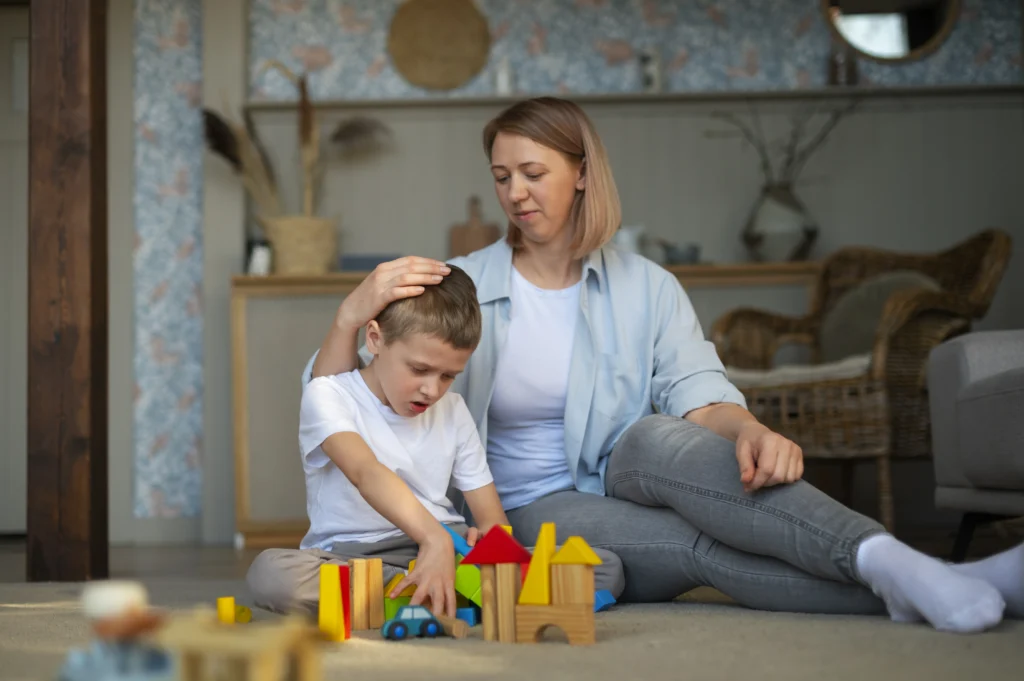
Occupational therapy focuses on helping children participate in meaningful everyday activities.
It may be particularly useful when motor difficulties affect fine motor control, self-care, play or classroom tasks.
An occupational therapist may work on:
- Handwriting and pencil control: Improving grip, hand coordination and control for drawing or writing.
- Dressing skills: Practicing buttons, zippers, shoelaces and other clothing-related tasks.
- Feeding and utensil use: Developing the hand skills needed to use spoons, forks and cups.
- Fine motor coordination: Using puzzles, building blocks, beads and other suitable activities.
- Sensory-related participation: Identifying environmental or sensory factors that make daily activities difficult and exploring practical adaptations.
The American Academy of Pediatrics describes occupational therapy as a support for fine motor development, self-care, handwriting and sensory modulation. (American Academy of Pediatrics, 2024)
Occupational Therapy vs Physiotherapy: What Is the Difference?
Both therapies can support functional development, and their roles may overlap.
The choice depends on the child’s specific difficulties and goals.
| Area | Physiotherapy | Occupational Therapy |
|---|---|---|
| Main focus | Movement and physical function | Daily activities and independence |
| Gross motor skills | Running, jumping, balance and walking | Functional movement during daily tasks |
| Fine motor skills | May address hand function when relevant to movement goals | Pencil control, grasp and hand coordination |
| Mobility | Gait, posture and mobility | Adapting activities and environments |
| Self-care | May support physical abilities needed for tasks | Dressing, feeding and personal care |
| Participation | Play, sports and physical activities | School, home routines, play and daily activities |
Some children benefit from both therapies, particularly when movement difficulties affect several areas of daily life.
How Are Motor Difficulties Assessed?
Assessment helps identify which skills need support and how motor difficulties affect everyday participation.
A pediatric physiotherapist or occupational therapist may review:
- Developmental and medical history.
- Walking, running, jumping and balance.
- Muscle strength, flexibility and joint movement.
- Hand function and fine motor coordination.
- Posture and movement patterns.
- Functional abilities at home, school and during play.
Standardized tools may also be used when appropriate.
These can include the Movement Assessment Battery for Children, Second Edition (MABC-2), Bruininks-Oseretsky Test of Motor Proficiency, Second Edition (BOT-2), and Test of Gross Motor Development (TGMD-3).
The choice of assessment depends on the child’s age, abilities and clinical needs. A test score should be considered alongside observations and everyday functioning. (Piccolo et al., 2025)
How Parents Can Support Motor Development at Home
Parents and caregivers can encourage movement and independence through enjoyable, everyday activities.
Some practical ideas include:
- Encourage outdoor play, walking and age-appropriate playground activities.
- Practice throwing, rolling and catching a soft ball.
- Use building blocks, puzzles and drawing activities to encourage hand coordination.
- Include simple movement games, such as stepping over cushions or following a short obstacle path.
- Allow children extra time to practice dressing, feeding and other daily tasks.
- Use clear instructions, demonstrations and predictable routines when helpful.
Choose activities that are safe, enjoyable and suited to the child’s abilities.
Avoid forcing participation or comparing progress with other children. A therapist can suggest activities that match the child’s individual goals.
When Should Parents Consider Professional Help?
Consider consulting a pediatrician, physiotherapist or occupational therapist if a child:
- Has persistent difficulty with balance, walking, running or coordination.
- Struggles with age-appropriate physical play.
- Frequently trips or falls, or avoids movement-based activities.
- Has difficulty with dressing, feeding, handwriting or other daily tasks.
- Walks on their toes persistently.
- Shows motor difficulties that affect confidence, independence or participation.
Seek prompt medical assessment if there is a sudden change in walking, new weakness, loss of previously acquired motor skills, significant pain or one-sided movement difficulty.
Final Thoughts
Every autistic child has their own strengths, interests and developmental journey. Motor difficulties, when present, should be understood as individual support needs rather than limitations that define the child.
With appropriate assessment, child-centered physiotherapy and occupational therapy can help children build functional skills, participate in everyday activities and develop greater independence. Progress is most meaningful when therapy respects the child’s comfort, choices and unique abilities.
Conclusion
Motor difficulties can affect how some autistic children move, play, learn and manage everyday activities.
With the right support, children can practice functional skills and improve their participation at home, school and in the community.
Physiotherapy can help address gross motor skills, balance, coordination, gait and physical activity, while occupational therapy can support fine motor development, self-care and everyday independence.
The most effective approach is individualized, child-centered and based on functional needs.
The goal is not to change a child’s autistic identity, but to help them develop skills, access activities and participate in daily life in ways that work for them.
Frequently Asked Questions
1. Do all autistic children have motor difficulties?
No. Motor difficulties are reported in many autistic children, but they do not affect everyone. Each child’s movement abilities and support needs are different.
2. Can physiotherapy help autistic children improve coordination?
Yes. When coordination difficulties affect everyday activities, physiotherapy may use structured movement practice, balance activities and age-appropriate exercises to support functional skills.
3. What is the difference between occupational therapy and physiotherapy for autism?
Physiotherapy commonly addresses gross motor skills, balance, gait and mobility. Occupational therapy often focuses on fine motor skills, self-care, handwriting and participation in everyday activities. Some goals may overlap.
4. Why do some autistic children walk on their toes?
Toe walking can occur for several reasons, including habitual walking patterns, limited ankle movement or other musculoskeletal and neurological factors. Persistent toe walking should be assessed by a healthcare professional.
5. Can occupational therapy improve handwriting in autistic children?
Occupational therapy may help children who have difficulty with pencil control, hand coordination, grip and other functional skills involved in handwriting. Support should be based on the child’s individual needs.
6. What activities can parents try at home?
Depending on the child’s abilities, parents can encourage ball games, building blocks, puzzles, drawing, simple obstacle courses and outdoor play. Activities should be safe, enjoyable and adapted to the child.
7. Can a child receive both occupational therapy and physiotherapy?
Yes. Some children benefit from both therapies when movement, coordination, fine motor skills and daily activities are affected. The care team can coordinate goals and treatment approaches.
8. When should parents consult a pediatric physiotherapist?
Parents may consider an assessment if a child has persistent difficulties with balance, walking, running, coordination or physical play, particularly when these challenges affect daily activities or independence.
Stay tuned with us for more health related topics.
Follow us on LinkedIn and Instagram for more.
More Read




Medical Disclaimer
The information in this article is provided for educational purposes only and should not replace professional medical advice, diagnosis or treatment. Motor development and therapy needs vary between children. Parents and caregivers should consult a qualified pediatrician, physiotherapist or occupational therapist for an individual assessment and appropriate guidance. Do not start, change or stop a child’s treatment based solely on information in this article. Seek prompt medical attention for sudden changes in walking, new weakness, loss of previously acquired motor skills or significant pain.