Head lice are a common childhood problem, particularly among school-going children.
Finding tiny insects or eggs in a child’s hair can be stressful for parents.
The frustration often increases when lice appear to return shortly after treatment.
Quick Answer
Head lice may return when treatment is not used correctly, a required second application is missed, live lice are not completely removed or a child becomes reinfested through close contact with someone who has lice.
The best approach is to confirm the presence of live lice, choose an age-appropriate treatment, follow the product instructions and check the scalp again at the recommended time.
Remember:
Finding old nits does not necessarily mean that head lice are still active. Look for live, moving lice before repeating treatment.
In many cases, the problem is not simply that the treatment has failed.
Parents may have used a product incorrectly, missed a recommended repeat application, mistaken old eggshells for live lice or overlooked another person with an active infestation.
Understanding how head lice spread and why treatment sometimes fails can help families manage the problem safely.
It can also prevent unnecessary medication, excessive household cleaning and avoidable disruption to a child’s school routine.
Key Takeaways for Parents
Head lice spread mainly through direct head-to-head contact, not because of poor personal hygiene.
Finding live lice is the most reliable way to confirm an active infestation.
Some treatments require a second application, but the timing depends on the specific product.
Check household members and close contacts to identify other active infestations.
Old nits may remain attached after successful treatment and do not automatically indicate treatment failure.
Extensive household disinfection is unnecessary. Focus on sensible cleaning and appropriate scalp checks.
What Are Head Lice?
Head lice are tiny, wingless insects that live on the human scalp and feed on small amounts of blood. The medical term for an infestation is pediculosis capitis.
Adult lice are generally around 2–3 mm long and may appear greyish, brown or tan.
Female lice lay eggs, commonly called nits, which attach firmly to individual hair strands using a glue-like substance.
Eggs are often found close to the scalp, particularly behind the ears and around the back of the neck.
Head lice are not a sign of poor personal hygiene.
They can affect children with clean or unwashed hair, regardless of hair length or type.
The American Academy of Pediatrics explains that head lice are common in childhood and are not associated with poor hygiene or the spread of disease (AAP, 2022)
How Do Children Get Head Lice?
Head lice spread mainly through direct head-to-head contact. This can happen when children:
- Play closely with friends or siblings.
- Put their heads together while reading or watching videos.
- Participate in activities involving close physical contact.
- Have close contact during sleepovers or family gatherings.
Lice crawl from one person’s hair to another. They cannot jump or fly.
Transmission through shared objects such as combs, brushes, hats, helmets and pillows is possible, but it is much less common than direct contact.
Head lice do not survive for long away from the human scalp because they need regular blood meals.
Pets do not spread human head lice. Dogs and cats have different types of lice that do not normally infest people.
Signs and Symptoms of Head Lice in Children
Some children experience noticeable itching, while others may have an infestation without recognizing any symptoms.
Itching can take several weeks to develop after the first infestation.
Common signs include:
1. Itching on the Scalp
Itching is one of the most recognized symptoms. It occurs because the child’s body reacts to substances released by lice while feeding.
The itching may be noticeable around the ears, back of the neck and scalp. However, not every child with head lice experiences itching.
2. A Tickling or Moving Sensation
Some children describe feeling something moving through their hair. This sensation may be more noticeable when they are quiet or lying down.
3. Visible Lice or Nits
Parents may notice tiny moving insects or oval-shaped eggs attached to hair strands. Nits may appear yellowish-white or brownish and are often easier to spot close to the scalp.
4. Scalp Irritation and Scratching
Repeated scratching can cause small red marks, irritation and broken skin. In some cases, damaged skin may develop a secondary bacterial infection.
5. Disturbed Sleep and Irritability
Persistent itching can make it difficult for some children to relax or sleep comfortably.
Poor sleep may contribute to temporary tiredness, irritability and difficulty concentrating during the day.
These symptoms are not exclusive to head lice. Dandruff, eczema, scalp psoriasis and allergic reactions can also cause itching.
Finding a live louse is the most reliable way to confirm an active infestation.
How to Check Your Child for Head Lice
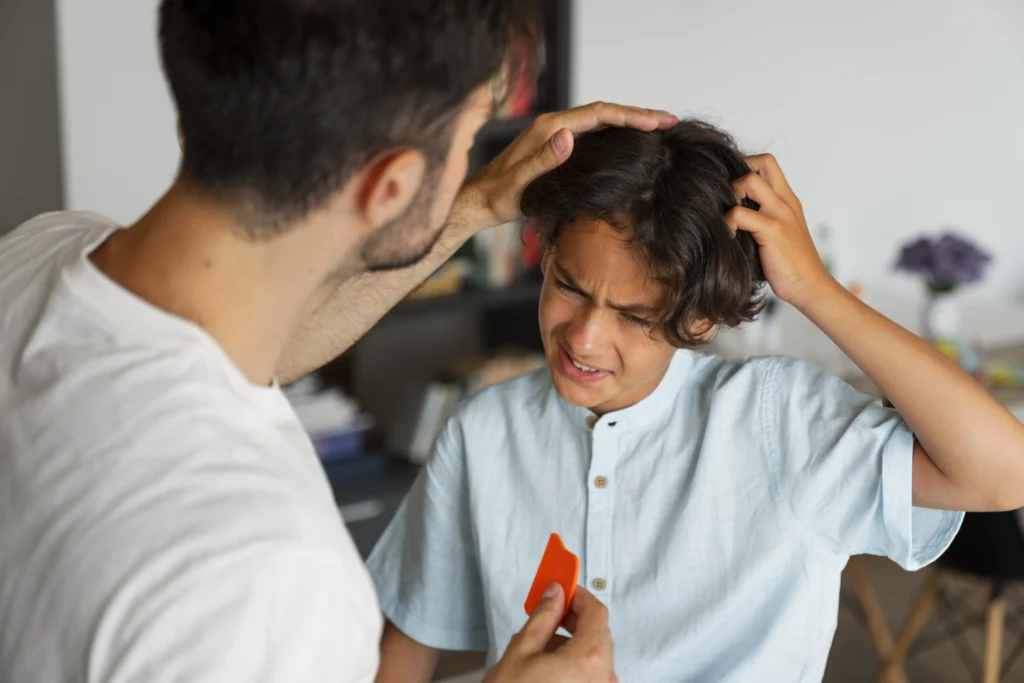
Parents should not rely only on itching or the appearance of white particles in the hair.
A careful examination helps distinguish an active infestation from old, empty eggshells.
Wet Combing Method
Wet combing is a practical way to identify live lice. It can also be used as a treatment approach when performed consistently.
Follow these steps:
- Wet the child’s hair and apply plenty of ordinary conditioner.
- Use a fine-toothed detection comb designed for head lice.
- Divide the hair into small sections.
- Place the comb close to the scalp and pull it slowly through the hair to the ends.
- Check the comb after each stroke for lice.
- Wipe the comb on a light-colored tissue or rinse it before the next stroke.
- Repeat across the entire scalp, paying attention to the areas behind the ears and around the neck.
Finding a live, moving louse confirms an active infestation.
Nits alone do not necessarily mean that the child currently has head lice.
Empty eggshells may remain attached after treatment, even when the infestation has been cleared.
The NHS recommends wet combing on days 1, 5, 9 and 13, followed by another check on day 17.
This schedule is intended for the wet-combing method and should not be confused with the repeat-treatment instructions for medicated products (NHS)
Why Do Head Lice Keep Returning?
Repeated infestations can be frustrating, but they often happen because one or more important steps have been missed.
1. Missing a Required Second Treatment
Some lice products kill live insects but do not reliably destroy their eggs. New lice can hatch from surviving eggs after the first application.
Depending on the active ingredient, a second application may be recommended around a week later. Other products may kill both lice and eggs and may not require routine repeat treatment.
Parents should follow the instructions for the exact product rather than assuming every treatment needs to be repeated after the same number of days.
Missing a required second application can allow newly hatched lice to survive and reproduce (CDC, 2025)
2. Applying the Product Incorrectly
Even an effective lice treatment may fail if it is not used according to its instructions.
Common mistakes include:
- Applying too little product.
- Not covering the scalp and hair adequately.
- Leaving the product on for the wrong amount of time.
- Applying conditioner before a treatment that requires untreated hair.
- Washing the hair too soon after application.
- Repeating treatment earlier than recommended.
Different products have different application requirements. Parents should read the label carefully rather than assuming all lice treatments work in the same way.
3. Choosing an Unsuitable or Ineffective Treatment
Some treatments may not work as expected because of incorrect use, resistance to an active ingredient or an unsuitable choice for the child’s age.
If live lice remain after the product has been used correctly and the recommended treatment course has been completed, repeating the same product several times is not a good solution.
A pharmacist or doctor can help determine whether the infestation is still active and whether a different treatment is appropriate.
4. Overlooking Other Infested Household Members
Children often have close contact with siblings and other family members. If one child has head lice, other people in the household may also have an infestation.
Check household members and people with regular close head-to-head contact. Treat those with confirmed active infestation according to appropriate medical advice.
People who share a bed with an infested person may also need particular attention.
Preventive chemical treatment without evidence of infestation is generally unnecessary.
The CDC recommends checking household members and close contacts and treating people with an active infestation at the same time (CDC, 2024)
5. Mistaking Nits for Live Lice
Parents sometimes continue applying lice products because small white or brown particles remain attached to the hair.
However, finding nits after treatment does not automatically mean that live lice remain. Empty eggshells can stay attached for weeks and gradually move away from the scalp as hair grows.
The important question is whether live, moving lice are still present. Treating repeatedly just because old nits are visible can expose a child’s scalp to unnecessary products.
6. Confusing Treatment Failure With Reinfestation
Treatment failure and reinfestation are not the same.
Treatment failure means live lice remain after an appropriate treatment has been used correctly.
Reinfestation happens when a child is successfully cleared of lice but later acquires them again through close contact with someone who has an active infestation.
If lice repeatedly return, parents should consider both possibilities rather than automatically assuming that the product is ineffective.
7. Treating Again Too Soon
Using a lice product more frequently than recommended does not necessarily make it more effective.
Repeated or excessive applications can irritate the scalp and increase exposure to treatment chemicals.
The CDC advises against using extra amounts or combining different lice medicines unless a healthcare professional recommends it. If live lice remain, seek advice before starting another course (CDC, 2024)
Head Lice in Children: Myth vs Fact
MYTH: Head lice only affect children with poor hygiene.
FACT: Head lice can affect any child, regardless of hair cleanliness or personal hygiene.
MYTH: Head lice can jump or fly from one child to another.
FACT: Head lice crawl. Direct head-to-head contact is their main route of transmission.
MYTH: Every visible nit means the infestation is still active.
FACT: Empty eggshells can remain attached to hair after treatment. Live lice are the most reliable sign of an active infestation.
MYTH: Every lice treatment must be repeated after seven days.
FACT: Repeat-treatment requirements vary by product. Parents should follow the specific instructions.
MYTH: The entire house must be disinfected to eliminate head lice.
FACT: Extensive cleaning and insecticide sprays are unnecessary. Sensible cleaning of recently used personal items is generally sufficient.
MYTH: Children with head lice must stay away from school until every nit is removed.
FACT: Routine school exclusion is generally unnecessary. Follow local school guidance and appropriate treatment advice.
Which Head Lice Treatments Are Available?
Treatment depends on the child’s age, the severity of the infestation, previous treatment attempts and the products available locally.
1. Wet Combing
Wet combing involves using conditioner and a fine-toothed comb to remove lice and eggs. It avoids exposure to insecticide-based products and can be suitable for children when performed carefully.
However, it requires patience and repeated sessions. Parents need to follow a consistent schedule to remove newly hatched lice before they mature.
2. Dimeticone-Based Products
Dimeticone is a silicone-based ingredient used in some head lice treatments. It works through a physical mechanism rather than relying on traditional insecticides.
Different formulations have different application times and repeat-treatment requirements. Parents should check the age restrictions and instructions for the specific product.
3. Insecticide-Based Treatments
Some products contain insecticide ingredients such as permethrin or pyrethrins. Their effectiveness can vary depending on local resistance patterns and correct application.
These products may not be suitable for every age group. A pharmacist or doctor can advise whether a particular formulation is appropriate.
4. Prescription Treatments
A doctor may recommend prescription treatment when standard approaches have failed or when a child has persistent infestation.
The choice depends on the child’s age, medical history, previous products used and local treatment guidance.
The CDC describes several over-the-counter and prescription options, but their approved ages, repeat-treatment schedules and precautions differ (CDC, 2025)
Parents should not combine different lice products or use repeated applications without professional advice. More treatment does not necessarily mean better results and may increase scalp irritation.
Can Scalp Itching Continue After Treatment?
Yes. Some children continue to experience itching even after the lice have been successfully treated.
The scalp may remain irritated from previous bites, scratching or the treatment product itself. This does not automatically mean that the lice have returned or that the product has failed.
Parents should check for live lice rather than using itching alone to decide whether another treatment is needed.
If itching becomes severe, persists or is accompanied by swelling, pain, crusting or discharge, consult a healthcare professional.
The child may have scalp irritation, an allergic reaction or a secondary skin infection that needs separate assessment.
Home Care and Hygiene: What Should Parents Clean?
Extensive household cleaning is usually unnecessary because head lice mainly survive on the human scalp.
The chance of catching lice from furniture, carpets or other household surfaces is very low.
A practical approach includes:
- Clean combs and brushes according to their manufacturer’s instructions.
- Wash recently used pillowcases, bedding and clothing if they have had close contact with the child’s head.
- Avoid sharing combs, brushes, hats and hair accessories.
- Vacuum furniture or car seats where the child’s head has recently rested, if needed.
There is no need to spray insecticides around the home, fumigate rooms or repeatedly disinfect every surface.
The NHS also states that hot-washing all laundry is not necessary for managing head lice (NHS)
Can Head Lice Affect a Child’s Sleep, Behavior or Development?
Head lice do not usually cause serious physical illness, but persistent itching can affect a child’s comfort and daily routine.
Children who sleep poorly may become temporarily tired, irritable or less attentive during school activities. Scratching can also damage the skin and occasionally lead to a secondary infection.
There is no good evidence that an uncomplicated head lice infestation causes long-term developmental problems, learning disabilities or neurological damage.
Parents should also consider the emotional impact. Children may feel embarrassed or anxious about being teased by classmates. Reassurance is important because head lice are common and are not a sign of poor hygiene or neglect.
When Should Parents Consult a Doctor?
Many uncomplicated infestations can be managed with appropriate pharmacy guidance and careful follow-up. However, professional advice is important when:
- The child is very young and you are unsure which treatment is safe.
- Live lice remain after correctly following the treatment instructions.
- The scalp becomes painful, swollen or increasingly red.
- There is pus, crusting or other evidence of a possible skin infection.
- The child develops a rash or significant irritation after using a lice product.
- The infestation repeatedly returns despite appropriate treatment.
- You are unsure whether the particles in the hair are nits, dandruff or another scalp condition.
Seek prompt medical assessment if the child develops fever along with signs of a spreading scalp infection or appears significantly unwell.
Should a Child With Head Lice Stay Home From School?
In most cases, head lice should not prevent a child from attending school or participating in normal activities.
The CDC and American Academy of Pediatrics discourage strict no-nit policies that exclude children until every egg or eggshell has been removed.
Nits may remain attached after successful treatment, and their presence alone does not establish an active infestation.
Parents should follow local school guidance and communicate with close contacts when appropriate.
Children can also be encouraged to avoid direct head-to-head contact and sharing personal hair accessories.
Does Physiotherapy Have a Role in Treating Head Lice?
Physiotherapy does not treat head lice because the condition is caused by an insect infestation of the scalp. It is not a musculoskeletal, neurological or developmental condition.
However, persistent itching and poor sleep may temporarily affect a child’s comfort, concentration and participation in everyday activities.
If a separate physical or functional concern develops, an appropriate healthcare professional should assess it.
Physiotherapy should not replace medical treatment for head lice.
The priority is accurate diagnosis, age-appropriate treatment, follow-up checks and reassurance.
How Can Parents Reduce the Chances of Head Lice Returning?
It is not possible to guarantee that a child will never get head lice again. Close contact with other children makes exposure difficult to avoid completely.
Parents can focus on early identification and appropriate management:
- Check the scalp when there is a known case among close contacts.
- Avoid sharing combs, brushes, hair clips, hats and other personal hair accessories.
- Check household members when one child is found to have live lice.
- Follow the complete treatment schedule, including a second application when recommended.
- Recheck the scalp after treatment to confirm that no live lice remain.
- Avoid unnecessary preventive use of medicated lice products.
Regular checks can help identify an infestation early. However, children do not need to avoid normal social activities because of the possibility of head lice.
Final Thoughts
Finding head lice in your child’s hair can feel overwhelming, particularly when the problem seems to return after treatment. However, repeated infestations can often be managed by identifying live lice, using the right treatment correctly and following the recommended schedule.
Parents do not need to rely on excessive cleaning or repeated applications of lice products. Careful scalp checks, sensible hygiene and attention to close contacts are much more useful.
A reassuring reminder
Head lice are common, treatable and not a reflection of poor parenting or hygiene. With appropriate care, children can return to their usual routines without unnecessary worry.
Conclusion
Head lice are common in children and can be frustrating when they seem to return after treatment.
In many cases, repeated infestations are linked to missed follow-up treatment, incorrect product application, confusion between nits and live lice, or renewed exposure to someone with an active infestation.
The most important step is to confirm the presence of live lice before starting treatment.
Parents should then choose an age-appropriate product or wet-combing approach, follow the instructions carefully and complete any recommended repeat treatment.
Good scalp checks, sensible household hygiene and reassurance can make a significant difference.
With the right approach, most childhood head lice infestations can be managed without unnecessary cleaning, repeated medication or disruption to school and everyday activities.
Frequently Asked Questions About Head Lice in Children
1. Why do head lice keep coming back after treatment?
Head lice may return because the treatment was not applied correctly, a required second application was missed, live lice survived or the child became reinfested through close contact with someone who has lice.
2. How do I know if my child still has live head lice?
Use a fine-toothed detection comb to check the scalp and hair. Finding live, moving lice confirms an active infestation. Visible nits alone do not necessarily mean that treatment has failed.
3. How many times should head lice treatment be repeated?
The number and timing of applications depend on the product. Some treatments require a second application to kill newly hatched lice, while others may not. Always follow the product instructions or professional advice.
4. Can head lice survive on pillows and bedsheets?
Head lice can survive for a limited period away from the scalp, but they do not usually live long on bedding. Cleaning recently used pillowcases and bedding is sensible, but extensive household disinfection is unnecessary.
5. Can head lice return even after all the nits are removed?
Yes. A child can become reinfested after successful treatment through close contact with someone who has live lice. Removing visible nits does not prevent future exposure.
6. Should the whole family be treated for head lice?
Everyone in the household should be checked, particularly those with close head-to-head contact. People with confirmed live lice should receive appropriate treatment. Preventive medication is generally unnecessary for people without an infestation.
7. Can my child go to school with head lice?
In most cases, children do not need to miss school because of head lice. Parents should follow local school guidance and begin appropriate treatment.
8. Why does my child’s scalp still itch after lice treatment?
Itching may continue because of irritation from previous bites, scratching or the treatment product. Persistent itching does not automatically mean live lice remain. Check for live lice and seek advice if irritation is severe or continues.
9. Does physiotherapy help treat head lice in children?
No. Physiotherapy does not treat head lice. Medical or pharmacy-guided treatment is required. Physiotherapy may only be relevant if a separate physical or functional concern needs assessment.
Stay tuned with us for more health related topics.
Follow us on LinkedIn and Instagram for more.
More Read




Medical Disclaimer
This article is intended for general educational and informational purposes only. It does not replace professional medical advice, diagnosis or treatment.
Head lice treatments may have different age restrictions, application instructions and repeat-treatment requirements. Parents should read the product label carefully and consult a qualified doctor or pharmacist before using a treatment, particularly for infants and young children.
If your child has persistent scalp irritation, signs of infection, an adverse reaction to treatment or repeated infestations, seek professional medical assessment. Do not combine or repeatedly apply lice products without appropriate guidance.