


If period cramps are affecting your daily routine, yoga for period pain offers simple poses that may help you move and feel better.
Have you ever skipped your morning walk, cancelled plans with friends, or curled up in bed because your period cramps felt unbearable?
If so, you’ve probably searched for a quick solution.
While heating pads and pain medication certainly have their place, many women are surprised to discover that one of the most effective natural remedies doesn’t come from a medicine cabinet at all.
It begins with a yoga mat, a few slow breaths, and gentle movement.
Yoga has been practiced for thousands of years to improve flexibility, breathing, and mental well-being.
In recent years, researchers have also explored its role in relieving menstrual pain.
The results are encouraging.
Several clinical studies have found that yoga can help reduce cramping, improve pelvic mobility, decrease stress, and make painful periods easier to manage.
Quick Answer
Yes. Yoga can be an effective natural way to relieve period pain. Gentle poses such as Child’s Pose, Cat-Cow, Reclining Bound Angle Pose, and Legs-Up-the-Wall may help relax tight muscles, improve pelvic circulation, reduce stress, and support better breathing. Regular yoga practice throughout the month often provides greater long-term benefits than practicing only during menstruation.
Unlike high-intensity workouts, yoga doesn’t ask your body to work harder when you’re already uncomfortable.
Instead, it encourages your muscles to relax, improves blood circulation around the pelvis, and helps calm the nervous system, which may reduce how intensely your body perceives pain.
The beauty of yoga is that it doesn’t require expensive equipment or advanced fitness levels.
Whether you’re a student, a working professional, or someone who has never tried yoga before, a few carefully selected poses can become a valuable part of your menstrual wellness routine.
A recent systematic review and meta-analysis of randomized controlled trials reported that women practicing yoga experienced significantly lower menstrual pain compared with control groups,
supporting yoga as a safe complementary approach for primary dysmenorrhea (Chien et al. 2020).
Throughout this guide,
you’ll learn how each yoga pose works, who can benefit from it, and simple modifications that make the exercises comfortable even if you’re completely new to yoga.
Key Takeaways
- Yoga combines stretching, breathing, and relaxation to help ease menstrual cramps naturally.
- Restorative poses are generally more comfortable than intense yoga styles during painful periods.
- Slow diaphragmatic breathing can reduce muscle tension and promote relaxation.
- Regular practice throughout the month may improve flexibility, posture, and pelvic mobility.
- Comfort is more important than achieving deep stretches or advanced poses.
- Stop any pose that causes sharp pain or significant discomfort.
- Persistent or worsening period pain should be assessed by a healthcare professional.
Can Yoga Really Help Period Pain?
Many women worry that stretching or exercising during their period might make cramps worse.
Fortunately, current evidence suggests the opposite for most women with primary dysmenorrhea.
Yoga combines three elements that are particularly helpful during menstruation:
- Gentle stretching
- Controlled breathing
- Relaxation
Together, these techniques address several factors that contribute to menstrual discomfort.
When cramps occur, it’s not only the uterus that responds.
The abdominal muscles tighten, the lower back often becomes stiff, the pelvic floor may become overactive, and stress can increase the body’s sensitivity to pain.
Yoga addresses each of these problems simultaneously.
Recent evidence from a Bayesian network meta-analysis evaluating non-pharmacological treatments found that yoga significantly reduced menstrual pain compared with no treatment,
supporting its use alongside other conservative approaches such as exercise and heat therapy (Li X. et al. 2024).
It’s important to remember that yoga isn’t an instant cure.
Like most lifestyle interventions, the greatest improvements usually occur when it becomes part of your regular weekly routine rather than something you try only when severe cramps begin.
Why Yoga Works for Menstrual Cramps
From a physical perspective, several mechanisms may explain why yoga helps relieve period pain.
It Reduces Muscle Tension
Pain naturally causes muscles to tighten.
Many women unknowingly hold tension in their abdomen, hips, lower back, shoulders, and even their jaw during menstruation.
Gentle yoga stretches help these muscles relax, reducing unnecessary strain around the pelvis.
It Encourages Deep Breathing
One of the most overlooked aspects of yoga is breathing.
Slow diaphragmatic breathing activates the parasympathetic nervous system, sometimes called the “rest and digest” system.
This helps reduce stress, lower muscle tension, and create a greater sense of relaxation during painful periods.
It Improves Pelvic Mobility
Long hours of sitting, limited physical activity, and poor posture can all contribute to stiffness around the hips and pelvis.
Yoga improves flexibility while encouraging healthier movement patterns.
Better mobility often means less tension pulling on the muscles surrounding the pelvis.
It Supports Emotional Well-being
Periods don’t just affect the body.
Many women also experience irritability, anxiety, fatigue, or emotional ups and downs.
Yoga encourages mindfulness and relaxation, helping many women feel calmer and more in control during their menstrual cycle.
Before You Begin
Before trying these yoga poses, keep a few simple guidelines in mind.
- Wear loose, comfortable clothing.
- Use a yoga mat or a soft carpeted surface.
- Never stretch into sharp pain.
- Move slowly and breathe naturally.
- Stop immediately if you feel dizzy or experience severe pelvic pain.
- If you have endometriosis, adenomyosis, recent pelvic surgery, or another medical condition, speak with your healthcare provider before starting a new exercise programe.
Remember that yoga should feel supportive, not exhausting.
Yoga Pose #1: Child’s Pose (Balasana)
If I had to recommend just one yoga pose for period pain, Child’s Pose would be at the top of the list.
This gentle resting position stretches the lower back, relaxes the abdominal muscles, and allows your breathing to slow naturally.
How to Perform It
- Kneel on your yoga mat.
- Sit back onto your heels.
- Separate your knees comfortably.
- Fold your body forward.
- Extend your arms in front of you or rest them beside your body.
- Rest your forehead on the mat or a cushion.
- Stay in the position for 30-60 seconds while breathing slowly.
Benefits
- Relaxes the lower back.
- Reduces abdominal tension.
- Encourages diaphragmatic breathing.
- Helps calm the nervous system.
Modification
If your hips don’t comfortably reach your heels, place a folded blanket or pillow between them for support.
Yoga Pose #2: Cat-Cow Pose (Marjaryasana-Bitilasana)
Cat-Cow is one of the best movements for relieving stiffness in the lower back and pelvis.
Instead of holding one position, this pose combines gentle spinal movement with controlled breathing.
How to Perform It
- Begin on your hands and knees.
- Keep your wrists below your shoulders and your knees below your hips.
- Inhale as you gently arch your back and lift your chest.
- Exhale as you round your spine and tuck your chin.
- Continue slowly for 8-10 breaths.
Benefits
- Improves spinal flexibility.
- Reduces lower back stiffness.
- Encourages coordinated breathing.
- Improves pelvic mobility.
Common Mistake
Many beginners move too quickly.
Slow, controlled movements coordinated with your breathing are much more effective than rushing through repetitions.
Yoga Pose #3: Reclining Bound Angle Pose (Supta Baddha Konasana)
This restorative yoga pose gently opens the hips while allowing your entire body to relax.
It is particularly helpful for women who experience pelvic tightness, hip discomfort, or lower abdominal cramping.
How to Perform It
- Lie comfortably on your back.
- Bring the soles of your feet together.
- Allow your knees to fall out to the sides naturally.
- Support your knees with cushions if needed.
- Rest your hands on your abdomen.
- Close your eyes and breathe slowly for two to five minutes.
Benefits
- Promotes relaxation.
- Opens the hips without forcing a stretch.
- Reduces pelvic muscle tension.
- Encourages mindful breathing.
Because this is a restorative pose, don’t worry about how far your knees fall.
Comfort is much more important than flexibility.
Yoga Pose #4: Supine Spinal Twist (Supta Matsyendrasana)
Period cramps don’t just affect the lower abdomen.
Many women also notice tightness in the lower back, hips, and waist.
A gentle spinal twist can help release this tension while encouraging the body to relax.
Unlike deep twisting yoga poses, the Supine Spinal Twist is restorative and suitable for most beginners.
How to Perform It
- Lie comfortably on your back.
- Bend your knees and bring them towards your chest.
- Slowly lower both knees to one side while keeping your shoulders resting on the floor.
- Turn your head gently towards the opposite side if it feels comfortable.
- Hold the position for 30-60 seconds before repeating on the other side.
Benefits
- Relieves lower back stiffness.
- Improves spinal mobility.
- Reduces muscle tension around the waist and hips.
- Encourages relaxation through slow breathing.
Helpful Tip
Place a pillow beneath your knees if they don’t comfortably reach the floor.
The purpose of the pose is relaxation, not achieving the deepest possible stretch.
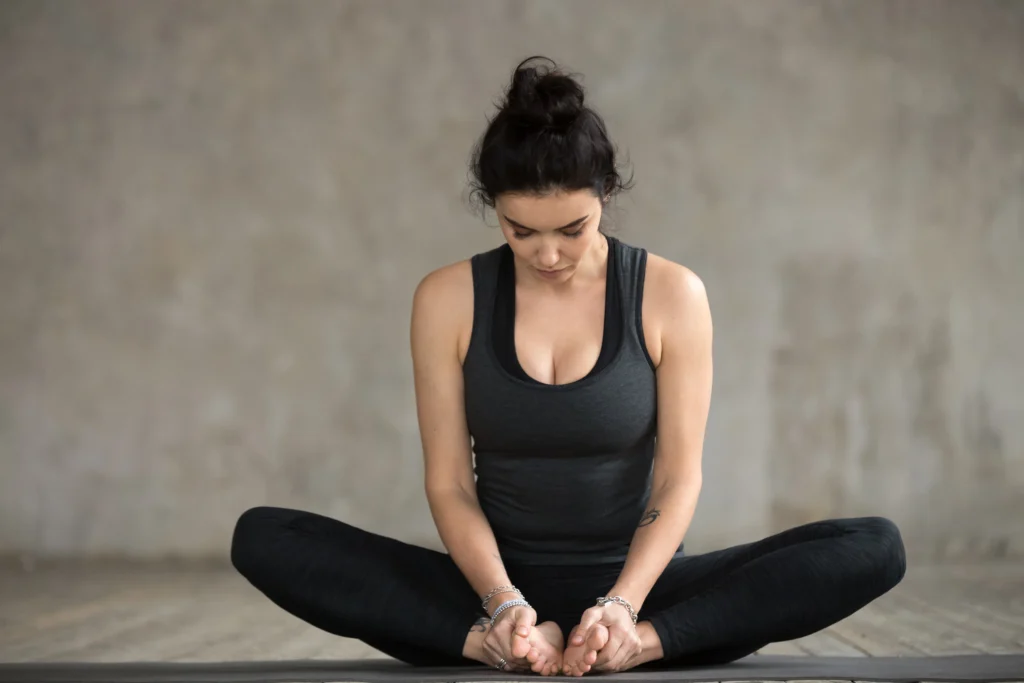
Yoga Pose #5: Butterfly Pose (Baddha Konasana)
The Butterfly Pose is widely recommended for improving flexibility around the hips and inner thighs.
During menstruation, this gentle stretch may help reduce feelings of tightness around the pelvis without placing excessive strain on the body.
How to Perform It
- Sit upright with your legs extended.
- Bring the soles of your feet together.
- Allow your knees to fall naturally to each side.
- Hold your feet gently with both hands.
- Keep your spine tall and breathe slowly for 30-60 seconds.
Benefits
- Improves hip flexibility.
- Reduces tension in the inner thighs.
- Encourages an upright sitting posture.
- Promotes relaxation around the pelvis.
Common Mistake
Avoid pressing your knees towards the floor.
Allow gravity to do the work while your muscles gradually relax.
Yoga Pose #6: Cobra Pose (Bhujangasana)
Although menstrual cramps are centered around the pelvis, prolonged discomfort often causes women to adopt a rounded posture.
Cobra Pose gently stretches the front of the body while improving mobility in the spine.
How to Perform It
- Lie on your stomach with your legs extended.
- Place your hands beneath your shoulders.
- Press gently into your palms as you lift your chest.
- Keep your elbows slightly bent and your shoulders relaxed.
- Hold for 15-20 seconds before lowering slowly.
Benefits
- Opens the front of the body.
- Improves spinal flexibility.
- Reduces stiffness caused by prolonged sitting.
- Encourages deeper breathing.
Modification
If lifting fully feels uncomfortable, simply raise your chest a few centimetres while keeping most of your weight supported by your forearms.
Yoga Pose #7: Legs-Up-the-Wall Pose (Viparita Karani)
This restorative pose is ideal for days when your energy levels are low but you still want to support your body with gentle movement.
Because the legs are elevated, many women find this position calming after a long day of work or study.
How to Perform It
- Sit sideways next to a wall.
- Gently swing your legs up the wall as you lie on your back.
- Rest your arms comfortably by your sides.
- Close your eyes and breathe naturally.
- Remain in the position for five to ten minutes.
Benefits
- Encourages relaxation.
- Reduces feelings of heaviness in the legs.
- Helps relieve lower back fatigue.
- Supports mindful breathing.
If you experience significant pelvic discomfort in this position, come out of the pose slowly and choose another restorative option instead.
Yoga Pose #8: Happy Baby Pose (Ananda Balasana)
Despite its playful name, Happy Baby Pose is an effective way to gently stretch the hips, groin, and lower back.
How to Perform It
- Lie on your back.
- Bend your knees towards your chest.
- Hold the outside of your feet or your ankles.
- Allow your knees to move towards your armpits comfortably.
- Hold for 20–30 seconds while breathing slowly.
Benefits
- Releases tension around the hips.
- Improves pelvic mobility.
- Gently stretches the lower back.
- Encourages relaxation.
There’s no need to pull forcefully on your feet. The stretch should feel comfortable and controlled.
Yoga Pose #9: Seated Forward Bend (Paschimottanasana)
Forward bends encourage relaxation and can gently stretch the muscles along the back of the body.
During menstruation, avoid forcing yourself into a deep stretch. A comfortable position is far more beneficial than trying to touch your toes.
How to Perform It
- Sit with both legs extended.
- Keep your back long as you lean forward from your hips.
- Rest your hands wherever they comfortably reach.
- Hold the stretch while breathing slowly for 20-30 seconds.
Benefits
- Improves flexibility in the back and hamstrings.
- Encourages relaxation.
- Helps reduce muscle tension.
- Promotes mindful breathing.
Yoga Pose #10: Garland Pose (Malasana)
Garland Pose is a deep squat that gently opens the hips and improves pelvic mobility.
However, it may not be comfortable for everyone during menstruation.
How to Perform It
- Stand with your feet slightly wider than hip-width apart.
- Slowly lower into a comfortable squat.
- Bring your palms together in front of your chest.
- Keep your chest lifted and your spine long.
- Hold for 15-30 seconds before standing slowly.
Benefits
- Improves hip mobility.
- Stretches the pelvic floor muscles.
- Enhances lower body flexibility.
Modification
If your heels lift off the floor, place a rolled towel or yoga block beneath them for support.
How Often Should You Practice Yoga for Period Pain?
One yoga session may leave you feeling more relaxed, but lasting improvements usually come from regular practice rather than occasional sessions.
A realistic routine for beginners might include:
- 10-15 minutes daily during your period, focusing on restorative poses and breathing exercises.
- 20-30 minutes, three to five times per week during the rest of your menstrual cycle to improve flexibility, posture, and overall pelvic health.
- Five minutes of diaphragmatic breathing each day to reduce stress and encourage pelvic floor relaxation.
There’s no need to perform all ten poses in one session.
Choose four or five that feel most comfortable and build a routine you can maintain consistently.
Research continues to support yoga as a beneficial complementary therapy for women with primary dysmenorrhea.
A systematic review concluded that regular yoga practice was associated with meaningful reductions in menstrual pain intensity and improvements in physical and emotional well-being,
although the authors also noted the need for larger, high-quality trials (Kanchibhotla et al. 2023).
Common Mistakes to Avoid While Practicing Yoga During Your Period
Yoga is meant to help your body feel better, not push it beyond its limits.
However, a few common mistakes can reduce its benefits or even make you feel more uncomfortable.
Trying Advanced Poses Too Soon
Many people are inspired by social media videos showing deep backbends or challenging inversions.
During your period, your goal should be comfort and relaxation rather than improving flexibility.
Choose gentle, restorative poses that allow your body to unwind instead of demanding strenuous effort.
Holding Your Breath
Breathing is one of the most powerful parts of yoga, yet it is often overlooked.
When menstrual cramps begin, many women unconsciously take short, shallow breaths or hold their breath during difficult poses.
This increases muscle tension and may make pain feel more intense.
Instead, focus on slow, controlled breathing throughout every movement.
Ignoring Pain Signals
A gentle stretching sensation is normal.
Sharp pelvic pain, dizziness, heavy discomfort, or increasing cramps are not.
If a pose causes pain rather than relief, come out of it slowly and try a more comfortable alternative.
Comparing Yourself to Others
Every woman’s body responds differently during menstruation.
Some may comfortably complete a full yoga session, while others benefit from only a few restorative poses.
Your progress should be measured by how you feel, not by how deeply someone else can stretch.
Practicing Inconsistently
Many women only think about yoga when cramps begin.
While even a short session may provide temporary relief, the greatest improvements usually occur when yoga becomes part of your weekly routine throughout the month.
Consistency allows your muscles, joints, breathing patterns, and nervous system to adapt over time.
Myth vs Fact
| Myth | Fact |
|---|---|
| Yoga should be avoided during periods. | Gentle yoga is generally safe for most women with primary dysmenorrhea and may help reduce pain. |
| The deeper the stretch, the better the results. | Comfortable, controlled movements are more beneficial than forcing your body into deep stretches. |
| Only advanced yoga practitioners benefit from yoga. | Beginners can also benefit from simple restorative poses and breathing exercises. |
| Yoga can cure all menstrual pain. | Yoga can help manage symptoms but cannot treat underlying conditions such as endometriosis or fibroids. |
When Should You Avoid or Modify Yoga?
Although yoga is generally safe for most women with primary dysmenorrhea, there are situations where you should modify your practice or seek medical advice first.
Consider postponing your yoga session or consulting a healthcare professional if you have:
- Sudden, severe pelvic pain.
- Heavy menstrual bleeding accompanied by dizziness or fainting.
- Fever or signs of an infection.
- Recent abdominal or pelvic surgery.
- Severe endometriosis or adenomyosis with significant pain.
- An injury that limits safe movement.
If you have a diagnosed medical condition, a healthcare professional or qualified yoga instructor can help you modify poses to suit your individual needs.
Building a Simple 15-Minute Yoga Routine for Period Pain
You don’t need to spend an hour on the yoga mat to experience benefits.
Here’s an easy routine that many beginners find manageable.
| Time | Activity |
|---|---|
| 2 minutes | Slow diaphragmatic breathing |
| 2 minutes | Child’s Pose |
| 2 minutes | Cat-Cow Pose |
| 2 minutes | Reclining Bound Angle Pose |
| 2 minutes | Supine Spinal Twist |
| 3 minutes | Legs-Up-the-Wall Pose |
| 2 minutes | Quiet relaxation and slow breathing |
This short sequence combines gentle stretching, relaxation, and mindful breathing without placing excessive stress on the body.
If you have more energy, you can gradually increase the duration or include additional poses discussed earlier in the article.
Expert Tips from a Women’s Health Physiotherapist
One of the biggest misconceptions I hear from patients is that they should avoid all physical activity during their period.
In reality, the body often responds better to gentle, well-controlled movement than to complete inactivity.
My advice is to treat yoga as part of your overall menstrual wellness routine rather than as an emergency solution used only when pain becomes severe.
Practicing for a few minutes several times each week can improve flexibility, reduce muscle tension, encourage better breathing patterns, and help you become more aware of how your body responds throughout your menstrual cycle.
Remember that yoga is only one piece of the puzzle.
Adequate sleep, balanced nutrition, regular physical activity, hydration, stress management, and timely medical care when needed all contribute to healthier, more comfortable menstrual cycles.
Most importantly, be patient with yourself.
Your body is not expected to perform at the same level every day of the month, and it’s perfectly acceptable to modify your practice based on how you feel.
When Should You See a Doctor?
While yoga can be an effective way to manage mild to moderate menstrual cramps,
it should not be used to ignore symptoms that may indicate an underlying medical condition.
Arrange a medical evaluation if you experience:
- Period pain that becomes progressively worse over several months.
- Pain that continues after your period has ended.
- Heavy bleeding that interferes with your daily activities.
- Pain during sexual intercourse.
- Difficulty becoming pregnant along with severe menstrual pain.
- Fever, foul-smelling vaginal discharge, or sudden severe pelvic pain.
- Menstrual pain that does not improve despite self-care and appropriate treatment.
Conditions such as endometriosis, adenomyosis, uterine fibroids, or pelvic inflammatory disease require proper diagnosis and treatment.
Final Thoughts
Yoga is more than a form of exercise, it is an opportunity to slow down, reconnect with your body, and manage period pain in a gentle, mindful way. A few restorative poses combined with steady breathing can make a meaningful difference to your comfort and overall well-being. Start with simple movements, progress at your own pace, and remember that consistency matters more than perfection. If your symptoms continue to interfere with your daily life despite regular yoga practice, seek medical advice to identify any underlying cause.
Conclusion
Yoga offers much more than improved flexibility.
For many women, it provides a gentle, practical, and evidence-informed way to reduce menstrual discomfort while supporting both physical and emotional well-being.
By combining mindful breathing with carefully selected poses, yoga can help ease muscle tension, improve circulation, encourage relaxation, and make monthly cramps easier to manage.
The key is not performing the most advanced poses but choosing movements that feel comfortable and practising them consistently.
Even a short routine performed several times a week can become an important part of your menstrual health plan.
At the same time, remember that every woman experiences menstruation differently.
If yoga helps you feel more comfortable, continue making it part of your routine.
If your pain remains severe, worsens over time, or significantly affects your quality of life, seek professional medical advice rather than relying solely on home-based remedies.
With patience, consistency, and a personalized approach, yoga can become a valuable tool that supports healthier, more comfortable menstrual cycles and helps you stay active throughout every stage of the month.
Frequently Asked Questions
1. Which yoga pose is best for period pain?
Child’s Pose, Reclining Bound Angle Pose, Cat-Cow, Legs-Up-the-Wall, and Supine Spinal Twist are among the most commonly recommended yoga poses for relieving menstrual cramps.
2. Is it safe to practice yoga during menstruation?
Yes. Most women with uncomplicated periods can safely practice gentle yoga. Avoid any pose that causes pain or discomfort, and modify movements based on your symptoms.
3. How often should I practice yoga for period pain?
For long-term benefits, practice yoga three to five times per week. During your period, even 10–15 minutes of gentle restorative yoga may help reduce discomfort.
4. Can yoga replace pain medication?
Yoga may reduce the need for pain relief in some women, but it should not replace medical treatment when severe pain or an underlying condition is present.
5. Are inversions safe during periods?
There is no strong scientific evidence that gentle inversions are harmful during menstruation. However, many women prefer to avoid advanced inversions if they feel uncomfortable and instead choose restorative poses.
6. Can beginners do yoga for period pain?
Absolutely. Most of the poses recommended in this article are beginner-friendly and can be modified using cushions, yoga blocks, or folded blankets.
7. Can yoga help with lower back pain during periods?
Yes. Gentle stretches such as Cat-Cow, Child’s Pose, and Supine Spinal Twist may help relieve muscle tension and improve spinal mobility.
8. When should I stop practicing yoga and see a doctor?
Seek medical advice if your period pain becomes progressively worse, is accompanied by heavy bleeding, fever, fainting, or continues despite regular self-care.
Stay tuned with us for more health related topics.
Follow us on LinkedIn and Instagram for more.


